Key takeaways
- Check the floor first: Put a ball down on the intended line and roll it both ways. If it repeatedly drifts in the same direction, correct the floor or choose another location before blaming the mat.
- Let the surface settle: After unrolling, give the mat time to relax. Follow the maker’s instructions for flattening rather than creasing it or placing heavy objects on the turf.
- Test more than one distance: Roll several putts from near and far positions. A mat can look smooth but still have a seam, wrinkle, or inconsistent spot that changes speed.
- Plan the cup area: A raised cup or return ramp can change how a ball behaves near the target. Treat it as a practice aid, not a perfect stand-in for a regulation hole.
Best Indoor Putting Greens for Home Practice: Picks by Space and Skill
The best indoor putting greens for most home golfers are a roll-up mat around 8–10 feet long and 2–3 feet wide; choose a modular or permanently installed green instead if you have a dedicated practice area and want multiple putt lengths. The right choice depends less on the number of features than on whether the surface fits your room, rolls consistently, and stays flat where you use it.
Indoor putting green comparison
The options below represent established product lines and common formats. Dimensions vary by model and configuration, so verify the exact size before buying. A mat’s length is not always its usable putting distance: allow extra room behind the ball for your stroke and at the cup end for a comfortable finish.
Our top picks


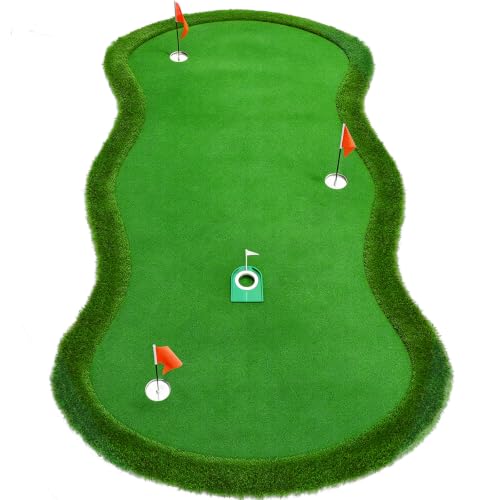
As an Amazon Associate we earn from qualifying purchases at no extra cost to you. Ratings are shown as listed on Amazon.
| Option | Approximate playing dimensions | Surface and roll | Setup and best fit |
|---|---|---|---|
| SKLZ Accelerator Pro | About 9 feet long; narrow lane | Synthetic putting surface with an automatic ball return; designed for straight putts | Roll out on a hard, level floor; useful for compact, repeatable practice |
| PuttOUT Putting Mat | Common version about 7.9 feet long and 1.6 feet wide | Short synthetic turf intended to provide a smooth, consistent roll | Roll out and flatten; a space-efficient option for short-to-medium putts |
| Wellputt putting mat | Common models about 10–13 feet long and roughly 1.6 feet wide | Marked synthetic surface with practice zones; roll depends on the model and floor beneath it | Requires a longer clear lane; suited to structured drills |
| Big Moss modular green | Varies by kit; multi-piece layouts can cover several feet in each direction | Artificial turf over a base, with configuration and features dependent on the set | More pieces and alignment than a roll-up mat; better for a dedicated practice space |
| Custom synthetic-turf installation | Made to fit the room; width and length are set by the plan | Carpet-like artificial turf over a prepared, level base; quality varies by turf and installation | Requires measuring, floor preparation, and a larger budget; best for permanent use |
These are approximate reference dimensions, not guarantees for every current configuration. Confirm the manufacturer’s specifications for the particular model, especially if the room is close to the listed size.
Which type fits your practice?
For a bedroom, office, or shared living space
Choose a narrow roll-up mat, such as the PuttOUT Putting Mat or a similar product, if you need to store it between sessions. A width around 1.5–2 feet is easy to fit along a hallway or beside a desk, but it limits practice to straight putts. A ball-return design such as the SKLZ Accelerator Pro saves time when you are practicing alone, though its return mechanism adds length and does not create a more realistic green.
Measure the full putting lane, not just the mat. For a 9-foot mat, you may need roughly 10–11 feet of clear floor to leave room for your stance and stroke. Also check whether a door, furniture, or a slope in the floor interrupts the path.
For a golfer working on pace and drills
A longer marked mat, such as a Wellputt model, gives you more distance for start-line and pace-control practice. Markings can make drills easier to repeat, but they do not replace a flat surface or a realistic read. If the mat ripples or sits on uneven flooring, alignment guides may encourage you to practice a stroke that compensates for the mat rather than improving on-course putting.
For a spare room or garage practice area
A modular green, such as a Big Moss configuration, provides more width and layout flexibility than a single-lane mat. The added area can support different starting angles and longer putts, but seams and connections need careful alignment. For a permanent setup, custom turf allows you to plan the shape around the room, though installation quality and the levelness of the base determine whether the ball rolls true.
Choose by room size, budget, and frequency
| Your situation | Best fit | What to prioritize |
|---|---|---|
| Small room; mat must be stored after use | Narrow roll-up mat, about 8 feet long | Easy flattening, manageable width, and a storage method that avoids sharp folds |
| Frequent short sessions; little time to retrieve balls | Mat with ball return | Reliable return path and enough room behind the cup for the mechanism |
| Intermediate golfer practicing pace and alignment | Longer marked mat | Several usable distances and markings that support, rather than dictate, your routine |
| Dedicated room; wants different angles and wider targets | Modular green | Usable width, stable joins, and a base that stays level |
| Permanent practice space used most days | Custom turf installation | Base preparation, maintenance access, and a layout that fits the room with clearance |
How to judge roll consistency and setup
Surface material matters, but the floor beneath it matters just as much. Short synthetic fibers are common on portable mats; denser or longer artificial turf is often used in wider practice greens. Neither category guarantees a particular speed. Carpet, concrete, subfloor seams, and small changes in level can alter the roll, especially under a thin mat.
- Check the floor first: Put a ball down on the intended line and roll it both ways. If it repeatedly drifts in the same direction, correct the floor or choose another location before blaming the mat.
- Let the surface settle: After unrolling, give the mat time to relax. Follow the maker’s instructions for flattening rather than creasing it or placing heavy objects on the turf.
- Test more than one distance: Roll several putts from near and far positions. A mat can look smooth but still have a seam, wrinkle, or inconsistent spot that changes speed.
- Plan the cup area: A raised cup or return ramp can change how a ball behaves near the target. Treat it as a practice aid, not a perfect stand-in for a regulation hole.
For a first setup, measure the room and mark the proposed footprint with painter’s tape. Add clearance for your feet, putter, and backswing. This simple check can prevent buying a long mat that technically fits but leaves no comfortable space to use it.
Ownership: what wears and what to avoid
On portable mats, the first problems are often curled ends, persistent creases, shifted backing, or dust and grit that interrupt the roll. On modular greens, poorly aligned joins can create bumps; with custom turf, a settling or uneven base may be more consequential than wear to the visible surface. Ball-return tracks can also collect debris or become misaligned, depending on their design.
Vacuum or brush the surface gently as directed, and keep grit off the putting line. Store a roll-up mat loosely rather than folding it sharply, and avoid leaving it in a hot vehicle or damp area unless the manufacturer says that is suitable. Before each session, check the starting lane and cup area for wrinkles, debris, and shifted sections. These small checks help maintain a consistent roll without special maintenance supplies.
Bottom line
For limited space and easy storage, pick a narrow roll-up mat roughly 8–10 feet long. Choose a longer marked mat if you have room for distance drills, and move to a modular or custom green when width and varied angles matter more than portability. Whichever format you choose, measure the complete practice footprint and test the floor: a well-sized mat on a level surface is more useful than a feature-rich green that does not roll consistently in your room.