Key takeaways
- You hit several times a week or take many iron shots: Prioritize a layered or bristle-style hitting surface and a secure base. The Fiberbuilt Flight Deck offers a compact option; a full Practice Station adds room for your feet.
- You want a broad, turf-like hitting area: Consider a Country Club Elite configuration. Its dense, longer turf is designed to accommodate club contact, but a mat’s feel still differs from real turf and does not reproduce every lie on a course.
- You have limited space or need to store it away: A 12 × 24-inch hitting strip is easier to move and store than a full stance mat. Pair it with a separate stable stance surface if needed.
- You are a beginner practicing occasionally: A basic range mat may be enough for tee shots and short sessions. If you expect to hit many irons, put more of the budget toward impact absorption and a stable base.
- You practice on a hard indoor floor: Look for a non-slip rubber base or plan to add a compatible protective layer. A mat that slides or bottoms out can undermine both comfort and floor protection.
Best Golf Practice Mats for Realistic Home Training: The Quick Picks
The best golf practice mats for home use are thick, layered mats with a stable, non-slip base: choose a Fiberbuilt Flight Deck or Practice Station for frequent practice and joint-conscious impact absorption, a Country Club Elite mat for a more substantial hitting surface, or a smaller, less expensive hitting strip if space and budget matter most. The right pick depends less on plushness than on how the surface responds to a fat strike, how securely it sits on your floor, and whether you need a stance area or just a hitting zone.
Specifications and prices vary by model and seller, so confirm the exact dimensions, thickness, and construction before ordering. The figures below are representative product or product-family specifications, not results from a hands-on test. Prices are broad U.S. market ranges and can change with size and configuration.
Our top picks

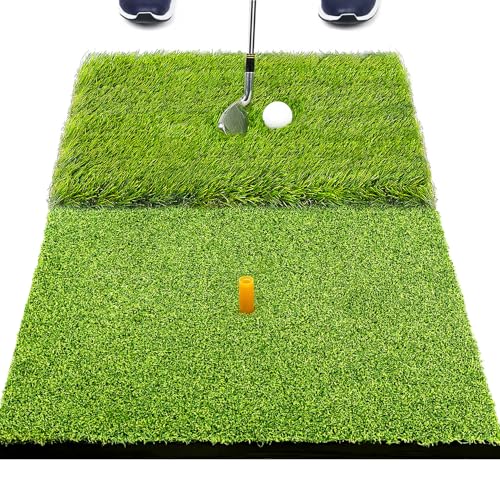


As an Amazon Associate we earn from qualifying purchases at no extra cost to you. Ratings are shown as listed on Amazon.
Compare the Main Options
| Option | Approximate size | Surface and construction | Best suited to | Typical price range |
|---|---|---|---|---|
| Fiberbuilt Flight Deck | About 12 × 24 in | Replaceable synthetic grass bristles over an impact-absorbing base | Compact, frequent hitting practice | $100–$200 |
| Fiberbuilt Practice Station | About 4 × 7 ft | Large stance area with a Fiberbuilt hitting section | Full setup with room to address the ball | $500–$900 |
| Country Club Elite mat | Commonly about 3 × 5 ft; larger configurations also exist | Dense, long synthetic turf intended to let a club pass into the surface | Golfers wanting a broad, realistic-feeling hitting area | $300–$700 |
| Commercial-style hitting strip | Often about 12 × 24 to 12 × 36 in | Layered artificial turf or bristle surface on a rubber or foam backing | Budget-conscious practice or replacement of a worn hitting zone | $40–$150 |
| Basic all-in-one range mat | Often about 3 × 5 ft | Short turf over foam or rubber, sometimes with tee holes | Occasional swings and limited budgets | $30–$120 |
Dimensions describe common configurations, not every model. Weight and exact thickness are not consistently published across product families; verify those details for the particular mat rather than treating a generic listing as a guarantee. A low-priced mat can be useful for tee work, but thin foam-backed turf is more likely to feel harsh on mishits and shift on a smooth floor.
Which Mat Fits Your Practice?
- You hit several times a week or take many iron shots: Prioritize a layered or bristle-style hitting surface and a secure base. The Fiberbuilt Flight Deck offers a compact option; a full Practice Station adds room for your feet.
- You want a broad, turf-like hitting area: Consider a Country Club Elite configuration. Its dense, longer turf is designed to accommodate club contact, but a mat’s feel still differs from real turf and does not reproduce every lie on a course.
- You have limited space or need to store it away: A 12 × 24-inch hitting strip is easier to move and store than a full stance mat. Pair it with a separate stable stance surface if needed.
- You are a beginner practicing occasionally: A basic range mat may be enough for tee shots and short sessions. If you expect to hit many irons, put more of the budget toward impact absorption and a stable base.
- You practice on a hard indoor floor: Look for a non-slip rubber base or plan to add a compatible protective layer. A mat that slides or bottoms out can undermine both comfort and floor protection.
What Matters More Than a “Realistic” Turf Label
Thickness and impact absorption
Thickness alone is not a reliable measure of comfort. A thick mat made mostly of soft foam can compress unevenly, while a thinner design with a well-engineered impact layer may feel more controlled. Look for information about the layers beneath the turf, the base material, and whether the hitting insert is replaceable. If the manufacturer does not publish thickness, ask for the total height and the hitting-surface depth separately.
On a fat shot, the club enters the mat before the ball. A forgiving surface allows some clubhead travel and spreads impact; a firm, shallow surface can feel abrupt. No mat can guarantee joint protection. If practice causes pain or you have a relevant injury, reduce the session and seek advice from a qualified health professional.
Turf realism and ball-flight surfaces
Artificial turf is most useful when it gives consistent contact without disguising poor strikes. Some dense surfaces can let the club slide through a slightly heavy shot, making contact seem cleaner than it would be on grass. Bristle-style surfaces behave differently from long turf and may offer a more forgiving strike, but neither perfectly recreates fairway, rough, or wet conditions.
Separate the hitting surface from the ball-flight system. A mat does not determine whether a golf ball flies realistically: that depends on the ball, available clearance, and whether you are hitting real balls into a net or using foam or plastic practice balls. For indoor practice, confirm ceiling clearance and the net or screen’s rated use before swinging.
Portability, floor protection, and stability
A compact insert is easier to carry, but it may not give you a level stance. A full mat provides foot placement and can reduce the risk of standing with one foot at a different height from the other. Check whether the underside grips your floor; rubber-backed products can still move on dusty or very smooth surfaces. For wood, tile, or finished concrete, use a clean, compatible protective layer and test for slipping before taking full swings.
Setup That Reduces Wear and Slipping
- Measure the swing area. Allow room for the clubhead, backswing, and follow-through, plus safe clearance around a net. Measure the entire footprint, not just the hitting strip.
- Place the mat on a clean, level floor. Dust and grit under the base can encourage movement and scratch flooring. Avoid stacking loose pads that can shift underfoot.
- Align the target line. Set the mat square to the net or target. Misalignment can make repeated practice reinforce an unintended setup.
- Test stability with short swings. Start gently and check whether the mat creeps, rocks, or bunches. Stop and reposition it if it moves.
- Rotate the hitting zone when possible. Repeatedly striking one spot wears turf and backing faster. For a replaceable insert, follow the maker’s instructions for rotation or replacement.
Ownership: What Wears First
The hitting patch usually wears before the stance area. Look for flattened turf, exposed backing, loose bristles, or a spot that feels noticeably firmer than the surrounding surface. A worn patch can change the way the club interacts with the mat, so replace an insert when the manufacturer provides one rather than continuing indefinitely on damaged material.
Keep the mat dry and free of dirt. Brush off debris with a soft brush and follow the maker’s cleaning guidance; harsh solvents or soaking can damage adhesives and backing. If you use real balls, inspect the hitting zone and surrounding net regularly. Avoid placing the mat outdoors long-term unless it is rated for weather exposure, since sun and moisture can shorten the life of turf, foam, and adhesive layers.
Bottom Line
For frequent practice, favor a layered, stable design over the cheapest thick-looking mat. Choose a compact Fiberbuilt Flight Deck when portability matters, a Fiberbuilt Practice Station when you want a complete stance-and-hit area, or a Country Club Elite mat when a broad turf surface is the priority. For occasional use, a basic range mat can work, but check its backing and stability before hitting irons. Match the mat to your space and practice volume, and treat floor protection and a safe swing area as part of the purchase—not afterthoughts.