Key takeaways
- Carpet-bonded vinyl: The common choice for cheer because it provides traction for shoes, supports controlled slides, and resembles competition-floor conditions.
- Vinyl-only surfaces: Easy to wipe clean and useful for stretching or barefoot conditioning, but they may become slippery with sweat or socks.
- Canvas covers: Breathable and relatively light, though they can absorb moisture and are usually less convenient to disinfect.
- Closed-cell foam with a vinyl cover: Resists moisture entering the foam and works well in homes where mats must be cleaned frequently.
The best cheer mats for home practice are usually 1.5-inch folding panel mats with a carpet-bonded vinyl surface, while teams should consider thicker 2-inch or 2.5-inch carpet-bonded systems that lock together securely and cover a larger training area.
Our top picks
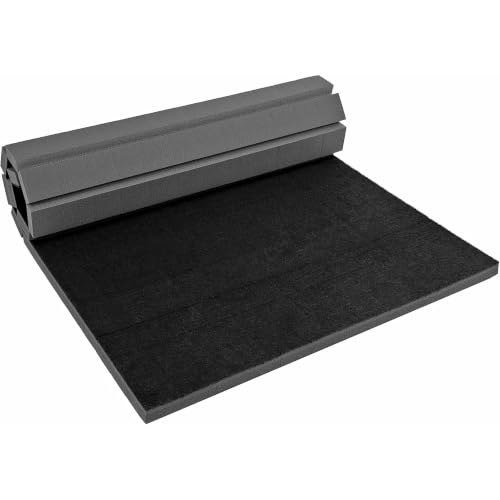


As an Amazon Associate we earn from qualifying purchases at no extra cost to you. Ratings are shown as listed on Amazon.
Best cheer mats by training situation
| Situation | Best mat type | Recommended size | Foam thickness | Typical market range |
|---|---|---|---|---|
| Beginner practicing stretches, jumps, and basic drills | Folding panel mat | 4 x 8 ft | 1.25–1.5 in | $120–$250 |
| Home tumbling and walkovers | Carpet-bonded folding mat or sectional strip | 5 x 10 ft or 3 x 12 ft | 1.5–2 in | $220–$500 |
| Frequent home training with limited storage | Roll-up carpet-bonded mat | 5 x 10 ft | 1.25–1.5 in | $250–$600 |
| Team tumbling lanes and stunt drills | Interlocking carpet-bonded panels or full practice floor | 5 x 10 ft panels or 42 x 42 ft floor | 1.5–2.5 in | $500–$10,000+ |
Prices vary with foam density, cover construction, custom colors, shipping, and whether the mat includes hook-and-loop connectors. A thicker mat is not automatically better: it adds weight, changes the feel of takeoffs, and requires more storage space.
What to look for in the best cheer mats
Foam thickness and density
Foam thickness affects impact absorption, firmness, and how stable the surface feels during a landing. A 1-inch mat can be suitable for floor exercises, conditioning, flexibility work, and low-impact drills. For repeated tumbling practice, 1.5 inches is a more versatile minimum for many home users. A 2-inch mat provides more cushioning, but it can feel less responsive for fast tumbling and may be harder to fold or carry.
Density matters as much as thickness. Low-density foam may feel soft initially but compress, crease, or develop permanent low spots sooner. High-density cross-linked polyethylene foam generally offers a firmer, more consistent training surface than basic soft polyurethane foam. Ask the manufacturer for the foam type and whether the stated thickness refers to the actual foam or includes the cover.
For stunts, avoid choosing the softest possible mat. Bases need a stable platform, and flyers need predictable footing. A firm, carpet-bonded surface is often more useful than a deeply cushioned mat for partner drills.
Surface materials
- Carpet-bonded vinyl: The common choice for cheer because it provides traction for shoes, supports controlled slides, and resembles competition-floor conditions.
- Vinyl-only surfaces: Easy to wipe clean and useful for stretching or barefoot conditioning, but they may become slippery with sweat or socks.
- Canvas covers: Breathable and relatively light, though they can absorb moisture and are usually less convenient to disinfect.
- Closed-cell foam with a vinyl cover: Resists moisture entering the foam and works well in homes where mats must be cleaned frequently.
For cheer, carpet-bonded material is generally the best all-purpose surface. Check the carpet pile and backing rather than judging by photographs. A very short pile can feel slick, while a deep pile may catch shoes during pivots or transitions.
Panel sizes and seams
Most folding mats use panels around 2 feet wide, producing common footprints such as 4 x 8 feet, 5 x 10 feet, or 5 x 12 feet. Narrower panels fold into a smaller package but create more fold lines. Wider panels reduce the number of seams but can be awkward to carry.
Seam stability is especially important for tumbling. Look for reinforced fabric hinges, full-width hook-and-loop fasteners, and connectors that keep adjacent sections from separating. A seam that opens under a hand or foot can interrupt a roundoff or cause a landing to feel uneven.
Inspect the mat on a flat floor before regular use. If panels do not lie level after being unfolded, or if the hinge area creates a ridge, use it for low-impact work until the issue is resolved. Do not assume a decorative zipper or a perimeter strap keeps the training surface aligned; the underside connector system matters more.
Folding versus roll-up cheer mats
Folding panel mats
Folding mats are the most practical option for many homes. They can be carried by one person, stored behind a sofa or under a bed, and expanded without needing a large empty room. Their disadvantage is the repeated stress placed on hinges and fold lines. Dust and hair can also collect in hook-and-loop strips, reducing seam grip.
Roll-up mats
Roll-up mats provide a continuous surface with fewer interruptions, making them attractive for tumbling lanes. They are often better for a long, narrow training area than a square folding mat. However, a 5 x 10-foot mat can be heavy and difficult to roll tightly, especially when carpet-bonded. It needs a storage space at least as long as the mat and enough clearance to unwind it without bending the edges.
Never store a roll-up mat tightly compressed for months unless the manufacturer allows it. Long-term compression can leave curled edges or a visible center ridge. Store it dry, use the supplied straps without over-tightening, and alternate the direction of the roll if the instructions permit.
How much floor space do you need?
A mat’s stated dimensions are not the same as the space required for safe practice. You also need a clear approach and landing area. For example, a 5 x 10-foot mat used for a standing back handspring should not be placed against a wall or furniture. Leave several feet around the mat wherever the drill can travel beyond its edges.
Use this coverage calculation before buying:
Required floor area = mat footprint + approach clearance + landing clearance.
Suppose a 5 x 10-foot mat is placed lengthwise in a room with 3 feet of clear space at each end and 2 feet on each side. The usable rectangle becomes 11 x 16 feet, or 176 square feet. The mat itself covers only 50 square feet, but the room needs roughly 176 square feet of unobstructed area for a more workable setup.
For basic jumps, conditioning, and flexibility, a 4 x 8-foot mat can work in a smaller room. For tumbling, prioritize length over width: a 3 x 12-foot strip may be more useful than a 6 x 8-foot square. For partner stunts, width becomes more important because bases need room to stand beside and behind one another.
Decision matrix: which mat fits your use?
| Your priority | Choose | Why | Trade-off |
|---|---|---|---|
| Lowest cost | 4 x 8 ft, 1.25–1.5 in folding mat | Small foam volume and easy shipping | Limited runway for tumbling |
| Small apartment or shared room | Folding panels with carry handles | Compact storage and quick setup | More seams and fold wear |
| Frequent tumbling | 5 x 10 ft, 1.5–2 in carpet-bonded mat | Better runway and durable surface | Heavier and more expensive |
| Small team practice | Interlocking 5 x 10 ft sections | Expandable coverage and stable connections | Requires substantial storage |
| Stunts and partner drills | Firm 1.5–2 in carpet-bonded panels | Stable footing with useful cushioning | Less soft than a thick crash mat |
Ownership, cleaning, and durability
The cover and seams usually show wear before the foam does. Watch for carpet lifting, frayed hinge fabric, flattened corners, cracked vinyl, and hook-and-loop strips that no longer hold across the full seam. A small cover tear can expand when the mat is folded, so repair it early with a manufacturer-approved patch or send it to a professional upholstery or mat-repair service.
- Vacuum or brush off grit before folding; trapped debris acts like sandpaper on hinges and carpet.
- Wipe vinyl with mild soap and water, then allow it to dry completely before storage.
- Do not soak foam-filled mats or use bleach, solvents, oils, or harsh disinfectants unless the manufacturer specifically approves them.
- Keep mats away from heaters, direct sunlight, and damp concrete, which can accelerate cover and foam deterioration.
- Use bare feet or clean indoor shoes according to the surface instructions; outdoor shoes can transfer grit and damage carpet fibers.
For cost per use, a $350 mat used three times a week for two years provides about 312 sessions. That works out to approximately $1.12 per session before cleaning and storage costs. A cheaper mat that becomes unusable after one year may provide less value than a sturdier mat used consistently for several years.
Bottom line
The best cheer mats balance firmness, traction, dimensions, and storage rather than simply maximizing thickness. Choose a 1.5-inch carpet-bonded folding mat for versatile home practice, a longer roll-up mat when tumbling distance matters most, and connected 2-inch sections when a team needs a stable, expandable floor. Measure the entire clearance zone, not just the mat footprint, and inspect seams and foam density before treating a product as suitable for repeated tumbling or stunts.