Key takeaways
- The outer fabric can fade, split, or absorb water if left uncovered.
- Repeated shooting at one aiming dot creates a dense channel inside the bag.
- Some bags are not rated for broadheads, which can cut the cover or become trapped.
- Loose fill can settle, leaving the upper or lower part less effective.
The best archery targets for most people are a layered-foam target for repeated practice, a bag target for affordable backyard shooting, or a 3D target when realistic animal-shaped aiming and field-style practice matter most.
Our top picks


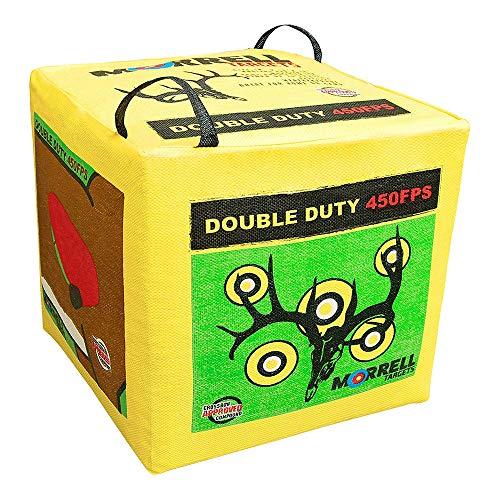
As an Amazon Associate we earn from qualifying purchases at no extra cost to you. Ratings are shown as listed on Amazon.
Best Archery Targets at a Glance
| Target type | Typical face or size | Arrow-stopping method | Typical weight | Arrow removal | Best use |
|---|---|---|---|---|---|
| Bag target | 20–28 inches square | Loose synthetic filling | 20–40 lb | Usually easy | High-volume backyard practice |
| Layered-foam target | 22–30 inches square | Compressed foam layers | 25–55 lb | Moderate to easy | Broad skill development and frequent use |
| Solid-foam target | 20–26 inches square | Self-healing or high-density foam | 15–40 lb | Moderate | Portable practice and mixed arrow setups |
| 3D foam target | 24–48 inches tall | Molded replaceable foam core | 15–45 lb | Easy in vital area; harder in dense zones | Realistic angles and hunting-style practice |
These are useful buying ranges rather than universal specifications. Actual stopping power depends on draw weight, arrow diameter, broadhead design, shooting distance, and the target’s condition.
Which Target Is Best for Your Situation?
| Your situation | Recommended choice | Why | What to avoid |
|---|---|---|---|
| New archer with a recurve or low-poundage compound | Medium bag target | Large aiming area, forgiving stopping performance, and low initial cost | A very dense target that makes arrows difficult to pull |
| Frequent compound-bow practice | Large layered-foam target | More consistent stopping across the face and better resistance to concentrated wear | A small, inexpensive bag used at one spot every session |
| Limited storage or regular transport | Compact solid-foam target with a handle | Easy to move and quick to set up | A large 3D target that cannot be protected from weather |
| Broadhead practice | Manufacturer-approved broadhead foam target | Designed for blades and usually offers a replaceable core | A standard bag unless its instructions specifically allow broadheads |
| Hunting-style distance and shot angles | 3D target | Shows realistic vital zones and exposes angle-related aiming errors | A flat square target as your only practice format |
| Heavy daily shooting on a tight budget | Large bag target | Inexpensive to run and often refillable or replaceable internally | Paying extra for a detailed 3D body that receives all shots in one area |
Bag Targets: Best Value for High-Volume Practice
Bag targets use a fabric cover packed with synthetic material. Arrows enter the filling and lose energy through friction, so a good bag can stop thousands of practice arrows without requiring a thick block of foam. Their broad, flat faces are particularly useful when several people share a target or when you are working on blank-bale form practice.
The main advantage is arrow removal. Most field-point arrows can be pulled with one hand when the bag has an appropriately loose fill. A target that is too tightly packed may stop arrows well but become tiring to use, especially with a high-poundage compound bow.
Weak points to check
- The outer fabric can fade, split, or absorb water if left uncovered.
- Repeated shooting at one aiming dot creates a dense channel inside the bag.
- Some bags are not rated for broadheads, which can cut the cover or become trapped.
- Loose fill can settle, leaving the upper or lower part less effective.
For durability, rotate the target regularly and use multiple aiming points. A rain cover helps, but a cover is not the same as waterproof construction; store the bag under shelter when possible.
Foam Targets: The Best All-Rounders
Foam targets are available as layered blocks, compressed blocks, and molded self-healing designs. Layered targets generally offer a large usable face and predictable stopping performance. As arrows repeatedly follow the same path, the layers eventually separate or form a channel, but rotating the target delays that failure.
Foam is often the best choice for an archer who practices several times a week and wants one target for different distances. It is also easier to keep clean than a fabric bag. However, foam density varies widely. A compact target that stops an arrow quickly may be inconvenient if arrows require two hands or an arrow puller.
Layered versus solid foam
Layered foam is made from stacked sheets, so it can provide good energy absorption over a substantial depth. It is usually heavier and less convenient to carry than a thin solid block. Solid self-healing foam can be lighter and leave smaller visible holes, but its stopping performance may change more noticeably as the face wears.
Look for a target with a replaceable core or replaceable shooting face if you expect high use. Replacing the worn center is cheaper and less wasteful than replacing the entire stand and body.
3D Targets: Best for Realistic Aiming
A 3D target is the best archery target for practicing shot placement rather than simply grouping arrows on a flat face. Models from established makers such as Rinehart and Delta McKenzie commonly represent deer, turkeys, bears, and other game animals. Their vital-area markings help you practice selecting a small zone from different angles and distances.
The trade-off is concentrated wear. If every arrow lands in the same heart or lung area, that section will fail before the rest of the target. A replaceable insert is therefore more valuable on a 3D target than decorative detail or a larger body silhouette.
Many 3D targets are suitable for field points and some broadheads, but the instructions matter. Broadheads can cut foam rather than simply compressing it, and arrows may be more difficult to remove from dense shoulder or leg sections. Use a target designed for the arrowhead type you intend to shoot.
Arrow-Stopping Performance and Safe Setup
Do not judge a target only by whether it stops an arrow. It also needs enough depth behind the aiming face to prevent pass-throughs as the target ages. For a typical recreational setup, a target roughly 22 to 30 inches thick provides more useful margin than a thin foam mat. Higher draw weights, heavier arrows, and broadheads can require a purpose-built target with different dimensions.
- Place the target on level ground with a stable stand or support.
- Keep the target face perpendicular to the expected arrow path; an angled target can cause arrows to glance off.
- Put a clear backstop behind it, even when the target is advertised as arrow-stopping.
- Begin at a short distance and confirm that arrows remain fully contained.
- Inspect the rear and sides periodically for protruding points or cracks.
Never shoot a target after its cover has opened, its core has shifted, or arrows are consistently penetrating through the back. A target can look usable from the front while its center is already exhausted.
Portability, Weather Resistance, and Ownership Cost
A 25-pound foam block is manageable for one person, while a 40-pound bag is less pleasant to carry once it becomes wet. Handles are useful, but they should not be used as a permanent hanging system unless the manufacturer allows it. For a target that stays outdoors, UV-resistant materials and a sloped cover are more valuable than a printed target face with many colors.
Consider cost per use rather than only purchase price. For example, a $120 target used three times a week for two years receives about 312 sessions. Its target-only cost is approximately $0.38 per session. A $55 target used once weekly for one year receives about 52 sessions, or approximately $1.06 per session. The cheaper target is not necessarily the less expensive ownership choice if it wears out quickly or cannot handle your bow.
Consumables include replacement inserts, target faces, covers, and sometimes replacement bag filling. Arrow pullers are not a substitute for a correctly matched target: if every arrow requires extreme force, choose a target with more suitable density before the surface becomes damaged.
How to Make Your Target Last Longer
- Move the aiming point frequently instead of shooting the same printed bullseye.
- Turn a square target 90 degrees periodically to distribute wear.
- Use field points only in targets that are not rated for broadheads.
- Remove arrows by pulling in line with the shaft, not by twisting aggressively.
- Keep fabric bags dry and store foam away from prolonged direct sunlight.
- Do not leave a target where animals, lawn equipment, or children can move it into an unsafe position.
Bottom Line
Choose a bag target for economical, high-volume field-point practice and easy arrow removal. Choose a layered-foam target when you want the strongest all-purpose balance of face size, durability, and consistent stopping performance. Choose a 3D target when realistic anatomy, angles, and hunting-style decisions are the priority. The best archery targets are not simply the densest or largest models; they are matched to your arrow type, shooting frequency, storage conditions, and willingness to rotate or replace worn sections.