Key takeaways
- Weight: A 3U racket is usually about 85–89 g, while a 4U racket is about 80–84 g. 3U provides more stability and potential power; 4U is easier to maneuver. A 5U racket, commonly about 75–79 g, is fast but can feel less solid on hard contact.
- Balance point: Head-heavy rackets generally measure above about 295 mm and favor smashes and clears. Even-balance rackets often sit around 285–295 mm. Head-light rackets are commonly below about 285 mm and favor defense and fast exchanges.
- Shaft flexibility: Flexible shafts bend more easily and can help moderate-speed swings. Stiff and extra-stiff shafts offer precision and a direct response but require better timing and acceleration.
- Frame stability: Heavier and more solid rackets resist twisting on off-center hits. Very light frames can be comfortable but may transmit more vibration and lose accuracy when contact is poor.
The best badminton rackets in 2026 are the Yonex Astrox 100 ZZ for maximum attacking power, Yonex Arcsaber 11 Pro for control, Yonex Nanoflare 800 Pro for fast doubles play, and Yonex Astrox 88D Pro as a balanced rear-court doubles choice.
The right choice depends less on the brand name than on four measurable traits: total weight, balance point, shaft flexibility, and the tension and grip size you can use comfortably. A powerful racket can feel slow in defense, while an ultra-light racket may demand better timing to produce depth.
Our top picks


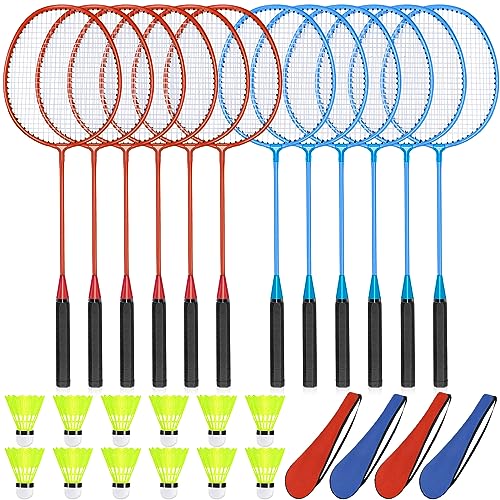
As an Amazon Associate we earn from qualifying purchases at no extra cost to you. Ratings are shown as listed on Amazon.
Quick comparison of the best badminton rackets
| Racket | Typical weight | Balance and shaft | Listed tension range | Best suited to |
|---|---|---|---|---|
| Yonex Astrox 100 ZZ | 83 g, 4U | Head-heavy; extra-stiff | 20–28 lb | Advanced singles attackers |
| Yonex Astrox 88D Pro | 83 g, 4U | Head-heavy; stiff | 20–28 lb | Rear-court doubles and singles |
| Yonex Arcsaber 11 Pro | 83 g, 4U | Even balance; medium-stiff | 19–27 lb | All-round control and singles |
| Yonex Nanoflare 800 Pro | 83 g, 4U | Head-light; stiff | 20–28 lb | Fast doubles exchanges |
| Victor Auraspeed 100X | 83 g, 4U | Even to slightly head-light; stiff | 20–29 lb | Quick, attacking all-round play |
| Yonex Nanoflare 370 Speed | 83 g, 4U | Head-light; medium-flex | 20–28 lb | Beginners and recreational doubles |
Specifications can vary by region, grip version, and production run. “4U” normally means approximately 80–84 g before strings and overgrip; the finished racket will weigh more. Check the label or manufacturer specification before stringing near the upper limit.
Best badminton rackets by playing situation
Best for singles power: Yonex Astrox 100 ZZ
The Astrox 100 ZZ is aimed at players who generate reliable racket-head speed and want a firm, direct response on smashes, full clears, and attacking drops. Its head-heavy balance adds momentum, while the extra-stiff shaft rewards a fast, technically sound swing.
It is not the easiest option for a new player. A slow swing may leave the racket feeling demanding, and the stiff shaft gives less assistance when contact is late. Choose it if you already have consistent overhead timing and prefer a decisive, compact stroke.
Best rear-court doubles racket: Yonex Astrox 88D Pro
The Astrox 88D Pro combines a head-heavy profile with a stiff shaft, making it particularly suitable for the back player who repeatedly smashes, clears, and follows up with steep attacking shots. Compared with an extremely specialized singles racket, it offers a more practical doubles compromise.
Its extra weight in the head can slow rapid drive exchanges. Front-court players or people who defend frequently may prefer a head-light model such as the Nanoflare 800 Pro.
Best for control: Yonex Arcsaber 11 Pro
The Arcsaber 11 Pro is the safest pick for players who value placement over maximum smash weight. Its even balance and medium-stiff response make it suitable for sliced drops, controlled lifts, counterattacks, and technically varied singles play.
This is a strong choice when you want one racket for different opponents and do not yet know whether your game will develop toward power or speed. It also suits experienced doubles players who dislike an overly head-heavy feel.
Best for speed and defense: Yonex Nanoflare 800 Pro
The Nanoflare 800 Pro is designed around fast handling. Its head-light balance helps with blocks, drives, interceptions, and repeated changes of direction at the net. It is especially effective in level doubles, where the shuttle may arrive quickly and there is little time for a large swing.
The trade-off is reduced easy power from the rear court. Players who depend on the racket’s weight rather than their own technique may find their clears and smashes less penetrating than with an Astrox model.
Best fast all-round alternative: Victor Auraspeed 100X
The Victor Auraspeed 100X sits between speed and attacking performance. It is quick enough for doubles defense but still gives a firm response for drives and attacking shots. Consider it when you want a faster racket than a traditional head-heavy design without moving to an extremely light-feeling frame.
Best beginner option: Yonex Nanoflare 370 Speed
For a beginner, the Nanoflare 370 Speed is more forgiving than an extra-stiff, high-tension racket. Its medium-flex shaft helps players who have not yet developed a fast swing, and its head-light balance reduces fatigue during basic rallies and doubles games.
Beginners should prioritize comfort, durability, and correct grip size over a professional-level maximum tension rating. A well-strung, moderate-weight racket usually improves learning more than an expensive competition frame.
How weight, balance, and shaft flexibility change performance
- Weight: A 3U racket is usually about 85–89 g, while a 4U racket is about 80–84 g. 3U provides more stability and potential power; 4U is easier to maneuver. A 5U racket, commonly about 75–79 g, is fast but can feel less solid on hard contact.
- Balance point: Head-heavy rackets generally measure above about 295 mm and favor smashes and clears. Even-balance rackets often sit around 285–295 mm. Head-light rackets are commonly below about 285 mm and favor defense and fast exchanges.
- Shaft flexibility: Flexible shafts bend more easily and can help moderate-speed swings. Stiff and extra-stiff shafts offer precision and a direct response but require better timing and acceleration.
- Frame stability: Heavier and more solid rackets resist twisting on off-center hits. Very light frames can be comfortable but may transmit more vibration and lose accuracy when contact is poor.
Decision matrix: choose by experience and frequency
| Your situation | Recommended specification | Suitable direction |
|---|---|---|
| First racket, 1–2 sessions per month | 4U or 5U; head-light; flexible or medium-flex | Nanoflare 370 Speed or a similar recreational racket |
| Beginner playing weekly doubles | 4U; head-light to even; medium-flex; 20–24 lb | Fast all-round racket with a durable string |
| Intermediate doubles player, 2–4 sessions weekly | 4U; even to head-light; medium-stiff; 23–27 lb | Nanoflare 800 Pro or Auraspeed 100X |
| Intermediate or advanced singles player | 4U or 3U; even to head-heavy; medium-stiff or stiff | Arcsaber 11 Pro or Astrox 88D Pro |
| Advanced attacking player with fast technique | 4U; head-heavy; stiff or extra-stiff; 26–30 lb if appropriate | Astrox 100 ZZ or a comparable power racket |
String tension and grip size: avoid the common mistakes
String tension changes feel more than many buyers expect. Lower tension, such as 20–24 lb, creates a larger and more forgiving sweet spot and can help beginners generate length. Higher tension, such as 26–30 lb, feels crisper and can improve control for a consistent striker, but mishits are less forgiving and the strings may break sooner.
Do not automatically use the highest number printed on the frame. A practical starting point is 2–4 lb below the racket’s maximum listed tension, then adjust after several sessions. Use a reputable stringer, inspect the grommets, and tell the stringer your previous tension and string model.
Grip codes differ by brand, but G4 and G5 are common badminton sizes. G4 is generally thicker than G5. Start with the manufacturer’s standard grip, then add a thin overgrip if needed. The handle should allow your fingers to close around it without squeezing hard; an excessively thick grip can restrict finger power and an excessively thin grip can encourage over-gripping.
Ownership, durability, and total cost
The strings and grip usually wear out before the racket frame. A frequent player may replace an overgrip every few sessions, while strings may last from several weeks to several months depending on tension, string type, mishits, and playing frequency. For example, if a player uses a racket twice weekly for 50 weeks, that is about 100 sessions per year. Replacing a $15–$30 string job four times costs roughly $0.60–$1.20 per session, before buying grips or shuttlecocks.
- Do not leave a racket in a hot car; heat can weaken strings, grommets, and adhesives.
- Use a full racket cover and avoid carrying the frame loose with keys or metal equipment.
- Never clash rackets deliberately or continue using a frame with a visible crack.
- Replace damaged grommets before restringing; sharp or missing grommets can cut the string.
- Wipe sweat from the handle and let the racket dry before storing it in a closed bag.
Final recommendation
Choose the Astrox 100 ZZ for advanced power, the Astrox 88D Pro for rear-court doubles, the Arcsaber 11 Pro for dependable control, and the Nanoflare 800 Pro or Victor Auraspeed 100X for speed. If you are new to badminton, start with a 4U, head-light, medium-flex racket at moderate tension rather than buying the stiffest or most expensive frame available.