Key takeaways
- Compare the best air rifles for target shooting and legal pest control, with break-barrel, pump, CO2 and PCP picks, key specs and buying tips.
The best air rifles make practice affordable, quiet, and repeatable for targets or, where legal, small pests around outbuildings. But they are not one-size-fits-all: each powerplant below solves a different problem.
This guide compares five rifles from five makers, covering each major powerplant, from a simple break-barrel to a bottle-fed PCP.
Disclosure: As an Amazon Associate, I earn from qualifying purchases.
1. Gamo Varmint Break-Barrel Air Rifle

The Gamo Varmint is the straightforward pick if you want a self-contained rifle and nothing else to buy. It is a single-shot, spring-piston break-barrel in .177 caliber: break the barrel, load one pellet, close it, aim, and fire. No cartridges, no pumping, no tank to fill.
The listing rates it at up to 1250 fps with PBA Platinum alloy pellets, plenty for paper, spinners, and, where legal, close-range pest work with an appropriate pellet and a humane shot. Light alloy pellets produce that headline number, so expect lower speeds with heavier lead pellets, and choose pellet weight for accuracy first.
At 5.47 pounds and 43.3 inches, it handles like a light sporting rifle. The synthetic Monte Carlo stock has dual raised cheekpieces, grip and forearm texturing, and a rubber recoil pad. The two-stage adjustable trigger helps groups more than raw power does. Use a loose, consistent hold, because spring-piston recoil is distinctive.
Specs
- Caliber: .177 pellet
- Velocity: Up to 1250 fps with PBA Platinum alloy pellets
- Powerplant and action: Spring-piston, break-barrel, single-shot
- Weight: 5.47 pounds
- Overall length: 43.3 inches
- Optic included: 4×32 scope with mount
- Trigger: Two-stage adjustable, manual safety
- Stock: Synthetic Monte Carlo, dual raised cheekpieces
2. Daisy Powerline 880 Multi-Pump Air Rifle with Scope

A benchmark multi-pump rifle since the early 1970s, the Daisy Powerline 880 lets you control the power. Pump three times for lower-power, short-range practice, or up to ten times for full velocity outdoors. New shooters can begin gently and add power as technique improves.
The 880 shoots both .177 pellets and BBs. For accuracy, use pellets and the rifled steel barrel; keep BBs for informal fun. It holds 50 BBs in a reservoir fed through the bolt action, while pellets load one at a time. Maximum velocity is listed at 800 fps with BBs, enough for targets and, where legal, very close pest tasks suited to this power level.
At 3.10 pounds and 37.6 inches, it is the lightest rifle here. The molded woodgrain Monte Carlo stock keeps a classic look, and you get both open sights and an included 4×15 scope, described as fogproof and shockproof. A crossbolt trigger block safety completes the package.
Specs
- Caliber: .177 BB or pellet
- Velocity: Up to 800 fps with BBs
- Powerplant and action: Multi-pump pneumatic, bolt action, 3 to 10 pumps
- Capacity: 50-shot BB reservoir, single-shot pellet loading
- Weight: 3.10 pounds
- Overall length: 37.6 inches
- Optic included: 4×15 scope, plus blade front and adjustable rear sights
- Barrel: Rifled steel
3. Crosman Full Auto R1 CO2 BB Air Rifle
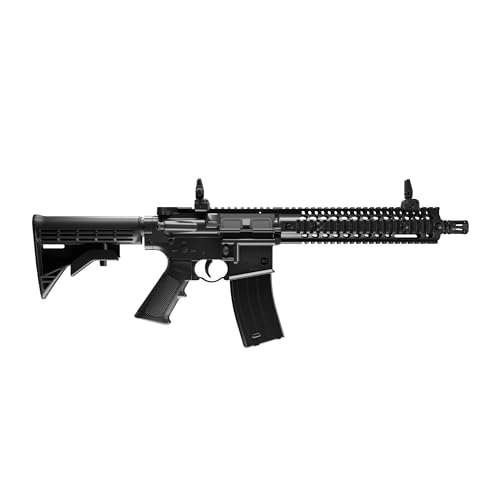
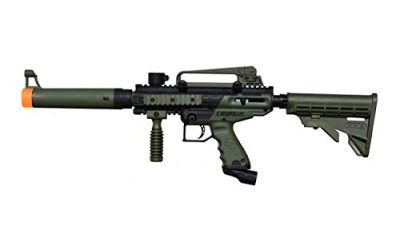
The Crosman Full Auto R1 is not a precision pellet rifle. It is a select-fire CO2 BB rifle built for fast, enjoyable target sessions. Two 12-gram CO2 cartridges in its 25-round drop-out magazine power semi-automatic fire for deliberate shots or full-automatic fire at up to 1400 rounds per minute for clearing a row of cans on a safe range.
Velocity is listed at up to 430 fps with 4.5 mm steel BBs, right for plinking and paper at modest distances. Blowback action gives it a lively feel that helps when practicing control and follow-through. Because it uses smooth-bore BBs rather than pellets, treat it as a recreational trainer, not a humane pest tool, where pellet accuracy and energy matter far more.
The synthetic stock adjusts to six positions, and the AR-compatible grip feels familiar to fans of modern sporting rifles. Rails accept accessories, and removable sights are included instead of a scope. At about 6 pounds it feels stable without being tiring. Keep spare cartridges ready, as full-automatic strings use gas quickly.
Specs
- Caliber: .177 (4.5 mm) steel BBs
- Velocity: Up to 430 fps
- Powerplant and action: CO2, semi-automatic and full-automatic, blowback
- Fuel: Two 12-gram CO2 cartridges in the magazine
- Capacity: 25-round drop-out magazine, up to 1400 rounds per minute
- Weight: About 6.0 pounds
- Optic included: No scope; removable front and rear sights, accessory rails
- Stock: Synthetic, 6-position adjustable
4. Umarex Forge Break-Barrel Air Rifle

The Umarex Forge blends a classic hardwood stock with a modern gas-piston powerplant. Its TNT (Turbo Nitrogen Technology) system replaces a coiled spring with a gas piston, which many shooters prefer for a smoother shot cycle. As a single-shot break-barrel, handling stays simple.
The listing headline rates the Forge at 1250 fps in .177 caliber, while the manufacturer text on the same listing notes up to 1050 fps, a reminder that velocity depends on pellet type and test method. Either way, it is a full-power break-barrel for target work and, where legal, small pest tasks at sensible ranges with a pellet it groups well. Fiber optic sights and an automatic safety support accurate shooting before you mount the optic.
Its Nucleus optics platform reduces scope movement and vibration, so the included 4×32 scope holds zero better under recoil. The attached SilencAir 5-chamber dampener reduces downrange noise. At 7.8 pounds and 47 inches, its weight helps it sit steadily from a rest.
Specs
- Caliber: .177 pellet
- Velocity: Up to 1250 fps as listed, 1050 fps in manufacturer feature text
- Powerplant and action: Gas piston (TNT), break-barrel, single-shot
- Weight: 7.8 pounds
- Overall length: 47 inches
- Optic included: 4×32 scope with rings, plus fiber optic sights
- Features: Nucleus optics rail, SilencAir 5-chamber dampener, automatic safety
- Stock: Hardwood
5. Benjamin Gunnar PCP Air Rifle

The Benjamin Gunnar is the step-up pick for PCP consistency, repeat shots, and tuning. This version, model BPG25S, is chambered in .25 caliber with a side-lever action and a 10-round rotary magazine, so follow-up target shots are fast and you keep your position between shots. Its shrouded barrel has integral sound suppression for discreet, legal pest work and practice where rules allow.
The .25 Gunnar is rated at up to 900 fps and 50 foot-pounds of energy, fed by a 500cc bottle filling to 3000 psi. An adjustable regulator and five-position external power adjuster let you balance velocity against shot count, and an onboard gauge tracks pressure. It is the most capable rifle here for larger pests at appropriate ranges, if the use is legal and the shot is ethical. The trade-off is infrastructure: you need a proper hand pump, compressor, or tank, none of which should be improvised.
The listing gives 8 pounds and 44 inches, with a Picatinny rail on top. No scope is included, so budget for an optic. A lower rail accepts a bipod, and the AR-compatible grip and adjustable buttstock help you build a repeatable position.
Specs
- Caliber: .25 pellet
- Velocity: Up to 900 fps, up to 50 foot-pounds of energy
- Powerplant and action: Pre-charged pneumatic (PCP), side-lever, repeater
- Air reservoir: 500cc bottle, 3000 psi fill, adjustable regulator
- Capacity: 10-round rotary magazine in .25 caliber
- Weight: 8 pounds
- Overall length: 44 inches
- Optic included: No scope; Picatinny optics rail fitted
- Features: Shrouded barrel, integral sound suppression, five-position power adjuster, onboard gauge
How to Choose the Right Air Rifle
Begin with the job. For targets and skill building, accuracy, trigger quality, and fit matter more than maximum velocity. For legal pest control, you also need enough energy with the pellet you actually use, and the accuracy to place every shot responsibly. If a rifle cannot group tightly at your distance, it is not a pest tool at that distance.
Then pick a powerplant you will maintain. Break-barrels are self-contained but need airgun-rated optics. Multi-pump rifles vary power with no cartridges or tanks, at the cost of pumping between shots. CO2 repeaters are easy, but gas adds cost and performance falls as cartridges empty. PCP rifles offer repeat shots and tunability, but need proper filling gear.
Match caliber to range, too. The .177 shoots flat and economically for targets and small pests at modest distances. The .25 carries more energy for larger pests where legal, with a loopier trajectory to learn. Included scopes on value rifles are a beginning point, so confirm the optic suits your rifle type and check zero often.
Safety and legality come first. Treat every air rifle as loaded, keep the muzzle in a safe direction, keep your finger off the trigger until ready, and know your target and what lies beyond it. Use a proper backstop, wear eye protection, and store the rifle unloaded and secured from children. Laws vary on power, hunting use, discharge, minimum age, and protected species, so check local rules and landowner permission before any pest control.
FAQ
Which caliber suits beginners, .177 or .25?
Usually .177. Pellets are widely available, trajectories are flatter at typical distances, and it covers targets and small pest tasks well. Choose larger calibers only for a specific legal need, with the practice to place shots precisely.
Do I need a scope, or are open sights enough?
Open and fiber optic sights work well at short range. A scope helps at longer distances and in low light. On a break-barrel, choose an airgun-rated scope and check that mounts stay tight.
How far can an air rifle be used responsibly?
As far as your proven groups allow, not as far as a velocity claim suggests. Find the range where every shot stays in a small group from your shooting position, and stay inside it for pest work. For targets, a sound backstop matters most.
Are air rifles loud?
It varies. Spring and gas-piston rifles add mechanical noise, CO2 rifles have a sharper report, and shrouded PCP rifles like the Gunnar are generally quietest here. Still be considerate of neighbors and follow local rules.
Conclusion
Choose the Gamo Varmint for self-contained power, the Daisy 880 for light weight, the Crosman R1 for fast target fun, the Umarex Forge for a smoother gas-piston cycle, or the Benjamin Gunnar for PCP repeat shots. Then practice until your groups, not the spec sheet, define what it can do.
More from Amazon
Programs that pair well with the guide above. Offers and eligibility are set by Amazon and may change.
Free shipping on eligible items, Prime Video and more. Eligible new members can start with a free trial.
Start a Prime free trialA Prime membership for ages 18-24 with a trial period. Eligibility is set by Amazon.
See Prime for Young AdultsAudiobooks and podcasts to listen to on the go. Eligible new members can start with a free trial.
Try Audible freeAd-free music streaming. Eligible new subscribers can start with a free trial.
Try Music Unlimited freeAs an Amazon Associate we earn from qualifying purchases.