Key takeaways
- The best padel rackets are chosen by matching shape and balance to your swing: round, low-balance rackets suit control and beginners; teardrop rackets offer the most versatile compromise; diamond, head-heavy rackets produce more power for experienced players who can create…
The best padel rackets are chosen by matching shape and balance to your swing: round, low-balance rackets suit control and beginners; teardrop rackets offer the most versatile compromise; diamond, head-heavy rackets produce more power for experienced players who can create their own timing.
There is no single best racket for every player. A beginner who buys an advanced diamond racket may lose more points through mishits than they gain from extra power, while an attacking player may find a soft, round racket too limited overhead. The useful comparison is therefore between playing characteristics rather than marketing labels.
Our top picks

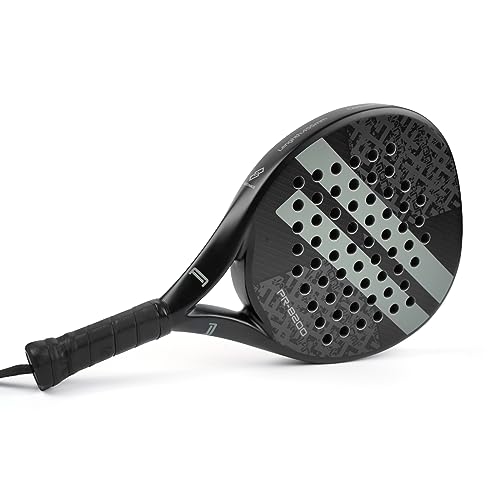


As an Amazon Associate we earn from qualifying purchases at no extra cost to you. Ratings are shown as listed on Amazon.
Quick comparison: which racket type fits you?
| Racket type | Typical balance | Typical weight | Sweet spot | Best suited to |
|---|---|---|---|---|
| Round | Low, approximately 250–265 mm | 350–370 g | Large and central | Beginners, defensive players, control-focused technique |
| Teardrop | Medium, approximately 260–275 mm | 355–375 g | Medium to large | Intermediate players wanting balance between control and power |
| Diamond | High, approximately 270–285 mm | 365–385 g | Smaller and higher on the face | Advanced attacking players and strong overhead hitters |
Manufacturers measure balance in different ways, and the figures can change with an overgrip, protector, or replacement strap. Treat these numbers as useful categories rather than laboratory-equivalent specifications.
Round rackets: the safest route to control
A round racket places more of its usable hitting area near the centre of the face. That makes it easier to return low balls, defend from the back glass, and handle shots that arrive close to the body. The larger sweet spot also reduces the penalty for contacting the ball slightly outside the centre.
Round shapes are particularly suitable for a new player still learning the continental grip, preparation, and wall rebounds. They are also useful for experienced players whose game depends on lobs, placement, and patience rather than repeated smashes.
The trade-off is leverage. A round racket generally does not help as much with kick smashes and high volleys because its balance is closer to the hand. You can still hit hard, but more of the result must come from technique, timing, leg drive, and clean contact.
Models such as the Nox ML10 Pro Cup and many beginner versions from Head, Wilson, Babolat, and Adidas illustrate this control-oriented category. Check the exact version before buying, because the same product family may include different foams, weights, or surface finishes.
Teardrop rackets: the best all-round compromise
Teardrop rackets move the effective hitting zone slightly upward and add moderate balance toward the head. This usually produces more depth and overhead assistance than a round racket without making defence unnecessarily demanding.
For many intermediate players, this is the most practical shape. It supports blocking at the net, controlled bandejas, occasional attacking acceleration, and enough forgiveness for imperfect preparation. If you play both sides of the court or are still deciding whether you are primarily defensive or attacking, a medium-balance teardrop is often the sensible starting point.
Examples include all-round lines from Head, Adidas, Bullpadel, Babolat, and Wilson. Do not choose solely by the word “hybrid”: compare the stated balance, weight range, foam, and hole pattern as well.
Diamond rackets: maximum assistance for attacking shots
Diamond shapes put more material above the centre of the face. The resulting head-heavy balance can increase ball speed on smashes, viboras, and aggressive volleys, but it also makes the racket feel slower when defending or changing direction.
This design rewards a player who already contacts the ball in front, rotates the torso effectively, and can control the racket head through the swing. It is less forgiving when the ball reaches the lower part of the face. A heavy diamond racket can also feel tiring during a long match, especially when repeated overheads are not yet efficient.
Advanced ranges such as the Bullpadel Hack, Adidas Metalbone, and Babolat Technical Viper are associated with attacking specifications, although individual generations differ. Treat those names as examples of product families, not as an automatic recommendation.
Core density: soft comfort versus firm precision
The foam inside a padel racket strongly affects how it responds. Softer EVA or polyethylene-based cores compress more easily, often providing a comfortable rebound at moderate swing speeds and a forgiving feel on defensive shots. They can be attractive to beginners and players who prefer a more cushioned response.
Medium-density foam is the versatile option. It gives enough rebound for controlled defence while remaining stable during faster volleys. Firm EVA cores feel more direct and precise at high speed, but they demand cleaner contact and may feel unforgiving when the ball is struck away from the sweet spot.
Core firmness is not the same as power. A soft core can launch the ball effectively on a compact swing, while a firm racket may produce higher maximum pace for a player who accelerates it properly. Temperature also matters: many foam materials feel firmer in cold conditions and softer in warm conditions.
Face materials and surface texture
Fiberglass faces are usually more flexible and comfortable, with a forgiving response that suits beginners and moderate swing speeds. Carbon-fibre faces are stiffer and more stable, particularly when the ball is struck hard. The number of carbon layers, weave, resin, and core construction all influence the final feel, so “carbon” alone is not a complete specification.
Rough finishes may help experienced players generate spin, but the surface does not replace brushing technique. Sand-textured coatings can wear with use, while molded or embossed patterns generally have different durability characteristics. If you rarely use topspin or kick effects, do not pay a large premium for texture you will not exploit.
Weight, balance, and vibration control
A nominal 360 g racket can become approximately 370–380 g after adding an overgrip and protector. That extra mass may improve stability, but it also increases the load during repeated swings. Beginners should normally stay near the lower or middle part of a model’s weight range until they know they can control it comfortably.
Vibration control comes from several features working together: a suitable foam, a flexible or damped frame, handle cushioning, and a properly fitted grip. Some rackets include shock-absorbing systems in the handle or throat. These can alter feel, but they are not a substitute for correct grip size and sound technique.
When comparing two rackets, hold them in playing position and make several slow shadow swings. A racket that feels easy to stop and reposition is often more useful than one that feels powerful only during a single fast swing.
Decision matrix by player and playing situation
| Your situation | Recommended specification | Why it works | What to avoid |
|---|---|---|---|
| Complete beginner, 1–2 sessions weekly | Round, 350–365 g, soft or medium core, fiberglass or mixed face | Large sweet spot and easier handling accelerate basic consistency | Very hard diamond rackets above 375 g |
| Intermediate all-round player | Teardrop, 360–375 g, medium core, carbon-fiberglass or medium carbon face | Balances defence, volleys, and developing overheads | Choosing solely for maximum advertised power |
| Advanced attacking player | Diamond or aggressive teardrop, 370–385 g, medium-firm or firm core | Provides stability and leverage at high swing speed | Excess weight that slows preparation |
| Frequent defender or player sensitive to harsh feel | Round, low balance, soft-to-medium core, cushioned handle | Reduces effort during blocks and repeated defensive contact | Stiff, head-heavy construction selected only for status |
| Budget-conscious buyer | Last-generation round or teardrop model, 355–370 g | Older construction can provide the needed control without premium pricing | Paying extra for carbon grade or texture you cannot use |
A practical way to choose your weight
Start with the racket’s unmodified weight, then estimate your playing setup. For example, a 360 g racket plus a 6 g overgrip and a 4 g protector weighs about 370 g. If your current racket is 350 g and your shoulder or forearm becomes tired late in sessions, moving directly to 380 g adds roughly 30 g, or about 8.6 percent. That may sound small, but the added head weight can make repeated overheads noticeably more demanding.
Increase weight gradually, preferably by 5–10 g, and judge the racket after a full session rather than after five minutes of hitting. A slightly lighter racket that you can position early will often outperform a heavier one that causes late contact.
Ownership, durability, and common mistakes
The face and frame usually show damage first. Repeated contact with the glass, floor, or metal fencing can chip the edge and weaken the protective strip. Keep the racket in a padded case, avoid leaving it in a hot car, and wipe dust away with a soft, slightly damp cloth. Do not soak the foam or use abrasive cleaners.
Overgrips are consumables. Replace one when it becomes smooth, compressed, or slippery; a worn grip encourages excessive squeezing and makes control worse. Inspect the frame for cracks and listen for new rattling sounds. A cosmetic scratch is not always serious, but a crack near the bridge or face can change the racket’s stability and is a reason to stop using it.
Common buying mistakes include selecting a racket only by its advertised maximum power, ignoring the final weight after accessories, and assuming a rough face will fix poor timing. Prioritise shape, balance, and sweet-spot location first; then compare core firmness, face material, and vibration features within that category.
Final recommendation
For most new players, the best padel rackets are round models around 350–365 g with a soft-to-medium core and a forgiving fiberglass or mixed face. Intermediate players should begin with a balanced teardrop racket around 360–375 g. Choose a diamond, head-heavy model only when your technique, conditioning, and overhead consistency justify the extra demand. The right racket is the one that lets you prepare early, contact the ball cleanly, and repeat that performance throughout an entire match.