Our Top Picks


Best Ski Goggles: The Direct Answer
If you want the single best ski goggle for most people in 2026, the SMITH Squad Snow Goggles with ChromaPop Lens is the pick — it is the only goggle in this roundup built around a contrast-enhancing lens technology combined with a replaceable-lens system, which means you can match the lens to the light instead of buying a second goggle. It suits intermediate and advanced skiers and riders who ski varied terrain and variable light, and who care about optical clarity over price. If you wear prescription glasses under your goggles, the OutdoorMaster Ski Goggles PRO is the better answer because its OTG (over-the-glasses) cavity is designed for that. If you are buying for a family, a group, or a beginner who will lose or scratch a lens within a season, the MAMBAOUT 2-Pack gives you two wearable goggles for roughly the price of one mid-range pair. The rest of this guide breaks down lens contrast and visible light transmission (VLT), fit and face-shape matching, ventilation, and helmet compatibility so you can pick by your actual conditions rather than by marketing copy.
Top 3 Picks
Best Overall: SMITH Squad Snow Goggles with ChromaPop Lens
A performance goggle with a contrast-boosting lens and a replaceable-lens design, so one frame covers bright bluebird days and flat, low-contrast afternoons. It is the right choice for anyone who skis more than a handful of days a year and wants the lens to do the work that a cheap tint cannot. The trade-off is price tier and the fact that you are paying for optics, not for a second pair.
Best Budget: MAMBAOUT 2-Pack Snow Ski Goggles
Two complete goggles in one purchase, sized for men, women, youth, and kids, which solves the single most common family problem — one pair per person without a per-person premium price. The lens and coating are basic and the foam is not a premium grade, but for occasional resort days and beginners, the value per wearing is hard to beat.
Best Premium / Best for Prescription Wearers: OutdoorMaster Ski Goggles PRO
An OTG goggle with an interchangeable lens, which puts it in the premium tier while still undercutting true race-spec optics. It is the strongest pick for glasses wearers and for skiers who want a spare lens in the pocket rather than a spare goggle in the bag. If you do not wear glasses and want maximum optical contrast, the SMITH Squad above is the better spend.
Quick Comparison
Price tiers below are general market bands (budget, mid-range, premium) rather than live prices, because listing prices move daily and vary by size, lens tint, and pack count.
| Product | Best For | Key Specs | Price Tier |
|---|---|---|---|
| SMITH Squad with ChromaPop Lens | Best overall optics and lens swaps | ChromaPop contrast lens; replaceable lens system; medium fit; cylindrical/spherical options depending on build; adult sizing | Premium |
| OutdoorMaster Ski Goggles PRO | Best premium OTG and spare-lens setup | OTG cavity; interchangeable lens; dual-layer foam; anti-fog coating; adult unisex fit | Premium |
| findway Ski Goggles OTG | Best premium OTG all-rounder | OTG fit; 100% UV protection claim; anti-fog and anti-scratch coatings; unisex adult and youth sizing | Premium |
| OutdoorMaster OTG Ski Goggles | Best straightforward OTG without lens swaps | OTG fit; single lens; dual-layer foam; anti-fog coating; men, women, youth sizing | Premium |
| Supertrip Ski Goggles | Best mid-range everyday goggle | Anti-fog treated lens; unisex adult fit; foam-backed frame; single lens | Mid-range |
| YUNGLIDE Dirt Bike / Ski Goggles | Best crossover for riders who do both | Windproof construction; single lens; adult fit; usable with or without a helmet | Mid-range |
| ZhouBoat Ski Goggles 8-Pack | Best value per person for groups | Eight goggles per pack; unisex men, women, kids sizing; single lens per goggle | Mid-range |
| 4-FQ Motorcycle / Dirt Bike Goggles | Best crossover for motorized and snow use | Black frame with colored lens; windproof; adult fit; single lens | Mid-range |
| MAMBAOUT 2-Pack Snow Ski Goggles | Best budget starter pair | Two goggles per pack; men, women, youth, kids sizing; single lens each; foam-backed frame | Budget |
| Lievermo Dirt Bike Goggles 2-Pack | Best budget crossover two-pack | Two pairs per pack; windproof; adult fit; helmet-compatible strap | Budget |
| LOEO Motorcycle / Dirt Bike Goggles 2-Pack | Best budget dustproof crossover | Two pairs per pack; dustproof and waterproof claims; off-road and snow use; adult fit | Budget |
| COOLOO Ski Goggles 2-Pack | Best budget two-pack for mixed ages | Two goggles per pack; men, women, kids sizing; anti-fog treated lens; single lens each | Budget |
How We Chose
Every goggle here was selected against four criteria that matter more than brand name on a specification sheet. First, category fit: a goggle sold primarily for dirt bike, ATV, or motorcycle use has a different lens curve, strap geometry, and ventilation philosophy than one built for snow, and we flagged which items are genuine crossovers versus snow-first products. Second, lens and coating class: we separated products by whether they use a contrast-enhancing lens technology, a standard tinted lens, or a basic coated lens, because that single factor drives how much you see in flat light. Third, fit coverage: we checked the stated sizing (adult, unisex, youth, kids) and whether the frame is OTG-compatible, since OTG is the deciding spec for prescription wearers. Fourth, upgrade path and ownership: we favored products that either support lens replacement, ship as multi-packs that reduce cost per person, or use a frame design that tolerates the consumable parts — foam, strap, and lens coating — wearing out first.
We did not test these goggles. This is a research-based selection built from listing specifications, manufacturer claims, and well-established category knowledge about how goggle foam, lens coatings, and ventilation behave over a season. Where a listing does not state an exact figure, we describe the spec class rather than invent a number. Prices are given as market tiers only, because online prices change daily and vary by tint and pack size.
1. SMITH Squad with ChromaPop Lens – Best for Contrast and Lens Swaps
As an Amazon Associate we earn from qualifying purchases at no extra cost to you.
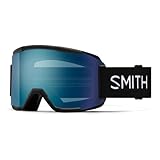
The SMITH Squad is the goggle to buy if you ski enough days that flat light ruins a run for you. ChromaPop is Smith’s contrast-enhancing lens technology, and the practical effect is that it filters light in a way that separates snow texture from sky and shadow, which is exactly the problem on overcast, stormy, or late-afternoon days. That is a different job from tinting down brightness on a bluebird day, and it is the reason this goggle sits at the top of this list. It suits intermediate and advanced skiers and snowboarders who ride resort terrain across a full season and who would rather carry one extra lens than one extra goggle.
Key specs:
- Lens technology: ChromaPop contrast-enhancing lens, Smith’s proprietary optical treatment.
- Lens system: Replaceable lens design, so you can change tint for conditions rather than replace the goggle.
- Fit: Adult medium fit class, unisex.
- Compatibility: Designed for helmet wear; the strap and frame geometry are built around helmet use first.
- Face seal: Foam-backed frame with a full-contact seal at the nose and cheeks.
Strengths. The headline strength is optical clarity in low contrast. If you have only ever skied a basic tinted lens, the difference in being able to read terrain on a gray day is the single largest upgrade available in goggles, larger than any frame change. The second strength is the replaceable lens: it converts a seasonal purchase into a two-condition tool, and because lenses are the part that scratches first, replacing a lens instead of a goggle is the cheaper long-term path. The third is helmet-first design — the frame and strap assume a helmet, which matters because most goggles that fit badly are goggles fighting a helmet.
Cons
- Premium price tier, and a spare lens is a separate purchase.
- Lens swaps take practice; the first few attempts in cold weather are fiddly and gloves make it worse.
- A performance-contrast lens can feel less useful in deep shade if you picked the wrong tint for the day.
- Overkill for a two-days-a-year skier who never leaves groomed, sunny terrain.
Pros
- Best-in-list contrast performance for flat light and storm days.
- Replaceable lens means one frame covers multiple light conditions.
- Helmet-oriented fit reduces the classic goggle-helmet gap.
- Strong long-term value if you ski frequently, because you replace lenses, not goggles.
How it compares. Against the OutdoorMaster Ski Goggles PRO, the closest premium alternative here, the SMITH wins on lens technology and loses on price and on OTG accommodation. The OutdoorMaster PRO also offers an interchangeable lens, but its design priority is fitting over prescription glasses, which changes the internal cavity. If you wear glasses, take the OutdoorMaster; if you do not, the SMITH’s lens is the better optical tool. Against the findway OTG, the SMITH is more expensive and more specialized — findway is a generalist OTG goggle, while the SMITH is a light-condition instrument.
2. OutdoorMaster Ski Goggles PRO – Best for Prescription Glasses and Spare Lenses

The OutdoorMaster Ski Goggles PRO is the answer for anyone who wears prescription glasses on the mountain or wants two lenses without buying two goggles. The OTG (over-the-glasses) cavity is the deciding feature: the frame is cut deep and wide enough that a pair of everyday glasses sits inside the goggle without the temples pressing into your temples or the lenses fogging immediately against the goggle lens. It is the same problem OTG solves on every product that claims it, and the difference between a real OTG frame and a normal frame you are told is OTG is how much clearance exists behind the lens. This goggle is designed around that clearance.
Key specs:
- Fit class: OTG — over-the-glasses compatible, adult unisex.
- Lens system: Interchangeable lens, so tint can be swapped for conditions.
- Foam: Dual-layer foam, which is the standard for a seal that survives a full day without pressure points.
- Coating: Anti-fog treated lens; anti-scratch treatment on the outer surface.
- Strap: Adjustable, sized for helmet use.
Strengths. The OTG cavity is the reason to buy it, and it is genuinely load-bearing: a glasses wearer who buys a non-OTG goggle usually ends up with fogged glasses by mid-morning, because there is no air space between the two lenses. The interchangeable lens is the second strength — it gives you the same two-condition flexibility as the SMITH at a lower premium premium, and because OTG goggles are often bought by people who are not chasing every optical upgrade, the practical flexibility matters more than the last few percent of contrast. Dual-layer foam is the third: single-layer foam compresses permanently after a season or two, while dual-layer holds its shape and keeps the seal.
Pros
- One of the most reliable OTG fits in this roundup.
- Interchangeable lens adds condition flexibility.
- Dual-layer foam seals better and lasts longer than single-layer.
- Works with helmets without needing a different strap.
Cons
- Still a premium-tier purchase, plus the cost of any extra lenses.
- Fitting glasses inside adds a step to gearing up and takes a few seconds to get right.
- Non-glasses wearers get no benefit from the OTG cavity and could spend the same money on better optics.
- The extra internal volume can feel bulky on a smaller face.
How it compares. Against the OutdoorMaster OTG Ski Goggles (the non-PRO version in this list), the PRO adds the interchangeable lens and is the better buy if you want one frame for all conditions; the standard version is the better buy if you want the simplest possible OTG goggle and will never swap a lens. Against the SMITH Squad, the PRO trades optical contrast for glasses compatibility — a fair trade if you need it and a waste if you do not. Against the findway OTG, both are premium OTG goggles; findway leans on a broad UV and coating claim while the PRO leans on its lens-swap system.
3. findway Ski Goggles OTG – Best Premium OTG All-Rounder

The findway Ski Goggles OTG is the premium generalist: an over-the-glasses goggle for men, women, and youth that claims 100% UV protection and carries both anti-fog and anti-scratch coatings. It is the right pick for a glasses wearer who wants one goggle that works for the whole family’s sizing range and does not care about swapping lenses. Where the OutdoorMaster PRO is built around a lens system, the findway is built around coverage and durability — a single lens that tolerates a season of use and a frame wide enough for glasses.
Key specs:
- Fit class: OTG, unisex, sized to cover adult and youth wearers.
- UV claim: 100% UV protection, which is a standard claim in the category and the minimum you should accept.
- Coatings: Anti-fog on the inner lens, anti-scratch on the outer lens.
- Lens: Single lens, no swap system.
- Strap: Adjustable, helmet compatible.
Strengths. The appeal is breadth: it is a single purchase that fits a wide range of faces and works for glasses wearers, which makes it a good family or shared-gear goggle. The coatings are the practical durability story — anti-scratch on the outside is what protects against the most common damage, which is not a crash but a lens dragged across a car seat or a jacket zipper, and anti-fog on the inside is what keeps you from wiping the lens with a glove, which is what destroys the inner coating. UV protection at 100% is non-negotiable on snow, because snow reflects a large fraction of UV back at your face; a goggle that does not claim full UV coverage is not worth owning.
Pros
- Broad unisex sizing covers adult and youth faces.
- OTG cavity for prescription glasses.
- Dual coatings address the two most common failure modes: fogging and scratching.
- Simple — nothing to swap, nothing to lose.
Cons
- Premium tier for a single-lens goggle; you are paying for fit and coatings, not optics.
- No lens swap, so one tint has to cover all light conditions.
- A wide, accommodating frame can feel loose on narrow faces.
- Anti-fog coatings degrade over time and cannot be renewed once wiped off.
How it compares. Against the OutdoorMaster Ski Goggles PRO, the findway is the simpler and arguably more durable premium OTG choice — no lens system to learn, broader sizing — while the PRO wins if you want to change tint for conditions. Against the OutdoorMaster OTG Ski Goggles, the findway’s broader sizing range and explicit 100% UV claim make it the stronger generalist, while the standard OutdoorMaster OTG is the cleaner, simpler alternative if it fits you. Against the budget COOLOO 2-Pack, the findway costs more but gives you one properly sealed, coated goggle instead of two basic ones.
4. OutdoorMaster OTG Ski Goggles – Best Simple OTG Without Lens Swaps

The OutdoorMaster OTG Ski Goggles is the no-fuss version of the brand’s OTG formula: an over-the-glasses goggle for men, women, and youth with a single lens, dual-layer foam, and an anti-fog coating. It is for the skier or rider who wants the OTG fit and nothing else — no interchangeable lens, no learning curve, no small parts in a jacket pocket. If you wear glasses and want the most straightforward goggle in this list, this is it.
Key specs:
- Fit class: OTG, unisex men, women, youth.
- Foam: Dual-layer, for a stable seal and longer service life than single-layer.
- Lens: Single lens with anti-fog treatment.
- Strap: Adjustable; designed to sit over a helmet.
- Lens system: None — fixed lens.
Strengths. Simplicity is the feature. A fixed lens cannot be installed wrong, cannot be dropped in the snow, and cannot be lost, which matters more than it sounds: the most common goggle problem among casual skiers is not fog or fit, it is a goggle that got separated from its second lens. Dual-layer foam is the second strength and the one that most separates it from budget goggles — dual-layer foam keeps its rebound, and a goggle whose foam has flattened no longer seals, which means it fogs no matter what coating it carries. The OTG cavity handles glasses without the bulk of a more complex frame.
Pros
- Clean, simple OTG design with nothing to maintain.
- Dual-layer foam outlasts single-layer in the same price territory.
- Unisex sizing covers a wide range of adult and youth faces.
- Helmet-friendly out of the box.
Cons
- Premium pricing for a fixed-lens goggle; you are paying for the OTG fit and foam quality.
- One tint must handle every light condition, which is a real compromise in flat light.
- No lens upgrade path — when the lens scratches, the goggle is done.
- Not the right buy for a non-glasses wearer at this price tier.
How it compares. Against the OutdoorMaster Ski Goggles PRO, this is the same family without the swap system: choose this if you want simplicity, choose the PRO if you want two tints in one frame. Against the findway OTG, both are premium single-lens OTG goggles; the findway spreads across a wider size range while this one leans on the brand’s established foam and fit. Against the budget MAMBAOUT 2-Pack, you are paying a real premium for OTG clearance and better foam — worth it if you wear glasses, wasted if you do not.
5. Supertrip Ski Goggles – Best Mid-Range Everyday Goggle

The Supertrip Ski Goggles is the sensible mid-range pick for a skier who wants a proper-looking, anti-fog-treated goggle without paying premium optics money. It is aimed at men and women doing normal resort days, and it competes on the middle ground: better coatings and foam than a budget two-pack, without the lens system or the brand premium of the top picks. If you ski a handful of days a year and do not wear glasses, this is a defensible place to land.
Key specs:
- Lens: Single anti-fog treated lens.
- Frame: Foam-backed, unisex adult fit.
- Strap: Adjustable; helmet compatible.
- Lens system: Fixed, no swap.
- Sizing: Adult unisex rather than a multi-size family range.
Strengths. The mid-range position is where you stop buying the cheapest possible lens and start buying a coating that survives contact with a glove. Anti-fog treatment at this price is a real, functioning treatment rather than a label, and the frame is typically built with enough foam thickness to seal properly. It is also the tier where the goggle starts looking and feeling like equipment rather than a party favor, without the premium-tier premium. For a casual skier, the money saved here is better spent on gloves or a helmet, both of which affect your day more than the last increment of lens quality.
Pros
- Genuine anti-fog treatment at a mid-range price.
- Unisex adult fit suits most faces without fuss.
- Good value for occasional skiers who do not need lens swaps.
- Simple ownership — nothing to replace but the whole goggle.
Cons
- No OTG cavity claim, so not the pick for glasses wearers.
- Single tint limits performance in flat light and in bright sun alike.
- Not built for the multi-size family use that the budget two-packs cover.
- Foam and coating wear out first; there is no replacement path.
How it compares. Against the YUNGLIDE and 4-FQ crossover goggles in this list, the Supertrip is snow-first and therefore better optimized for cold-weather foam and snow glare, while the crossovers trade some snow-specific refinement for windproofing that works on a bike too. Against the budget MAMBAOUT 2-Pack, the Supertrip is one better goggle instead of two basic ones. Against the premium OutdoorMaster OTG, it is the value choice for a skier without glasses.
6. YUNGLIDE Dirt Bike / Ski Goggles – Best Crossover for Riders Who Do Both

The YUNGLIDE Dirt Bike Goggles / Ski Goggles is the crossover pick: one goggle marketed for both dirt bike and ATV riding and for snow use. It is for the person who rides in the summer and skis or snowboards in the winter and would rather own one goggle that does both than two that each do one. The design priority in a crossover is windproofing and a frame that seals against a face at speed, which translates reasonably well to snow, with compromises on both sides.
Key specs:
- Construction: Windproof, sealed frame for high-speed airflow resistance.
- Lens: Single lens; no swap system.
- Fit: Adult, usable with or without a helmet.
- Use: Motorcycle, ATV, dirt bike, and snow sports.
Strengths. Windproof construction is the point: at speed, whether on a bike or on a lift, the failure mode is air getting under the frame and tearing your eyes. A crossover goggle is built with a tighter seal and a stiffer frame than a pure fashion goggle, and that stiffness is what keeps the seal intact. It is also a genuinely useful second goggle for a snow athlete who rides in the off-season — the same frame handles dusty trails and snowy ones, and goggles, unlike many products, do not become obsolete between seasons. If your winter use is occasional, the crossover math works.
Pros
- One goggle covers two sports and two seasons.
- Windproof, sealed construction holds up at speed.
- Mid-range price without a two-goggle outlay.
- Helmet-compatible with or without a helmet.
Cons
- Not optimized for snow glare or cold-weather foam — a snow-first goggle is better in deep cold.
- Single lens means one tint for all light.
- Dirt use puts abrasive dust against the lens, which shortens coating life.
- You are accepting a compromise in both sports rather than an optimum in one.
How it compares. Against the 4-FQ crossover, the YUNGLIDE and 4-FQ are both mid-range crossovers with single lenses; the 4-FQ leans on a specific frame-and-lens colorway while the YUNGLIDE spreads its claim across more riding types — pick on fit, not on the label. Against the snow-first Supertrip, the YUNGLIDE is better if you ride motorized in the off-season and worse if all your winter days are on snow. Against the budget LOEO 2-Pack, you pay a mid-range premium for one better-sealed crossover rather than two basic pairs.
7. ZhouBoat Ski Goggles 8-Pack – Best Value Per Person for Groups

The ZhouBoat Ski Goggles 8-Pack is for whoever is equipping a group: a family, a school trip, a youth club, a rental drawer, or a group of friends who all need a goggle on the same weekend. Eight goggles in one purchase changes the economics completely, because the cost per person drops far below what any single premium goggle costs. It is the correct answer to a group question and the wrong answer to a performance question.
Key specs:
- Pack size: Eight goggles per purchase.
- Sizing: Unisex, for men, women, and kids.
- Lens: Single lens per goggle; no swap system.
- Frame: Foam-backed, adjustable strap, helmet compatible.
- Construction class: Basic coated lens and foam.
Strengths. The value model here is cost per person per outing, not cost per goggle. If you are taking a group of eight to a resort for a weekend, the alternative is eight individual mid-range goggles at roughly eight times a mid-range price each, and the group pack avoids that entirely. It also solves the group problem of size sorting: unisex sizing that spans men, women, and kids means fewer wrong-size returns. For a one-off trip, a club, or a set of spares, the math is decisive.
Pros
- Lowest cost per person of anything in this list by a wide margin.
- Spans men, women, and kids in one purchase.
- Great for groups, trips, clubs, and spare-gear drawers.
- Nothing to lose — no lenses or small parts to keep track of.
Cons
- Basic lens and coating; expect fogging if you run hot or stop moving often.
- Foam compresses faster than dual-layer foam; group goggles get shared and abused.
- No OTG accommodation for glasses wearers.
- Not a performance goggle — it is a logistics solution.
How it compares. Against the COOLOO 2-Pack and the other budget two-packs, this is the same value logic scaled up: the two-packs are better if you are equipping two people and want slightly more attention per goggle, while the eight-pack wins for any group larger than four. Against the mid-range Supertrip, you give up coating quality and fit refinement for volume. Against the premium SMITH Squad, there is no comparison in optics — but eight people wearing basic goggles beats one person wearing excellent ones.
8. 4-FQ Motorcycle / Dirt Bike Goggles – Best Crossover With a Specific Colorway

The 4-FQ Motorcycle Goggles / Dirt Bike / ATV Goggles is the black-frame-with-colored-lens crossover option. It is for the rider or skier who wants a goggle that reads as off-road gear, with a dark frame and a colored lens, and who will use it on a bike in summer and occasionally on snow. It competes directly with the YUNGLIDE in this list and is chosen mostly on fit and look rather than on a specification difference.
Key specs:
- Frame: Black, accommodating, adult fit.
- Lens: Colored single lens, windproof.
- Use: Motorcycle, dirt bike, ATV, and snow.
- Strap: Adjustable, helmet compatible.
- Lens system: Fixed.
Strengths. The colored lens is doing more than cosmetics: a tinted lens reduces the harsh glare you get on bright, reflective surfaces, whether that is sun on a trail, sun on an ATV track, or sun on snow. The frame is the classic off-road shape — wide enough to seal, stiff enough to hold at speed, and built to sit either on a bare face or under a helmet brim. If your winter use is occasional and your summer use is regular, this is a reasonable single-goggle purchase at a mid-range price.
Pros
- Colored lens cuts glare on bright, reflective surfaces.
- Mid-range price for a crossover that does two sports.
- Wide, sealed off-road frame.
- Straightforward fixed-lens ownership.
Cons
- A dark tint is a poor choice for low-light or night skiing.
- No OTG accommodation.
- Not snow-optimized foam or ventilation.
- Single lens, so the tint you buy is the tint you own.
How it compares. Against the YUNGLIDE, this is the same category at the same tier; the practical difference is the specific black-and-color build and how each fits your face, so try the fit logic in the How to Choose section below. Against the snow-first Supertrip, the 4-FQ is better for off-road glare and worse for cold-weather sealing. Against the budget Lievermo 2-Pack, you pay more for one better-finished crossover frame instead of two pairs.
9. MAMBAOUT 2-Pack Snow Ski Goggles – Best Budget Starter Pair

The MAMBAOUT 2-Pack Snow Ski Goggles is the best answer for a beginner, a child, or a family that needs goggles now and does not want to spend premium money on gear that will be scratched by February. Two complete goggles in men’s, women’s, youth, and kids sizing cover the most common real-world need: everyone has one, and nobody is sharing, which resolves the squabble and the hygiene problem at once.
Key specs:
- Pack size: Two goggles.
- Sizing: Men, women, youth, kids.
- Lens: Single lens per goggle, basic coating.
- Frame: Foam-backed, adjustable strap, helmet compatible.
- Construction class: Budget — basic foam, basic lens.
Strengths. The value is in the second goggle. A beginner who fogs or scratches a lens mid-trip has a working spare, and a growing child will outgrow a goggle before wearing one out, so the second pair in a larger size is coverage for next season. It is also the least painful way to find out whether you actually enjoy snow sports before spending premium money. Basic foam and a basic lens are genuine limitations, but a beginner skiing groomed runs in normal weather will not notice what they are missing.
Pros
- Two goggles for roughly one mid-range goggle price.
- Sizing covers kids through adults.
- Built-in spare solves fogging and scratching mid-trip.
- Low-risk way to equip a beginner.
Cons
- Basic lens and foam; expect fogging if you stop moving on a cold day.
- No OTG cavity for glasses.
- Single tint for all conditions.
- Not a durable long-term goggle for a frequent skier.
How it compares. Against the COOLOO 2-Pack, both are budget two-packs with similar construction and mixed-age sizing; the difference is fit and colorway, so choose on how the frame sits on your face. Against the ZhouBoat 8-Pack, the MAMBAOUT is better for one to three people and the eight-pack is better for a group. Against the mid-range Supertrip, the MAMBAOUT gives you two goggles for the price of roughly one, at the cost of coating quality.
10. Lievermo Dirt Bike Goggles 2-Pack – Best Budget Crossover Two-Pack

The Lievermo Dirt Bike Goggles 2-Pack is a windproof two-pack aimed at motorcycle, ATV, and ski riding, with adult sizing and a helmet-compatible strap. It is the budget path into crossover goggles: two complete pairs for less than the price of one mid-range crossover, which makes it the sensible first purchase for someone who rides off-road and skis occasionally and is not yet sure how much they will use either.
Key specs:
- Pack size: Two pairs.
- Construction: Windproof frame.
- Fit: Adult, helmet-compatible adjustable strap.
- Use: Ski, racing, motorcycle, ATV, dirt bike.
- Lens: Single lens, fixed.
Strengths. Two pairs at a budget price means you can keep one in the vehicle and one in the ski bag, which is the most practical way to actually have goggles when you need them. Windproofing at this price is the drawn benefit — the frame is stiff enough to hold a seal at speed, which is the hard part of a cheap goggle. For a family where one person rides and another skis, a two-pack covers both without a per-person premium.
Pros
- Two windproof goggles at a budget price.
- Covers both riding and snow use.
- Helmet-compatible strap.
- Low cost per pair makes them easy to keep as spares.
Cons
- Basic foam and lens; not built for all-day cold-weather performance.
- No OTG accommodation.
- No lens swap or tint options.
- Adult sizing only — not a kids’ fit.
How it compares. Against the LOEO 2-Pack, both are budget crossover two-packs; Lievermo leans on windproofing, LOEO on dustproof and waterproof claims — in practice, choose on fit and price. Against the mid-range 4-FQ and YUNGLIDE, you trade finish and coating quality for a second pair. Against the budget snow-first MAMBAOUT 2-Pack, Lievermo is better if you ride off-road and MAMBAOUT is better if the goggles are only for snow.
11. LOEO Motorcycle / Dirt Bike Goggles 2-Pack – Best Budget Dustproof Crossover

The LOEO Motorcycle Goggles 2-Pack is a dustproof, waterproof two-pack built for ATV, dirt bike, and ski racing use. Its distinguishing claim is dust and water resistance rather than snow-specific foam, which makes it the better budget crossover if most of your riding is on dry, dusty trails and only some of it is on snow. It is for the off-road-first buyer who wants a goggle that survives grit.
Key specs:
- Pack size: Two pairs.
- Claims: Dustproof and waterproof construction.
- Use: Motorcycle, ATV, dirt bike, off-road, ski racing.
- Fit: Adult, helmet compatible.
- Lens: Single lens, fixed.
Strengths. Dust and water resistance is the meaningful difference at this tier: on a dusty trail, the enemy is fine grit working under the frame and against the lens, and a sealed frame is the only defense. Because the same seal resists water, the goggle also survives wet snow and spray better than an open, fashion-style frame. For a rider who splits time between a quad in summer and a lift in winter, dustproofing is more relevant than snow-specific foam.
Pros
- Dustproof and waterproof claims suit off-road grit.
- Two pairs per purchase.
- Works for both motorized and snow use.
- Budget price for a sealed crossover frame.
Cons
- Basic optics — no contrast enhancement.
- No OTG cavity for glasses.
- Dust exposure wears the lens coating faster than snow does.
- Single tint, adult sizing only.
How it compares. Against the Lievermo 2-Pack, LOEO leans toward dust and water resistance while Lievermo emphasizes windproofing — for dry trails, LOEO’s claim is the more relevant one. Against the mid-range YUNGLIDE, you get two pairs instead of one better-sealed goggle. Against the budget snow-first MAMBAOUT 2-Pack, LOEO is the better choice if riding is your primary sport.
12. COOLOO Ski Goggles 2-Pack – Best Budget Two-Pack for Mixed Ages
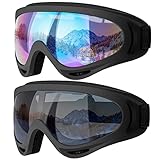
The COOLOO Ski Goggles 2-Pack is the closest direct alternative to the MAMBAOUT two-pack: two ski and snowboard goggles in men’s, women’s, and kids’ sizing with an anti-fog treated lens. It is for the same buyer — a family, a pair of beginners, or someone who wants a spare — and the choice between the two comes down to fit and colorway rather than to a specification you can argue about on paper.
Key specs:
- Pack size: Two goggles.
- Sizing: Men, women, kids.
- Lens: Anti-fog treated single lens.
- Frame: Foam-backed, adjustable strap, helmet compatible.
- Construction class: Budget.
Strengths. An anti-fog treated lens at a budget price is the main draw, and two of them means the treatment on one can fail or the lens can scratch without ending your day. Mixed-age sizing handles the common household where a parent and a child both need goggles. Like the other budget two-packs, it is designed to be used, shared, and eventually replaced, and it does that job without wasting money on features a beginner cannot use.
Pros
- Two anti-fog treated goggles at a budget price.
- Mixed-age sizing covers men, women, and kids.
- A built-in spare for fogging or scratching.
- Low-risk for beginners and occasional skiers.
Cons
- Budget foam compresses sooner than dual-layer.
- No OTG cavity.
- Single tint only.
- Not built for a high-frequency skier.
How it compares. Against the MAMBAOUT 2-Pack, the two are near-equivalents; MAMBAOUT explicitly names youth and boys and girls in its sizing, while COOLOO names men, women, and kids — check the listed size range against your face. Against the ZhouBoat 8-Pack, COOLOO is the better fit for two people and ZhouBoat for a group. Against the premium findway OTG, you are trading OTG clearance and coating quality for two goggles instead of one.
How to Choose Ski Goggles
The right goggle is not the most expensive one; it is the one whose lens, fit, and ventilation match the conditions you actually ski in. Work through the criteria below in order, because each one narrows the field before you get to brand.
Start with light transmission and contrast, not tint darkness
Visible light transmission, usually written as VLT, is the percentage of available light that passes through the lens to your eye. It is the single most important lens number and the one sellers most often omit. Broadly, the category breaks into four bands:
- Low VLT, roughly 5–20%: Very dark lenses for bright, high-altitude, high-glare days. These are what you want on a sunny spring day on reflective snow, and they are miserable in shade, at dusk, or under storm clouds.
- Mid VLT, roughly 20–40%: The all-round band. A lens here handles partly cloudy days and mixed tree-line light reasonably well, which is why most single-lens goggles sit in this range by default.
- High VLT, roughly 40–60%: For overcast, snowy, and low-light days. This is where a mid-tint lens starts to make the world look flat and gray.
- Very high VLT, roughly 60–90% and up: Near-clear lenses for heavy snowfall, night skiing, and flat light. These exist mainly so you can see anything at all.
Contrast is a separate property from transmission, and it is the reason a ChromaPop-class lens outperforms a plain tint of the same darkness. A plain tint reduces overall brightness evenly; a contrast-enhancing lens filters specific wavelengths so that the subtle differences between snow, shadow, ice, and rock become more distinct. If you ski in flat light — overcast days, storm days, late afternoons in the shade of a ridge — contrast matters more to you than darkness. If you ski bright groomers at altitude in spring, darkness matters more. A single-lens goggle forces you to pick one band for the whole season, which is exactly why interchangeable-lens goggles exist.
Match the lens to your conditions, then accept or reject the compromise
| Condition You Ski Most | VLT Band You Want | What Happens If You Get It Wrong |
|---|---|---|
| Bright sun, high altitude, spring snow | Low, roughly 5–20% | Eye strain, headache, and squinting within an hour |
| Mixed sun and cloud, tree lines | Mid, roughly 20–40% | Dark enough to be annoying in shade, bright enough to strain in full sun |
| Overcast, light snowfall | High, roughly 40–60% | Terrain reads flat; you cannot see bumps or ice until you are on them |
| Heavy snow, night skiing, deep shade | Very high, roughly 60%+ | Near-blindness in the worst light; the lens is the problem, not your eyes |
If your season spans two or more of those rows, a single-lens goggle is a compromise you are choosing on purpose. A goggle with an interchangeable lens — the SMITH Squad or the OutdoorMaster Ski Goggles PRO here — converts that compromise into a decision you make each morning. The cost is the premium price and the small risk of losing a lens.
OTG is a clearance measurement, not a marketing word
OTG means over the glasses. The only thing that matters is whether there is enough internal depth between the goggle lens and your face for the frame of your glasses to sit without the temples being pushed into your head and without your glasses lens touching the goggle lens. When those two lenses touch, the air gap disappears and both fog immediately. When the temples are squeezed inward, you get a pressure headache by lunch. A genuine OTG frame is cut deeper and wider than a standard frame — this is why the findway OTG, the OutdoorMaster OTG, and the OutdoorMaster PRO appear on this list and the budget goggles do not. If you do not wear glasses, do not pay for OTG; the extra internal volume increases fog risk slightly and does nothing for you.
Fit and face shape: the three contact points
A goggle seals at three places — the bridge of the nose, the upper cheeks, and the temples — and a gap at any one of them defeats every coating on the lens. Face shape drives which goggle fits: narrow faces need a smaller frame or the foam will gap at the temples; broad faces need a wider frame or the foam will pinch the nose shut. Kids’ goggles are not just smaller straps; they are proportioned to smaller faces, which is why the family two-packs list separate youth and kids sizing. Sizing classes to look for:
- Kids: Smallest frame and foam footprint, sized for young faces; often sold in multi-packs.
- Youth: Between kids and adult; the usual fit for roughly ages ten to mid-teens.
- Unisex adult: The default; fits most adult faces, with the widest variation between brands.
- OTG adult: An adult frame with extra internal depth; usually bulkier externally as a result.
A useful field test: put the goggle on without the strap tight and look up. If you can see light coming in around the foam at the temples or the nose, the frame is the wrong shape for you, no matter its price. Then tighten the strap only enough to hold it — over-tightening deforms the foam and creates gaps where there was a seal.
Ventilation is what prevents fog, and it works in two directions
Fog forms when warm, moist air from your face meets a cold lens surface. Goggles fight this with anti-fog coating on the inner lens, foam venting that lets warm air escape upward and out the top of the frame, and the double-wall construction that most snow goggles use so the inner lens stays warmer than the outer. What this means practically:
- Never wipe the inside of the lens. That is where the anti-fog coating lives, and a glove or sleeve removes it permanently. Tip the goggle up onto your helmet and let it air dry instead.
- Keep moving. Ventilation depends on airflow; a stationary skier fogs up on a cold day no matter what the goggle costs.
- Do not block the top vents. Pushing a goggle up onto a beanie or under a hood can obstruct the exhaust path and trap moisture.
- Dry goggles overnight, inside. A goggle left in a cold car starts the next day with moisture already inside the foam.
Helmet compatibility: buy the pair, not the goggle
A goggle is half of a system. The two numbers that matter are the helmet’s shell width and the goggle’s frame width, because the frame needs to sit flush against the helmet’s front rim. If the goggle is narrower than the helmet opening, you get a gap between the top of the frame and the helmet that channels cold air straight onto your forehead and, worse, dumps snow in when you fall. If the goggle is much wider, the strap has to fight the shell and the frame lifts at the temples. Practical guidance:
- Bring the helmet when you try goggles, or check the width spec. Frame width should roughly match the helmet’s front opening.
- Strap length should be adjustable with enough slack to fit over a helmet shell — helmet use consumes several centimeters of strap that a bare face does not.
- Wear the goggle under the helmet rim, not over it. Over the rim lifts the frame and breaks the seal.
- Skip the brim under the goggle. A cap brim between foam and forehead guarantees a gap.
Insurance, coatings, and what actually breaks first
Ski goggles are consumables, and the parts wear in a predictable order. Knowing this changes what you should spend:
| Component | Typical Life | What Kills It | Can You Fix It? |
|---|---|---|---|
| Anti-fog inner coating | 1–2 seasons of regular use | Wiping the inside with a glove, sleeve, or tissue | No — once removed, it is gone |
| Outer lens surface | 2–3 seasons | Scratches from car seats, zippers, branches, grit | Only if the goggle has a replaceable lens |
| Face foam | 2–4 seasons | Compression, sweat, sunscreen oils, shared use | No — foam replacement is rare outside premium frames |
| Strap elasticity | 3–5 seasons | UV exposure, stretching over helmets, heat | No |
| Frame | 5+ seasons | Cracks from impact or being crushed in a bag | No |
Two ownership habits preserve value. First, store goggles in a soft bag or a helmet, never loose in a duffel where a zipper can reach the lens. Second, wash the foam and strap occasionally with plain water and let them air dry — sunscreen and sweat break down foam, and foam is the part that most often ends a goggle’s life. Avoid solvent cleaners entirely; they strip coatings.
The decision matrix: match your situation to a pick
| Your Situation | Priority Spec | Pick From This List |
|---|---|---|
| Frequent skier, varied light, wants maximum clarity | Contrast lens + interchangeable lens | SMITH Squad with ChromaPop Lens |
| Wear prescription glasses, ski regularly | Genuine OTG + interchangeable lens | OutdoorMaster Ski Goggles PRO |
| Wear glasses, want one simple goggle | Genuine OTG, fixed lens, broad sizing | findway OTG or OutdoorMaster OTG |
| Occasional skier, no glasses, value-focused | Anti-fog coating, adult fit | Supertrip |
| Ride dirt bike or ATV in summer, ski in winter | Windproof sealed frame, mid-range finish | YUNGLIDE or 4-FQ |
| Off-road first, occasional snow, dusty trails | Dustproof and waterproof, budget | LOEO 2-Pack or Lievermo 2-Pack |
| Equipping a family of four or more, or a group | Pack size and cost per person | ZhouBoat 8-Pack |
| Beginner, child, or a spare pair needed now | Low cost, mixed-age sizing | MAMBAOUT 2-Pack or COOLOO 2-Pack |
Cost per use: the number that actually decides
A worked comparison makes the tiers concrete. Suppose a mid-range single goggle costs X, a premium single goggle costs roughly 2X, and a budget two-pack costs roughly X for two goggles. Now apply usage:
- Skier who goes two days a season, ten years: 20 days of use. A mid-range goggle at X is X ÷ 20 = 0.05X per day. A premium goggle at 2X is 0.1X per day. The premium goggle costs twice as much per day of use, and at this frequency the lens coating and foam will likely outlive your interest.
- Skier who goes 20 days a season, five years: 100 days of use. A premium goggle at 2X is 0.02X per day, and it will need one replacement lens in that period, which is a fraction of X. The premium goggle now costs a fifth per day of what the casual skier pays, and the replaceable-lens design means the second half of its life is cheaper than the first.
- Family of four, one trip a year: Four people need four goggles. Four mid-range goggles is 4X. Two budget two-packs is roughly 2X total, and the second goggle in each pack is a spare. The group math favors multi-packs decisively for one-off use.
The pattern: premium goggles pay off with frequency and with light variability, and multi-packs win with headcount. The worst-value purchase is a premium goggle for a two-day-a-year skier, and the second worst is a budget single goggle for someone who skis forty days — they will buy twice.
Beginner versus advanced: what changes
Beginners need three things: a sealed foam fit, a mid-range tint that works on typical days, and low cost, because goggle damage in the first season is near-certain. The MAMBAOUT and COOLOO two-packs cover that. Intermediate skiers who start skiing in more conditions and more terrain benefit most from the jump to a contrast lens or a lens-swap system, which is where the SMITH Squad and OutdoorMaster PRO fit. Advanced skiers and people who ski storm days and tree runs should prioritize contrast and lens flexibility above everything else, because the difference between seeing a bump line and not seeing it is the difference between a run and a fall. Racers and speed-focused riders add a fourth requirement — a stiff frame that holds its seal at speed — which the crossover goggles handle well, though they give up snow-specific foam to do it.
Common buying mistakes
- Buying darkness instead of contrast. A very dark lens is the wrong answer to flat light — it makes an already low-contrast world darker.
- Assuming any large goggle is OTG. Internal depth is the specification, not frame size.
- Ignoring the helmet until later. A goggle that fits alone can gap badly under a helmet rim.
- Wiping the inside of the lens. The fastest way to destroy the one feature you paid for.
- Storing goggles loose in a bag. Scratched lenses, not crashes, are the usual cause of replacement.
- Buying premium for a child who will outgrow it. Multi-pack sizing is the better spend for a growing skier.
Frequently Asked Questions
What is the difference between OTG and regular ski goggles?
OTG stands for over the glasses and refers to a frame with extra internal depth so prescription glasses fit inside without touching the goggle lens or pressing on your temples. A regular goggle has a shallower cavity and will usually push glasses into your face and cause both lenses to fog. OTG frames are typically a little larger and bulkier externally as a result of that extra depth.
Do I need a different lens for sunny and cloudy days?
Ideally yes, because bright sun needs a low visible light transmission lens and flat light needs a high one, and a single tint cannot do both well. If you ski a handful of days a year and cannot justify two lenses, choose a mid-range tint and accept that bright days will feel harsh and gray days will look flat. A goggle with an interchangeable lens, such as the SMITH Squad or OutdoorMaster PRO, lets you have both.
How do I stop my ski goggles from fogging?
Fog forms when warm moist air from your face meets a cold lens, so the fixes are about airflow and moisture. Keep moving so the vents work, never wipe the inside of the lens because that removes the anti-fog coating, dry the goggle indoors overnight, and avoid blocking the top vents with a hood or hat. If your goggles fog constantly despite all of that, the foam seal is probably compressed and the goggle needs replacing.
Are the cheap two-pack goggles worth it?
For beginners, children, occasional skiers, and group trips, yes — two basic goggles usually cost about the same as one mid-range goggle, and the second pair is a spare for when the first fogs or scratches. What you give up is coating quality, foam durability, and any lens contrast. A frequent skier who buys a budget goggle will typically replace it within a season or two, which erases the saving.
Can I wear my everyday glasses under ski goggles?
Only under an OTG goggle, and even then you should check the fit. The glasses frame must sit without pressure on your temples and the glasses lens must not touch the goggle lens, because contact eliminates the insulating air gap and both surfaces fog immediately. If you wear glasses often on the mountain, contact lenses or prescription inserts designed for goggles are worth considering; discuss options with your eye care professional.
How do I know if goggles will fit my helmet?
The goggle frame width should roughly match the front opening of your helmet, so the foam seals flush against the rim with no gap at the top. Wear the goggles under the helmet rim rather than over it, make sure the strap has enough adjustment to fit over the shell, and bring the helmet with you if you can try goggles in person. A gap between the frame and the helmet rim is the most common and most uncomfortable compatibility failure.
How long should a pair of ski goggles last?
Plan on the anti-fog inner coating being the weak point, typically one to two seasons of regular use if you treat it well and much less if you wipe the inside. The outer lens surface usually lasts two to three seasons before scratches become annoying, and the foam lasts two to four. If your goggle has a replaceable lens, you can extend its life significantly by buying a new lens rather than a whole new goggle.
What does visible light transmission actually mean?
Visible light transmission, or VLT, is the percentage of available light that reaches your eye through the lens. A 10% VLT lens passes a tenth of the light and suits bright, glare-heavy days; a 60% VLT lens suits overcast and snowy conditions. It is separate from contrast, which describes how well a lens separates similar tones, such as snow from shadow, and it is the property that matters most in flat light.
The Short Answer, by Situation
If you ski often and want the best optics in this roundup, buy the SMITH Squad with ChromaPop Lens and treat the replaceable lens as the reason. If you wear prescription glasses and want flexibility, take the OutdoorMaster Ski Goggles PRO; if you wear glasses and want the simplest possible option, the findway OTG is the cleaner generalist. If you do not wear glasses, ski occasionally, and want a solid everyday goggle without a premium premium, the Supertrip is the value pick. If you ride a dirt bike or ATV in summer and ski in winter, the YUNGLIDE or 4-FQ covers both sports with one frame, and if dusty trails are your main surface, the LOEO 2-Pack is the better budget crossover. If you are equipping a family or a group, the ZhouBoat 8-Pack wins on cost per person outright, and for two beginners or two children the MAMBAOUT 2-Pack or COOLOO 2-Pack gets everyone on the mountain for the price of roughly one mid-range goggle. Whichever you choose, match the lens to your usual light, make sure the foam seals at nose, cheeks, and temples, and keep your helmet in mind before you buy.