Key takeaways
- Rail type: Most modern crossbows use a Picatinny or Weaver-style top rail, but the included rings may not fit every rail.
- Ring height: Medium-height rings commonly work, but the scope must clear the barrel, cocking mechanism, and rail accessories.
- Tube diameter: Verify whether the scope uses 1-inch or 30 mm rings. These sizes are not interchangeable.
- Rail length: A long variable scope may not allow enough fore-and-aft adjustment on a short crossbow rail.
- Speed calibration: Match the reticle’s specified speed range to the actual velocity of your setup.
- Manufacturer restrictions: Some crossbow makers recommend particular scopes or prohibit accessories that interfere with the warranty or cocking system.
The best crossbow scopes for most hunters are illuminated 1.5–5×32 models with a speed-calibrated reticle, generous eye relief, and enough shock resistance for repeated 400–500-grain arrow launches; the Hawke XB30 Pro 1.5–5×32 is the strongest all-around optical choice, while the TenPoint EVO-X Marksman scope is a practical pick when its reticle matches your crossbow’s advertised speed.
Our top picks
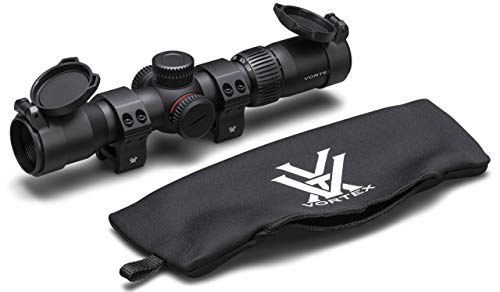


As an Amazon Associate we earn from qualifying purchases at no extra cost to you. Ratings are shown as listed on Amazon.
Best Crossbow Scopes at a Glance
| Scope or scope type | Best for | Magnification | Objective | Reticle and illumination | Typical market range |
|---|---|---|---|---|---|
| Hawke XB30 Pro 1.5–5×32 | All-around hunting and target work | 1.5–5x | 32 mm | Speed-calibrated SR reticle; illuminated options | $250–$350 |
| TenPoint EVO-X Marksman | TenPoint crossbows using a compatible speed setting | Fixed or variable, depending on version | Typically 32 mm | Illuminated multi-line reticle | $100–$250 |
| UTG 4×32 crossbow scope | Budget hunting and recreational targets | 4x | 32 mm | Range-compensating reticle; illuminated models available | $70–$130 |
| Garmin Xero X1i | Frequent shooters wanting electronic ranging and aiming | Digital aiming display | Digital optical system | Selectable aiming points with built-in rangefinder | $1,000–$1,300 |
| Basic fixed 4×32 scope | Low cost and simple setups | 4x | 32 mm | Duplex or multi-line reticle | $40–$90 |
Specifications can vary by production year and package, especially for included rings, illumination colors, and speed-calibration ranges. Confirm the exact model before ordering.
Which Reticle Style Is Best?
Speed-calibrated multi-line reticles
A multi-line crossbow reticle places aiming marks below the central crosshair for different distances. It is quick in the field because you can use the appropriate mark without dialing elevation. The limitation is that the marks are only accurate when the scope’s calibration speed is close to the actual bolt speed.
For example, a reticle calibrated at 350 feet per second may not place its lower marks correctly on a crossbow launching a 400-grain bolt at 400 feet per second. A chronograph reading, rather than the manufacturer’s maximum speed claim, gives the better starting point.
Illuminated reticles
Red or green illumination can make fine aiming marks easier to see against a dark target or shaded woods. It does not create light or improve a poor image. At dawn and dusk, the lowest usable brightness is usually preferable; excessive brightness can obscure the target and reduce your eye’s adaptation to low light.
Duplex and simple crosshairs
A duplex reticle is uncluttered and works well for target practice at a known distance, but it requires you to compensate for trajectory using holdover or turret adjustments. Choose it when simplicity matters more than rapid range changes.
Digital aiming systems
The Garmin Xero X1i combines a digital display with a built-in rangefinder and selectable aiming points. It can remove much of the guesswork at changing distances, but it costs several times more than a conventional scope and depends on batteries and electronics. It is most compelling for frequent shooters, range work, and hunters who value speed over minimal weight and simplicity.
Magnification, Eye Relief, and Practical Range
Most crossbow hunting shots occur inside 40 yards, where 1.5x to 3x is generally sufficient. Four power is useful for inspecting groups and aiming at small targets at 40–60 yards, but higher magnification also narrows the field of view and makes it harder to find a moving animal quickly.
Variable 1.5–5x scopes offer a useful compromise: keep the scope near 1.5x for close hunting shots, then increase magnification for target practice. A fixed 4x scope is lighter, less expensive, and mechanically simple, but it gives you less flexibility in thick cover.
Eye relief matters because a crossbow scope must be positioned far enough from your face to provide a full image without forcing an awkward head position. A practical target is approximately 3–4 inches of usable eye relief. Check the manufacturer’s specification and mount the scope so your normal cheek position produces a full, circular sight picture.
Magnification cannot compensate for trajectory uncertainty. A scope may show a crisp target at 60 yards, but wind, bolt weight, string condition, and shooter error make that distance substantially less forgiving. Zero and confirm every aiming mark at the range where you intend to use it.
Durability and Weather Resistance
Crossbows produce a sharp forward-and-back impulse that can loosen mounts, damage weak internal assemblies, or shift zero over time. Look for an aluminum scope tube, sealed optics, nitrogen or similar fog resistance, and explicit shockproof construction. Water resistance is useful in rain, but “water resistant” does not mean safe to submerge.
The first parts to show ownership wear are often the battery cap, illumination switch, turret covers, mounting screws, and lens coatings. Keep a spare illumination battery in your kit, but do not leave the battery installed for years in a scope stored in a hot vehicle. Moisture trapped beneath a lens cap can also promote fogging or corrosion.
After a wet hunt, remove the scope covers, wipe the exterior with a clean microfiber cloth, and allow the scope and crossbow to dry indoors. Do not use household glass cleaner on optical coatings. Blow away grit before wiping, since dry particles can scratch the lenses.
Mounting Compatibility: What to Check Before Buying
- Rail type: Most modern crossbows use a Picatinny or Weaver-style top rail, but the included rings may not fit every rail.
- Ring height: Medium-height rings commonly work, but the scope must clear the barrel, cocking mechanism, and rail accessories.
- Tube diameter: Verify whether the scope uses 1-inch or 30 mm rings. These sizes are not interchangeable.
- Rail length: A long variable scope may not allow enough fore-and-aft adjustment on a short crossbow rail.
- Speed calibration: Match the reticle’s specified speed range to the actual velocity of your setup.
- Manufacturer restrictions: Some crossbow makers recommend particular scopes or prohibit accessories that interfere with the warranty or cocking system.
Mount the scope with the crossbow unloaded and uncocked. Tighten ring screws evenly in an alternating pattern, using the manufacturer’s torque recommendation rather than guessing with excessive force.
Decision Matrix by Shooter and Situation
| Your situation | Best fit | Why | Main compromise |
|---|---|---|---|
| New shooter, occasional use, under $100 | Basic fixed 4×32 scope | Simple, light, and inexpensive to replace | Less flexibility and often less refined illumination |
| Regular hunting from 20–50 yards | Illuminated 1.5–5×32 | Useful field of view at low power and detail at higher power | Higher cost and more moving parts |
| Crossbow already matched to TenPoint accessories | TenPoint EVO-X Marksman | Convenient reticle and package compatibility | Calibration may not suit another brand or bolt weight |
| Frequent range practice and changing distances | Garmin Xero X1i | Integrated ranging and electronic aiming points | High price, greater weight, and battery dependence |
| Target shooting at known distances | Fixed 4x or quality 1.5–5x scope | Clear aiming picture without unnecessary complexity | Manual range and elevation management |
How to Zero a Multi-Line Crossbow Scope
- Use the same bolts and broadhead or field-point weight that you will use later. A different weight changes velocity and point of impact.
- Begin at 20 yards with the crossbow supported and the manufacturer’s primary aiming mark. Make small windage and elevation adjustments.
- Confirm at 30 and 40 yards. Record where each lower reticle mark actually hits instead of assuming the printed yardages are exact.
- Check the longest intended distance separately. Do not infer 50-yard accuracy from a perfect 20-yard zero.
- Recheck after transport and after several dozen shots. If the group moves, inspect ring screws, rail fasteners, the string, cables, and contact points before adjusting the scope again.
For a useful ownership calculation, consider a scope costing $200 and used for 10 range sessions each year over five years. At 50 sessions, the optical cost is about $4 per session before batteries or replacement rings. A cheaper scope that repeatedly loses zero can cost more in lost bolts, range time, and frustration than a better-sealed model purchased once.
Final Buying Recommendation
Choose the Hawke XB30 Pro 1.5–5×32 when you want one scope for hunting and target accuracy, especially if you can verify its reticle calibration against your actual bolt speed. Choose the TenPoint EVO-X Marksman when it is supplied or recommended for a compatible TenPoint setup. A fixed 4×32 scope remains the sensible budget choice for short-range practice, while the Garmin Xero X1i is the premium solution for shooters who will use electronic ranging often enough to justify its price and complexity.
Whatever you buy, prioritize correct mounting, usable eye relief, verified reticle calibration, and repeatable zero over maximum magnification. Those factors have a larger effect on practical crossbow accuracy than a high power number printed on the scope.