Key takeaways
- Compare the best youth batting helmets, from T-ball sizes to junior models with jaw guards, plus how to measure a head and check NOCSAE markings.
The Easton Z50 with the multi-adjust jaw guard in Small/Medium is the best overall youth batting helmet in this group for most players who are facing live pitching, because it combines a hard ABS shell, a size range that covers many growing heads and a jaw guard that mounts for either left- or right-handed hitters. The youngest players are better served by a T-ball size such as the Easton ALPHA or the Rawlings COOLFLO T-Ball. A batting helmet is protective headgear that should meet the NOCSAE standard for baseball and softball, and fit matters as much as brand: a helmet that slides or sits too high protects far less than the same helmet sized correctly.
Quick List
- Rawlings COOLFLO One Size (6 1/2 to 7 1/2) – best for a larger-headed or older youth player who needs an adult-range one-size helmet
- Easton ALPHA T-Ball/Small – best for the youngest hitters who need a small, light helmet
- Rawlings COOLFLO T-Ball (black) – best for a vented, familiar T-ball helmet
- Rawlings COOLFLO T-Ball (pink) – best for the same T-ball fit with a bright color
- Easton MOJO Junior – best for a straightforward junior-size helmet with a team-ready look
- Easton Z50 with Multi-Adjust Jaw Guard (S/M) – best for older youth players facing live pitching
Which One Is Right for You?
| If you… | Choose |
|---|---|
| Have a player facing live pitching and want a jaw guard | Easton Z50 with Multi-Adjust Jaw Guard |
| Need a junior helmet with a straightforward shell and no extras | Easton MOJO Junior |
| Have a small T-ball player and may add a mask later | Easton ALPHA T-Ball/Small |
| Want a vented T-ball helmet in a classic style | Rawlings COOLFLO T-Ball (black) |
| Want the same T-ball helmet in a color a child will enjoy wearing | Rawlings COOLFLO T-Ball (pink) |
| Have a youth player with a larger head or a quick growth spurt coming | Rawlings COOLFLO One Size |
Measure the head first, pick the size band second and the brand third. T-ball sizes generally top out near 6 7/8 hat size, junior sizes start around 6 1/2, and a one-size helmet that spans 6 1/2 to 7 1/2 is really aimed at older and larger wearers. If a child sits near a size boundary, try both rather than guessing.
Team context matters too. A coach who is buying for a whole roster should lean toward a double-ear style or a helmet with a reversible jaw guard, since those avoid the need to separate right- and left-handed sets. A parent buying for a single child can be more selective, choosing the exact size band and a color the child likes. Either way, inspect the helmet on arrival, check the certification marking, and try it on before the first practice so that any sizing problem is caught before the season begins.
All 6 Picks in Detail
1. Rawlings COOLFLO One Size (6 1/2 to 7 1/2) – Best for older or larger-headed youth, runner-up for small players
As an Amazon Associate we earn from qualifying purchases at no extra cost to you.
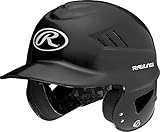
This is the standard adult-range COOLFLO helmet, sold as one size fits most for 6 1/2 to 7 1/2. For the youngest players it is simply too big, which is why it sits last on the list. For an older youth with a larger head, or for a family who wants a helmet that will keep fitting through a growth spurt, it can be a practical choice, but a helmet that is too loose can shift on impact, so check fit carefully. Rawlings states the helmet meets the NOCSAE standard and is pre-drilled for face guards.
- One size fits most, hat sizes 6 1/2 to 7 1/2
- Molded shell with fifteen air vents per the maker
- Pre-drilled for face guards
- Black one-tone finish
- Not a T-ball size; confirm on listing
Pros
- Wide size range for growing or larger-headed players
- Simple, durable design
Cons
- Too large for small children
- One-size designs can fit loosely at the lower end of the range
For smaller heads, step down to the Easton MOJO Junior or the T-ball models.
2. Easton ALPHA T-Ball/Small – Best for the youngest hitters

The ALPHA in T-Ball/Small covers hat sizes 6 1/4 to 6 7/8, which is the range most T-ball and early coach-pitch players fall into. Easton lists an ABS thermoplastic shell, a dual-density foam liner, a BioDri moisture-wicking liner and a removable forehead sticker for team customization. It is certified to the NOCSAE standard for baseball and softball batters’ helmets, and the unpainted gloss finish is compatible with Easton’s universal masks and jaw guards if a league requires one. This is a smaller, lighter helmet than the junior and S/M picks above.
- T-Ball/Small, hat sizes 6 1/4 to 6 7/8
- ABS shell, dual-density foam liner
- BioDri moisture-wicking liner
- Compatible with Easton universal mask and jaw guard accessories
- Black gloss finish
Pros
- Right-sized for small heads
- Mask-ready if the league requires one later
Cons
- Outgrown quickly as the child gets bigger
- Accessories are sold separately
Next to the Rawlings COOLFLO T-Ball, the ALPHA offers an accessory path and a cooler-running liner; the Rawlings is the more vented, double-ear style.
3. Rawlings COOLFLO T-Ball (Black) – Best for a vented T-ball helmet
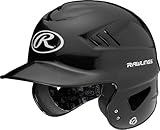
The T-Ball COOLFLO is Rawlings’s small helmet, sized 6 1/4 to 6 7/8. Rawlings describes a double-ear design, dual-density foam, pre-drilled holes for face guards and a chin strap snap, plus fifteen air vents. The shell is a molded plastic with a one-tone finish, and the manufacturer says it meets the NOCSAE standard. It is a long-running design, so you may see it on many youth teams.
- T-Ball size, hat sizes 6 1/4 to 6 7/8
- Double-ear protection design
- Roughly 15 vents for airflow per the maker
- Pre-drilled for face guard attachment
- Black one-tone finish
Pros
- Good ventilation for hot practices
- Plain black matches almost any uniform
Cons
- Face guard is sold separately
- Less adjustability than newer helmet designs
The pink version below is the same fit; the black is the safe team-wide choice, while the Easton ALPHA offers a smoother shell and customizable sticker.
4. Rawlings COOLFLO T-Ball (Pink) – Best for the same fit in a color kids love
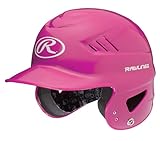
This is the same T-Ball COOLFLO helmet in pink, sized 6 1/4 to 6 7/8. Everything about construction and sizing mirrors the black version, so choose it for the color and nothing else. Younger players often take better care of equipment they like, and a bright color also makes the helmet easy to spot in a pile of gear. Confirm any league rules about helmet color or matching teammates before you buy.
- T-Ball size, hat sizes 6 1/4 to 6 7/8
- Double-ear design, dual-density foam, vented shell per maker
- Pre-drilled for face guard
- Pink molded finish
- Same fit as the black version
Pros
- Easy to identify on a crowded bench
- Same proven fit as the black helmet
Cons
- Color may not match team rules or uniforms
- Same limited adjustment as other COOLFLO T-ball helmets
Choose it over the black version only for the color; otherwise the two are functionally identical.
5. Easton MOJO Junior – Best for a straightforward junior-size helmet

The MOJO Junior is a baseball batting helmet sized 6 1/2 to 7 1/8 with an ABS thermoplastic shell, a dual-density foam liner and a moisture-wicking BioDri liner according to retail descriptions. The listing says USA, which appears to refer to the color or finish pattern, so confirm what that means before ordering for a team. The line is described as an upgrade of Easton’s older Z5 helmet, and the signature pattern gives it a clean team look. Whether this exact listing includes a jaw guard is not stated in its name, so confirm on listing.
- Junior size, hat sizes 6 1/2 to 7 1/8
- ABS shell with dual-density foam
- BioDri liner and wrapped ear pads, per product descriptions
- Meets the NOCSAE standard for all levels of play per the maker
- Jaw guard inclusion not stated; confirm on listing
Pros
- Familiar Easton construction in a junior size
- Simple design that suits most leagues
Cons
- Listing details are less specific than the Z50
- Pattern or color may not suit every team uniform
If a jaw guard is a must, go to the Z50; if you want less hardware, the MOJO is the cleaner choice.
6. Easton Z50 with Multi-Adjust Jaw Guard (S/M) – Best for older youth hitters facing live pitching

The Z50 is a modern Easton helmet with a matte finish in charcoal, shown here in Small/Medium for hat sizes 6 1/2 to 7 1/8. The multi-adjust jaw guard is pre-assembled and can mount on either side, so one helmet works for right- and left-handed batters. Easton lists the helmet as meeting the NOCSAE standard for all levels of play, with an ABS shell, a dual-density liner and slatted top vents for airflow. The listing says baseball, so confirm the manufacturer’s softball compatibility before using it in softball.
- Small/Medium size, hat sizes 6 1/2 to 7 1/8
- High-impact ABS shell with dual-density foam liner
- Pre-assembled jaw guard that adjusts and mounts on either side
- Top vent slots and moisture-wicking fabric liner
- NOCSAE standard per the manufacturer; confirm on listing
Pros
- Includes jaw protection that is ready to use
- One helmet covers a wide youth size range
Cons
- Larger and heavier feeling than a small T-ball helmet
- Check league rules on jaw guards and softball use
Against the Easton MOJO, the Z50 adds the jaw guard; the MOJO is the more minimal choice for players who do not need one.
Specs Compared
| Helmet | Size band | Shell / liner | Jaw guard / mask | Finish |
|---|---|---|---|---|
| Rawlings COOLFLO One Size | 6 1/2 to 7 1/2 | Molded shell, foam; confirm on listing | Pre-drilled for face guard; sold separately | Black |
| Easton ALPHA T-Ball/Small | 6 1/4 to 6 7/8 | ABS, dual-density foam | Accessory-compatible; sold separately | Gloss black |
| Rawlings COOLFLO T-Ball (Black) | 6 1/4 to 6 7/8 | Molded shell, dual-density foam | Pre-drilled for face guard; sold separately | Black |
| Rawlings COOLFLO T-Ball (Pink) | 6 1/4 to 6 7/8 | Molded shell, dual-density foam | Pre-drilled for face guard; sold separately | Pink |
| Easton MOJO Junior | 6 1/2 to 7 1/8 | ABS, dual-density foam | Confirm on listing | Patterned; confirm on listing |
| Easton Z50 S/M | 6 1/2 to 7 1/8 | ABS, dual-density foam | Multi-adjust jaw guard included | Matte charcoal |
How We Chose These
These recommendations come from research, not from wearing the helmets on a field. We started with the six helmets in the current catalog set and read each listing name, along with manufacturer product pages and retailer specification fields, to see what was stated about size band, shell and liner, certification and accessories. Fit and certification mattered most, followed by whether a jaw guard is included, how clearly the listing states its dimensions, and how easy it is to match a helmet to a child’s age and head size. Where a listing does not state a detail, we say to confirm it. The one-size Rawlings is labeled as a runner-up for small players because its size range is aimed at larger heads.
What to Look For
Check for the NOCSAE standard first
Baseball and softball batting helmets sold in the United States are made to meet a standard set by the National Operating Committee on Standards for Athletic Equipment (NOCSAE), and most youth leagues require a helmet marked as meeting it. Look for the NOCSAE statement on the helmet itself or on the manufacturer page. A helmet with no visible certification, damaged markings or a cracked shell should not be used in play. Never rely on the box alone; the permanent marking on the helmet is the proof.
Measure the head and use the size chart
Use a soft tape measure around the head about an inch above the eyebrows, over the widest part at the back. Convert to hat size by dividing the circumference in inches by about 3.14. A worked example: a head measuring 21 inches around divides to roughly 6 11/16, which lands in the T-ball/small band of 6 1/4 to 6 7/8 and just below the junior band. A 22-inch head works out to a hat size near 7, which fits the junior band of 6 1/2 to 7 1/8 and also the one-size range. If a child is on the border, a helmet with an adjustment system or a slightly larger band may last longer, but it should never wobble.
Fit, pad placement and stability
A correctly fitted helmet sits level on the head with the front edge about an inch above the eyebrows. The padding should touch all around the head with firm but comfortable pressure, and the helmet should not rotate or slide when the child shakes their head. A loose helmet can slip over the eyes or expose the temple. Do not stack extra padding or a hat under the helmet unless the manufacturer says to, because it changes how the shell sits.
Jaw guards, masks and league rules
Some leagues require a face guard or jaw guard, especially in younger divisions and in softball. Helmets like the Z50 come with a jaw guard installed, while the COOLFLO and ALPHA are designed to accept accessories sold separately. Make sure any add-on is rated for the specific helmet, and follow the manufacturer’s installation instructions. Do not drill, glue or modify a shell, which can weaken it.
Match the helmet to the level of play
The needs of a T-ball player are not the needs of a twelve-year-old facing a fast pitcher. In T-ball and early coach-pitch, the ball is stationary or slow, the bigger risks are a swung bat and a dropped ball, and the priority is a small, light helmet that stays put on a small head. Once pitchers throw harder and with less control, a jaw guard or face guard becomes a sensible addition, and the shell should cover the temple and ear area fully. For that reason, many families move from a T-ball helmet to a junior helmet with a jaw guard in a single step, skipping the middle sizes.
Right-handed, left-handed and switch hitters
A traditional batting helmet has an ear flap on one side only, so the helmet is built for right-handed or left-handed hitters. Double-ear designs such as the COOLFLO T-Ball cover both sides, which is why they are popular with beginners and with players who might switch sides. When a helmet has a jaw guard that mounts on either side, like the Z50, the same helmet serves both hands, which is handy when siblings share equipment or a coach manages a pool of team helmets. Check that the jaw guard is properly aligned to the side that faces the pitcher before every game.
Ventilation and comfort in the heat
Young players often wear helmets for long stretches in hot weather, and a poorly vented helmet can be an unpleasant distraction. Vent openings in the shell move air across the scalp, while moisture-wicking liners help manage sweat. More vents do not automatically mean better protection or worse protection; certified helmets meet the same impact standard regardless of venting. Choose the helmet that your child will actually keep on, and make sure the padding is clean and dry before each use.
Think about growth and hand-me-downs
Children’s heads grow more slowly than their feet, but a growth spurt can change the fit by a full size band in a single season. A helmet that fits well now but sits at the top of its size range will not last, while a helmet that is a little loose is unsafe from day one. If you are passing a helmet down, inspect it for cracks, deep scratches, worn pads or missing hardware, and clean the liner. Many leagues keep a team pool of helmets for this reason, and sharing a pool is usually fine as long as every helmet fits the player who is wearing it and carries the proper certification.
Care, stickers and replacement
Store helmets away from direct heat, such as a car trunk in summer, and keep them out of hot sun, which can degrade plastics and foam. Clean with mild soap and water, and avoid solvents or harsh paints. Follow the maker’s guidance on decals and stickers. Replace a helmet after any hard impact, visible crack or deep dent, even if the damage looks small. Certification periods vary, so check the manufacturer’s recommended service life.
Questions
What size batting helmet does my child need?
Measure the head just above the eyebrows, divide the circumference by about 3.14 to get a hat size, then match it to the helmet’s size band. If your child is on the border between two sizes, try both and choose the one that stays level without shifting.
Do youth batting helmets need a jaw guard?
Requirements vary by league and age group, so check your league rules before you buy. A jaw guard adds coverage for the cheek and jaw and is common in older youth divisions.
Can I use a baseball helmet for softball?
Not automatically. Some helmets are certified for both, but softball often requires a face guard or a specific certification, so confirm the manufacturer’s statement and your league’s rules.
How long does a batting helmet last?
There is no universal lifespan. Replace it after any serious impact, visible damage or when the padding no longer holds firmly, and follow the manufacturer’s service-life guidance.
Is a one-size helmet a good idea for a child?
It can be for older or larger-headed players, but a wide range sometimes means a looser fit at the low end. For small children, choose a T-ball or junior size designed for their head.
Are colors and stickers safe to change?
Team stickers are generally fine if the maker allows them, but paints, solvents and adhesives can weaken plastic. When in doubt, follow the manufacturer’s instructions.
Update History
- October 20, 2026 – Initial publication; product set drawn from current catalog listings.
- Check the product page for current specifications and availability before buying.
Sources
- Manufacturer product and specification pages for Easton and Rawlings
- Retailer listing titles and specification fields for the six listed helmets
- NOCSAE standard statements as cited on manufacturer and retailer product pages