Key takeaways
- Center lock bar: A single vertical bar locks all drawers with one key turn. Found on Milwaukee, US General, and most value carts. Simple and effective, but if the bar bends, all drawers jam.
- Tubular / cylinder lock with detents: Each drawer has its own latch plus a central lock. Snap-on and Beta use this. It prevents drawers from opening during movement even when unlocked, which is critical if you roll the cart across a shop all day.
- Electronic / combination lock: Offered on some Beta and Hazet models. No key to lose, but adds complexity and battery dependency. Best for shared shops where multiple users need access.
The best mobile tool trolleys with locking drawers for most garages and professional workshops are the Milwaukee 40-Inch Steel Tool Cart for heavy-duty use, the US General Series 3 5-Drawer Roller Cart for best value, and the Snap-on KRA Series Roll Cart for lifetime professional reliability, with the right choice depending on your weight requirements, drawer layout, and how often you need to move the trolley under load.
Our top picks

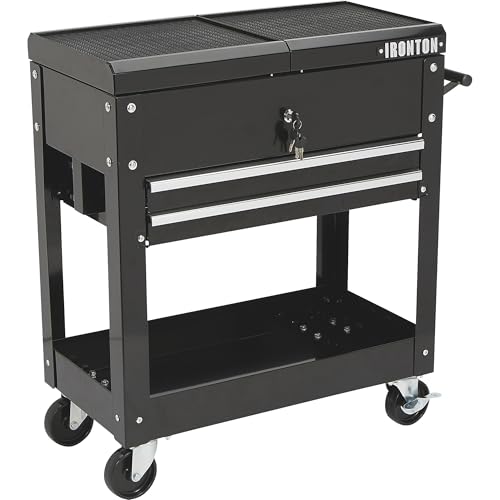

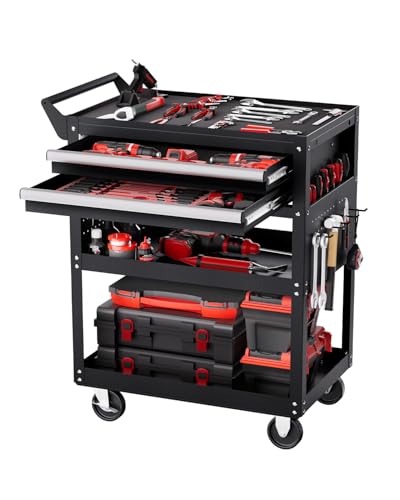
As an Amazon Associate we earn from qualifying purchases at no extra cost to you. Ratings are shown as listed on Amazon.
Top Mobile Tool Trolleys Compared: Specs That Matter
Locking drawers are not all equal. A cheap trolley may advertise 5 drawers but only give you 2 inches of usable depth, while a professional cart uses thicker steel and full-extension ball-bearing slides rated for 100+ lbs per drawer. Use this comparison to see what you actually get for your money in 2026.
| Model | Drawers / Layout | Steel Thickness | Per-Drawer Capacity | Total Load Capacity | Casters | Locking System |
|---|---|---|---|---|---|---|
| Snap-on KRA2422 Roll Cart (7-Drawer) | 7 drawers: 1x 3.5″, 4x 2.2″, 2x 4.8″ deep | 18-20 gauge double-wall | 120 lbs (ball-bearing slides) | 2,400 lbs | 5″ x 2″ mag wheel, 2 swivel with brake, 2 rigid | Tubular keyed lock, all drawers + detent latches |
| Milwaukee 40″ High Capacity Steel Tool Cart | 4 drawers + deep bottom bin: 3x 3″, 1x 5.5″ | 16-18 gauge reinforced frame | 100 lbs soft-close slides | 1,200 lbs | 5″ industrial polyurethane, 2 locking swivel | Keyed center lock bar |
| US General Series 3 5-Drawer Roller Cart | 5 drawers: 1x 3.6″, 3x 2.4″, 1x 8.5″ deep | 19-20 gauge single-wall | 75 lbs | 1,000 lbs | 5″ x 1.5″ polypropylene, 2 swivel with brake | Keyed internal lock bar |
| Craftsman 2000 Series 5-Drawer Rolling Cart | 5 drawers: 2x 2.5″, 2x 3″, 1x 7″ deep | 20 gauge | 50-75 lbs (depending on drawer) | 800 lbs | 4″ x 1.2″ casters, 2 locking swivel | Keyed center lock + drawer latches |
| Teng Tools TCW807N 7-Drawer Roller Cabinet | 7 drawers: 5x 2.9″, 2x 5.1″ deep | 18 gauge | 65 lbs (Teng slide system) | 1,100 lbs | 5″ x 1.6″ rubber, 2 with total-lock brakes | Central cylinder lock, all drawers |
| Beta RSC24/7 Mobile Roller Cab | 7 drawers: 5x 2.7″, 2x 4.9″ deep | 18 gauge reinforced | 88 lbs | 1,800 lbs | 4.9″ oil-proof rubber, 2 swivel with brake | Keyed front lock with drawer safety locks |
General market range in 2026: value carts like US General and Craftsman typically fall between $300-$550, mid-range like Teng Tools and Beta between $650-$1,100, and premium like Milwaukee and Snap-on from $1,200 to over $3,500 depending on configuration and dealer.
How to Judge a Locking Tool Trolley Before You Buy
1. Drawer Capacity and Usable Space
Advertised drawer count means little without internal dimensions. Look for full-extension slides that let you access the back 4-6 inches of the drawer. For automotive work, you want at least one 4-inch+ deep drawer for power tools and torque wrenches, and several 2-3 inch drawers for sockets and ratchets. Measure your longest tool first. A 26-inch wide cart holds most socket rails and wrench sets without overhang, while a 40-inch cart is needed if you store pry bars, levels, or cordless impacts with batteries attached.
Weight limit per drawer is more important than total capacity. A trolley rated for 1,000 lbs total but only 50 lbs per drawer will sag and bind if you load the top drawers with sockets. Professional carts use 100 lb+ rated ball-bearing slides that stay smooth when fully loaded. Friction slides found on budget trolleys will stick and bend under half that weight.
2. Steel Thickness and Build Quality
Steel is measured in gauge – lower number means thicker steel. 16-gauge is commercial truck-box thick, 18-gauge is professional workshop grade, and 20-gauge is light garage use. Double-wall construction on the sides and drawer fronts prevents flexing when you lean on the cart or load it unevenly. Check the welds: continuous spot welds and reinforced corners indicate a cart that will not rack when pushed over thresholds. A single-wall 20-gauge cart can be 15-20 lbs lighter but will dent easily if a car door hits it.
3. Caster Quality and Maneuverability
Casters determine whether a loaded trolley is easy to push or a chore. For a garage with smooth epoxy, 4-inch casters are adequate. For a workshop with cracked concrete, expansion joints, or air hoses on the floor, you need 5-inch or larger casters with a wider wheel. Polyurethane and rubber wheels are quieter and roll over debris better than hard polypropylene, but they cost more.
Look for two locking swivel casters and two rigid casters as a minimum. Total-lock brakes that lock both wheel rotation and swivel are safer than simple wheel brakes when working on an incline. Load rating per caster should be at least 300 lbs for a fully loaded cart. Sealed bearings will not clog with metal dust and grinding debris.
4. Locking Systems
There are three common systems:
- Center lock bar: A single vertical bar locks all drawers with one key turn. Found on Milwaukee, US General, and most value carts. Simple and effective, but if the bar bends, all drawers jam.
- Tubular / cylinder lock with detents: Each drawer has its own latch plus a central lock. Snap-on and Beta use this. It prevents drawers from opening during movement even when unlocked, which is critical if you roll the cart across a shop all day.
- Electronic / combination lock: Offered on some Beta and Hazet models. No key to lose, but adds complexity and battery dependency. Best for shared shops where multiple users need access.
For garages where theft is a concern, a tubular lock with a hardened cylinder is harder to pick than a standard wafer lock. For professional shops, auto-closing detents that keep drawers shut when you slam the cart closed matter more than absolute theft resistance.
5. Weight Limits and Stability
Never load a trolley beyond 70-80% of its rated total capacity if you plan to move it. Top-heavy loading makes narrow carts tip when a drawer is fully extended. A 27-inch wide cart with 7 drawers should have the heaviest tools in the bottom two drawers. If your total tool weight exceeds 600 lbs, choose a cart rated for at least 1,200 lbs to keep caster and slide life reasonable.
Which Trolley Fits Your Situation?
Use this matrix to match your use case to the right spec level rather than just price.
| Your Situation | Priority | Best Match Type | Why |
|---|---|---|---|
| Home garage, 2-3 days/week, <300 lbs of tools | Value and footprint | Craftsman 2000 Series or US General Series 3 | 5 drawers, 800-1,000 lbs total capacity is plenty, 4″ casters fine for smooth floors |
| Mobile mechanic or shared workshop, daily rolling | Maneuverability and durability | Milwaukee 40″ Cart or Beta RSC24 | 5″ poly/rubber casters, 100+ lb slides, reinforced frame handles daily abuse |
| Professional technician, lifetime investment | Max capacity and warranty | Snap-on KRA Series | Thickest steel, highest per-drawer limit, parts and lock cylinders replaceable for decades |
| Tight single-car garage or apartment workspace | Compact size | 26″-27″ 5-drawer cart (Teng TCW807N or US General 26″) | Narrow 18-20″ depth fits beside a car, still locks securely |
| Heavy power tools, impacts, diagnostic kits | Deep drawers + high limits | Milwaukee or Beta with deep bottom bin | 7″+ bottom drawer holds cordless kits upright, 88-100 lb slides prevent sag |
Worked Calculation: How Much Drawer Weight Can You Actually Use?
Manufacturers list total capacity, but drawer distribution limits you. Here is a realistic load check for a 5-drawer cart rated at 1,000 lbs total, 75 lbs per drawer:
- Top drawer (sockets, ratchets): 45 lbs
- Drawer 2 (wrenches): 55 lbs
- Drawer 3 (screwdrivers, pliers): 35 lbs
- Drawer 4 (hammers, pry bars): 60 lbs
- Bottom drawer (impacts, batteries, specialty): 75 lbs
- Cart body and top tray misc: 40 lbs
Total on slides: 270 lbs + 40 lbs = 310 lbs. Well within the 1,000 lb total, but drawer 4 and 5 are at their per-drawer limit. Adding another 20 lbs to drawer 5 would exceed its 75 lb slide rating and cause premature wear, even though the total rating suggests you have 690 lbs left. Always calculate by the weakest drawer, not the total.
If you calculate cost per year of ownership: a $450 value cart lasting 7 years with daily use costs about $64 per year. A $1,400 professional cart lasting 20+ years with replaceable slides and casters costs about $70 per year but avoids the downtime and replacement hassle. For heavy daily use, the lifetime cost converges; for light home use, the value cart wins economically.
Durability and Ownership Realities
What wears first on locking trolleys is consistent across brands:
- Slides fail before steel. Overloading the top drawers bends the outer slide member. You will hear grinding or see the drawer drop 3-5mm when fully extended. Keep drawers under 80% of their rating and avoid slamming them closed under load.
- Casters clog. Metal shavings and sawdust pack into the swivel bearing. Cheap polypropylene casters without sealed bearings lock up within a year in a grinding environment. Blow out casters with compressed air monthly and replace with sealed polyurethane if you work with metal dust.
- Lock bars bend. Forcing a locked drawer bends the vertical lock bar, which then prevents all drawers from locking. Never pull hard on a locked drawer; if a drawer sticks, check that the cart is level and the drawer is fully closed before turning the key.
- Powder coating chips at the edges. All carts chip where drawers contact the frame. Touch up chips with enamel to prevent rust, especially in unheated garages where condensation forms.
Common mistakes to avoid: using the trolley top as an anvil or jack stand base (dents the top and racks the frame), exceeding one open drawer at a time on narrow carts (tip-over risk), and storing liquids on top without a liner (oil seeps into slide grease).
Basic Setup and Maintenance
- On arrival, tighten all caster bolts to spec (usually 25-35 ft-lbs) and check for shipping damage to slides. Run each empty drawer in and out 10 times to distribute grease.
- Apply dry PTFE lubricant to slides every 6 months, not WD-40 which attracts dust.
- Distribute weight low and evenly. Place socket sets centered in drawers, not piled at the front, to reduce slide stress.
- Clean drawer liners weekly. Foam liners trap moisture; rubber liners clean easier and prevent tools from sliding when rolling.
Final Recommendations by Use Case
For most home garages that need secure, lockable storage without taking up a full toolbox bay, the US General Series 3 offers the best balance of drawer depth, locking security, and rolling ease for the money. If you roll your cart daily over rough floors with heavy loads, the Milwaukee and Beta justify their higher price with thicker steel, softer casters, and slides that remain smooth after years of loading. The Snap-on KRA is the professional benchmark if you want a cart that can be repaired rather than replaced, with every slide, caster, and lock cylinder available as a spare part.
Measure your space, weigh your heaviest drawer load on a bathroom scale, and choose based on per-drawer capacity and caster size first. A locking trolley that cannot roll smoothly when loaded or cannot close securely is not saving you time or security, no matter how many drawers it advertises.
Frequently Asked Questions
Do I need drawers that lock individually or is a center lock enough?
A center lock is sufficient for theft prevention in a locked garage. Individual detent latches matter for mobility – they keep drawers from flying open when you push the cart over a bump, even when unlocked. If you move the trolley loaded, prioritize detents.
What size trolley fits between a wall and a parked car?
Most single-car garages have 28-32 inches of clearance beside a car. A 26-inch wide cart with 18-inch depth will fit and still allow drawers to open. A 40-inch cart needs at least 42 inches of wall space to open drawers fully without hitting the car.
Can I add extra security to a keyed trolley?
Yes. You can replace a standard wafer cylinder with a tubular cam lock of the same diameter on many carts, or add a hasp for a padlock on value carts. Keep the original key number recorded; replacement cylinders from the manufacturer require it.