Key takeaways
- Power adapters and controllers: Heat, condensation, and repeated unplugging can shorten their life.
- Connectors: Uncapped extension ends can collect water and corrosion.
- Bulb housings: Sunlight can make plastic brittle, especially on south-facing installations.
- Adhesive clips: They commonly fail before the lights do. Use outdoor-rated screw hooks or cable guides where permitted.
- Software support: A functional light can become inconvenient if the app loses scheduling or platform compatibility.
The best smart outdoor string lights for most patios are weather-rated, low-voltage lights with individually controllable bulbs, a dependable app, and enough brightness to illuminate—not merely decorate—the space.
Our top picks



As an Amazon Associate we earn from qualifying purchases at no extra cost to you. Ratings are shown as listed on Amazon.
Best smart outdoor string lights by situation
| Situation | Best choice | What to prioritize | Typical specification |
|---|---|---|---|
| Small balcony or 10-by-10-foot patio | Compact color string | Short cable, adjustable white light, simple setup | 25–40 feet, 20–40 bulbs, 800–1,500 lumens |
| Large deck or pergola | Extendable smart string system | Longer runs, connectors, segmented control | 48–96 feet, 40–96 bulbs, IP65 or better |
| Frequent entertaining | Bright, individually addressable bulbs | Fast scenes, scheduling, dimming, local control | At least 1,500 lumens per 50 feet |
| Cold, wet, or exposed installation | Heavy-duty low-voltage string | Sealed sockets, protected controller, replaceable power supply | IP65–IP67 light section; outdoor-rated transformer |
| Lowest-cost decorative upgrade | Basic Wi-Fi or Bluetooth color string | Reliable scheduling rather than advanced effects | 25–50 feet, 20–50 bulbs, 500–1,000 lumens |
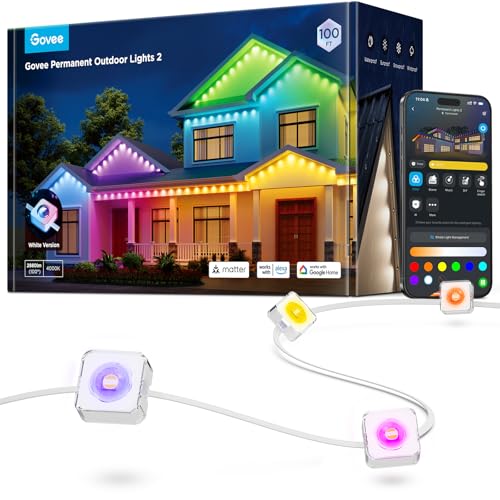
Well-known ecosystems such as Govee, Twinkly, Philips Hue, Nanoleaf, and WiZ offer different approaches. The right choice depends less on the logo and more on the cable length, weather rating, bulb spacing, brightness, control method, and replacement options.
Weather resistance: read the rating, not the marketing
Outdoor string lights should have an explicit IP rating. IP44 generally indicates protection from splashing water and is suitable only for relatively sheltered locations. IP65 provides dust protection and resistance to water jets, making it a stronger choice for open patios and pergolas. IP67 adds temporary immersion protection, although that does not mean the power adapter or controller can be left in standing water.
Check every component separately. A light strand may be weather-resistant while its controller or power brick must remain under a covered outlet, inside a weatherproof box, or above ground. The weakest component determines the safe installation.
Look for thick, flexible cable insulation, molded bulb sockets, sealed end caps, and outdoor-rated connectors. Avoid sharply bending the cable at each socket. Water often enters through damaged insulation, loose end caps, or connectors lying on a wet deck.
What wears out first
- Power adapters and controllers: Heat, condensation, and repeated unplugging can shorten their life.
- Connectors: Uncapped extension ends can collect water and corrosion.
- Bulb housings: Sunlight can make plastic brittle, especially on south-facing installations.
- Adhesive clips: They commonly fail before the lights do. Use outdoor-rated screw hooks or cable guides where permitted.
- Software support: A functional light can become inconvenient if the app loses scheduling or platform compatibility.
Unplug the system before cleaning. Wipe bulbs and cable with a damp cloth and mild soap; do not pressure-wash the sockets or immerse the controller. Inspect the cable at the beginning and end of each season.
Bulb spacing determines both appearance and coverage
Bulb spacing is one of the most overlooked buying decisions. Spacing of 8 to 12 inches creates a dense, festive line and works well around a pergola edge. Spacing of 18 to 24 inches looks more architectural and reduces the number of visible connection points. Wider spacing also produces more distinct pools of light rather than an almost continuous glow.
Measure the actual route, not the patio’s square footage. For a 12-by-16-foot pergola, a perimeter run is:
12 + 16 + 12 + 16 = 56 feet.
Add roughly 10 percent for slack and routing around posts, giving a target of about 62 feet. A 48-foot strand will leave a gap or require an awkward extension. A 96-foot strand may work if it can be routed across the interior, but excess cable should not be tightly coiled while powered because it can retain heat.
For a 60-foot run, 12-inch spacing gives approximately 60 bulbs. At 24-inch spacing, it gives approximately 30 bulbs. The first option is visually fuller, while the second may be easier to maintain and less visually busy.
Brightness: decorative glow versus usable light
Color effects are not a substitute for white-light brightness. Many smart strings look vivid in saturated red, blue, or green but provide limited illumination for dining or walking. For practical patio lighting, compare lumens and the brightness of the warm-white setting, not just RGB color capability.
As a useful starting point, allow 800 to 1,200 lumens for a small seating area and 1,500 to 3,000 lumens for a larger deck or entertaining zone. These are planning ranges rather than guarantees: dark surfaces absorb light, while pale walls reflect it and make the same string appear brighter.
Dimming is essential. A string that is pleasant at 30 percent for dinner may need 70 to 100 percent for cleaning or moving furniture. Look for separate control of brightness, color temperature, and color effects. Warm white around 2,200–3,000K is usually more comfortable outdoors than a cool, bluish white.
App and voice controls that matter
The app should do more than change colors. Useful features include schedules, sunrise and sunset triggers, dimming, grouped-room control, power-loss recovery, and a way to set a default state after the lights reconnect.
Individually addressable bulbs allow gradients, chasing effects, and sections that display different colors. They cost more and may require more setup. If the goal is simply warm white at sunset, individually addressable control is unnecessary.
Wi-Fi models are convenient for remote access but depend on a strong signal at the installation point. Bluetooth models can be simpler and more private but usually have shorter range and less reliable remote scheduling. Some systems support Matter or integrate with Apple Home, Google Home, or Alexa; verify that the specific model—not merely the brand—supports the platform you use.
Voice control is best for basic commands such as “turn the patio lights on” or “set them to 30 percent.” Detailed scenes, timers, and color effects are generally faster to configure in the manufacturer’s app. If your outdoor Wi-Fi signal is weak, improve coverage before blaming the lights.
A practical buying decision matrix
| Your priority | Choose | Avoid |
|---|---|---|
| Infrequent seasonal use | Simple app, robust weather sealing, moderate price | Complex systems requiring a hub and frequent updates |
| Daily use | Scheduling, power-loss recovery, replaceable components | Strands that reset to bright white after every outage |
| First smart-home purchase | Wi-Fi setup with clear instructions and voice-assistant support | Systems with multiple bridges or unclear compatibility |
| Large outdoor area | Extendable strands, joinable sections, strong controller range | Several unrelated strings controlled by separate apps |
| Maximum durability | IP65 or higher, sealed sockets, protected power supply | Indoor-rated adapters or exposed USB power connections |
Installation tips that prevent common failures
- Test everything on the ground. Pair the lights, update firmware, and confirm every bulb works before climbing a ladder.
- Plan the power location. Keep the adapter and controller away from puddles, sprinklers, and direct sun.
- Use support cable for long spans. Do not make the electrical cable carry the full weight across a wide pergola.
- Leave a drip loop. Let cable descend below the outlet or connector before rising again, so water does not run directly into it.
- Secure without crushing. Use clips or hooks that hold the cable gently; staples can pierce insulation.
- Set a conservative schedule. Dimming lights late at night reduces glare and unnecessary operating hours.
For cost planning, suppose a 60-foot string uses 36 watts and runs six hours each night. That is 0.216 kilowatt-hours per night, or about 79 kWh per year. At an electricity rate of $0.20 per kWh, operation costs roughly $16 per year. The purchase price, replacement controller, mounting hardware, and eventual bulb or strand replacement will usually matter more than electricity.
Bottom line
Choose the best smart outdoor string lights by matching the system to the space: IP65 or better for exposed locations, enough cable for the measured route, bulb spacing suited to the look you want, and at least 800–1,200 useful white-light lumens for a small seating area. Prioritize scheduling and dependable reconnection over flashy effects if the lights will run every day. For a large pergola or deck, an extendable system with individually controllable sections and a protected controller is worth the additional cost; for a small covered patio, a shorter Wi-Fi string with warm-white dimming may deliver the better overall value.