Key takeaways
- Compression level: High and focal. Tightness is fully adjustable via hook-and-loop closure.
- Adjustability: Excellent. You can tighten or loosen in seconds between games.
- Comfort during play: Minimal coverage means less heat and bulk. Most players forget it is there after a few minutes. Can slip if not sized correctly or if you sweat heavily.
- Pressure distribution: Concentrated on a 3-5 cm zone. Effective for classic lateral tennis elbow pain that worsens with gripping or wrist extension.
The best tennis elbow brace for you depends on where your pain is and how you play: a single counterforce strap gives targeted pressure to offload the tendon, a compression sleeve provides even, low-level support and warmth for diffuse soreness, and a dual-strap or epicondylitis clasp system offers the highest stability for severe or recurring lateral elbow pain during play.
This guide compares the three main designs on compression, adjustability, comfort, and pressure distribution to help you choose by situation, not just by product name. This is general information only and not medical advice — if pain is persistent, worsening, or caused by an injury, talk to a clinician or physical therapist.
Our top picks


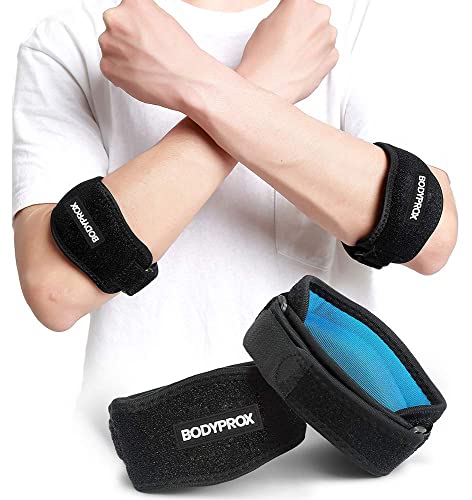

As an Amazon Associate we earn from qualifying purchases at no extra cost to you. Ratings are shown as listed on Amazon.
The 3 Designs Compared: Strap vs. Sleeve vs. Dual-Strap
1. Counterforce Strap (Single Strap)
A narrow band, typically 2 to 3 inches wide, worn 1-2 inches below the elbow crease over the forearm extensor muscle belly. It has a padded insert or air cushion that creates a secondary anchor point, which is intended to distribute load away from the lateral epicondyle where the tendon attaches.
- Compression level: High and focal. Tightness is fully adjustable via hook-and-loop closure.
- Adjustability: Excellent. You can tighten or loosen in seconds between games.
- Comfort during play: Minimal coverage means less heat and bulk. Most players forget it is there after a few minutes. Can slip if not sized correctly or if you sweat heavily.
- Pressure distribution: Concentrated on a 3-5 cm zone. Effective for classic lateral tennis elbow pain that worsens with gripping or wrist extension.
2. Compression Sleeve (Elbow Sleeve)
A tubular sleeve that covers elbow and part of the forearm and bicep, made from knit elastic, nylon, or neoprene blends. Brands like Bauerfeind, McDavid, and Copper Fit offer medical-grade knit versions with zoned compression.
- Compression level: Low to moderate and diffuse, usually 15-25 mmHg graduated. Not adjustable once on.
- Adjustability: None. Fit depends entirely on choosing the correct size.
- Comfort during play: Very comfortable for long wear, provides warmth and proprioceptive feedback. Can feel hot in summer and may bunch during full elbow flexion.
- Pressure distribution: Even circumferential pressure around the entire joint. Better for diffuse ache, mild swelling, golfer’s elbow (medial pain), or for players who want support without a pressure point.
3. Dual-Strap and Epicondylitis Clasp
Combines a sleeve or base with one or two adjustable straps, or uses a rigid clasp with dual pressure pads. Mueller and Bauerfeind EpiTrain-style designs are common examples.
- Compression level: Moderate to high, with both diffuse and focal components.
- Adjustability: Good. Base sleeve stays in place while straps allow fine-tuning of targeted pressure.
- Comfort during play: Most stable during aggressive swings, but bulkiest and warmest. Best for players who need support for both tennis elbow and general joint stability.
- Pressure distribution: Dual-zone. Sleeve spreads load broadly while strap or air pad adds focal counterforce. Useful when pain radiates up or down the forearm.
Head-to-Head Spec Comparison
Specifications vary by brand, but this table shows typical ranges you will find in 2026 for adult braces:
| Feature | Single Counterforce Strap | Compression Sleeve | Dual-Strap / Clasp System |
|---|---|---|---|
| Typical Weight (per unit) | 30 – 55 g | 45 – 80 g | 75 – 120 g |
| Materials | Neoprene, nylon, closed-cell foam pad | 3D knit nylon-elastane, silicone grip dots | Knit sleeve + neoprene straps + plastic clasp/air cell |
| Compression Type | Focal (adjustable 0-~40 mmHg equivalent under pad) | Graduated 15-25 mmHg diffuse | Combined: 20-30 mmHg diffuse + focal pad |
| Size Range | One-size or S-L by forearm circumference (20-33 cm) | XS-XL by elbow/forearm circumference (21-35 cm) | S-XL by forearm circumference (22-34 cm) |
| Profile / Thickness | 3-6 mm under pad, 2 mm strap | 1.5-3 mm knit | 4-8 mm at clasp/pad zone |
| General Market Price Range | $12 – $30 | $20 – $55 | $30 – $70 |
| Best Use Case | Targeted lateral pain during tennis, pickleball, golf | All-day mild pain, warmth, recovery between sessions | Frequent players with recurrent or bilateral pain |
How Pressure Distribution Affects Relief
Tennis elbow pain often comes from repetitive overload of the extensor carpi radialis brevis tendon. Braces do not heal the tendon directly; they change how force travels through the forearm.
A counterforce strap works like moving the origin of the muscle. By pressing on the muscle belly distal to the elbow, it shortens the lever arm on the tendon attachment, which reduces peak tension at the lateral epicondyle during wrist extension. This is why placement matters more than tightness: 2-3 cm below the painful point, not directly on it.
A sleeve does not redirect force the same way. It increases joint awareness, retains heat to keep tissues pliable, and mildly limits vibration after ball impact. Players with diffuse forearm tightness often prefer this even pressure over a single hard point, especially if they have sensitive skin or also have mild arthritis.
Dual-strap systems try to do both. The sleeve controls swelling and vibration while the strap provides the focal offload. The trade-off is more material over the elbow, which can reduce breathability and restrict full extension for players with very muscular arms.
Decision Matrix: Choose by Your Situation
| Your Situation | Recommended Design | Why |
|---|---|---|
| Lateral elbow pain only when gripping/playing, no swelling | Single Counterforce Strap | Targeted offload with minimal heat; easiest to adjust between sets |
| Dull ache throughout elbow, stiffness in morning, or mild swelling after play | Compression Sleeve | Even warmth and circulation support without pressure point irritation |
| Pain on both sides of elbow (tennis + golfer’s elbow) or pain that travels down forearm | Dual-Strap / Clasp | Combines diffuse and focal control; stays put during hard swings |
| Need to wear brace all day at work + play twice a week | Sleeve for day, Strap for play | Sleeve is lower-profile under clothing; strap is better for sport-specific load |
| Budget under $25 or want to try a brace first | Single Counterforce Strap | Lowest cost, lowest risk if sizing is slightly off |
| History of strap slipping or skin irritation under pad | Knit Sleeve or Dual-Strap with silicone borders | Knitted sleeves with silicone grippers reduce slipping without over-tightening |
Sizing and Fit: A Worked Calculation
Fit determines effectiveness more than price. An over-tight strap can cut circulation; a loose sleeve provides no support.
How to Measure
- Relax your arm at your side with elbow slightly bent.
- Wrap a soft tape measure around the thickest part of your forearm, about 2-3 cm (roughly one finger width) below the crease of the elbow. This is where a strap’s pad should sit.
- For sleeves, also measure elbow circumference at the joint line and 5 cm above the elbow. Use the largest of these for knit sleeves.
Example
If your forearm measures 27.5 cm: On most sizing charts, Small is 20-24 cm, Medium is 24-28 cm, Large is 28-32 cm. You would be at the top of Medium. Choose Medium for a snug sport fit or Large if you have very muscular forearms or want to wear it for hours without indentations. For a one-size strap, tighten so you can slide one finger under the band but not two – if you feel tingling, numbness, or the hand turns pale/cold, it is too tight.
Placement check: With arm extended, palm up, the tender bony point on the outside of the elbow should remain uncovered. The pad should sit over the soft muscle bulge below it. Flex and extend the wrist – you should feel support where the muscle tightens, not pressure on the bone.
Durability and Ownership Realities
Braces are consumables, not lifetime gear. Knowing what wears first helps you get full value.
- What fails first: Hook-and-loop (Velcro) on straps loses grip after 6-12 months of sweat and washing. Foam pads compress and harden, reducing focal pressure. Elastic knit in sleeves gradually stretches, especially with hot water washes. Stitching at the strap-pad junction frays first on low-cost neoprene models.
- Cleaning: Hand wash cold with mild soap, air dry flat. Do not machine dry or use bleach or fabric softener – they degrade neoprene and elastic fibers. Knit sleeves like Bauerfeind-style products can typically tolerate a gentle cold machine cycle in a laundry bag.
- Common mistakes: Wearing the strap directly on the painful epicondyle, overtightening to “numb” the pain, wearing a sleeve too small to increase pressure, and not replacing a stretched sleeve. All can increase discomfort or reduce circulation.
- How long they last: A daily-use strap lasts roughly 6-9 months before closure weakens; a sleeve worn 3-4 times per week lasts 9-14 months before compression feels noticeably looser. Dual-strap systems fall in between but replacement straps are often sold separately.
- Skin care: Neoprene traps heat and can cause irritation for sensitive skin. Look for latex-free, moisture-wicking liners and rotate between two braces to let each dry fully if you play daily. If you develop persistent redness, itching, or bruising under the pad, discontinue use and consult a professional.
Comfort During Play: Practical Tips
For match play, most players prioritize low bulk and secure fit over maximum compression. Start with a looser setting and tighten incrementally after warm-up when the muscle is engorged with blood – what felt right before hitting may feel tight after 15 minutes. If you wear a sleeve under a strap, ensure the strap sits outside the sleeve to avoid double-layer pressure on skin.
Use a brace only as part of a broader approach: modify activity volume, check racquet grip size and string tension, and incorporate eccentric wrist extensor exercises as advised by a therapist. A brace supports load management but does not replace rest, technique adjustments, or progressive strengthening.
FAQ
Can I wear a tennis elbow brace all day?
A light compression sleeve is generally better tolerated for extended wear than a tight strap. Remove any brace periodically to check skin, and avoid sleeping in a tight counterforce strap unless a clinician advises it.
Strap vs. sleeve – which is better for pickleball and golf?
Both sports create similar forearm extensor load. A strap is preferred for sharp lateral epicondyle pain during grip and snap motions, while a sleeve is often preferred for lingering soreness after play or for medial (golfer’s elbow) pain.
How tight should a tennis elbow brace be?
Snug but not constrictive. You should be able to slide a fingertip under the strap, retain normal hand color and sensation, and feel reduced tension when extending the wrist against resistance. If grip strength drops or tingling occurs, loosen immediately.