Key takeaways
- Hold a flexible resistance bar (such as TheraBand FlexBar) vertically in the affected hand, elbow extended but not locked, palm facing down.
- Use your unaffected hand to cock the wrist of the affected side back into extension.
- Slowly release the wrist into flexion over 3-4 seconds, resisting the bar’s untwisting force. The unaffected hand does the lifting, the affected side does the slow lowering.
- Do 3 sets of 10-15 repetitions with 60 seconds rest between sets.
What's inside
- How Tennis Elbow Exercises Work
- The 5 Core Tennis Elbow Exercises for At-Home Rehab
- Support Gear: What Actually Helps and What to Choose
- Spec Comparison: Common At-Home Tools for Tennis Elbow
- Decision Matrix: Pick Gear by Your Situation
- Durability and Ownership Realities
- Simple Setup and Maintenance Routine
- When to Progress or Seek Care
Tennis elbow exercises that speed recovery focus on eccentric wrist extension, wrist flexion, and forearm pronation/supination using light resistance, combined with wrist extensor stretches and a counterforce strap to reduce tendon load during daily activity. A simple at-home program with a flexible resistance bar and light resistance bands, performed daily for 6 to 12 weeks, is the standard conservative approach recommended alongside rest and professional guidance.
- How Tennis Elbow Exercises Work
- The 5 Core Tennis Elbow Exercises for At-Home Rehab
- Support Gear: What Actually Helps and What to Choose
- Spec Comparison: Common At-Home Tools for Tennis Elbow
- Decision Matrix: Pick Gear by Your Situation
- Durability and Ownership Realities
- Simple Setup and Maintenance Routine
- When to Progress or Seek Care
General information only. Tennis elbow (lateral epicondylalgia) can have different causes and severity. If you have persistent pain, swelling, numbness, or loss of grip strength, consult a physician or physical therapist before starting a new exercise program.
As an Amazon Associate we earn from qualifying purchases at no extra cost to you.


How Tennis Elbow Exercises Work
Tennis elbow is typically irritation of the common extensor tendon where it attaches near the outside of the elbow. Rehab does not just rest the tendon; it gradually loads it to stimulate remodeling and improve forearm muscle endurance. The most effective at-home moves are slow, controlled eccentric exercises where the muscle lengthens under load, plus static stretches to maintain wrist and elbow mobility.
Support gear does not cure the tendon itself. A counterforce strap or elbow sleeve compresses the forearm muscle just below the elbow to distribute force away from the painful insertion, while resistance tools let you apply progressive, measurable load without needing weights.
The 5 Core Tennis Elbow Exercises for At-Home Rehab
Perform these once daily after warming up the forearm with 2-3 minutes of gentle wrist circles and light grip squeezes. Use no weight or very light resistance at first. Pain during exercise should stay at 3/10 or below and should not worsen 24 hours later. Stop and seek professional advice if pain sharpens.
1. Eccentric Wrist Extension with FlexBar
This is the foundational move in most physical therapy protocols for lateral epicondylalgia.
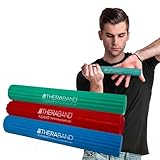
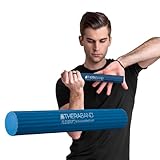
- Hold a flexible resistance bar (such as TheraBand FlexBar) vertically in the affected hand, elbow extended but not locked, palm facing down.
- Use your unaffected hand to cock the wrist of the affected side back into extension.
- Slowly release the wrist into flexion over 3-4 seconds, resisting the bar’s untwisting force. The unaffected hand does the lifting, the affected side does the slow lowering.
- Do 3 sets of 10-15 repetitions with 60 seconds rest between sets.
2. Wrist Extensor Stretch
- Extend the affected arm straight in front of you, palm down.
- With the opposite hand, gently press the hand downward and slightly inward until you feel a stretch on the outer forearm.
- Hold 20-30 seconds, breathe normally, repeat 3 times. Do this before and after strengthening.
3. Wrist Flexion and Extension with Resistance Band
- Anchor a light loop resistance band under your foot, forearm resting on a thigh or table with wrist hanging over the edge, palm down.
- For extension: Pull the band upward by extending the wrist, then lower over 2-3 seconds.
- For flexion: Flip palm up and curl wrist upward. This balances flexor and extensor strength.
- Do 2 sets of 12-15 for each direction. Resistance should allow full control without compensation from the shoulder.
4. Forearm Pronation and Supination
- Hold a small hammer or the resistance bar at one end, elbow bent at 90 degrees and tucked at your side.
- Slowly rotate the palm to face up (supination) then down (pronation) over 3 seconds each way.
- Do 2 sets of 10 each direction. This targets the muscles that attach near the lateral epicondyle and improves grip stability.
5. Isometric Grip Hold
- Hold the resistance bar or a rolled towel with a neutral wrist, squeeze gently at about 30-40% of maximal effort.
- Hold 20-30 seconds, 3 repetitions. Isometric holds are useful when eccentric moves are too irritating in the first week.
Weekly Progression Plan
- Weeks 1-2: Stretch daily + eccentric wrist extension only, lightest resistance. Focus on form and slow tempo.
- Weeks 3-4: Add wrist flexion/extension band work and pronation/supination if pain is stable or decreasing.
- Weeks 5-8+: Increase FlexBar resistance level or band thickness only when you can complete all sets with pain at or below 2/10. Add grip holds.
- Throughout: Wear a counterforce strap during aggravating tasks like typing, lifting, or racquet sports, not while sleeping.
Support Gear: What Actually Helps and What to Choose
For at-home rehab you need two categories: a load tool for exercise and a support for pain relief during activity. They serve different purposes.
- Flexible resistance bars: Provide torsional resistance ideal for eccentric training. More durable and easier to grade than dumbbells for small forearm muscles.
- Loop and therapy bands: Provide linear resistance for wrist curls, extensions, and shoulder stability. Choose latex or latex-free fabric based on allergy and durability needs.
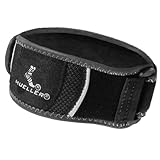
- Counterforce straps (tennis elbow braces): A 2-3 inch wide strap with a pad that sits 1-2 cm below the painful spot. It does not immobilize the joint; it reduces vibration and peak tendon tension.
- Compression sleeves: Light uniform pressure and warmth. Better for diffuse soreness rather than pinpoint lateral pain, and useful if you find straps too restrictive.
Spec Comparison: Common At-Home Tools for Tennis Elbow
Use this table to match resistance and sizing to your current strength, not your normal fitness level. Starting too heavy is the most common reason for flare-ups.
| Product Type (Example Brand) | Material | Resistance / Force Levels | Dimensions | Weight | Best For |
|---|---|---|---|---|---|
| TheraBand FlexBar – Red, Green, Blue, Yellow | Natural rubber | Red 4.5 kg (10 lb), Green 6.8 kg (15 lb), Blue 11.3 kg (25 lb), Yellow 2.7 kg (6 lb) | 30.5 cm length x 3.8-5.1 cm diameter | 110-170 g | Eccentric wrist extension; most research-backed for lateral epicondylalgia |
| TheraBand Professional Latex Bands (non-latex version available) | Latex or latex-free TPE | Tan 1.1 kg, Yellow 1.3 kg, Red 1.7 kg, Green 2.1 kg at 100% elongation | 1.5 m x 12.7 cm band, cut to length | ~90 g per 1.5 m band | Wrist flexion/extension, pronation/supination; fine gradation |
| Band-It Forearm Band | Neoprene strap with molded plastic pad + secondary pressure pad | Adjustable compression via velcro, one size fits 19-33 cm forearm | Strap 25.4 cm x 5 cm, pad 6.3 cm | 45 g | Pinpoint counterforce during typing, lifting, golf/tennis |
| Simien / McDavid 489 Counterforce Strap | Neoprene + nylon with gel/foam pad | Adjustable, fits 20-35 cm forearm | Strap approx. 35 cm x 5 cm | 60-85 g | Adjustable daily-use strap for broader forearms |
| Mueller Hg80 or Bauerfeind EpiPoint Style Sleeve | Knitted fabric + silicone insert | Graduated compression, sizes XS-XL for 18-32 cm forearm | Sleeve length 18-22 cm | 70-110 g | Diffuse soreness, warmth, all-day comfort if strap pressure is too focal |
Decision Matrix: Pick Gear by Your Situation
| Your Situation | Primary Tool to Buy First | Resistance Starting Point | Support During Day |
|---|---|---|---|
| Acute pain, cannot do wrist extension without sharp pain | Isometric grip + wrist extensor stretch only | No resistance for 7-10 days, then FlexBar Yellow/Red | Counterforce strap during any gripping or computer work |
| Mild pain, can type/lift with discomfort but grip is weak | FlexBar Red + light loop band | Red FlexBar (10 lb), Red band (1.7 kg) | Strap only during aggravating activity, not all day |
| Recovering athlete returning to tennis/golf 2-3x per week | FlexBar Green/Blue + set of 3 bands | Green FlexBar (15 lb), progress to Blue when 3×15 is easy | Focal strap like Band-It during play, sleeve off-court if needed |
| Limited space/budget, wants one tool | Single FlexBar Red (covers 70% of protocol) | Red FlexBar | Basic neoprene counterforce strap (general market range $12-30) |
| Latex allergy or need more durability | Fabric loop bands or TPE FlexBar equivalent | Start one level lighter than latex chart (fabric has higher initial tension) | Fabric sleeve instead of neoprene strap |
General market ranges in 2026: flexible bars $18-35, latex band sets $12-28, counterforce straps $12-40, medical-grade sleeves $30-65. A complete at-home kit (one bar + one strap + one band) typically costs $40-80 and lasts well beyond a single rehab cycle.
Durability and Ownership Realities
Knowing what wears first prevents gaps in your program.
- What wears first: Latex bands develop small nicks and lose elasticity after 4-6 months of daily use, especially if stored in heat or sunlight. Neoprene straps lose velcro grip before the pad wears out, usually after 8-12 months. Rubber FlexBars can crack if left in a hot car; with indoor storage they last 1-2 years.
- Cleaning: Wipe rubber bars and bands with mild soap and water, air dry, and dust with talc if sticky. Hand wash straps and sleeves weekly if worn against skin; air dry completely to prevent odor and skin irritation.
- Common mistakes: Placing the strap directly on the painful bony point instead of 1-2 finger widths below it; using momentum and bending the elbow during wrist work; progressing resistance when pain has increased the next morning; and wearing a strap so tight that fingers tingle or the forearm aches.
- Fit check: You should be able to slide one fingertip under the strap. It should feel snug, not numb. For sleeves, measure forearm circumference 5 cm below the elbow crease and follow the manufacturer’s sizing chart; if between sizes, choose the larger for rehab comfort.
Simple Setup and Maintenance Routine
- Anchor bands on a closed door anchor or underfoot, never on sharp edges. Inspect for tears before each session.
- Store bands and bars flat in a cool drawer, not folded tightly or knotted.
- Log sets, resistance color, and next-day pain (0-10). Only increase resistance when you have completed 3 sessions at the same level without increased next-day pain.
- Replace any band with visible thinning, stickiness, or small tears, as it can snap.
When to Progress or Seek Care
Expect gradual improvement over 6-12 weeks of consistent loading, not days. If you have no improvement after 3 weeks of correct, light daily work, if night pain worsens, or if you have tingling into the hand, have the elbow evaluated. A physical therapist can assess grip strength, technique, and whether a different loading angle or a night wrist position needs adjustment.
Consistency matters more than intensity. Light, slow tennis elbow exercises done daily with the right support gear for activity protection tend to outperform occasional heavy sessions.