Key takeaways
- Qobuz: A strong choice for CD-quality and high-resolution listening, with detailed album information and downloads. Its catalogue and recommendations can be less convenient for casual discovery in some regions.
- Tidal: Offers lossless listening, a large catalogue, Tidal Connect, and strong device integration. Verify the current plan and format details in your country because service tiers can change.
- Spotify: Excellent discovery, playlists, social features, and device support through Spotify Connect. It remains a practical choice when usability matters more than the last step in file resolution.
- Apple Music: Broad catalogue, lossless and high-resolution options, and useful integration with Apple devices. AirPlay 2 is convenient, but native support varies between streamer brands.
- Deezer: A solid lossless option with good catalogue coverage in supported markets, though hardware integration is not equally broad across all manufacturers.
Best Music Streamers for Better Sound
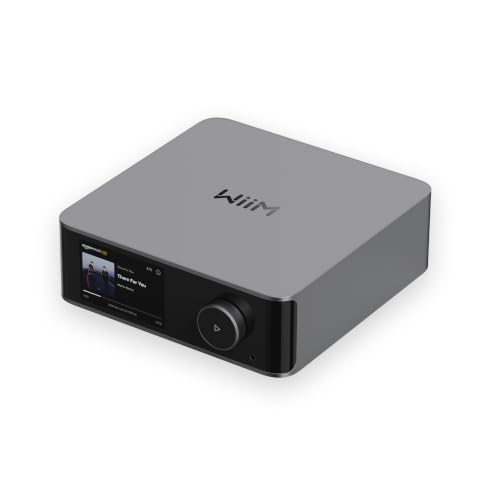
The best music streamers for most hi-fi systems are the WiiM Pro Plus for value, the Bluesound NODE for a polished multiroom upgrade, and the Eversolo DMP-A6 when you want a large display, stronger connectivity, and a genuinely high-end digital source.
A streamer does not automatically make music sound better than a phone or laptop. Its value comes from cleaner digital conversion, lower electrical noise, more stable software, better integration with streaming services, and the ability to send music to the right amplifier or DAC. The ideal choice depends on whether your system needs a DAC, a network transport, multiroom support, or simply a more convenient way to listen.
Our top picks


As an Amazon Associate we earn from qualifying purchases at no extra cost to you. Ratings are shown as listed on Amazon.
Quick comparison of the leading choices
| Streamer | Approx. market range | Size and weight | Maximum PCM support | Wireless and network | Best match |
|---|---|---|---|---|---|
| WiiM Pro Plus | $200–$250 | 140 × 140 × 42 mm; about 0.9 kg | Up to 24-bit/192 kHz | Wi-Fi 5, Bluetooth 5.1, Ethernet | Affordable integrated amplifiers and separate DACs |
| Bluesound NODE | $500–$600 | 220 × 46 × 146 mm; about 1.1 kg | Up to 24-bit/192 kHz | Dual-band Wi-Fi, Bluetooth, Ethernet | Easy multiroom systems and existing amplifiers |
| Cambridge Audio CXN V2 | $700–$1,000, depending on availability | 430 × 112 × 340 mm; about 4.7 kg | Up to 24-bit/384 kHz; DSD support | Wi-Fi, Bluetooth, Ethernet | Full-width hi-fi racks and balanced systems |
| Eversolo DMP-A6 | $850–$1,100 | About 270 × 187 × 90 mm; about 2.4 kg | Up to 32-bit/768 kHz; DSD512 | Wi-Fi 6, Bluetooth, Gigabit Ethernet | High-resolution libraries and broad digital connectivity |
Specifications vary slightly by revision and region, so treat maximum resolution as a capability rather than a promise of better sound. A well-designed 24-bit/96 kHz signal can sound excellent, while a poorly mastered high-resolution file will not improve simply because its number is larger.
Best music streamer for most systems: WiiM Pro Plus
The WiiM Pro Plus is the strongest low-cost all-rounder when your amplifier already has an analog input and you want both streaming convenience and a competent built-in DAC. It supports Spotify Connect, Tidal Connect, Apple Music through AirPlay 2, Chromecast-compatible casting, internet radio, and common network playback methods. Its analog input is also useful for bringing a turntable with a phono preamp into a whole-home setup.
Its app is unusually capable for the price. It provides room correction, equalization, source selection, volume control, and automation features that are uncommon on inexpensive streamers. Coaxial and optical digital outputs let you bypass the internal DAC later, so the unit can remain useful after a DAC upgrade.
Choose the Pro Plus rather than the less expensive WiiM Mini when you need Ethernet, a digital input, or better analog output quality. Choose it over a basic Bluetooth receiver when you want lossless network playback, gapless listening, and reliable control from a phone without keeping the phone near the stereo.
Best for simple multiroom: Bluesound NODE
The Bluesound NODE is a safer choice for a household that may add more rooms later. Bluesound’s BluOS platform is built around synchronized multiroom playback, shared music libraries, and independent room control. It supports major services including Tidal, Qobuz, Spotify Connect, Deezer, Amazon Music, and internet radio, with availability depending on region and service changes.
The NODE works particularly well with an older integrated amplifier or power amplifier because it offers analog RCA output, optical and coaxial digital outputs, HDMI eARC on current versions, and a subwoofer output. HDMI eARC is valuable if the same system handles television sound. The NODE also supports two-way Bluetooth on suitable devices, although Wi-Fi or Ethernet is preferable for serious listening.
The main reason to pay more than the WiiM is not necessarily a dramatic change in sound. It is the mature BluOS experience, wider ecosystem, and easier path to adding compatible speakers and players. If you will use one room only and already own a high-quality DAC, the NODE’s extra cost may be difficult to justify.
Best high-resolution upgrade: Eversolo DMP-A6
The Eversolo DMP-A6 is aimed at listeners who want the streamer to become the central digital component. Its large front touchscreen, internal storage support, balanced analog outputs, USB audio, HDMI audio output, and extensive format compatibility make it more flexible than a basic network bridge.
It is a particularly good fit for a system built around balanced XLR connections or a power amplifier with no conventional source switching. The touchscreen is useful when the streamer sits beside the listening position, although most users will still browse albums through the control app. It can also manage local files from a network drive or internal solid-state storage, which is useful for a large ripped CD collection.
Its high-resolution support is valuable only if your library or service uses those formats and your amplifier chain is transparent enough to reveal differences. For ordinary CD-quality streaming, the Eversolo’s advantage is more about build, connectivity, display, and upgrade headroom than resolution alone.
Best full-width option: Cambridge Audio CXN V2
The Cambridge Audio CXN V2 remains attractive for a traditional hi-fi rack. Its full-width metal chassis, large display, balanced outputs, and dual digital-to-analog converter architecture suit systems where the source should look and operate like a conventional component.
It supports network playback, Spotify Connect, Tidal, internet radio, USB media, and digital inputs. The StreamMagic app is clear and generally easy to navigate, though compact streamers from WiiM can offer more modern automation and room-correction features. Check software support before buying older stock, particularly if you expect new service integrations over many years.
The CXN V2 makes the most sense when you value its physical format and balanced connection more than the smallest possible footprint. It is less compelling for a desk system, a minimalist setup, or an amplifier hidden in a cabinet.
Streaming services: which one sounds and works best?
- Qobuz: A strong choice for CD-quality and high-resolution listening, with detailed album information and downloads. Its catalogue and recommendations can be less convenient for casual discovery in some regions.
- Tidal: Offers lossless listening, a large catalogue, Tidal Connect, and strong device integration. Verify the current plan and format details in your country because service tiers can change.
- Spotify: Excellent discovery, playlists, social features, and device support through Spotify Connect. It remains a practical choice when usability matters more than the last step in file resolution.
- Apple Music: Broad catalogue, lossless and high-resolution options, and useful integration with Apple devices. AirPlay 2 is convenient, but native support varies between streamer brands.
- Deezer: A solid lossless option with good catalogue coverage in supported markets, though hardware integration is not equally broad across all manufacturers.
For a blind buying decision, choose the service with the albums, playlists, and discovery tools you will actually use. Switching from compressed Bluetooth audio to lossless network playback is usually a more meaningful upgrade than changing between two competent lossless services.
Wireless standards and connectivity explained
Use Ethernet when the streamer is near your router. It avoids wireless interference and is especially useful for high-resolution files, local libraries, and systems placed far from a phone. Wi-Fi 5 is already sufficient for stereo music; Wi-Fi 6 improves network efficiency but does not directly make the audio sound better.
Bluetooth is convenient for guests, but it is normally a secondary input rather than the best main connection. Bluetooth codecs and receiver implementations vary, and phone volume controls may complicate bit-perfect playback. Spotify Connect, Tidal Connect, AirPlay 2, Chromecast, or the manufacturer’s native network protocol usually provide better day-to-day results.
Before buying, identify the amplifier input you will use. Analog RCA is required if the streamer’s DAC will feed an amplifier directly. Coaxial or optical output is preferable when an existing DAC is better. HDMI eARC matters for television systems. XLR outputs make sense only when the rest of the chain supports balanced connections; they are not automatically superior merely because they use a different plug.
Decision matrix: choose by system and listening habits
| Your situation | Best direction | Why |
|---|---|---|
| Under $300, one room, first streamer | WiiM Pro Plus | Low entry cost, useful DAC, Ethernet, digital outputs, and strong app features |
| Several rooms now or later | Bluesound NODE | BluOS provides a more coherent dedicated multiroom ecosystem |
| Existing external DAC | WiiM Pro Plus or a dedicated network transport | Digital output avoids paying for a DAC you will not use |
| Balanced amplifier and local high-resolution library | Eversolo DMP-A6 | XLR output, USB, storage support, display, and broad format capability |
| Traditional full-width hi-fi rack | Cambridge CXN V2 | Conventional chassis, display, balanced outputs, and physical-system presence |
| Television and music share one system | Bluesound NODE or a streamer with HDMI eARC | Simple TV integration and volume control through the amplifier system |
Setup choices that affect sound and reliability
- Connect the streamer to the correct input. Start with analog output if you are evaluating its internal DAC; use coaxial or optical if an external DAC is already central to the system.
- Prefer Ethernet where practical. It reduces dropouts and makes troubleshooting easier, especially with network drives.
- Set one volume control. Fixed output into the amplifier is usually simplest. If the streamer controls volume digitally, leave the amplifier at a known level and avoid accidentally reducing resolution with excessive digital attenuation.
- Update firmware and the control app. Updates often address service authentication, network compatibility, and multiroom synchronization rather than changing sound quality.
- Keep ventilation clear. Do not stack a hot amplifier directly on a compact streamer, and leave space around the unit’s vents.
The parts most likely to cause ownership frustration are not the DAC chips. They are aging power supplies, unstable Wi-Fi, discontinued service integrations, and apps that stop receiving updates. Keep the streamer on a wired network when possible, retain a digital output for future DAC changes, and avoid buying into a closed ecosystem unless its multiroom features are important to you.
Final verdict
Buy the WiiM Pro Plus if you want the best balance of price, sound, connectivity, and upgrade value. Choose the Bluesound NODE when dependable multiroom operation and a polished ecosystem matter most. Move to the Eversolo DMP-A6 for a more ambitious, feature-rich digital hub, or choose the Cambridge CXN V2 when a full-width component and balanced hi-fi connections are part of the brief. The best music streamers are not defined by maximum resolution alone; they are the ones whose outputs, software, network features, and future upgrade path match the system you actually own.