Key takeaways
- Bluetooth stability: Bluetooth 5.0, 5.1 and 5.3 offer better auto-reconnect and less dropout than older 4.2 chips. Look for a transmitter that pairs in under 5 seconds after you start the car and supports A2DP for music. Models with a dedicated Bluetooth 5.3 chipset and an external antenna tend to hold connection even with phone in pocket or bag.
- Sound quality: No FM transmitter will match a direct aux cable, but the best reduce hiss with a built-in noise suppression chip and allow you to choose an empty frequency. Transmitters with support for 87.5-108.0 MHz in 0.1 MHz steps give you more empty slots than those locked to 88.1-107.9 MHz. Bass and treble adjustment on the device helps compensate for FM compression.
- Charging and fit: Old cars often have a single, shallow 12V socket near the shifter or in an ashtray. A bulky transmitter will block the armrest or gear shift. Check depth and gooseneck flexibility. For charging, a QC 3.0 or PD USB-C port is essential if you use navigation while streaming, otherwise your phone will drain faster than it charges.
- Call quality: A built-in microphone with CVC noise cancellation makes hands-free calls usable. In older, louder cabins, a transmitter with a mic positioned on a flexible neck near the driver is clearer than a mic flush with the dashboard.
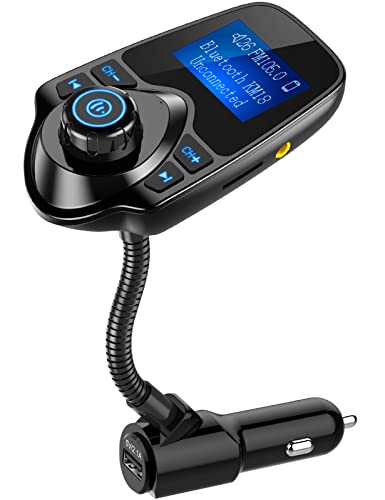
The best FM transmitters for old cars are models with Bluetooth 5.0 or newer, a stable FM chip that holds 87.5-108.0 MHz without drift, and at least one fast-charging USB port, with top options in 2026 being the Nulaxy KM18, Anker Roav SmartCharge T2, LENCENT T25, and Syncwire SW-BT11.
For cars without aux or built-in Bluetooth, the transmitter that plugs into your 12V cigarette lighter is the simplest way to stream music and take calls. The difference between a clear, steady stream and constant static comes down to Bluetooth stability, ground-loop isolation, power filtering, and how crowded the FM band is where you drive.
Our top picks



As an Amazon Associate we earn from qualifying purchases at no extra cost to you. Ratings are shown as listed on Amazon.
What matters most in an old car
FM transmitters work by creating a short-range FM station that your car radio tunes into. In older cars, three things cause most problems:
- Bluetooth stability: Bluetooth 5.0, 5.1 and 5.3 offer better auto-reconnect and less dropout than older 4.2 chips. Look for a transmitter that pairs in under 5 seconds after you start the car and supports A2DP for music. Models with a dedicated Bluetooth 5.3 chipset and an external antenna tend to hold connection even with phone in pocket or bag.
- Sound quality: No FM transmitter will match a direct aux cable, but the best reduce hiss with a built-in noise suppression chip and allow you to choose an empty frequency. Transmitters with support for 87.5-108.0 MHz in 0.1 MHz steps give you more empty slots than those locked to 88.1-107.9 MHz. Bass and treble adjustment on the device helps compensate for FM compression.
- Charging and fit: Old cars often have a single, shallow 12V socket near the shifter or in an ashtray. A bulky transmitter will block the armrest or gear shift. Check depth and gooseneck flexibility. For charging, a QC 3.0 or PD USB-C port is essential if you use navigation while streaming, otherwise your phone will drain faster than it charges.
- Call quality: A built-in microphone with CVC noise cancellation makes hands-free calls usable. In older, louder cabins, a transmitter with a mic positioned on a flexible neck near the driver is clearer than a mic flush with the dashboard.
Spec comparison: 4 proven models for cars without aux or Bluetooth
This table compares dimensions, wireless specs, and power features that actually affect daily use. All four plug into a standard 12V socket (12-24V input) and work with iPhone and Android.
| Model | Bluetooth Version | FM Range & Step | Charging Ports | Body Size & Weight | Extra Features |
|---|---|---|---|---|---|
| Nulaxy KM18 | 5.0, A2DP, auto-reconnect | 87.5-108.0 MHz, 0.1 MHz | 1x USB-A QC 3.0 18W + 1x USB-A 5V/2.4A | 3.1 x 1.7 x 1.2 in, 1.6 oz, flexible gooseneck | 1.8-inch color display, bass/treble control, microSD/TF slot up to 64GB |
| Anker Roav SmartCharge T2 | 5.0 with PowerIQ | 87.5-108.0 MHz, 0.1 MHz | 1x USB-A QC 3.0 + 1x USB-A PowerIQ 12W (total 30W) | 2.9 x 1.4 x 1.1 in, 1.4 oz, low-profile head | Roav app for frequency finder, ground-loop noise filter, 2-mic array |
| LENCENT T25 | 5.3, A2DP, BLE | 87.5-108.0 MHz, 0.1 MHz | 1x USB-C PD 20W + 1x USB-A QC 3.0 18W | 3.4 x 1.6 x 1.3 in, 1.8 oz, 360-degree gooseneck | LED voltmeter (car battery voltage), Hi-Fi DSP, supports USB flash drive |
| Syncwire SW-BT11 | 5.1, fast pairing | 88.1-107.9 MHz, 0.1 MHz | 1x USB-A 5V/2.4A + 1x USB-C 5V/2.4A | 3.0 x 1.5 x 1.0 in, 1.5 oz, compact straight plug | Large dial knob for frequency, voice assistant button |
General market range for these types is $16 to $36. Bluetooth 5.3 and PD fast-charging models sit at the higher end, while basic dual-USB models with Bluetooth 5.0 sit at the lower end. You do not need to pay more for extra LED light strips or larger screens, which add glare at night without improving sound.
Decision matrix: Which transmitter fits your situation
Choose based on your car and how you drive, not just feature count.
| Your Situation | Most Important Feature | Best Fit Type |
|---|---|---|
| Old car with deep, recessed or angled 12V socket (common in 90s-2000s sedans) | Flexible gooseneck + compact plug that doesn’t hit the shifter | Nulaxy KM18 or LENCENT T25 |
| Long commute, you run Google Maps/Waze and music for 1-2 hours daily | PD or QC 3.0 fast charging (18-20W) to keep phone net-positive | LENCENT T25 or Anker Roav SmartCharge T2 |
| Mostly rural or suburban driving with many empty FM frequencies | Any 87.5-108.0 MHz model; cheapest stable option is fine | Syncwire SW-BT11 or Nulaxy KM18 |
| City driving in crowded FM band + frequent calls | Strong FM chip with 0.1 MHz tuning + noise-filtered mic array | Anker Roav SmartCharge T2 |
| Want music without phone battery drain (older phone) | USB flash drive / microSD playback so phone Bluetooth can stay off | Nulaxy KM18 or LENCENT T25 |
Best FM transmitters by use case
1. Best for overall stability: Nulaxy KM18
The KM18 remains the most balanced choice for old cars because it combines a reliable Bluetooth 5.0 connection, a full 87.5-108.0 MHz range, and a display that shows both frequency and car voltage. The gooseneck lets you angle the screen away from sunlight and positions the mic closer to you than flush-mount plugs. The two USB-A ports can charge two devices, with the QC 3.0 port delivering up to 18W for quick top-ups. Its microSD slot is useful if your phone Bluetooth is unstable or you want to leave a card with music in the car permanently.
2. Best for fast charging while streaming: LENCENT T25
If your priority is keeping a modern phone charged while navigating, the T25’s Bluetooth 5.3 chip offers the fastest reconnect and lowest dropout in this group, and its USB-C PD 20W + QC 3.0 combo is the only one here that can fast-charge an iPhone or Samsung at near-full speed while streaming. The integrated voltmeter helps spot a weak car battery before winter – if it consistently reads below 12.2V with the engine off, have the battery checked. The trade-off is a slightly larger body, so check clearance if your 12V socket sits under a flip lid.
3. Best for clean calls in noisy cabins: Anker Roav SmartCharge T2
The Roav T2 uses a filtered power circuit and dual-microphone CVC noise suppression, which reduces the alternator whine and road noise that older cars transmit through the FM band. Its companion app can scan for the quietest FM frequency based on your location, saving you from manually hunting for static-free channels. It sits lower in the socket than gooseneck models, so it rarely interferes with manual shifters. Charging tops out at 30W shared, which is enough for navigation plus music without overheating.
4. Best compact budget option: Syncwire SW-BT11
For a secondary car or occasional use, the Syncwire SW-BT11 is a straight-plug design with a large tuning knob that is easier to use while driving than small buttons. It lacks QC/PD fast charging, so it will maintain but not quickly charge a phone running GPS. Its FM range starts at 88.1 MHz, which is fine in most US areas but gives you two fewer options at the very low end where empty frequencies are sometimes found.
How to set up for the clearest sound
A good transmitter will still sound hissy if it shares a frequency with a local station. Use this process every time you change cities:
- Find an empty frequency first: With the transmitter OFF, scan your car radio from 87.5 to 108.0 MHz and note 2-3 frequencies where you hear only pure static with no hint of music or talk. In most metro areas, 87.5, 87.9, or 107.7-107.9 are often free. Avoid 88.1-92.1 if you have strong NPR stations nearby.
- Match the transmitter to the radio: Plug in the transmitter, set it to the same empty frequency you found (use 0.1 MHz steps), then set your phone volume to 80-90% and car radio volume to your normal listening level. Keeping phone volume near max but not 100% prevents digital clipping while giving the FM modulator a strong signal.
- Position and power: Fully seat the transmitter in the 12V socket – a loose connection is the number one cause of whine that changes with engine RPM. If you hear a high-pitched whine, route your phone’s charging cable away from the transmitter’s body and try the other USB port.
- Enable auto-connect: Pair once, then allow your phone to auto-connect. Bluetooth 5.x models will reconnect within 3-5 seconds on next startup if you leave the phone’s Bluetooth on.
Durability and ownership realities
FM transmitters are inexpensive electronics exposed to heat, vibration, and dirty power. What typically fails first:
- Gooseneck and socket contacts: After 12-18 months of daily plugging, the 12V plug spring weakens and the gooseneck loosens. Avoid hanging heavy cables from it and unplug by the body, not the neck. If you leave the car parked in summer heat above 95F, remove the transmitter – interior temps above 140F degrade the display and battery in models with built-in batteries.
- USB port wear: The QC/PD port is rated for about 10,000 insertions, but lint and arcing from a weak car socket will cause intermittent charging before that. Clean the 12V socket with the car off using a dry cotton swab and keep the USB ports covered if not in use.
- FM drift: Cheap oscillators drift when the car heater or AC cycles. If sound gets fuzzy after 20 minutes, nudge the frequency up or down 0.1-0.2 MHz and resave. Models with a crystal oscillator (noted in specs as PLL FM) hold frequency better than LC types.
- Common mistake: Setting phone volume to 50% and car volume to max amplifies FM hiss. Do the opposite: phone high, car moderate. Also, do not use a second FM transmitter or phone hotspot in the 88-108 MHz range nearby; it will create interference no transmitter can filter.
Worked example: Does fast charging matter for your drive?
Streaming over Bluetooth plus navigation uses roughly 800-1100 mA per hour on a modern phone. A standard 5V/2.4A (12W) port delivers about 1200-1500 mA to the phone after conversion losses, so you gain only 100-400 mA per hour – barely enough on a long drive. A QC 3.0 18W or PD 20W port delivers 2000-2700 mA, giving you a net gain of 1000+ mA per hour.
Example: A 90-minute commute with navigation and music drains about 1500 mAh. With a 12W port you recover around 1800 mAh, net +300 mAh (about 8% on a 4000 mAh battery). With an 18W QC port you recover about 3200 mAh, net +1700 mAh (about 42%). If you drive over 60 minutes daily, the fast-charging model effectively pays for its price difference by preventing the need for a separate car charger.
Frequently asked questions
Will an FM transmitter drain my car battery?
No, when the engine is off and the 12V socket is switched off with the ignition (true in most old cars), it draws zero power. If your socket stays live when the car is off, unplug the transmitter overnight. Its idle draw is only 0.3-0.8W, but over several days it can lower a weak battery.
Why does my FM transmitter sound worse in the city than outside town?
Cities have fewer empty frequencies, so your signal competes with broadcast stations. Try a frequency below 88.5 MHz or above 106.5 MHz, and avoid frequencies adjacent to strong stations (0.2 MHz away). Re-scan after you drive 20-30 miles.
Can I use an FM transmitter if my old car radio only has AM?
No. You need an FM tuner. If your radio is AM-only, the lowest-cost alternative is a portable Bluetooth speaker with a 12V charger, or replacing the head unit with a basic FM/Bluetooth model, which typically costs in the general market range of $40 to $90 plus installation.
Do I need aux-in for better quality?
If your old car has a hidden aux or CD changer port, a Bluetooth-to-aux adapter will sound cleaner than any FM transmitter. FM transmitters are the right choice only when you have FM radio and no aux, Bluetooth, or cassette adapter option.