Key takeaways
- Choose 8–12 ounces if you usually make one drink and want the least waste.
- Choose 12–20 ounces for the most flexible home setup and regular latte-art practice.
- Choose 24–32 ounces only when your machine can steam larger quantities efficiently.
- Prioritize 304 stainless steel and approximately 0.7–1.0 mm walls for a balance of durability and heat feedback.
- Choose etched markings if repeatable milk quantities matter to you.
- Choose a medium-fine spout for general use; choose an especially narrow spout only if detailed latte art is a main goal.
- Choose a broad, comfortable handle if you steam several times per day or have larger hands.
The best milk frothing pitchers for smooth foam are usually 12-ounce or 20-ounce stainless-steel pitchers with a controlled pouring spout, comfortable handle, clear internal measurements, and walls thick enough to retain shape during daily use.
The right choice depends less on the logo and more on how much milk you steam, how accurately you pour, and whether you value speed, durability, or latte-art control. A small pitcher can produce excellent microfoam for one drink, while a larger model is more practical for several servings but requires more milk and stronger steam control.
Our top picks


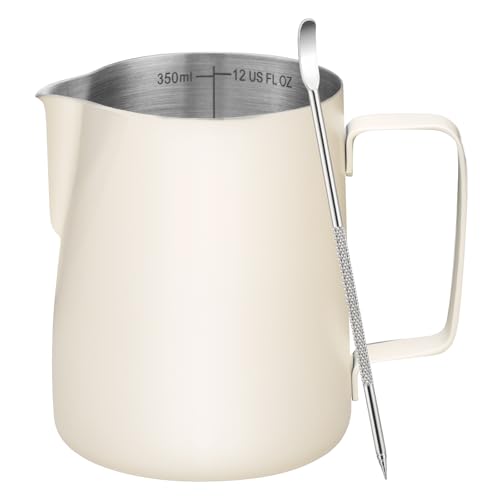
As an Amazon Associate we earn from qualifying purchases at no extra cost to you. Ratings are shown as listed on Amazon.
Quick comparison of the best milk frothing pitchers
| Pitcher type | Typical capacity | Approx. wall thickness | Empty weight | Best for | Typical price range |
|---|---|---|---|---|---|
| Compact single-drink pitcher | 8–12 oz / 240–355 ml | 0.5–0.8 mm | 140–220 g | One cappuccino or small latte | $10–$25 |
| Standard café pitcher | 12–20 oz / 355–600 ml | 0.7–1.0 mm | 200–330 g | One large latte or two smaller drinks | $18–$45 |
| Large service pitcher | 24–32 oz / 710–950 ml | 0.8–1.2 mm | 300–500 g | Three or more drinks at once | $25–$60 |
| Precision latte-art pitcher | 12–20 oz / 355–600 ml | 0.7–1.0 mm | 180–320 g | Controlled tulips, rosettas, and hearts | $25–$70 |
These are practical market ranges rather than fixed specifications. Manufacturers measure thickness, capacity, and weight differently, so use them as comparison points rather than exact promises.
What separates a good frothing pitcher from an ordinary one?
Stainless-steel thickness and heat response
Most durable pitchers use food-grade 304 stainless steel. Thinner walls heat quickly and keep the pitcher light, but they can transmit temperature changes abruptly and may dent more easily. A wall around 0.7 to 1.0 mm is a useful middle ground for home use: responsive enough for learning while sturdy enough for frequent steaming.
Very thick steel is not automatically better. It can slow tactile temperature feedback, making it harder to stop steaming at the right moment. If you rely on your hand to judge milk temperature, a medium-weight pitcher is generally easier to control. Some models use a polished interior and brushed exterior; the finish has little effect on foam quality, but a brushed exterior hides scratches better.
Capacity and usable fill level
Do not choose a pitcher by its maximum volume alone. Milk expands during steaming, so the practical starting fill is normally about one-third of the vessel’s capacity. An 8-ounce pitcher may take roughly 4 ounces of cold milk, while a 20-ounce pitcher may take 8 to 10 ounces.
That means a 12-ounce pitcher is often the most versatile size for one drink. Choose 20 ounces if you regularly make a large latte, two small cappuccinos, or drinks with plant-based milk that need extra room for expansion. A 32-ounce pitcher is efficient for a group but awkward for a single serving because the steam wand may not sit at the correct depth.
Spout precision
The spout controls the final pour, not the quality of the foam itself. A narrow, sharply formed spout releases a thin stream and gives better control for latte art. A rounded or wider spout is more forgiving when transferring foam into a mug but tends to produce less definition.
Look for a spout that is centered, symmetrical, and smoothly joined to the rim. A crooked tip can make the stream veer to one side even when the pitcher is held level. For beginners, a medium-fine spout is preferable to an extremely narrow competition-style tip because it remains usable for both simple pours and detailed patterns.
Measurement markings
Internal markings are useful when you want repeatable drinks. They can show ounces, milliliters, or both, but markings near the bottom matter most because that is where small single-serving differences occur. Laser-etched markings usually last longer than printed graduations, although heavy abrasion and aggressive cleaners can eventually reduce visibility.
Markings are not a substitute for weighing milk. A practical routine is to use the pitcher’s measurements while learning, then weigh the milk when you want consistent recipes. The markings remain valuable for quickly checking whether enough milk is present for the steam wand.
Handle comfort and grip
A welded loop handle is durable and easy to rinse, but its shape matters. A narrow loop can press against the fingers, especially with a full 20-ounce pitcher. A broader, slightly angled handle provides better leverage when rolling milk and pouring.
Handle-free pitchers offer more direct heat feedback and take less space, but they require careful technique. They are most suitable for experienced users who already know the temperature cues. For most home kitchens, a conventional handle with enough clearance for two or three fingers is the safer choice.
Best pitcher size by drinking situation
| Your situation | Recommended size | Why it fits | What to avoid |
|---|---|---|---|
| One espresso drink each morning | 8–12 oz | Better vortex control and less wasted milk | Oversized pitchers that require excessive fill |
| One large latte | 12–16 oz | Enough expansion room without becoming unwieldy | Very small pitchers filled to the rim |
| Two cappuccinos | 16–20 oz | Allows one steaming cycle and a controlled split pour | 8-ounce pitchers that force multiple batches |
| Three or more drinks | 24–32 oz | More efficient for shared preparation | Using the large pitcher for a single small drink |
| Frequent latte-art practice | 12–20 oz, fine spout | Balances volume, control, and repeatability | Blunt spouts and flexible, easily dented steel |
How popular pitcher styles compare
Classic café pitcher
The classic tapered pitcher is the best all-purpose option. It typically has medium-thick stainless steel, a moderate spout, and a handle that works for both steaming and pouring. It is the sensible choice for a first pitcher and usually offers the best value in the $15–$35 range.
Latte-art pitcher
A latte-art model normally has a narrower, more defined spout and a body shaped to create a strong milk vortex. It can make detailed pours easier, but it exposes poor steaming technique: bubbles and thin foam will still produce a messy pattern. Choose this style when the milk texture is already reasonably consistent.
Competition-style thin pitcher
Thin-walled pitchers heat rapidly and are favored by users who want precise temperature feedback. They are light and responsive, but more susceptible to dents and scratches. They are better for frequent, attentive use than for a busy household where the pitcher may be dropped into a crowded sink.
Large catering-style pitcher
A large pitcher is useful when preparing several drinks together, particularly with a powerful commercial steam wand. On a small domestic machine, however, a large volume may take too long to heat and may not form a stable vortex. Match the pitcher to the steam wand’s power, not only to the number of people drinking coffee.
Ownership realities: what wears out first?
The stainless-steel body can last for many years, but the first problems usually appear at the spout, handle weld, markings, or rim. Repeated knocks can flatten the spout and change the pour. A handle may loosen if the pitcher is regularly dropped or used to scrape hardened milk from a counter. Printed measurement marks can fade sooner than etched ones.
Rinse the pitcher immediately after steaming, then wash it with warm water and a non-abrasive detergent. Dried milk residue is harder to remove and can clog the spout edge. Avoid steel wool, harsh scouring powders, and leaving milk overnight. A dishwasher-safe label does not mean unlimited dishwasher exposure; high heat and detergent can dull finishes and fade markings over time.
Never steam milk in a damaged pitcher with a visibly sharp rim or loose handle. The cost difference between repairing a handle and replacing a basic pitcher is usually small, while a compromised grip creates an unnecessary spill risk.
A simple buying decision
- Choose 8–12 ounces if you usually make one drink and want the least waste.
- Choose 12–20 ounces for the most flexible home setup and regular latte-art practice.
- Choose 24–32 ounces only when your machine can steam larger quantities efficiently.
- Prioritize 304 stainless steel and approximately 0.7–1.0 mm walls for a balance of durability and heat feedback.
- Choose etched markings if repeatable milk quantities matter to you.
- Choose a medium-fine spout for general use; choose an especially narrow spout only if detailed latte art is a main goal.
- Choose a broad, comfortable handle if you steam several times per day or have larger hands.
For most home users, the strongest overall specification is a 12- or 16-ounce 304 stainless-steel pitcher with medium-thick walls, etched internal markings, a balanced handle, and a precise but not excessively narrow spout. That combination minimizes wasted milk, works with common domestic espresso machines, and leaves room to improve pouring technique without requiring specialized equipment.