Key takeaways
- Compare the best cheer shoes for flyers, tumblers, and bases, from featherlight stunt shoes to durable practice pairs, and find the fit for your role.
The best cheer shoes are the ones that disappear on your feet. When a shoe fits the way it should, you stop thinking about it during a routine and start thinking about timing, height, and landing. When it does not fit, every jump feels a little late, every landing feels a little harder, and every stunt feels a little less secure. Cheerleading asks more from footwear than almost any other indoor sport. The same pair of shoes has to grip a spring floor during tumbling passes, stay light enough for a flyer to be lifted and tossed, hold steady under a base who is catching weight overhead, and survive months of practices on mats that punish weak soles and loose stitching.
That is why cheer shoes are their own category. A running shoe is built to move forward in a straight line. A court shoe is built for lateral cuts and hard stops. A cheer shoe is built for vertical explosion, soft landings, quick pivots, and the specific demands of stunting, where one athlete stands on the hands of another and the shoe becomes the contact point between two people. The outsole has to grip without sticking. The upper has to breathe without stretching out of shape. The cushioning has to absorb impact without feeling soft or wobbly underfoot. The whole shoe has to be light, because extra weight at the end of the leg changes jump height and stunt timing in ways that add up over a full routine.
This guide compares five cheer shoes that cover the main roles on a squad: flyers who spend time in the air, tumblers who need rebound and grip, bases who need stability and support, and athletes who need one dependable pair for practice and competition. Each shoe is judged on the same points: weight and feel, grip on mats and spring floors, cushioning and landing support, breathability, durability, fit and sizing, and the role it serves best.
As an Amazon Associate, we earn from qualifying purchases.
Table of Contents
- Quick Answer
- How to Choose Cheer Shoes for Your Role
- 1. Nfinity Vengeance Cheer Shoe
- 2. Nfinity Flyte Cheer Stunt Shoe
- 3. Nfinity Evolution Cheer Shoes
- 4. Chassé Apex Cheerleading Shoes
- 5. Nfinity Titan Cheer Shoe
- Cheer Shoe Comparison Table
- Sizing Guide: How Cheer Shoes Should Fit
- How to Make Cheer Shoes Last Longer
- Who Should Skip a Dedicated Cheer Shoe
- Frequently Asked Questions
- Conclusion
- Product and ASIN Reference
Quick Answer
The Nfinity Vengeance is the strongest all-around pick for competition cheerleaders who fly, tumble, and stunt in the same routine, thanks to its light build, breathable mesh upper, and grippy outsole. The Nfinity Flyte is the best choice for flyers and stunt specialists who want the lightest shoe in this roundup and a grip pattern tuned for stunting. The Nfinity Evolution is the best pick for bases and all-around athletes who want more ankle support and cushioning for landings and catches. The Chassé Apex is the best budget pick for recreational squads, school teams, and younger athletes who need a solid cheer shoe without the premium tier. The Nfinity Titan is the best pick for tumblers who want a durable, supportive shoe built to handle repeated tumbling passes.
The short version of the buying advice is simple: flyers should chase the lightest shoe with the best stunt grip, bases should chase support and cushioning, tumblers should chase rebound and outsole durability, and everyone should size carefully, because cheer shoes from the brands in this guide tend to run small. The rest of this guide explains why each shoe earns its spot and how to match one to your role.
How to Choose Cheer Shoes for Your Role
Cheer shoes look similar at a glance, but the differences between them matter more than the similarities. Two shoes can share a white colorway, a mesh upper, and a lace-up closure while feeling completely different on a spring floor. The right way to choose is to start with your role on the squad, then check weight, grip, cushioning, breathability, and fit in that order. A shoe that is perfect for a flyer can be the wrong shoe for a base, and a shoe that survives a season of tumbling can still be the wrong shoe for sideline cheering on a hard track.
Start with your role on the squad
Your role decides which features matter most. Flyers spend the most time in the air, and every extra ounce at the end of the leg makes jumps and tosses harder to control. A flyer needs a light shoe with a secure fit, a low profile that lets the foot point cleanly, and a sole that grips a base’s hands without slipping. Stunt grip matters more than deep cushioning for a flyer, because the shoe is a platform that other athletes stand on and hold.
Bases and back spots carry weight. They lift, catch, and hold flyers overhead, and they absorb the force of every landing that comes back down to the mat. A base needs a shoe with a stable platform, solid ankle support, and cushioning that softens repeated impact. Weight matters less for a base than for a flyer, because a base’s feet stay on the ground for most of the routine. What matters is a shoe that does not roll, twist, or compress unevenly when the load shifts suddenly.
Tumblers need rebound and grip in equal measure. A tumbling pass starts with a run, builds through a roundoff and handspring, and ends with a landing that has to stick. The shoe has to flex with the foot through the run, grip the floor through the takeoff, and cushion the landing without feeling mushy. Outsole durability matters more for tumblers than for anyone else, because the same contact points take the same pounding on every pass.
Weight changes everything
Weight is the first number to check, and the reason is simple physics. Cheerleading is a jumping sport, and jump height depends on how much mass the legs have to lift. A shoe that weighs a few ounces more than another shoe may not sound like much, but the difference is felt at the end of the leg, where it has the most leverage. Over a two-minute routine with dozens of jumps, that difference turns into fatigue, and fatigue turns into landings that drift and stunts that wobble.
The lightest shoes in this guide sit in the featherlight range, with the Flyte at the front of the pack. The heaviest shoe here, the Chassé Apex, is still light by the standards of a normal athletic shoe, but it is nearly twice as heavy as the lightest option, and flyers notice that gap. That does not make a heavier shoe a bad shoe. A base who never leaves the ground will trade a little weight for support and durability without a second thought. The mistake is buying a heavier shoe for a flyer who needs the lightest shoe available, or buying the lightest shoe for a base who needs the support that a slightly heavier build provides.
Grip has to work on mats, spring floors, and hardwood
Grip is the feature that keeps athletes safe. A cheer shoe has to grip a spring floor during a tumbling run, grip a mat during a jump, and grip the hands and shoulders of a base during a stunt. Rubber outsoles with textured tread grip well on mats and gym floors, and shoes with rubber pods at high-wear points keep their grip longer, because the contact areas are reinforced instead of wearing smooth.
Cushioning should absorb landings without feeling soft
Cushioning in a cheer shoe has a narrower job than cushioning in a running shoe. A running shoe cushions thousands of small, repetitive impacts in a straight line. A cheer shoe cushions fewer, harder impacts from jumps and tumbling landings, and it has to do it without feeling unstable. A midsole that is too soft feels wobbly under a base who is holding weight overhead. A midsole that is too firm sends every landing straight up through the ankles and knees.
Breathability keeps feet cool through long practices
Cheer practices run long, and routines run hot. A shoe with a closed, heavy upper traps heat and moisture, and feet that overheat get uncomfortable fast. Breathable mesh uppers and perforated panels let air move through the shoe, which keeps feet cooler and drier through a full practice. Some shoes in this guide use knit uppers that breathe especially well. Others use leather and synthetic panels that breathe less but offer more structure and durability.
Fit and sizing deserve more attention than any other feature
Cheer shoes fit differently from street shoes, and the brands in this guide are known for running small. A shoe that fits perfectly in a store can feel tight on a mat, and a shoe that feels fine standing still can pinch during a jump. The standard advice is to size up, usually by half a size for women and a full size for men, and to check the sizing chart for the specific model before ordering. Youth sizes run on their own scale, and a youth size does not convert directly to an adult size.
Indoor-only shoes and outdoor use
One of the most common mistakes in cheer shoe shopping is buying an indoor competition shoe and wearing it outside. Competition shoes are built for blue mats and spring floors. Their outsoles are tuned for grip on smooth indoor surfaces, their uppers are built light rather than tough, and their cushioning is designed for mat landings. On concrete or asphalt, the outsole wears down fast, the upper picks up dirt and scuffs, and the shoe loses the grip that makes it safe indoors. Check the intended use before buying, and if the squad practices outdoors, keep a separate pair for the track or field.
1. Nfinity Vengeance Cheer Shoe

The Nfinity Vengeance is the shoe that most competition cheerleaders picture when they think of a cheer shoe. It is the flagship model in the Nfinity line, and it shows up on mats at every level of the sport, from youth squads to college programs to all-star teams. The Vengeance earns that place by doing the core job of a cheer shoe better than most of its rivals: it is light, it breathes, it grips, and it holds its shape through the kind of season that wears lesser shoes out by mid-year.
The first thing athletes notice about the Vengeance is the weight, or rather the lack of it. This is a featherlight shoe by any standard, and the difference is obvious the first time an athlete jumps in it after training in a heavier pair. The light build comes from a breathable mesh upper layered over a low-profile midsole, a combination that keeps the shoe close to the foot without adding bulk. Mesh panels move air through the shoe, which keeps feet cooler during long practices and helps the shoe dry out between sessions. The mesh is backed by synthetic overlays that give the upper structure, so the shoe does not stretch out of shape after a few weeks of hard use. That balance between breathability and structure is hard to get right, and the Vengeance gets it right more consistently than most shoes in its class.
Grip is the second strength. The outsole is built for the surfaces cheerleaders actually compete on: spring floors, blue mats, and gym floors. Rubber pods at the high-wear points give the shoe traction where it counts, at the forefoot for push-off and at the heel for landing. The tread pattern grips firmly without locking the foot in place, which matters during twists and turns. An athlete who plants for a roundoff needs the shoe to hold. An athlete who twists out of a full needs the shoe to release cleanly. The Vengeance does both, which is why it works for tumblers as well as for flyers and bases. It is a true all-around competition shoe, not a specialist that only works for one role.
Cushioning in the Vengeance is tuned for responsiveness rather than softness. The midsole absorbs the shock of landings and returns energy on takeoff, which helps tumblers string skills together without losing height between passes. The insole is padded and shaped to support the arch, and the heel is reinforced so the foot stays locked in place during jumps. That heel lock matters more than it sounds. A heel that slips inside a shoe during a jump changes the angle of the foot at landing, and a landing with the wrong angle is how ankles get hurt. The Vengeance holds the heel in place, and athletes who have worn it for a season tend to mention that locked-in feel as one of the things they would miss most in another shoe.
The Vengeance sits in the premium group in this roundup. That is the trade-off for a shoe that does everything well. For a competition athlete who flies, tumbles, and bases in the same routine, the Vengeance is the easiest recommendation in this guide, because it does not ask the athlete to give anything up. For a recreational athlete or a younger cheerleader who is still growing out of shoes every season, the tier is harder to justify, and one of the budget or mid-range options below will serve better. But for the athlete who needs the best all-around cheer shoe available, the Vengeance is the benchmark the other shoes are measured against.
Specs
- Best for: all-around competition, flyers, tumblers, and bases who want one shoe for every role
- Upper: breathable mesh with synthetic overlays for structure and support
- Outsole: rubber with reinforced pods at high-wear points for grip on mats and spring floors
- Cushioning: responsive midsole with a padded, arch-supporting insole and a reinforced heel
- Fit: runs small, order a size up from a normal street shoe
- Use: indoor competition and practice on mats and spring floors
- Colors: white and black
- Extras: hard-shell carry case included
- Group: Premium
2. Nfinity Flyte Cheer Stunt Shoe

The Nfinity Flyte is the lightest shoe in this roundup, and it is built for one job above all others: stunting. Where the Vengeance is an all-around competition shoe, the Flyte is a specialist. It is the shoe a flyer reaches for when the routine depends on being light in the air, quick on the takeoff, and steady on the hands of a base. At a listed weight in the featherlight range, the Flyte is the shoe that makes the biggest difference to jump height and stunt timing, and flyers who switch to it from a heavier shoe usually feel the difference in the first practice.
The Flyte achieves its light weight with a hyper-breathable knit upper. The knit is the most breathable material in this guide, and it moves air through the shoe better than the mesh panels on the Vengeance or the synthetic leather on the Apex. That breathability keeps feet cool through long stunt sessions, and the knit flexes with the foot instead of resisting it, which makes the shoe feel like an extension of the foot rather than a piece of equipment strapped to it. The trade-off is that a knit upper offers less structure than a leather or synthetic upper, and the Flyte compensates with a reinforced metatarsal area that supports the middle of the foot and keeps the shoe from twisting under load. That reinforcement is the key engineering detail in the Flyte, and it is what lets a shoe this light hold up under the forces of stunting.
Grip is where the Flyte earns its name. The outsole uses a stunt-specific grip pattern with three rubber pads placed at the high-wear areas of the sole. Those pads are positioned where a flyer’s foot contacts a base’s hands and shoulders, and they are designed to hold firm without slipping. The grip is directional in the right way: it holds when the flyer plants and pushes off, and it releases when the flyer needs to turn. The rubber outsole is durable for a shoe this light, and the pad placement means the grip lasts longer than it would on a shoe with a uniform tread that wears evenly across the whole sole.
Fit follows the usual Nfinity pattern: the Flyte runs about half a size small, so most athletes should order a half size up from their normal street shoe. The knit upper has a little give, which helps the shoe conform to the foot, but it does not stretch the way a fabric shoe does, so the size still has to be right. The shoe comes in white and black, and the white version is the one most squads require for competition.
The Flyte sits in the mid-range group, which makes it one of the best values in this roundup for the athlete it was built for. A flyer who buys the Flyte gets the lightest shoe available at a tier below the premium Vengeance, and the stunt-specific grip is genuinely better than the grip on any general-purpose shoe. A base or a tumbler who buys the Flyte will be disappointed, because the shoe was not built for their job. The lesson of the Flyte is the lesson of this whole guide: match the shoe to the role, and the right shoe will feel like it was made for you.
Specs
- Best for: flyers and stunt specialists who want the lightest shoe available
- Upper: hyper-breathable knit with a reinforced metatarsal area
- Outsole: rubber with three pads at high-wear points and a stunt-specific grip pattern
- Cushioning: thin, responsive midsole with padded Achilles support
- Fit: runs about half a size small, order a half size up
- Use: indoor stunting and competition on mats and spring floors
- Colors: white and black
- Weight: listed in the featherlight range, the lightest shoe in this roundup
- Group: Mid-range
3. Nfinity Evolution Cheer Shoes

The Nfinity Evolution is the shoe for the athlete who does the heavy lifting. Bases, back spots, and all-around athletes who spend a routine catching weight overhead need support and cushioning more than they need the lightest shoe on the market, and the Evolution is built around that priority. It is the most supportive shoe in this roundup, and it is the one that coaches most often recommend for athletes who are new to competitive cheerleading, because it protects the ankles and cushions the landings while the athlete is still learning to control them.
The headline feature of the Evolution is AnkleLoc technology, a design that locks the heel and ankle in place so the foot does not slide inside the shoe during jumps and stunts. The heel is reinforced and shaped to hug the ankle, and the lacing system works with the heel structure to keep everything fixed. That matters most for bases, who plant their feet and hold weight overhead while the flyer moves above them. A base whose foot shifts inside the shoe loses balance at the worst possible moment. The Evolution keeps the foot where it belongs, and the difference is noticeable during long stunt sequences when fatigue makes every small instability worse.
The forefoot uses NfiniFit, a design that shapes the front of the shoe around the natural curve of the toes and the impact area. That shaping matters because the forefoot takes the first contact on every landing. A shoe that fits the forefoot well spreads the force of a landing across the whole front of the foot instead of concentrating it on one spot. The interlocking lacing system adds to that secure feel, and the bubble laces hold tension through a routine without loosening. Bubble laces are the thick, elastic laces that show up on several shoes in this guide, and they are popular for a simple reason: they stay tied, they hold the shoe snug, and they do not need to be re-tied between stunts.
Cushioning is the second reason to choose the Evolution. The padded insole is thicker and more supportive than the insole in the Flyte, and it is shaped to hug the arch and reduce pressure on the heel and forefoot. The midsole is built for the repeated impact of a base’s job: catching a flyer, absorbing a landing, and doing it again a dozen times in a single routine. The natural rubber outsole adds grip and durability, and the rubber pods at the high-wear points keep the traction working through a full season. The Evolution is a competition shoe, which means it is built for indoor use on mats and spring floors, and it will wear out faster if it is worn on rough outdoor surfaces.
The Evolution sits in the mid-range group, which makes it one of the strongest value picks in this guide. It costs less than the Vengeance, it offers more support and cushioning than the Flyte, and it is durable enough to survive a full season of practice and competition. For a base who needs stability and landing support, it is the best shoe in this roundup. For an all-around athlete who flies, tumbles, and bases in the same routine, it is a strong alternative to the Vengeance that trades a little lightness for a lot of support. For a flyer who wants the lightest shoe possible, it is the wrong choice, and the Flyte will serve better.
Specs
- Best for: bases, back spots, and all-around athletes who want support and cushioning
- Upper: leather, sateen, and mesh for structure, durability, and breathability
- Outsole: natural rubber with reinforced pods at high-wear points
- Cushioning: padded, arch-supporting insole with a responsive midsole built for repeated impact
- Support: AnkleLoc technology locks the heel and ankle in place
- Fit: runs small, order a size up from a normal street shoe
- Lacing: interlocking lacing system with bubble laces
- Use: indoor competition and practice on mats and spring floors
- Colors: white and black
- Group: Mid-range
4. Chassé Apex Cheerleading Shoes
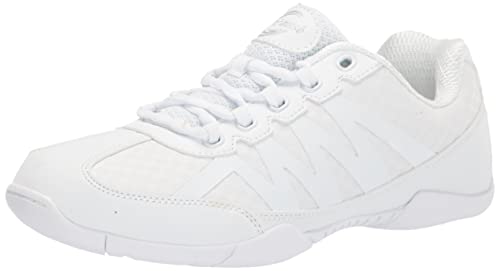
The Chassé Apex is the best budget pick in this roundup, and it is the shoe that makes the most sense for the largest number of cheerleaders. Not every athlete needs a premium competition shoe. School squads, recreational teams, and younger athletes who are still growing need a shoe that grips well, supports the foot, looks clean on the mat, and does not need to be replaced at a premium tier every time a foot grows half a size. The Apex does all of that, and it does it at the most accessible tier in this guide.
The Apex is built around a synthetic leather upper with a textured surface. That upper is the reason the shoe is so durable for its tier. Synthetic leather resists scuffs and holds its shape better than thin mesh, and it wipes clean easily after practice. The textured surface works with the high-gloss TPU system that connects the lace eyelets to the gripping panels on the sides of the shoe, a design that keeps the foot locked in during stunts. The threaded metal eyelet lace system is a small detail that matters, because metal eyelets do not tear the way fabric eyelets can, and they keep the laces running smoothly through a season of daily use. Bubble laces come standard, and they hold the shoe snug through jumps and tumbling without needing to be re-tied.
The outsole is rubber molded for durability, and it grips well on mats and gym floors. It is not as specialized as the stunt-specific grip on the Flyte or the podded outsole on the Vengeance, but it is reliable, and reliability is what a budget shoe has to deliver first. The Apex is a low-profile shoe, which keeps it close to the ground and makes it easy to point the foot cleanly during jumps and motions. The low profile also helps with stunting, because a thinner sole means the foot sits lower and more stable on a base’s hands.
Weight is the one area where the Apex shows its tier. At a listed weight that is nearly twice the weight of the lightest shoe in this guide, the Apex is noticeably heavier than the Flyte and the Vengeance. Flyers will feel that weight in every jump, and a flyer who competes at a high level should look at the Flyte instead. But for bases, sideline cheerleaders, and recreational athletes, the extra weight is a fair trade for the durability and the accessible tier. The Apex is also the shoe in this guide that handles mixed use best. The synthetic leather upper and the molded rubber outsole hold up better than mesh and knit uppers when the shoe is worn on harder surfaces, which makes the Apex a reasonable choice for squads that split time between the gym and the sideline.
The Apex sits in the budget group, and that is the point. It is the shoe that a squad can buy for a whole team without stretching the budget, and it is the shoe a parent can buy for a growing athlete without worrying about replacing a premium shoe every few months. It does not do anything better than the premium shoes in this guide, but it does everything well enough, and for the athlete it was built for, that is exactly right. A recreational cheerleader in the Apex will jump, tumble, and stunt safely and comfortably. A competition flyer in the Apex will feel the weight and wish for the Flyte. Matching the shoe to the athlete is what matters, and the Apex matches a lot of athletes very well.
Specs
- Best for: recreational squads, school teams, and younger athletes who want a solid cheer shoe at the budget tier
- Upper: synthetic leather with a textured surface and a high-gloss TPU support system
- Outsole: molded rubber designed for durability and grip on mats and gym floors
- Lacing: threaded metal eyelet system with bubble laces
- Fit: runs half a size small, order a half size up
- Care: hand wash in cold water with a mild detergent, air dry only
- Use: practice, sideline, and competition, indoors and on harder surfaces
- Colors: white and black
- Group: Budget
5. Nfinity Titan Cheer Shoe

The Nfinity Titan is the tumbler’s shoe. Where the Flyte is built for stunting and the Evolution is built for basing, the Titan is built for the athlete who runs, flips, and lands, over and over again, on every practice and every routine. Tumbling is the most punishing job in cheerleading for footwear, because the same contact points take the same impact on every pass, and the shoe has to keep its grip and its shape through hundreds of repetitions. The Titan is designed for that job, and it is the most durable shoe in this roundup for tumbling work.
The Titan’s strength starts with its build. It is a sturdy, well-structured shoe with a reinforced outsole and a durable upper that holds up to the repeated friction of tumbling passes. The outsole is built to grip through the takeoff of a roundoff and the landing of a handspring, and the reinforcement at the high-wear points keeps the traction working long after a lighter shoe would have worn smooth. That durability is the reason coaches recommend the Titan for athletes who tumble heavily. A shoe that loses its grip mid-season is a safety problem, and the Titan is built to keep its grip through a full season of tumbling.
The fit is supportive and stable. The Titan has a padded heel and arch support that keep the foot locked in during the run-up to a tumbling pass, and the stable feel underfoot helps the athlete control the takeoff and the landing. The shoe is light for its build, and it moves with the foot instead of fighting it, which matters during the quick transitions of a tumbling pass. The upper is made from quality materials that resist scuffing and hold their shape, and the white colorway looks clean on the mat through a season of use.
Cushioning in the Titan is tuned for the repeated impact of tumbling. The midsole absorbs the shock of landings without feeling soft or unstable, and the padded insole supports the arch through the run and the landing. Tumblers land hard, and they land often, and a shoe that cushions well without losing its shape is the difference between a season that ends strong and a season that ends with sore feet and tired legs. The Titan finds that balance. It is not the softest shoe in this guide, and it should not be. A tumbling shoe that is too soft feels wobbly on takeoff, and a wobbly takeoff is how passes go wrong. The Titan is firm where it needs to be firm and cushioned where it needs to be cushioned.
Fit follows the usual Nfinity pattern and runs small, so most athletes should order a size up. The Titan is available in youth and adult sizes, which makes it a good option for younger tumblers who are still growing and for older athletes who need a durable shoe for competition. The youth sizes are especially useful, because young tumblers wear through shoes fast, and a shoe that survives a season of tumbling is worth more than a shoe that is light but wears out in a month.
The Titan sits in the mid-range group, and it is one of the best values in this guide for the athlete it was built for. A tumbler who buys the Titan gets a shoe that is built for their job at a tier below the premium Vengeance, and the durability means the shoe lasts longer than a lighter shoe would under the same workload. A flyer who buys the Titan will find it heavier than the Flyte and less suited to stunt work. A base who buys the Titan will find it less supportive than the Evolution. But a tumbler who buys the Titan will find a shoe that was made for exactly what they do, and that is the whole point of a specialist shoe.
Specs
- Best for: tumblers who want a durable, supportive shoe built for repeated tumbling passes
- Upper: durable, structured materials with a clean white finish
- Outsole: reinforced rubber built for grip and durability on mats and spring floors
- Cushioning: responsive midsole with a padded insole and arch support
- Support: padded heel and stable platform for controlled takeoffs and landings
- Fit: runs small, order a size up from a normal street shoe
- Use: indoor tumbling, practice, and competition on mats and spring floors
- Colors: white and black
- Group: Mid-range
Cheer Shoe Comparison Table
| Shoe | Best For | Group | Upper | Standout Feature |
|---|---|---|---|---|
| Nfinity Vengeance | All-around competition | Premium | Breathable mesh with synthetic overlays | Lightest all-around build with a carry case included |
| Nfinity Flyte | Flyers and stunt specialists | Mid-range | Hyper-breathable knit | Lightest shoe in this roundup with stunt-specific grip |
| Nfinity Evolution | Bases and all-around athletes | Mid-range | Leather, sateen, and mesh | AnkleLoc support and the most cushioning here |
| Chassé Apex | Recreational and school squads | Budget | Synthetic leather | Most durable budget build with metal eyelets |
| Nfinity Titan | Tumblers | Mid-range | Durable structured materials | Reinforced outsole built for repeated tumbling |
Sizing Guide: How Cheer Shoes Should Fit
Getting the size right matters more with cheer shoes than with almost any other athletic shoe, because the fit affects safety as well as comfort. A shoe that is too loose lets the foot slide during jumps and stunts, which changes the timing of landings and makes the athlete less stable. A shoe that is too tight pinches the toes, causes blisters, and makes it hard to point the foot cleanly. The right fit is snug without being tight, with the heel locked in place and the toes able to move slightly without sliding forward.
Start by measuring both feet, because most people have one foot slightly larger than the other, and the larger foot decides the size. Measure at the end of the day, when feet are at their largest, and measure while standing, because feet spread under weight. Compare the measurement to the sizing chart for the specific model, not to a generic chart, because sizing varies between brands and between models from the same brand. The shoes in this guide run small, and the standard advice is to order a half size up for the Flyte and the Apex, and a full size up for the Vengeance, the Evolution, and the Titan. Athletes who wear thick socks or who have wider feet should consider going up another half size, and athletes between sizes should always choose the larger size.
Try the shoes on with the socks that will be worn during cheer, and walk, jump, and pivot in them before deciding. The heel should stay in place during a jump. The toes should not press against the front of the shoe when landing. The arch should feel supported without being squeezed. The laces should be snug enough to lock the foot in without cutting off circulation. If the shoe feels tight in the store, it will feel tighter on the mat, and it will not stretch enough to fix a bad fit. If the shoe feels loose in the store, it will feel looser during a routine, and no amount of lacing will fix that either.
How to Make Cheer Shoes Last Longer
Cheer shoes are not cheap, and making them last is mostly a matter of using them the way they were designed to be used. The single most important rule is to wear competition shoes only indoors, on mats and spring floors. Outdoor surfaces wear down the outsole fast, and once the tread is gone, the shoe loses the grip that keeps the athlete safe. Keep a separate pair for outdoor sideline work if the squad cheers on a track or a field, and save the competition shoes for the gym.
Cleaning matters too. Wipe the shoes down after every practice with a damp cloth to remove chalk, dust, and mat residue. That residue builds up on the outsole and reduces grip, and it stains the upper if it is left to set. For deeper cleaning, hand wash in cold water with a mild detergent and air dry away from direct heat and sunlight. Never put cheer shoes in the washing machine or the dryer unless the manufacturer says it is safe, because the heat and the agitation break down the adhesives and the cushioning. Remove the insoles to dry separately, which reduces odor and helps the shoe dry faster.
Who Should Skip a Dedicated Cheer Shoe
A dedicated cheer shoe is the right choice for most cheerleaders, but it is not the right choice for everyone. Athletes who only cheer occasionally, or who cheer as a small part of a larger sport, may not need a specialist shoe. A recreational athlete who attends one practice a week and performs at a handful of games will do fine in a general athletic shoe with good grip and support, and the savings can go toward other gear.
Outdoor sideline cheerleaders should also consider whether a competition shoe is the right tool. If the squad spends most of its time on a track, a field, or a concrete surface, a competition shoe built for indoor mats will wear out fast and grip poorly. A shoe with a full rubber outsole and a tougher upper, like the Apex, will hold up better outdoors, but even the Apex is not a trail shoe. Finally, athletes who are still growing fast may want to think twice before buying the most expensive shoe in this guide. A young cheerleader who grows out of a shoe in three months gets the same value from a budget shoe as from a premium shoe, because the shoe will be outgrown before it wears out.
Frequently Asked Questions
What is the best cheer shoe for a flyer?
The best cheer shoe for a flyer is the lightest shoe with the best stunt grip, and in this roundup that is the Nfinity Flyte. Flyers spend the most time in the air, and every extra ounce at the end of the leg makes jumps and tosses harder to control. The Flyte is the lightest shoe here, and its stunt-specific grip pattern is designed for the exact job a flyer does: holding steady on a base’s hands and pushing off cleanly for the next skill. The Nfinity Vengeance is the best alternative for a flyer who also tumbles and bases, because it is nearly as light and more versatile across roles.
How do cheer shoes differ from regular athletic shoes?
Cheer shoes differ from regular athletic shoes in weight, grip, and construction. They are lighter than running shoes and court shoes, because cheerleading is a jumping sport and extra weight at the end of the leg changes jump height and stunt timing. Their outsoles are tuned for grip on spring floors, blue mats, and gym floors, with tread patterns that hold during stunts and release during twists. Their uppers are built for breathability and a close, locked-in fit, with features like reinforced heels, interlocking lacing, and bubble laces that keep the shoe secure during routines.
Should cheer shoes be worn outdoors?
Most competition cheer shoes should not be worn outdoors, because they are built for indoor mats and spring floors. The outsoles are tuned for grip on smooth indoor surfaces, and concrete, asphalt, and track surfaces wear the tread down fast. Once the tread is gone, the shoe loses the grip that keeps the athlete safe indoors, and the upper picks up dirt and scuffs that are hard to clean. If a squad cheers on a track or a field, the best approach is to keep a separate pair for outdoor use and save the competition shoes for the gym. The Chassé Apex is the most outdoor-tolerant shoe in this roundup, thanks to its synthetic leather upper and molded rubber outsole, but even the Apex will last longer if it is kept off rough surfaces whenever possible.
How long do cheer shoes last, and when should they be replaced?
How long cheer shoes last depends on how often they are worn, where they are worn, and how well they are cared for. With regular practice, most competition cheer shoes perform well for a full season, and athletes who train daily may need a replacement sooner. The signs that a shoe needs replacing are a worn-smooth outsole that has lost its grip, a compressed midsole that no longer rebounds after landings, visible creasing or tearing in the upper, and a heel that no longer locks the foot in place. A shoe that has lost its grip or its cushioning is a safety risk, even if it still looks clean.
Conclusion
The best cheer shoes are the ones that match the athlete wearing them. A flyer needs the lightest shoe with the best stunt grip, and the Nfinity Flyte delivers that at a mid-range tier. A base needs support and cushioning for the weight of every catch and landing, and the Nfinity Evolution delivers that with AnkleLoc support and the most protective insole in this roundup. A tumbler needs a durable shoe that keeps its grip through hundreds of passes, and the Nfinity Titan delivers that with a reinforced outsole built for the job. A recreational athlete or a growing young cheerleader needs a solid shoe at an accessible tier, and the Chassé Apex delivers that with a tough synthetic leather build and reliable grip. And the athlete who does a little of everything needs a shoe that does a little of everything well, and the Nfinity Vengeance delivers that as the strongest all-around pick in this guide.
Start with your role, then check weight, grip, cushioning, breathability, and fit in that order. Size up, because the shoes in this guide run small. The right shoe will not make a routine by itself, but the wrong shoe will hold a routine back, and the right shoe will let an athlete forget about their feet and focus on the performance.
Product and ASIN Reference
| Product | ASIN |
|---|---|
| Nfinity Vengeance Cheer Shoe | B006WAEL66 |
| Nfinity Flyte Cheer Stunt Shoe | B01MZG5BK0 |
| Nfinity Evolution Cheer Shoes | B00505Q39M |
| Chassé Apex Cheerleading Shoes | B071Z3BLBN |
| Nfinity Titan Cheer Shoe | B0167JBB1Y |
More from Amazon
Programs that pair well with the guide above. Offers and eligibility are set by Amazon and may change.
Free shipping on eligible items, Prime Video and more. Eligible new members can start with a free trial.
Start a Prime free trialA Prime membership for ages 18-24 with a trial period. Eligibility is set by Amazon.
See Prime for Young AdultsAudiobooks and podcasts to listen to on the go. Eligible new members can start with a free trial.
Try Audible freeAd-free music streaming. Eligible new subscribers can start with a free trial.
Try Music Unlimited freeAs an Amazon Associate we earn from qualifying purchases.