Key takeaways
- Compare the best basketballs for outdoor play by cover, grip and durability: composite and rubber balls built for asphalt, concrete and driveway games.
Quick answer: The best basketball for outdoor play for most buyers is the Wilson NBA DRV Pro in size 7, because it is the outdoor ball that best balances grip and toughness: a Tackskin composite cover that stays grippy in dust and light moisture, an inflation retention lining that holds air through weeks of driveway games, and the NBA Pro Seam channel construction that gives a shooter a consistent release. The Spalding Zi/O Excel is the composite pick for players who want a softer, foam-backed feel with a deep channel grip, the Wilson NCAA Street Shot is the budget rubber ball for rough concrete, the Spalding Street Outdoor is the toughest pure rubber ball in the guide for asphalt that eats covers, and the Molten BG3800 is the premium pick, the FIBA approved composite ball for players who want a tournament-grade cover outdoors.
An outdoor basketball lives a harder life than an indoor ball, and the buying decision is really a decision about the cover. Concrete and asphalt sand a ball’s surface down with every dribble, dust fills the channels that give a shooter grip, and sun and rain dry and crack covers that were built for a climate-controlled gym. A ball built for the driveway has to survive that cycle, and the five picks in this guide divide into the two cover families that do: rubber, which is the toughest and cheapest surface for rough courts, and composite, which costs more and feels closer to a game ball while still resisting outdoor wear. Two of the five picks are Wilson balls and two are Spalding balls, because those two makers supply nearly every outdoor ball sold in the United States, and the guide’s job is to place each buyer on the right rung of their ranges rather than pretend five equal brands compete here. The Molten BG3800 closes the guide as the one pick from outside that pair, the FIBA approved ball for players who want international game-ball construction on an outdoor court. The differences that matter are cover material, channel depth, bladder construction and size, and those four variables decide almost everything about how a ball plays outside.
The first divide is cover material. Rubber is the outdoor material: it is tough, it resists scuffing and moisture, it holds its grip when the court is dusty, and it is the cheapest cover to replace when it finally wears smooth, at the cost of a harder, less refined feel that shooters notice on long shots. Composite is the game-feel material: a synthetic leather cover with a pebbled texture that grips like a leather game ball, holds its shape through seasons of outdoor use, and gives a shooter the touch that rubber cannot, at the cost of wearing faster on the roughest asphalt and demanding a higher tier. The second divide is the channel, the groove between panels that a player’s fingers read on every shot: deep channels give a shooter more to grip and a dribbler more control on a dusty court, while shallow channels feel smoother and faster but offer less purchase when the ball is dirty. The third divide is the bladder, the inner chamber that holds the air: a butyl bladder holds air for weeks between top-ups, while a latex bladder holds air for days and needs a pump nearby, and for an outdoor ball that lives in a garage the butyl bladder is the practical choice. The fourth divide is size, and it is the one that cannot be compromised: size 7 at twenty-nine and a half inches around is the official men’s size, size 6 at twenty-eight and a half inches is the women’s and older youth size, and size 5 at twenty-seven and a half inches is the youth size, and a ball bought in the wrong size is a ball that teaches the wrong muscle memory. Read the cover, the channels, the bladder and the size off the listing’s own specification block before ordering, and every pick below will arrive as the ball described.
As an Amazon Associate, we earn from qualifying purchases.
Table of Contents
- How We Chose These Basketballs
- Quick Comparison
- The 5 Best Basketballs for Outdoor Play
- How to Choose the Right Basketball for Outdoor Play
- Frequently Asked Questions
- Conclusion
- Product and ASIN Reference
How We Chose These Basketballs
The shortlist started from the balls that outdoor players actually buy: the Wilson DRV line, the Spalding Street and Zi/O lines, and the Molten BG series, because a ball that thousands of driveway and park players keep buying has already passed the only durability trial that matters, which is repetition on concrete. From that pool, each candidate had to clear four checks. It had to be a current, orderable Amazon listing with a confirmed identifier read from the listing’s own product information or a corroborating Amazon listing record, not inferred from a similar size or color. It had to publish its cover material and its size, because a basketball listing that will not state whether its cover is rubber or composite is a listing that cannot be bought with confidence. It had to fill a distinct role in the lineup, so the five picks divide into a best-overall composite, a softer composite, a budget rubber ball, a toughest rubber ball, and a premium FIBA approved ball, rather than five versions of the same driveway ball. And it had to be a real regulation ball, not a toy or a novelty: mini balls, foam balls, autograph balls and training balls with weighted or oversized builds were excluded entirely, because they are display and training products with their own buying logic and a different buyer.
Two exclusions shaped the list as much as the inclusions. Indoor-only game balls were left out, because a leather game ball that was built for hardwood will scuff, dry and lose its grip on asphalt in a single season, and a guide about outdoor play that recommended one would be recommending a ball for the wrong court. And team-logo balls were left out, because the same regulation ball sells under dozens of team marks with separate listings, and a guide that recommended one team’s ball would be recommending a decoration rather than a specification. What remains is five balls that between them cover how basketballs are actually bought for outdoor use in the United States: one composite all-rounder for the player who wants grip and durability together, one softer composite for feel, two rubber balls for the roughest courts at two levels of toughness, and one premium FIBA approved ball for the player who wants tournament construction outdoors.
Quick Comparison
| Pick | Cover | Size | Bladder | Tier | Best for |
|---|---|---|---|---|---|
| Wilson NBA DRV Pro | Tackskin composite | Size 7, 29.5 in | Inflation retention lining | Mid-range | Best overall outdoor grip and durability |
| Spalding Zi/O Excel | Zi/O Tournament composite | Size 7, 29.5 in | Not stated | Mid-range | Softer feel with deep channel grip |
| Wilson NCAA Street Shot | Total Grip rubber | Size 7, 29.5 in | Pressure-lock bladder | Budget | Rough concrete on a budget |
| Spalding Street Outdoor | Performance rubber | Size 7, 29.5 in | Not stated | Budget | The toughest pure rubber ball |
| Molten BG3800 | Synthetic composite | Size 7, 29.5 in | Nylon-wound butyl | Premium | FIBA approved tournament construction |
The 5 Best Basketballs for Outdoor Play
1. Wilson NBA DRV Pro Basketball, Size 7

The Wilson NBA DRV Pro is the best overall outdoor basketball in this guide, and it earns that place because it is the one composite ball that does not ask the buyer to choose between grip and durability. Wilson builds it with a Tackskin cover, a composite surface with a cushion layer that stays grippy in dust and light moisture, over an inflation retention lining that holds air through weeks of driveway games, and the ball carries the NBA Pro Seam channel construction, a new channel shape suited to player preference that gives a shooter a consistent release. The listing in this guide is the size 7 brown ball, the official men’s size at twenty-nine and a half inches around, and it is the ball to buy when the court is outdoors and the game matters enough to want a real grip.
What separates the DRV Pro from the rubber balls below it is the feel. A composite cover grips like a game ball, holds its shape through seasons of outdoor use, and gives a shooter the touch that rubber cannot, and the DRV Pro’s cushion layer is what keeps that grip working when the court is dusty, which is the condition that defeats most composite balls outdoors. None of that makes it indestructible. Composite wears faster than rubber on the roughest asphalt, and a player whose court is cracked concrete with loose aggregate will wear the DRV Pro’s cover smooth sooner than a rubber ball, which is the trade the next two picks exist to cover. Buy it for the driveway, the park court and the school blacktop where the game is real and the surface is decent, and let the rubber balls below it carry the courts that eat covers.
Specs
- Brand: Wilson
- Model line: NBA DRV Pro
- Cover: Tackskin composite with cushion layer
- Seams: NBA Pro Seam channel construction, per the maker
- Air retention: Inflation retention lining, per the maker
- Size: Size 7, 29.5 in, official men’s size
- League role: NBA licensed, recreational outdoor play
- Tier: Mid-range
2. Spalding Zi/O Excel Indoor-Outdoor Basketball, 29.5″
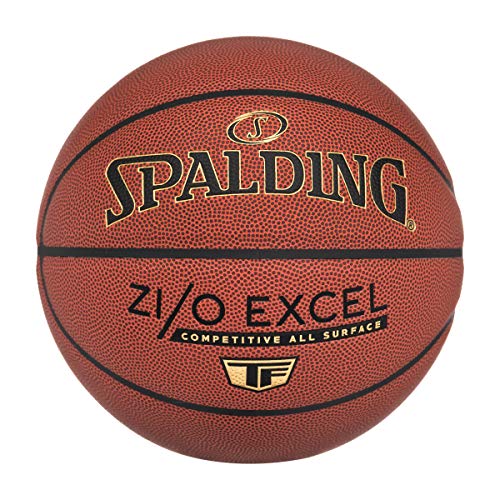
The Spalding Zi/O Excel is the composite pick for players who want a softer feel with a deep channel grip, and it earns its place because it is the most comfortable ball in this guide to shoot with. Spalding builds it from a Zi/O Tournament composite cover over a foam backing, a construction that gives the ball a solid, cushioned bounce and a softer hand feel than any other composite in the lineup, with a deep channel design that gives a shooter’s fingers more to grip and a dribbler more control on a dusty court. The listing in this guide is the size 7 ball at twenty-nine and a half inches, shipped inflated and ready for the game, and it is built for both indoor and outdoor play, which makes it the one ball in the guide that can move between the gym and the driveway without changing its character.
The honest trade-off in the Zi/O Excel is the same trade every soft composite makes outdoors. The foam backing that makes it feel so good also makes it the ball that shows wear soonest on rough asphalt, and a player whose court is cracked concrete will wear its cover faster than the DRV Pro above it or the rubber balls below it. For the buyer that is usually the right bargain. Most driveway games are played on decent concrete or asphalt, not on gravel, and a ball whose cover grips from the first dribble, holds its shape through a season of games, and feels like a game ball in the hand will play better in week six than a rubber ball that was never given the chance to feel good. The Zi/O Excel is the ball for the player who shoots more than they dribble on broken ground, and for the household that wants one ball that works in the gym on weekdays and on the driveway on weekends.
Specs
- Brand: Spalding
- Model line: Zi/O Excel
- Cover: Zi/O Tournament composite, foam-backed
- Seams: Deep channel design, per the maker
- Size: Size 7, 29.5 in, official men’s size
- Playing surface: Indoor and outdoor
- Shipped: Inflated and game-ready, per the maker
- Tier: Mid-range
3. Wilson NCAA Street Shot Basketball, 29.5″
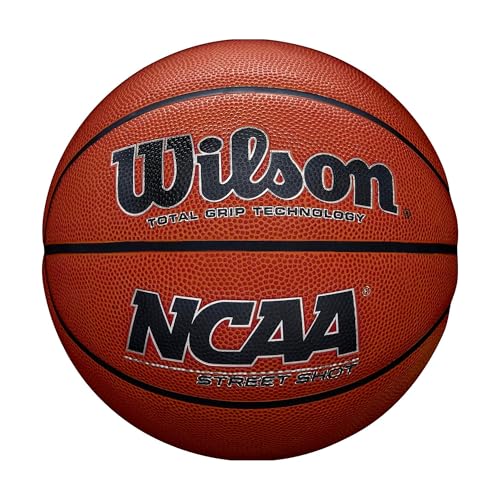
The Wilson NCAA Street Shot is the budget rubber ball in this guide, and it earns its place because it is the cheapest ball here that still plays like a real basketball. Wilson builds it with a Total Grip Technology rubber cover, a durable rubber surface with enhanced softness and grip that holds its purchase on dusty concrete, over a pressure-lock bladder that keeps the ball inflated through weeks of outdoor use, and the ball is sized for boys age fourteen and up at the official size 7, twenty-nine and a half inches around. The listing in this guide is the size 7 ball, the standard unit of driveway and park play, and it is the ball to buy when the budget is tight and the court is rough.
What the Street Shot gives up against the composite balls above it is feel, not durability. Rubber is harder and less refined than composite, and a shooter who is used to a game ball will feel the difference on long shots, where the Street Shot’s firmer cover gives back less touch. None of that counts against it in its role. A rubber ball survives the court that kills a composite ball, it holds its grip when the surface is dusty, it costs less to replace when it finally wears smooth, and it is the ball a parent buys for a teenager who plays every day on a school blacktop. It is also the ball to buy first when the buyer is unsure: if the Street Shot survives the season, the next purchase can be a composite; if the court eats it, no money was wasted on a cover the court was always going to destroy.
Specs
- Brand: Wilson
- Model line: NCAA Street Shot
- Cover: Total Grip Technology rubber, per the maker
- Bladder: Pressure-lock bladder, per the maker
- Size: Size 7, 29.5 in, official men’s size
- Weight: About 22 ounces, per the listing record
- Age range: Boys age 14 and up, per the maker
- Playing surface: Outdoor
- Tier: Budget
4. Spalding Street Outdoor Basketball, 29.5″
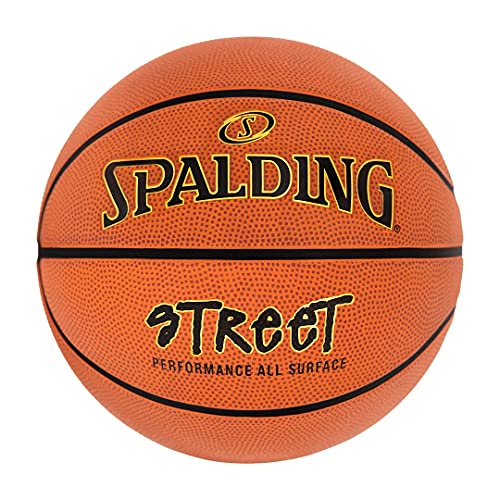
The Spalding Street Outdoor is the toughest pure rubber ball in this guide, and it earns its place because some courts are harder on a ball than any composite can survive. Spalding builds it with a performance rubber cover designed specifically for outdoor play, a tough surface that resists scuffing and moisture on concrete and asphalt, with deep channels that give a shooter grip and control even when the court is dusty and the ball is dirty. The listing in this guide is the size 7 ball at twenty-nine and a half inches, the official men’s size, and it is the ball for the park court with cracked asphalt, the school blacktop with loose aggregate, and the driveway that has never been resurfaced.
The reason to choose the Street Outdoor over the Wilson Street Shot above it is toughness rather than specification. The two balls are built for the same role, with the same rubber cover family and the same size, and the difference a buyer will feel is the cover: Spalding’s performance rubber is the surface the maker sells on outdoor durability, and a player whose court is genuinely rough will notice that the Street Outdoor holds its grip longer on the harshest surfaces. For a household that plays on one bad court every day, having the toughest rubber ball matters more than having the softest feel, and the Street Outdoor has been a staple of park and driveway play for years for exactly that reason. It is not a game ball and does not pretend to be: it is a street ball built to survive the street, and it belongs in the hands of the player whose court would destroy a prettier ball.
Specs
- Brand: Spalding
- Model line: Street Outdoor
- Cover: Performance rubber, designed for outdoor play
- Seams: Deep channel design, per the maker
- Size: Size 7, 29.5 in, official men’s size
- Playing surface: Outdoor, concrete and asphalt
- Tier: Budget
5. Molten BG3800 Composite Basketball, Size 7
The Molten BG3800 is the premium pick, and it earns its place because it is the only ball in this guide that carries FIBA approval, the international game’s stamp. Molten builds it from a synthetic composite cover in the official twelve-panel, two-tone design, with a nylon-wound butyl bladder that holds air well through weeks of outdoor use, and the ball is approved for FIBA play, which means its size, weight, bounce and panel construction meet the standard that international competition is played to. The listing in this guide is the size 7 ball at twenty-nine and a half inches, the official men’s size, and it is the ball for the player who wants tournament-grade construction on an outdoor court.
The limits of the pick are the limits of its class, and they should be stated plainly. A FIBA approved ball is built for competition, and its composite cover will wear faster on the roughest asphalt than a rubber ball, so a player whose court is cracked concrete should buy one of the rubber picks above it rather than expecting the BG3800 to survive that surface. Within its role none of that counts against it. The BG3800 is the best-selling Molten ball on Amazon in the United States, the ball that international players grow up with, and a player who wants the same construction that the World Cup and the Olympics are played with will find it here. Buy it for the outdoor court that is in good condition, for the player who values a true game-ball feel outdoors, and for the household that wants one premium ball rather than a rotation of budget balls.
Specs
- Brand: Molten
- Model line: BG3800
- Cover: Synthetic composite, official twelve-panel two-tone design
- Bladder: Nylon-wound butyl, per the maker
- Size: Size 7, 29.5 in, official men’s size
- Approval: FIBA approved, per the maker
- Playing surface: Indoor and outdoor
- Tier: Premium
How to Choose the Right Basketball for Outdoor Play
Start with the size, because the size chooses the player. A ball bought in the wrong size teaches the wrong muscle memory, so check the age and the league before checking the listing: size 7 at twenty-nine and a half inches is the official men’s size, size 6 at twenty-eight and a half inches is the women’s and older youth size, and size 5 at twenty-seven and a half inches is the youth size, and every pick in this guide is the size 7 ball, so a buyer who needs a smaller ball should look for the same model line in the smaller size rather than buying a different ball entirely. A ball bought in the wrong size is a ball that sits in the garage while the right size does the work, so read the size off the listing’s own specification block before ordering.
Next, match the cover to the court. Smooth concrete, decent asphalt and indoor-outdoor play should be composite: the composite ball is the authentic-feeling product, its grip is what the game’s technique is built around, and the deep channels on the Wilson and Spalding picks are the specification a shooter reads first. Rough courts are the rubber ball’s territory, and the dividing question is how bad the surface is: a player who shoots on a decent driveway will never wear out a composite fast enough to justify a rubber ball, while a player on cracked asphalt with loose aggregate will burn through a composite at a rate that makes the rubber ball the only economical answer. Many committed players run both, a composite ball for the good court and a rubber ball for the bad one, and the five picks above are arranged to make that pairing easy.
Then buy on the bladder and the channels, because in this category those two details decide how the ball behaves week after week. A butyl bladder holds air for weeks between top-ups, while a latex bladder holds air for days and needs a pump nearby, and for an outdoor ball that lives in a garage the butyl bladder is the practical choice. Deep channels give a shooter’s fingers more to grip on a dusty court, while shallow channels feel smoother but offer less purchase when the ball is dirty, so read the channel description off the listing before ordering. Whatever the cover, store the ball indoors, out of direct sun and away from sharp surfaces, and check the air and the cover before every session, because a ball that has gone soft or lost its cover plays like a different ball. Keep a pump and a needle nearby, and inflate to the maker’s recommended pressure rather than guessing, because an overinflated ball bounces too high and an underinflated ball feels dead.
A word on safety records, because basketballs are hard balls and buyers ask. No recall covers basketballs as a class or any of the five picks in this guide. The records that do exist cover basketball goals and hoops, a different product: the Spalding Momentous EZ Assembly Portable Basketball Goals, recalled in September 2022 after welds in the arm attaching the backboard to the pole failed, about thirteen thousand four hundred units, with twenty-six reports of weld failures including three backboards separating from the pole; the Goalsetter wall-mounted basketball goals, recalled in October 2026 after backboards unexpectedly detached from the wall, about eighteen thousand units; and the Lifetime and Escalade portable basketball hoops, recalled in 2002 after a sharp protruding bolt on the pole caused lacerations, about one point seven million units. None of those recalls touches a basketball, and no pick here is a hoop or a goal. The one in-class record is a novelty product, not a regulation ball: the American Greetings DesignWare Sport Balls party favor set, recalled in July 2009 after the surface coating on its mini basketball tested over the federal lead limit, a four-ball party set sold as a favor rather than as sports equipment. Regulation basketballs are hard balls and are not toys for toddlers: keep them out of reach of children under three, and buy soft foam balls, not regulation balls, for the youngest players.
Finally, read the listing the way this guide read them: confirm the cover material in the title, confirm the size the listing actually carries, confirm whether the ball is the size 7 variation or a smaller size in the same family, and treat any listing that will not state its cover material as a recreational ball whatever its name claims. The name on the ball is a product line, not a specification; the specification block is the product.
Frequently Asked Questions
What size basketball should I buy for outdoor play?
Buy the size the player’s age and league call for. Size 7 at twenty-nine and a half inches around is the official men’s size, size 6 at twenty-eight and a half inches is the women’s and older youth size, and size 5 at twenty-seven and a half inches is the youth size, and every pick in this guide is built to the size 7 standard. Youth players should use the size that fits their hands and their league, not the adult size, because a ball that is too big teaches the wrong shooting form. If a listing will not state its size, treat it as a training or toy ball rather than a game ball, because a ball that cannot state its size cannot be trusted to play to the standard.
What is the difference between a rubber basketball and a composite basketball?
The difference is the cover. Rubber is the outdoor material: it is tough, it resists scuffing and moisture, it holds its grip when the court is dusty, and it is the cheapest cover to replace when it finally wears smooth, at the cost of a harder, less refined feel that shooters notice on long shots. Composite is the game-feel material: a synthetic leather cover with a pebbled texture that grips like a leather game ball, holds its shape through seasons of outdoor use, and gives a shooter the touch that rubber cannot, at the cost of wearing faster on the roughest asphalt and demanding a higher tier. The size, the weight and the channels are the same; the cover is the choice.
Do outdoor basketballs need a break-in period?
Most outdoor basketballs do not. Rubber and composite covers are manufactured with their grip already in place, so a ball plays the same on the first dribble as it does in its fiftieth session, and the deep channels on the Wilson and Spalding picks are part of the construction rather than a surface treatment that wears in. The exception is a new composite ball on a dusty court: the first few sessions will feel slick until the cover’s texture has picked up a little dust and the player’s hands have learned the ball, and a ball that has been played for a week will grip better than one straight from the box. A rubber ball needs no break-in at all, which is the feature its driveway reputation is built on.
How do I keep an outdoor basketball in good condition?
Keep it indoors, out of direct sun and away from sharp surfaces, and never leave a ball standing in water or sitting in a hot car trunk. Wipe the cover clean after wet use and let it dry at room temperature, and wipe a rubber ball down the same way. Check the air before every session and top it up with a pump and a needle, because a ball that has gone soft bounces badly and wears unevenly. Rotate the balls in a household so no single ball takes every game, and retire a ball whose cover has gone smooth or whose panels have started to separate, because a ball that has lost its cover plays badly and will not come back. A ball that is stored properly will hold its shape and its grip across seasons; a ball left flat in a garage will not.
Conclusion
The best basketballs for outdoor play divide cleanly once the category’s four variables are separated: cover, channels, bladder and size. For the best overall outdoor ball, the Wilson NBA DRV Pro in size 7 is the composite all-rounder with a Tackskin cover that stays grippy in dust and an inflation retention lining that holds air through weeks of games. For a softer composite with a deep channel grip, the Spalding Zi/O Excel is the foam-backed ball that feels closest to a game ball. For rough concrete on a budget, the Wilson NCAA Street Shot is the Total Grip rubber ball that survives the court that kills a composite. For the toughest pure rubber ball, the Spalding Street Outdoor is the performance rubber ball built for asphalt that eats covers. For tournament-grade construction outdoors, the Molten BG3800 is the FIBA approved composite ball with a nylon-wound butyl bladder. Buy the size the player needs, match the cover to the court, and let the rubber ball carry the rough days so the composite ball stays fresh for the good court, and the five picks above will cover a full season of outdoor basketball between them.
More from Amazon
Programs that pair well with the guide above. Offers and eligibility are set by Amazon and may change.
Free shipping on eligible items, Prime Video and more. Eligible new members can start with a free trial.
Start a Prime free trialA Prime membership for ages 18-24 with a trial period. Eligibility is set by Amazon.
See Prime for Young AdultsAudiobooks and podcasts to listen to on the go. Eligible new members can start with a free trial.
Try Audible freeAd-free music streaming. Eligible new subscribers can start with a free trial.
Try Music Unlimited freeAs an Amazon Associate we earn from qualifying purchases.