Key takeaways
- Compare the best racquetball rackets by weight, head size, balance and frame: a power frame, a beginner frame, an aluminum starter and a tournament frame.
- Top Pick: Wilson Striker Racquetball Racquet
- Runner-up: HEAD CPS Heat Racquetball Racquet
- Also consider: Gearbox GB-50 Racquetball Racquet
Quick answer The best racquetball racket for most players is the Wilson Striker, because it is the simplest racket that does the core job well: an aluminum alloy frame with a V-Matrix beam, a 107 square inch head and a 3 5/8 inch grip, built for power on a full swing at a budget tier. The HEAD CPS Heat is the best beginner racket, a 190 gram carbon fiber frame with a 107 square inch oversized head and vibration damping, for the player who is learning the game and wants forgiveness on off-center hits. The Gearbox GB-50 is the best aluminum starter racket, a 190 gram frame built from 7000 series aluminum with a quad and teardrop hybrid shape, for the beginner who wants a tough frame that survives wall contact. The E-Force Bedlam 170 Lite is the best tournament racket, a 170 gram graphite frame with strings that run the full 22 inch length of the frame, for the competitive player who wants swing speed and power transfer. The Python Intro 5000 is the best lightweight beginner racket, a 180 gram teardrop frame with a head-light balance, for the new player who wants quick handling and easy control. Note that racquetball is not squash, tennis, badminton or padel: a racquetball racket is 22 inches long, the ball is larger and bouncier than a squash ball, and the game is played in an enclosed court where the walls are in play, so a racket built for any of those other sports is the wrong tool for this court.
A racquetball racket looks simple from the outside, a short frame with strings and a grip, but the differences that matter are weight, head size, balance and frame material, because those four variables decide how fast the racket swings, how forgiving it feels on a mishit, how much power it returns and how long it lasts when it meets a wall. A light racket swings faster and tires the arm less, while a heavier racket carries more mass into the ball and returns more power with less effort from the player. A large head gives a bigger sweet spot and forgives contact away from the center, while a smaller head gives more precision to a player who already hits the center of the strings. A head-heavy balance adds power to the swing, while a head-light balance makes the racket quicker to move and easier to control in fast exchanges at the front of the court. An aluminum frame is tough and affordable, while a graphite frame is lighter and stiffer for the same weight. Read the weight, the head size and the balance off the listing before ordering, and every pick below will arrive as the racket described.
One distinction has to be settled before any pick is described, because it is the distinction that decides whether the buyer orders the right product at all. Racquetball rackets are sold by weight in grams, and the number in the model name is usually that weight: a 170 gram racket is a light racket, a 190 gram racket is a middleweight racket, and a racket above 200 grams is a heavy racket. The weight in the name is the unstrung weight, measured before strings and grip are added, so the racket in the hand will feel a little heavier than the number on the listing, and a buyer comparing two rackets should compare unstrung weight to unstrung weight rather than mixing the two figures. A second distinction matters just as much. A racquetball racket is always sold pre-strung and ready to play, and the factory strings are a wear item: they are fitted for the first games, not for a season of hard play, so a buyer who plays often should plan on a restring sooner rather than later, and should treat the factory string as a starting point rather than a permanent feature. A third distinction is the wrist strap. Every racquetball racket carries a wrist strap, sometimes called a wrist cord or tether, and it is not an accessory: it keeps the racket from leaving the hand and striking another player or a wall, and most clubs require it, so check the listing for the strap before ordering and use it every time the racket is in the hand.
The first divide is weight, and it is the one that shapes every other choice. Most adult racquetball rackets weigh between 160 and 200 grams unstrung, and that range matters more than it looks, because a 20 gram difference is a difference the arm feels on every swing of a long rally. A 170 gram racket suits a player who values swing speed and plays a fast game built on quick reactions, because the light frame moves fast and recovers fast. A 190 gram racket suits a player who wants power without giving up maneuverability, because the extra mass drives the ball harder while the frame still moves well. A racket near 200 grams suits a beginner who needs the frame to supply power the swing does not yet produce, because the mass does work the arm cannot yet do. The second divide is head size. A 107 square inch head is the oversized end of the range and gives the largest sweet spot, while a 103 square inch head is smaller and more precise, and a 106 square inch head sits between the two. The third divide is balance. A head-heavy racket puts weight toward the tip and adds power, a head-light racket puts weight toward the handle and adds control, and an even balance splits the difference. The fourth divide is frame material, because aluminum survives wall contact and costs less, while graphite is lighter and stiffer and suits a player who swings fast and wants the frame to stay rigid at contact. The fifth divide is head shape, because a teardrop head gives a larger hitting area high in the strings and more power, while a quadraform head gives a squarer shape with more control across the string bed.
As an Amazon Associate, we earn from qualifying purchases.
Table of Contents
- How We Chose These Racquetball Rackets
- Quick Comparison
- The 5 Best Racquetball Rackets
- How to Choose the Right Racquetball Racket
- Frequently Asked Questions
- Conclusion
- Product and ASIN Reference
How We Chose These Racquetball Rackets
The shortlist started from the racquetball rackets that club players, league players and beginners actually buy again and again: the Wilson Striker line, the HEAD CPS Heat line, the Gearbox GB-50 line, the E-Force Bedlam line and the Python Intro line, because a racket that players keep reordering has already passed the only durability trial that matters, which is repetition on a real court. From that pool, each candidate had to clear four checks. It had to be a current, orderable Amazon listing with a confirmed identifier read from the listing’s own product information or a corroborating Amazon listing record, not inferred from a similar model or a different configuration. It had to publish its weight and its head size, or its grip size and its frame material, because a racket listing that will not state how heavy it is or how large its head is cannot be bought with confidence. It had to fill a distinct role in the lineup, so the five picks divide into a best-overall power racket, a best beginner racket, a best aluminum starter racket, a best tournament racket and a best lightweight beginner racket, rather than five versions of the same beginner frame. And it had to be a real adult racquetball racket with a 22 inch frame and a wrist strap, not a junior racket, a squash racket, a tennis racket or a padel racket: junior rackets are shorter and lighter, squash rackets are longer and narrower with a smaller head, tennis rackets are far longer and heavier, and padel rackets have no strings at all, and a guide about racquetball rackets should start with rackets made for racquetball.
Two exclusions shaped the list as much as the inclusions. Racket and ball starter kits were left out of the main lineup entirely, because a kit bundles a racket with balls and sometimes a second racket, and a buyer comparing rackets should compare one racket to one racket rather than a bundle to a single frame. And rackets sold only through a maker’s own shop or a specialist racquet retailer, with no Amazon listing to confirm, were left out even when the racket itself earned praise, because a pick without a confirmed Amazon identifier cannot be ordered with the confidence this guide promises. One well-known name fell to a different rule during research: the HEAD Intelligence i.165 is a widely praised light graphite racket for players moving past their first frame, but no Amazon listing record could be confirmed for it with a matching identifier, so it is not picked here, and a buyer who wants one should check the listing at the time of ordering rather than taking this guide’s word for it. What remains is five rackets that between them cover how racquetball rackets are actually bought: one power racket for the player who wants the standard choice, one beginner racket for the player who is learning, one aluminum starter racket for the player who wants toughness, one tournament racket for the competitive player, and one lightweight beginner racket for the player who wants quick handling.
One honest note belongs up front, before any pick is described. A racket does not make a racquetball player better on its own, and the lightest racket in this guide will not save a rally lost on footwork, while the most powerful racket here will serve a player whose swing is already sound and whose positioning is already good. What a good racket does is remove friction: the right weight means the arm never tires before the match ends, the right head size means mishits still reach the front wall, and the right balance means the racket is where the hand expects it to be when the ball comes back fast. The five picks below are judged on exactly that job, and on the published specifications that let a buyer check the racket before ordering.
Quick Comparison
| Pick | Weight | Head size | Balance | Best for |
|---|---|---|---|---|
| Wilson Striker | Over 7 oz strung | 107 sq in | Head-heavy feel | Best overall power racket |
| HEAD CPS Heat | 190 g unstrung | 107 sq in | Even balance | Best beginner racket |
| Gearbox GB-50 | 190 g | 106 sq in | Head-light | Best aluminum starter racket |
| E-Force Bedlam 170 Lite | 170 g | Teardrop | Head-heavy | Best tournament racket |
| Python Intro 5000 | 180 g unstrung | 106 sq in | Head-light | Best lightweight beginner racket |
The 5 Best Racquetball Rackets
1. Wilson Striker Racquetball Racquet

The Wilson Striker Racquetball Racquet is the best racquetball racket in this guide, and it earns that place because it is the racket that does the core job with the least fuss and the most forgiveness. Wilson builds it as an aluminum alloy frame, and the listing states that it carries a 107 square inch head and a 3 5/8 inch grip, which is the full set of facts a buyer needs to know whether it will feel powerful, whether it will forgive a mishit, and whether it will fit the hand. The construction is the point of the racket: Wilson builds the Striker around a V-Matrix beam, a cross-section shape that adds stiffness and stability to the frame, so the racket holds its shape on hard hits and returns power without twisting, and the aluminum alloy frame survives contact with a wall that would crack a lighter composite frame. The frame is strung at the factory and ready to play out of the package, and the Wilson Wrap grip gives the hand a tacky surface to hold through a long rally, while the long handle counterbalances the large head so the racket does not feel tip-heavy in the hand.
What separates the Striker from the other rackets below it is the balance of power, toughness and familiarity, and the trade that comes with it. A 107 square inch head is the oversized end of the range, so the sweet spot is large and a ball struck away from the center still travels well, which is the forgiveness a club player needs when the rally speeds up and the feet are not set. The trade is that it is neither the lightest racket here nor the most precise: a player who values swing speed above all will be quicker with the E-Force Bedlam 170 Lite below, and a player who wants a smaller, more precise head will find the Gearbox GB-50 more controlled. A player who needs the lightest frame will find the Python Intro 5000 easier to move. A player who wants vibration damping built into the frame will find the HEAD CPS Heat more comfortable. None of that counts against the Striker in its role. Most racquetball is played by club players who want a tough, powerful racket that survives the wall, forgives a mishit and swings the same way every time, and a racket that does all of that at a budget tier is the racket that belongs in most bags. Buy it for the player who wants the standard choice, for the club regular who plays twice a week, and for the household that wants one racket any adult in the family can pick up and play.
Specs
- Brand: Wilson
- Model line: Striker Racquetball Racquet
- Type: Adult racquetball racket, pre-strung, per the maker
- Frame material: Aluminum alloy, per the maker
- Beam: V-Matrix beam, per the maker
- Head size: 107 sq in, per the listing
- Grip size: 3 5/8 in, per the listing
- Grip: Wilson Wrap grip, per the maker
- Weight: Over 7 oz strung, per current buying guides
- Length: 22 in, standard adult racquetball length
- Tier: Budget
2. HEAD CPS Heat Racquetball Racquet

The HEAD CPS Heat Racquetball Racquet is the best beginner racquetball racket in this guide, and it earns its place because it is the racket for the player who is learning the game and wants the frame to help rather than punish. HEAD builds it as a carbon fiber frame, and the listing states that it weighs 190 grams unstrung, carries a 107 square inch oversized head and comes pre-strung, which is the full set of numbers a buyer needs to know whether it will swing easily, whether it will forgive a mishit, and whether it will be ready on arrival. The construction is the point of the racket: HEAD fits it with Crystal Power System technology, a frame treatment the maker says boosts power generation on every swing, and a Dynamic Powerzone string pattern of 16 x 16, an open pattern that adds pop to the ball while keeping control. The frame carries Damp Plus technology, a damping system that soaks up vibration at contact and reduces arm fatigue across a long session, and the I-Beam construction adds stability to the frame so it stays rigid when the ball is struck hard.
The honest trade-off in the CPS Heat is the beginner focus itself, and a buyer needs to understand it before ordering. A 190 gram frame with a 107 square inch head is built to forgive and to supply power, so it is heavier and less precise than a tournament frame, and an advanced player who already hits the center of the strings will find it less exact than the E-Force Bedlam 170 Lite below. The factory strings are fitted for the first games and can break within weeks of regular play, so a buyer who plays often should plan on a restring early. A player who wants the toughest frame will find the aluminum Gearbox GB-50 more resistant to wall contact. A player who wants the most power for the least effort will find the Wilson Striker above more forceful. A player who wants the lightest frame will find the Python Intro 5000 quicker in the hand. Within its role none of that counts against it. A racket that weighs 190 grams, carries a 107 square inch head, damps vibration and arrives pre-strung is a racket that lets a new player learn the swing without fighting the frame, and the oversized head is the feature that does that job. Buy it for the player who is trying the sport for the first time, for the recreational player who plays once a week, and for the club that needs a dependable racket for new members.
Specs
- Brand: HEAD
- Model line: CPS Heat Racquetball Racquet
- Type: Adult beginner racquetball racket, pre-strung, per the maker
- Frame material: Carbon fiber, per the listing
- Weight: 190 g unstrung, 6.7 oz unstrung, per the listing
- Head size: 107 sq in, per the listing
- Grip size: 3 5/8 in, per the product description
- Length: 22 in, per the listing
- String pattern: 16 x 16 Dynamic Powerzone, per the maker
- Technology: Crystal Power System and Damp Plus, per the maker
- Construction: I-Beam, per the maker
- Tier: Budget
3. Gearbox GB-50 Racquetball Racquet

The Gearbox GB-50 Racquetball Racquet is the best aluminum starter racquetball racket in this guide, and it earns its place because it is the racket for the beginner who wants a frame that survives the learning curve. Gearbox builds it from 7000 series aluminum, an aircraft-grade alloy the maker combines with copper, zinc and magnesium for stiffness and durability, and the listing states that it weighs 190 grams and carries a 3 5/8 inch grip, which is the full set of numbers a buyer needs to know whether it will swing easily and whether it will fit the hand. The construction is the point of the racket: Gearbox shapes the GB-50 as a hybrid of quadraform and teardrop, a frame that blends the square shape of a control frame with the rounded shape of a power frame, so the racket gives a little of both rather than committing to one. The frame is strung with 16-gauge monofilament strings, a thicker string that holds up to hard use, and the power string pattern reinforces the string bed so performance stays even across the face.
The limits of the pick are the limits of an aluminum beginner frame, and they should be stated plainly. A 190 gram aluminum frame is heavier and less lively than a graphite tournament frame, so a competitive player who swings fast will find the E-Force Bedlam 170 Lite quicker and more responsive. The frame is built for durability first, so a player who wants the most precise head will find the smaller heads elsewhere more exact. A player who wants vibration damping built into the frame will find the HEAD CPS Heat more comfortable on the arm. A player who wants the largest sweet spot will find the 107 square inch heads of the Wilson Striker and the HEAD CPS Heat more forgiving. A player who wants the lightest frame will find the Python Intro 5000 easier to move. Within its role none of that counts against it. The GB-50 is the racket for the beginner who hits the wall, for the school program that needs frames that last, and for the recreational player who wants one tough racket rather than a delicate one. Buy it for the player who is hard on equipment, for the beginner who is still learning court awareness, and for the household that wants a racket that can be handed to any guest without worry. One note for the buyer: the Amazon listing record for this racket showed no featured offers available in the most recent crawl, so check the listing at the time of ordering before relying on it.
Specs
- Brand: Gearbox
- Model line: GB-50 Racquetball Racquet
- Type: Adult beginner racquetball racket, pre-strung, per the maker
- Frame material: 7000 series aluminum, per the maker
- Weight: 190 g, per the listing
- Head size: 106 sq in, per current buying guides
- Grip size: 3 5/8 in, per the listing
- Frame shape: Quadraform and teardrop hybrid, per the maker
- Strings: 16-gauge monofilament, per the maker
- Skill level: Beginner, per the listing
- Tier: Mid-range
4. E-Force Bedlam 170 Lite Racquetball Racquet

The E-Force Bedlam 170 Lite Racquetball Racquet is the best tournament racquetball racket in this guide, and it earns its place because it is the racket for the competitive player who wants swing speed and power transfer in the same frame. E-Force builds it as a graphite frame, and the maker states that it weighs 170 grams, carries a 3 5/8 inch grip and uses a 22 inch LongString design, which is the full set of numbers a buyer needs to know whether it will swing fast, whether it will fit the hand, and whether it will return power. The construction is the point of the racket: E-Force runs the center strings the full length of the frame, through the hollow handle, so the string bed flexes more at contact and returns more power to the ball, and the Total Carbon Head and Tri Carbon construction keep the frame light and stiff so power moves into the ball rather than bending the frame. The frame carries Zero Richter Tubes X2 and Booster tubes, damping parts inside the handle that cut vibration and firm up the string bed, and the teardrop head shape, which E-Force calls a tri-tear shape, gives a larger hitting area high in the strings for power on the serve and the overhead.
The reason to choose the Bedlam 170 Lite over a beginner frame is the weight, not the forgiveness. A player who plays tournaments and rallies at full speed needs a frame that moves fast and recovers fast, and the Bedlam 170 Lite is the only pick here built for that job at a weight a competitive player will accept. The trade is the same as any light graphite tournament frame: the frame is less forgiving of wall contact than an aluminum frame, so a player who hits the wall often should buy the Gearbox GB-50 above instead, and the factory strings are a starting point that many players replace early. A player who wants the largest sweet spot will find the 107 square inch heads of the Wilson Striker and the HEAD CPS Heat more forgiving. A player who wants the cheapest frame will find the Wilson Striker far cheaper. A player who wants the lightest beginner frame will find the Python Intro 5000 easier to control. Within its role none of that counts against it. The Bedlam 170 Lite is the pick for the league player, the tournament player and the club regular who plays to win, for the player who counts every gram in the hand, and for the household that wants a frame that can keep up with a fast game. Buy it for league night, for a tournament bracket, and for the player who has outgrown a beginner frame and wants a frame that rewards a full swing.
Specs
- Brand: E-Force
- Model line: Bedlam 170 Lite Racquetball Racquet
- Type: Adult tournament racquetball racket, pre-strung, per the maker
- Frame material: Graphite, per the maker
- Weight: 170 g, per the maker
- Grip size: 3 5/8 in, per the maker
- Length: 22 in, per the maker
- Head shape: Tri-tear teardrop, per the maker
- String design: 22 in LongString, per the maker
- String: 17-gauge, per the maker
- Technology: Total Carbon Head, Tri Carbon, Zero Richter Tubes X2 and Booster tubes, per the maker
- Tier: Premium
5. Python Intro 5000 Racquetball Racquet
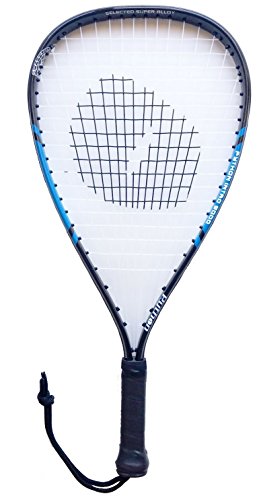
The Python Intro 5000 Racquetball Racquet is the best lightweight beginner racquetball racket in this guide, and it earns its place because it is the racket for the new player who wants quick handling and easy control. Python builds it as a teardrop frame, and the listing states that it weighs 180 grams unstrung, carries a 106 square inch head and a 3 5/8 inch grip, which is the full set of numbers a buyer needs to know whether it will swing quickly, whether it will forgive a mishit, and whether it will fit the hand. The construction is the point of the racket: Python builds the frame from graphite composite, a light material that keeps the frame easy to move without giving up strength, and the head-light balance puts weight toward the handle, so the racket feels quick in the hand and easy to control in fast exchanges at the front of the court. The grip carries a non-skid cover, so the hand holds firm through a long rally, and the frame comes in several color designs, so a player can tell rackets apart in a shared bag.
The honest trade-off in the Intro 5000 is the beginner focus itself, and a buyer needs to understand it before ordering. The frame is light and head-light, so it is quick rather than powerful, and a player who needs the frame to supply power will find the Wilson Striker above more forceful. The sweet spot is smaller than the 107 square inch heads in this guide, so a player who mishits often will find the HEAD CPS Heat more forgiving. The factory strings are fitted for the first games and can feel soft, so a player who plays often should plan on a restring early. A player who wants the toughest frame will find the aluminum Gearbox GB-50 more resistant to wall contact. A player who wants a tournament frame will find the E-Force Bedlam 170 Lite quicker still and more powerful. Within its role none of that counts against it. The Intro 5000 is the racket for the new player, for the junior moving into an adult frame, and for the school program that needs light, controllable rackets for first-time players. Buy it for a first season of racquetball, for a player who is still building swing speed, and for the household that wants a light racket any new player can pick up and enjoy.
Specs
- Brand: Python
- Model line: Intro 5000 Racquetball Racquet
- Type: Adult beginner racquetball racket, pre-strung, per the maker
- Frame material: Graphite composite, per the listing
- Weight: 180 g unstrung, per current buying guides
- Head size: 106 sq in, per current buying guides
- Grip size: 3 5/8 in, per the listing
- Frame shape: Teardrop, per the maker
- Balance: Head-light, per current buying guides
- Grip: Non-skid cover, per the maker
- Tier: Budget
How to Choose the Right Racquetball Racket
Start with the weight, because the weight chooses the racket before anything else. A racket that is too heavy will tire the arm before the match ends, and a racket that is too light will ask the arm to supply power the frame does not give, so the buyer should match the weight to the swing rather than to the model name. A player who is new to the game should buy a racket near 190 grams, which means the HEAD CPS Heat or the Gearbox GB-50, because the mass supplies power the swing does not yet produce. A player who plays at full speed and values quick reactions should buy a racket near 170 grams, which means the E-Force Bedlam 170 Lite, because the light frame moves fast and recovers fast. A player who wants quick handling without giving up all power should buy a racket near 180 grams, which means the Python Intro 5000, because the middle weight splits the difference. Whatever the weight, remember that the figure in the model name is the unstrung weight, and the racket in the hand will feel a little heavier once strings and grip are added, so compare unstrung weight to unstrung weight when two rackets are set side by side.
Next, match the head size to the player. A 107 square inch head suits a player who wants the largest sweet spot, because the oversized head forgives contact away from the center, and the Wilson Striker and the HEAD CPS Heat are the 107 square inch rackets in this guide. A 106 square inch head suits a player who wants a balance of forgiveness and precision, and the Gearbox GB-50 and the Python Intro 5000 are the 106 square inch rackets here. A teardrop head suits a player who wants power high in the strings, because the shape gives a larger hitting area near the tip, and the E-Force Bedlam 170 Lite and the Python Intro 5000 are the teardrop rackets here. A player who does not know which head suits them should start with the larger head, because forgiveness helps more than precision while the swing is still developing, and a smaller head can wait until the swing is consistent.
Then buy on the balance, because that is the detail that shows its value after the first match. A head-heavy racket adds power to the swing, and the Wilson Striker and the E-Force Bedlam 170 Lite lean that way. A head-light racket adds control and quickness, and the Gearbox GB-50 and the Python Intro 5000 lean that way. An even balance splits the difference, and the HEAD CPS Heat sits there. Check the balance on the listing before ordering, and confirm that the listing says racquetball racket rather than a squash racket or a tennis racket, because a squash racket is longer and narrower with a smaller head and a tennis racket is far longer and heavier, and a buyer who orders either by mistake will receive a racket built for a different court entirely.
A word on safety records, because buyers ask. No recall covers any of the five picks in this guide. The records that do exist cover different products in the wider racquet sports family, and they are worth knowing because they show how the categories differ. HEAD publishes voluntary recall notices for other product lines in other markets, and none of those notices names a racquetball racket. Safety notices for racquetball eyewear and goggles cover eye protection, where a lens or a strap can fail, and no pick here is eyewear: every pick in this guide is a racket, and eye protection is a separate purchase that belongs in the bag beside the racket. The CPSC has recalled balls and toys in other sports where a small part can detach, and no pick here is a ball or a toy. None of those records touches a racquetball racket in this guide. A racquetball racket is a frame with strings and a grip: inspect the strings for fraying before a match, check the wrist strap for wear and replace it if it frays, wear eye protection every time the racket is in the hand, and never play without the wrist strap fitted, because a racket that leaves the hand in an enclosed court is a danger to everyone on it.
Finally, read the listing the way this guide read them: confirm the weight in the specification block, confirm the head size and the grip size, confirm that the listing says racquetball racket with a 22 inch frame rather than a squash racket or a tennis racket, and treat any listing that will not state its weight or its head size as a racket to skip whatever its name claims. The name on the racket is a product line, not a specification; the specification block is the product.
Frequently Asked Questions
What weight racquetball racket should a beginner buy?
A beginner should buy a racket near 190 grams unstrung, because the mass supplies power the swing does not yet produce and the frame forgives a mishit while the swing is still developing. The HEAD CPS Heat at 190 grams and the Gearbox GB-50 at 190 grams are the beginner rackets in this guide, and both carry a 3 5/8 inch grip that fits most adult hands. A beginner who wants quicker handling can step down to the Python Intro 5000 at 180 grams, and a beginner who wants the most power can step up to the Wilson Striker, which carries a 107 square inch head. A player who moves past the beginner stage and wants swing speed should look at a 170 gram frame such as the E-Force Bedlam 170 Lite, but only after the swing is consistent enough to supply its own power.
What is the difference between a racquetball racket and a squash racket?
A racquetball racket is 22 inches long with a larger head and a larger, bouncier ball, and the game is played in an enclosed court where the walls are in play. A squash racket is longer and narrower with a smaller head, the ball is smaller and less bouncy, and the game is played on a different court with different rules. A tennis racket is far longer and heavier, a badminton racket is far lighter with a much smaller head, and a padel racket has no strings at all. The sports share a family resemblance, but the equipment does not cross over: a squash racket on a racquetball court is the wrong length, the wrong head size and the wrong weight, so buy the racket that names the sport on the listing.
How often should racquetball racket strings be replaced?
Factory strings are fitted for the first games, not for a season of hard play, so a player who plays once a week should expect to restring within the first months of regular play, and a player who plays several times a week should expect to restring sooner. The signs are easy to read: strings that fray, strings that lose tension and feel soft, and a sweet spot that feels smaller than it did when the racket was new. A restring replaces the strings only, not the frame, and it is the cheapest way to make an old racket feel new again. A player who breaks strings often should ask the stringer about a thicker gauge, such as the 16-gauge string on the Gearbox GB-50, because a thicker string lasts longer than a thin one.
Do I need to wear eye protection for racquetball?
Yes, eye protection belongs in the bag beside the racket, because racquetball is played in an enclosed court with a fast, hard ball and a swinging frame, and the ball and the racket both travel close to the face. Most clubs require eye protection, and most leagues require it as well, so a player should buy goggles made for racquetball rather than ordinary sunglasses, because racquetball goggles are built to take impact and stay in place during play. The wrist strap is the other piece of safety gear that is not optional: fit it every time the racket is in the hand, check it for wear, and replace it if it frays, because a racket that leaves the hand in an enclosed court can strike another player.
Conclusion
The best racquetball rackets divide cleanly once the category’s four variables are separated: weight, head size, balance and frame material. For the best overall power racket, the Wilson Striker is the aluminum alloy frame with a V-Matrix beam, a 107 square inch head and a 3 5/8 inch grip at a budget tier. For the best beginner racket, the HEAD CPS Heat is the 190 gram carbon fiber frame with a 107 square inch head, a 16 x 16 string pattern and vibration damping at a budget tier. For the best aluminum starter racket, the Gearbox GB-50 is the 190 gram frame built from 7000 series aluminum with a quadraform and teardrop hybrid shape at a mid-range tier. For the best tournament racket, the E-Force Bedlam 170 Lite is the 170 gram graphite frame with a 22 inch LongString design and a tri-tear teardrop head at a premium tier. For the best lightweight beginner racket, the Python Intro 5000 is the 180 gram teardrop frame with a 106 square inch head and a head-light balance at a budget tier. Buy the weight for the swing, match the head size to the player, check the balance against the game, and the five picks above will cover a full season of racquetball between them.
More from Amazon
Programs that pair well with the guide above. Offers and eligibility are set by Amazon and may change.
Free shipping on eligible items, Prime Video and more. Eligible new members can start with a free trial.
Start a Prime free trialA Prime membership for ages 18-24 with a trial period. Eligibility is set by Amazon.
See Prime for Young AdultsAudiobooks and podcasts to listen to on the go. Eligible new members can start with a free trial.
Try Audible freeAd-free music streaming. Eligible new subscribers can start with a free trial.
Try Music Unlimited freeAs an Amazon Associate we earn from qualifying purchases.