Key takeaways
- The space between a bike's top tube and seat tube is prime real estate, and a frame bag is the cleanest way to use it.
The space between a bike’s top tube and seat tube is prime real estate, and a frame bag is the cleanest way to use it. Tools, a spare tube, a wallet, and a snack ride better there than in a jersey pocket or a backpack that leaves a sweaty patch across the shoulders. The catch is that “frame bag” covers several different shapes, and picking the wrong one means a bag that rubs knees, blocks a bottle cage, or simply will not fit a small frame.
This guide is for riders weighing a triangle bag that fills the main frame against a slim top tube pouch that sits just behind the stem. It covers commuters, gravel riders, and weekend road riders who want to leave the backpack at home in 2026. The seven bags below are compared strictly on the details listed in their product titles, such as capacity in liters, fabric, pocket layout, and whether a phone fits.
Quick Picks
Our top picks



As an Amazon Associate we earn from qualifying purchases at no extra cost to you.
| Product | Best for | Key spec from the title |
|---|---|---|
| WOTOW Triangle Frame Bag | Tools and spares under the tubes | 2L, water-resistant, reflective, two side pockets |
| NDakter 2L Triangle Bag | Mountain, road, and commuter bikes | 2L, waterproof, storage pouch |
| ROCKBROS Phone Front Frame Bag | Phone access on the move | Waterproof, phone under 7 inches, e-bike friendly |
| ROCKBROS Top Tube Bag 1.3L | Quick snack and key access | 1.3L, 3-point elastic cord, one-hand zipper |
| NDakter 1.2L 3-in-1 Bag | Compact, flexible mounting | 1.2L, two side zipper pockets, waterproof fabric |
| ROCKBROS 840D Nylon Triangle Bag | Larger loads on longer rides | 3L, 840D nylon, double bag design, reflective |
| Csoalpo Frame Bag | Simple, light storage | Small, black, lightweight triangle design |
How to Choose
Pick the shape that your frame allows
Triangle bags sit inside the main frame and fill the gap between the top tube, down tube, and seat tube. They need a frame with open space, so a full-suspension mountain bike or a very small frame may leave too little room. Top tube bags strap on just behind the stem and work on nearly any bike. Before ordering, measure the inside of the frame triangle in inches, and compare it with the dimensions on the listing, since titles here list capacity but rarely list length.
Match capacity to what actually goes inside
The titles give capacities from 1.2 liters to 3 liters. A liter is roughly the size of a small water bottle, so 1.2 to 1.3 liters holds keys, a card, and a compact multi-tool. Around 2 liters adds a spare tube and a mini pump or CO2 inflator. Three liters starts to hold a light jacket or a day’s food. Overfilling a frame bag makes it bulge into the rider’s knees, which is more annoying than carrying a slightly smaller bag.
Look at fabric, zippers, and weather claims
Titles use both “water-resistant” and “waterproof,” and these are not the same promise. Water-resistant fabric handles light rain, while waterproof claims usually depend on taped seams and sealed zippers, which listings seldom detail. An 840D nylon figure points to a thicker fabric weave, but the number alone does not guarantee longevity. Check whether the zipper pulls are easy to grab with gloves on, since fiddly zippers are where cheaper bags cut corners.
Check mounting straps and clearance
Most bags attach with hook-and-loop straps around the frame tubes. Three-point systems are more stable than two-strap setups, and elastic cords help keep a top tube bag from flapping. Watch clearance for water bottle cages, and consider cable routing on bikes with frame-mounted shifters. Reflective trim is a nice extra for evening rides but does not replace proper lights.
It also helps to think about what will not go inside. Bags near the knees should keep hard, sharp objects away from the rider, and a heavy multi-tool is better placed at the bottom of a triangle bag than near the top. Loading the heaviest items low and centered keeps the bike steady, especially on narrow gravel trails where a swaying frame bag becomes noticeable.
The 7 Best Options
WOTOW Triangle Frame Bag
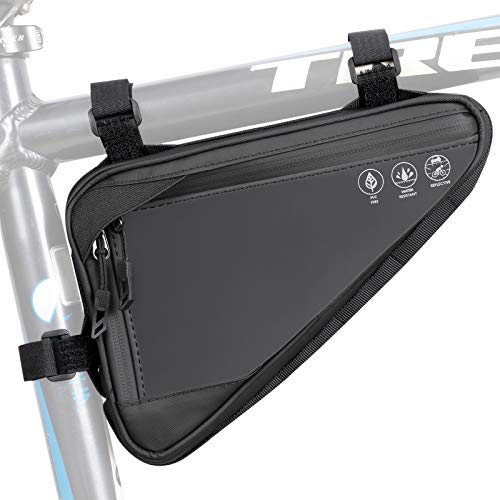
The WOTOW is a two-liter triangle bag described as water-resistant and reflective, with two side pockets and a strap-on design for cycling accessories and tools.
- Strength: the two side pockets help separate small items like patches from bulkier tools.
- Strength: a reflective trim adds visibility when the light fades.
- Trade-off: the title says water-resistant, not waterproof, so a rain cover or dry bag inside is wise for electronics.
It suits riders who want a straightforward repair kit holder that stays out of the way and does not need to be removed between rides, since the bag simply stays strapped in place. Skip it if sealed, waterproof storage is the priority or if the frame triangle is on the tight side.
NDakter 2L Triangle Bag
This two-liter triangle bag is listed as waterproof and designed for mountain, road, and commuter bikes, with room for cycling accessories in a storage pouch.
- Strength: broad frame compatibility is claimed across mountain, road, and commuter bikes.
- Strength: the waterproof description appeals to riders who commute in unpredictable weather.
- Trade-off: the title lists no pocket count or dimensions, so interior layout needs checking on the listing.
It fits commuters who carry a tube, tire levers, and a wallet, and who want one bag that works if the bike changes later. Skip it if a very small frame leaves little triangle space, because two liters of volume needs real room between the tubes to sit without pressing on the rider’s legs.
ROCKBROS Phone Front Frame Bag
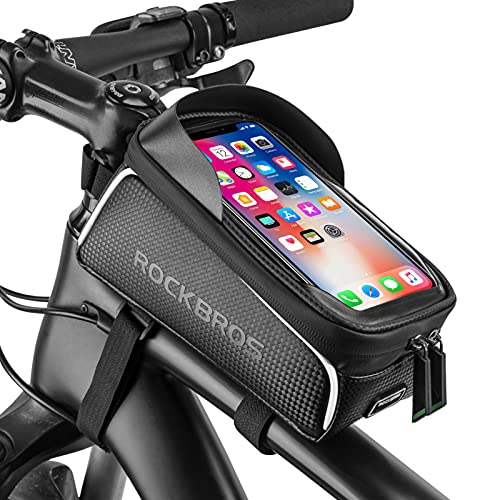
Unlike the triangle bags, this front frame tube pouch is aimed at keeping a phone visible and reachable. The listing mentions waterproof construction, compatibility with phones under 7 inches, and a fit for e-bike frames.
- Strength: phone access suits navigation by app on commutes.
- Strength: straps are described as fitting a range of frame tubes.
- Trade-off: very large phones in thick cases may not fit under the 7-inch limit.
It suits e-bike riders who rely on a phone for routes. Skip it if the bag is mainly for tools, since capacity is not the focus.
ROCKBROS Top Tube Bag 1.3L
A slim 1.3-liter pouch built for the top tube, with a three-point elastic cord, one-hand zipper access, external mesh pockets, anti-wear fabric, and a headphone jack opening.
- Strength: one-hand access suits grabbing a gel or snack without stopping.
- Strength: the headphone port allows cable routing from a power bank or earbuds.
- Trade-off: 1.3 liters is small, so a spare tube may crowd out everything else.
It suits road riders who want fuel and keys within reach, particularly on group rides where stopping to dig through a bag costs time. Skip it if the plan is to carry a full repair kit, since a spare tube plus tools will quickly use up the limited space.
NDakter 1.2L 3-in-1 Bag
The 1.2-liter NDakter is billed as a three-in-one top tube bag, with two side zipper pockets, waterproof fabric, and reflective details.
- Strength: the multi-use design can be mounted in more than one position.
- Strength: two zipper pockets keep small items from sliding together.
- Trade-off: capacity is the smallest of the group, so it is for essentials only.
It fits riders with limited frame space who still want a bag with separated compartments, for example someone who keeps a patch kit in one pocket and keys in the other. Skip it for long rides needing spare parts and layers, where the small size becomes a constraint.
ROCKBROS 840D Nylon Triangle Bag
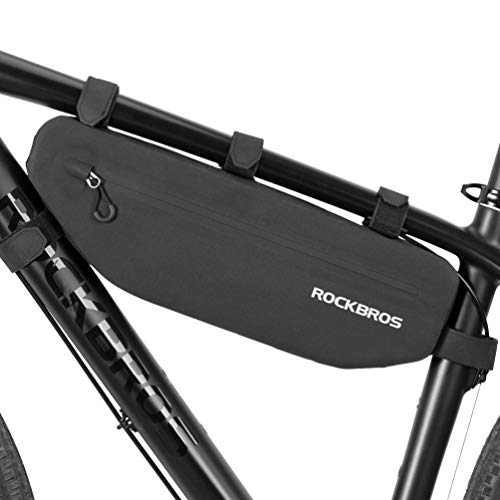
The largest bag here is a three-liter triangle with 840D nylon, a double-bag design, and reflective trim, aimed at under-top-tube corner storage.
- Strength: three liters gives room for tools, a spare tube, and a snack.
- Strength: the thicker nylon fabric is a durability signal for rougher use.
- Trade-off: a three-liter bag requires a roomy frame triangle and can touch knees on small bikes.
It suits touring and gravel riders who carry more gear and ride on rough surfaces, where a sturdier fabric earns its keep. Skip it on compact frames, where a three-liter bag can crowd the legs and make pedaling feel cramped.
Csoalpo Frame Bag
This is a lightweight triangle bag sold for mountain and road bikes in a small black size, with minimal features listed.
- Strength: simple, low-profile styling that blends in on a frame.
- Strength: the small size keeps it clear of the knees.
- Trade-off: the title lists no capacity, waterproofing, or pocket details, so those need confirming.
It suits riders wanting a basic storage pouch for a first frame bag, or for a spare bike that sees occasional use. Skip it if weather protection or reflective trim matters, or if exact capacity needs to be known before the purchase.
Which One Fits Your Situation
Daily commuting in changing weather
The NDakter 2L is described as waterproof and fits a repair kit plus a wallet, making it the practical choice for a rider who hits the road regardless of the forecast. Even then, sliding a phone into a small zip bag before it goes inside adds a cheap second layer against spray.
Following a map on a phone
The ROCKBROS Phone Front Frame Bag keeps the screen where eyes already go. Anyone with a phone larger than 7 inches should skip it.
Fast road rides with snacks and keys only
The ROCKBROS Top Tube Bag at 1.3 liters offers one-hand access and a headphone port, which suits short, quick outings.
Longer gravel or touring days
The ROCKBROS 840D triangle bag brings the largest listed capacity at three liters and a tough nylon fabric, so it handles spare parts and a layer without a backpack.
Common Mistakes
- Buying a triangle bag without measuring the open space inside the frame.
- Treating “water-resistant” as the same as “waterproof” and leaving a phone unprotected.
- Stuffing the bag so full that it rubs the rider’s knees while pedaling.
- Forgetting about bottle cage clearance, which a bulky bag can block.
- Putting heavy tools high in the bag, where they make the bike feel top-heavy.
Related guides
Frequently Asked Questions
Do frame bags fit full-suspension mountain bikes?
Often they do not, because the rear shock and linkage take up the space in the main triangle. A top tube bag is the safer choice on those frames.
How many liters do most riders need?
For a short ride, one to one and a half liters covers essentials. A two-liter bag handles a spare tube and tools, while three liters is for longer days. A simple way to decide is to lay out the gear that usually travels on the bike, then pick the smallest bag that holds it with a little room left for a snack.
Will straps damage the frame paint?
Hook-and-loop straps can rub on grit over time. Wiping the frame before mounting and placing a small piece of protective tape under the straps reduces wear.
Can a frame bag block cables?
It can on frames with exposed cables or frame-mounted shifters. Check cable routing before buying, and leave enough slack so steering stays smooth. After the first ride, turn the handlebars fully in both directions with the bag mounted to confirm nothing pulls or catches.
More from Amazon
Programs that pair well with the guide above. Offers and eligibility are set by Amazon and may change.
Free shipping on eligible items, Prime Video and more. Eligible new members can start with a free trial.
Start a Prime free trialA Prime membership for ages 18-24 with a trial period. Eligibility is set by Amazon.
See Prime for Young AdultsAudiobooks and podcasts to listen to on the go. Eligible new members can start with a free trial.
Try Audible freeAd-free music streaming. Eligible new subscribers can start with a free trial.
Try Music Unlimited freeAs an Amazon Associate we earn from qualifying purchases.