Key takeaways
- Compare the best trolling motors for boats and kayaks, with thrust, shaft length, voltage and mount picks from Minn Kota, Newport and more top brands.
A good electric trolling motor changes how you fish. Instead of drifting past a bank or fighting the wind with a paddle, you hold position quietly, creep along a weed edge, and keep both hands free for casting. The right motor depends on three basics: how much thrust your hull needs, how long the shaft must be to keep the propeller submerged, and whether a transom clamp or a bow mount fits the way you fish.
This guide compares five electric trolling motors from five different makers, covering small kayaks and jon boats through to mid-size bass boats: a hand-steered freshwater workhorse, a saltwater-ready transom motor with a battery meter, a value freshwater option for small craft, a remote-controlled bow mount, and a cable-steer bow mount for instant response at the pedal. Every pick runs on 12 volts, so most anglers can power them with a single deep-cycle battery.
Disclosure: As an Amazon Associate, I earn from qualifying purchases.
1. Minn Kota Endura C2 30 — Simple Transom Power for Small Boats
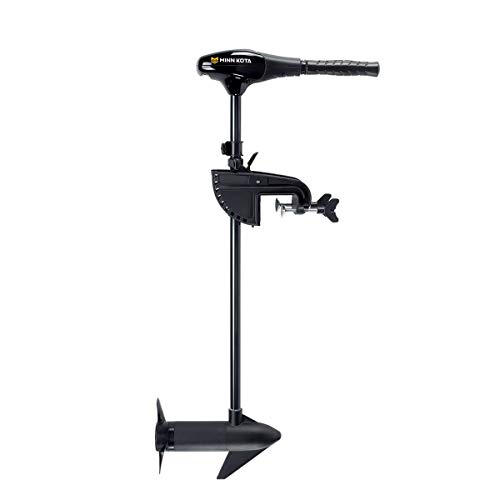
The Endura C2 30 is the motor many anglers buy first. It clamps onto the transom in minutes, steers with a telescoping tiller handle, and asks almost nothing in the way of setup. For a canoe, kayak with a transom plate, inflatable, or small jon boat on calm freshwater, 30 pounds of thrust moves the hull steadily without draining a modest battery too quickly.
Minn Kota builds this model around a composite shaft and a 10-position lever lock bracket that resists flexing and sun damage. The tiller extends by six inches, which helps when you are seated low in a kayak or reaching back from a bench seat. Five forward speeds and three reverse speeds give you enough steps to slow down for a finesse presentation or back away from cover. This is a freshwater motor, so store it accordingly if you fish brackish water.
Specs
- Thrust: 30 lb
- Shaft length: 30 inches
- Voltage: 12 volts
- Mount: Transom mount, lever lock bracket
- Control: Telescoping tiller handle, hand steer
- Speeds: 5 forward / 3 reverse
- Water type: Freshwater
2. Newport Vessels NV-Series 55 lb — Saltwater-Ready Transom Motor

If your small boat fishes both lakes and coastal bays, the NV-Series 55 lb from Newport Vessels covers more water than most transom motors in its class. Its 55 pounds of thrust suits loaded jon boats, aluminum fishing boats, dinghies, and larger kayaks, and the maker rates it for saltwater use with corrosion-resistant hardware.
Control comes from a six-inch telescoping tiller with eight speeds in total, five forward and three reverse. A five-point LED battery indicator sits on the motor head, so a quick glance tells you how much fishing time you have left. The 30-inch shaft adjusts for depth, and the three-blade propeller delivers strong low-end push to get a loaded hull moving. The listing recommends a 12-volt deep-cycle battery of 50 amp-hours or more. At just over 23 pounds, it stays manageable to carry from truck to transom.
Specs
- Thrust: 55 lb
- Shaft length: 30 inches
- Voltage: 12 volts
- Mount: Transom mount
- Control: Telescoping tiller handle, hand steer
- Speeds: 5 forward / 3 reverse
- Battery indicator: 5-point LED meter
- Water type: Saltwater and freshwater
3. Watersnake Tracer Transom Mount — Lightweight Freshwater Value

The Watersnake Tracer is built for anglers who want a light, uncomplicated motor for small watercraft. The 30-pound thrust version pairs with a 30-inch shaft, fitting kayaks, canoes, inflatables, and small jon boats on ponds, creeks, and sheltered lakes. The design keeps the focus on simple tiller control and easy transport.
The shaft is telescopic chrome-plated steel, the tiller extends for comfortable steering from a seated position, and the weedless two-blade propeller slides through light vegetation instead of wrapping it around the hub. Five forward speeds and two reverse speeds, per the maker manual for this model, cover slow trolling passes and quick corrections in a light breeze. The compact unit suits car-top boats where the motor travels in the trunk and mounts in minutes at the ramp. This Tracer version is a freshwater motor, so keep it out of saltwater.
Specs
- Thrust: 30 lb
- Shaft length: 30 inches
- Voltage: 12 volts
- Mount: Transom mount
- Control: Extendable tiller handle, hand steer
- Speeds: 5 forward / 2 reverse
- Propeller: Weedless two-blade
- Water type: Freshwater
4. AQUOS Haswing Cayman B 55 lb — Bow Mount With Wireless Remote

The Cayman B from AQUOS, built by Haswing, moves you to the bow and frees your hands entirely. Instead of a tiller, you steer with a 2.4G wireless remote that works from anywhere in the boat, and variable speed control lets you dial in an exact pace. With 55 pounds of thrust on 12 volts, it is sized for boats up to about 2,750 pounds, covering many bass boats, pontoons, and inflatables.
The 48-inch shaft works well on hulls with moderate bow height, and the aluminum shaft and sacrificial anode help the motor handle both freshwater and saltwater use. A quick release bracket makes removal for storage easier, and cruise control on the remote holds a steady speed along a contour while you cast. For anglers who fish alone, remote steering from the casting deck is a genuine step up compared with reaching back to a transom tiller all day.
Specs
- Thrust: 55 lb
- Shaft length: 48 inches
- Voltage: 12 volts
- Mount: Bow mount with quick release bracket
- Control: 2.4G wireless remote, variable speed
- Max boat weight: Up to 2,750 lb per maker
- Water type: Saltwater and freshwater
5. MotorGuide X3 45 lb — Cable-Steer Bow Mount for Precise Control

The MotorGuide X3 answers a different need: direct, mechanical response at the bow. Its cable-steer foot control uses a dual cable pull-pull system that removes slack, so the motor turns the moment your foot moves. Variable Ratio Steering reduces torque feedback and tightens turning response when you thread a boat between docks or hold a line in wind.
This configuration delivers 45 pounds of peak thrust on 12 volts with a 36-inch shaft, a good match for smaller bass boats and aluminum hulls with lower bow height. The mount is aircraft-grade aluminum, the outer shaft is stainless steel, and the composite inner shaft carries a lifetime guarantee from the maker. Digital Power Management extends run time by delivering power more efficiently at partial throttle, where most trolling happens. If you prefer the connected feel of cable steering over a remote, the X3 is the control-focused pick in this group.
Specs
- Thrust: 45 lb peak
- Shaft length: 36 inches
- Voltage: 12 volts
- Mount: Bow mount, aircraft-grade aluminum
- Control: Cable steer, foot control
- Steering: Variable Ratio Steering, dual cable pull-pull
- Water type: Freshwater
How to Choose the Right Trolling Motor
Match thrust to your loaded hull. A common guideline is about 2 pounds of thrust for every 100 pounds of loaded boat weight, including people, batteries, and gear. Small kayaks and canoes do well at 30 lb. Loaded jon boats usually feel better at 45 to 55 lb, especially in wind or light current.
Measure for shaft length. The propeller should sit at least 12 inches below the waterline so it stays submerged in chop. For transom motors, measure from the mounting point to the waterline and add about 12 inches. For bow mounts, measure from the bow deck to the waterline and add 16 to 20 inches if you fish rough water often.
Pick the mount and control you will enjoy using. Transom motors clamp on in minutes and steer by hand, which suits small boats and portable setups. Bow mounts pull the boat instead of pushing it, track straighter in wind, and open up foot pedals and wireless remotes. If you cast constantly, hands-free control is worth more than a small gain in thrust.
Plan the battery side. All five motors here run on 12 volts, so one deep-cycle battery covers them. Check maximum amp draw and battery capacity in amp-hours to estimate run time, and run at moderate speeds to stretch a charge.
FAQ
How much thrust do I need for a kayak?
Most fishing kayaks work well with 30 to 36 lb of thrust. A heavier kayak with a lot of gear, or one fished in current, benefits from stepping up toward 55 lb, as long as the transom or mount can support the motor weight.
Can I use a freshwater trolling motor in saltwater?
It is not a good idea for regular use. Freshwater models lack the corrosion protection and sacrificial anode that saltwater models carry, and exposure can shorten the life of the shaft, hardware, and motor housing. Choose a model built for saltwater if you fish bays or the coast.
What battery should I buy for a 12-volt trolling motor?
Use a 12-volt deep-cycle marine battery, lead-acid or lithium, sized to the maker recommendation. Several motors here suggest 50 amp-hours or more. Bigger capacity means longer run time, and lithium cuts weight for kayak use.
Is a bow mount better than a transom mount?
Neither is better for everyone. A bow mount pulls the boat, tracks straighter, and supports foot or remote control for serious casting anglers. A transom mount is simpler, lighter, and easier to move between boats.
How long will a trolling motor run on one charge?
Run time depends on speed, load, wind, and battery size. At moderate speeds, a properly sized deep-cycle battery can power a day of fishing. Full thrust draws the most current, so save top speed for short moves between spots.
Conclusion
The best trolling motor matches your hull, your water, and the way you fish. Pick the Minn Kota Endura C2 30 for simple freshwater power on small boats, the Newport NV-Series 55 lb for stronger thrust and saltwater capability, and the Watersnake Tracer for a light setup that travels easily. Move to the AQUOS Haswing Cayman B for wireless bow control, and consider the MotorGuide X3 if precise cable-steer foot control matters most. Measure your shaft length, size your battery with care, and any of these five will hold you on the fish with steady control.
More from Amazon
Programs that pair well with the guide above. Offers and eligibility are set by Amazon and may change.
Free shipping on eligible items, Prime Video and more. Eligible new members can start with a free trial.
Start a Prime free trialA Prime membership for ages 18-24 with a trial period. Eligibility is set by Amazon.
See Prime for Young AdultsAudiobooks and podcasts to listen to on the go. Eligible new members can start with a free trial.
Try Audible freeAd-free music streaming. Eligible new subscribers can start with a free trial.
Try Music Unlimited freeAs an Amazon Associate we earn from qualifying purchases.