Key takeaways
- Measure first. Confirm rail diameter, bed width, rod-butt diameter, and the clearance required to lift each rod out.
- Load-test the position. Apply firm hand pressure in the direction a rod will pull. If the mount shifts before installation, it will shift more when wet and under vibration.
- Use the correct fasteners. Marine stainless bolts with washers spread the load better than short self-tapping screws. Seal drilled holes with an appropriate marine sealant.
- Separate dissimilar metals. Use nonconductive washers or sleeves where the design permits, particularly with aluminum racks and stainless hardware.
- Rinse after every saltwater trip. Flush tubes, hinges, clamps, and screw threads with fresh water, then let them dry before storage.
- Inspect the wear points. Check straps, retaining pins, plastic collars, clamp pads, and mounting bolts at the start of each trip.
Best Fishing Rod Holders: Secure Storage for Any Boat
The best fishing rod holders match the mounting surface, withstand corrosion, and hold the number of rods you actually carry without making them difficult to reach. For most boat owners, a marine-grade stainless-steel or UV-stabilized polymer holder with a secure locking collar is the safest all-around choice; bank anglers usually need a ground spike, while truck users need a rack that protects rods during transport.
Quick picks by fishing situation
| Situation | Best holder type | Useful capacity | Recommended construction | Typical 2026 market range |
|---|---|---|---|---|
| Occasional bank fishing | Single or double ground spike | 1–2 rods | Powder-coated steel or UV-stable polymer | $10–$35 |
| Frequent shore fishing | Heavy-duty sand or bank spike | 2–3 rods | Stainless steel, aluminum, or reinforced polymer | $25–$70 |
| Small fishing boat | Clamp-on or flush-mount holder | 1–2 rods | 316 stainless steel or marine-grade polymer | $20–$90 |
| Large boat or group fishing | Rail-mounted multi-holder or rocket launcher | 4–8 rods | 316 stainless steel or anodized aluminum | $80–$350 |
| Pickup truck transport | Bed rail, crossbar, or hitch-mounted rack | 2–6 rods | Aluminum, stainless steel, and padded polymer supports | $60–$250 |
How to choose the right mount
Bank and shoreline holders
A ground spike is the simplest option, but its performance depends more on the ground than on the holder. Narrow spikes work well in firm soil and compacted gravel. In loose sand or soft mud, choose a wider or screw-style anchor with a shaft of roughly 18–30 inches. A short plastic spike can twist or lean when a fish pulls sideways.
Our top picks
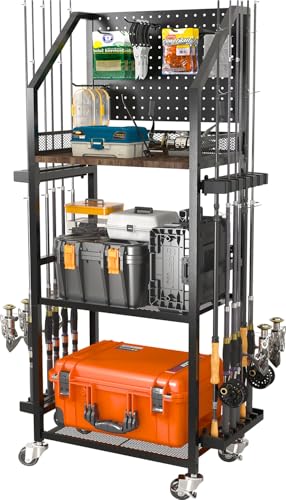


As an Amazon Associate we earn from qualifying purchases at no extra cost to you. Ratings are shown as listed on Amazon.
Look for a rod tube that keeps the reel above the ground and leaves enough clearance for the handle. A tube with an internal diameter of 1.5–2 inches accommodates many freshwater spinning rods, but large saltwater reels may need more space. Bank holders should also have a lower drainage opening so rain and spray do not collect around the rod butt.
Boat rail and clamp-on holders
Clamp-on holders are practical for rented boats, small aluminum boats, and anglers who do not want to drill holes. Measure the rail or gunwale before buying: common clamp ranges cover approximately 0.75–1.5 inches, while heavier models may accommodate rails up to 2 inches. A clamp that is too wide can shift under load even when its screw feels tight.
Rail-mounted systems are convenient when several anglers need access to rods. They are less suitable for narrow walkways because a full rack can catch clothing, fishing line, or a landing net. Position the holders where a rod can be lifted vertically without striking a windshield, canopy, or another angler.
Flush-mount holders
Flush mounts create the cleanest installation and are difficult to knock loose, making them a good choice for permanent boat layouts. They require accurate drilling and access to the underside of the mounting surface. Before cutting, check for wiring, flotation compartments, fuel lines, and structural ribs.
Most flush holders are designed for storage or trolling rather than fighting a fish directly from the holder. If you fish rough water, use a model with a positive locking pin or strap. Friction alone may not stop a rod from bouncing out when the boat crosses wakes.
Truck and vehicle racks
Truck racks should secure both the rod butt and the upper section near the reel or handle. A single lower tube leaves a long rod free to whip, vibrate, and damage guides. For highway travel, choose padded contact points and a strap system that does not press directly on ceramic guides.
Bed-mounted racks are convenient for short trips, while crossbar systems keep rods higher and farther from loose cargo. Do not carry rods in an open rack if the tips extend beyond the vehicle’s legal load limits. Remove reels or use reel covers when road grit and rain are unavoidable.
Material and corrosion resistance matter more than appearance
316 stainless steel is the strongest corrosion-resistant choice for saltwater, especially around threaded fasteners and hinges. It is not rust-proof: salt deposits can still stain or pit the surface if they dry repeatedly. 304 stainless steel is suitable for freshwater and many occasional saltwater applications, but it needs more consistent rinsing in marine environments.
Anodized aluminum keeps weight down and resists surface corrosion, although scratches can expose the underlying metal. It is useful for large multi-rod racks where several pounds of stainless steel would become cumbersome. Avoid mixing bare aluminum with stainless fasteners in wet saltwater locations without suitable washers or isolation, because galvanic corrosion can attack the aluminum.
UV-stabilized nylon, ABS, and other marine-grade polymers are light, quiet, and generally affordable. They do not corrode, but prolonged sunlight can make inferior plastic brittle. Polymer holders are a sensible choice for freshwater, occasional boating, and applications where reducing noise matters. Check that the product uses UV-resistant material rather than generic indoor plastic.
Capacity is not the same as usable capacity
A holder advertised for six rods may become awkward when all six rods have large reels, lure covers, or fighting-belt handles. As a practical rule, allow about 8–12 inches of horizontal space per conventional rod on a rack. Heavy saltwater outfits may need 12–16 inches each to prevent reel handles and line from tangling.
For a two-person boat, four rod positions are usually more useful than a six-rod rack if deck space is limited. Keep two rods rigged for immediate use and two protected as spares. On a truck, calculate capacity by rod diameter and reel width, not by the number of holes alone.
Decision matrix: which specification should lead?
| Your priority | Choose | Avoid | Why |
|---|---|---|---|
| Lowest cost and occasional use | Single polymer or coated-steel holder | Complex permanent rack | Fewer parts and no drilling keep ownership costs low |
| Saltwater every week | 316 stainless hardware and replaceable fasteners | Uncoated mild steel | Salt accelerates rust at seams and threads |
| Limited deck space | Compact flush mount or rotating clamp | Wide fixed multi-holder | Reduces trip hazards and preserves casting room |
| Many rods on a large boat | Rail rack with 4–8 positions | Several unrelated single clamps | A unified rack is easier to inspect and organize |
| Frequent highway travel | Two-point padded truck rack with straps | Open tubes with no upper restraint | Limits vibration and prevents rods from bouncing out |
Installation and maintenance that prevent most failures
Use this setup sequence for a boat or truck mount:
- Measure first. Confirm rail diameter, bed width, rod-butt diameter, and the clearance required to lift each rod out.
- Load-test the position. Apply firm hand pressure in the direction a rod will pull. If the mount shifts before installation, it will shift more when wet and under vibration.
- Use the correct fasteners. Marine stainless bolts with washers spread the load better than short self-tapping screws. Seal drilled holes with an appropriate marine sealant.
- Separate dissimilar metals. Use nonconductive washers or sleeves where the design permits, particularly with aluminum racks and stainless hardware.
- Rinse after every saltwater trip. Flush tubes, hinges, clamps, and screw threads with fresh water, then let them dry before storage.
- Inspect the wear points. Check straps, retaining pins, plastic collars, clamp pads, and mounting bolts at the start of each trip.
The first parts to wear are commonly rubber pads, elastic straps, locking pins, and the plastic insert where a rod rests. These are preferable to permanently replacing the whole holder, so look for a design with accessible replacement parts. A cracked tube, stripped clamp thread, or pitted load-bearing bolt is a reason to retire the holder rather than reinforce it with tape.
A simple capacity and cost calculation
Suppose two anglers need four rods on a boat. A rack with six tightly spaced positions may cost $150, but if it blocks a 24-inch walkway, it can reduce usable deck space. Two four-position racks costing $85 each total $170, yet they can be mounted on opposite sides and leave the center clear. The extra $20 buys better access and redundancy: if one clamp fails, the other rack still secures two rods.
For a bank angler who fishes twice a month for a year, a $24 holder used 24 times costs about $1 per outing before maintenance. A $60 heavy-duty holder used three times per week for a full season of 20 weeks costs roughly $0.67 per outing. Frequent use can justify stronger materials even when the initial price is higher.
Common mistakes to avoid
- Choosing a holder by the rod tube diameter while ignoring reel width and handle length.
- Mounting a holder where a rod tip can hit a canopy, windshield, or another person.
- Using an open truck rack without a secondary strap on rough roads.
- Leaving saltwater inside a stainless holder because stainless is mistaken for rust-proof.
- Overloading a clamp-on mount beyond its stated capacity or rail-size range.
- Storing wet rods in closed tubes, which can trap moisture around reel seats and cork or foam grips.
For the broadest combination of security and service life, select a mount designed for your exact surface, choose 316 stainless steel for regular saltwater exposure, leave generous space between rods, and buy fewer positions rather than overcrowding the available area. The best fishing rod holders are not necessarily the largest or most expensive; they are the ones that stay fixed, drain properly, and let you retrieve the right rod without disturbing the rest.