Key takeaways
- Compare the best wrist rollers for forearm and grip training, with handle, strap and loading pin details to help you choose the right trainer for home use.
A wrist roller looks simple, but few small tools work the forearms as completely. You hold a bar with both hands, arms extended, and rotate your wrists to wind a cord or strap around the center. As the cord winds, it lifts a weight plate hanging below. Roll one way and you train the extensors on the top of the forearm. Reverse the motion to lower the weight under control and you hit the flexors underneath. One full up-and-down cycle can leave your forearms burning in under a minute.
That direct loading is why lifters, climbers, and racket sport athletes keep a roller in the gym bag. Stronger forearms support a firmer grip on deadlifts and rows and more stable wrists when you swing, throw, or strike. Because you load it with plates you already own, you can add weight in small steps for months.
This guide compares five plate-loaded wrist rollers from five different brands. Each one uses a handle, a cord or webbing strap, and a loading pin or carabiner for plates, but they differ in handle thickness and texture, strap length, plate fit, and total capacity. Below you will find what to look for before you buy, then a detailed look at each model so you can match a roller to your hands, your plates, and your training space.
Disclosure: As an Amazon Associate, I earn from qualifying purchases.
How to Choose the Best Wrist Roller
Handle Material and Diameter
The handle is the part you will feel most. Slim steel bars with foam or rubber grips are comfortable for longer sets and for anyone new to forearm training. They let you focus on smooth rotation without your grip failing first. Thicker handles increase the challenge. A fat grip forces your fingers to work harder just to hold on, so the same plate weight feels much heavier. If your main goal is maximum grip strength, a thicker handle is worth considering. If you plan to use the roller for rehabilitation work or high-repetition endurance sets, a standard diameter with a soft, non-slip surface is usually the better fit.
A one-piece alloy steel core will handle heavy loading without flexing. Foam improves comfort but can compress over time. Textured rubber stays secure when your palms sweat, helping you keep the bar level through the final turns.
Cord, Strap, and Webbing
Rollers use either a round cord or a flat nylon webbing strap. Flat webbing winds evenly around the bar and is less likely to bunch to one side, which keeps the weight hanging straight. Round cord is simple and easy to replace, but check how it attaches to the bar. A strap that slips sideways mid-set makes the load swing and breaks your rhythm.
Length controls range of motion. A longer strap, around 50 inches, gives more turns and longer time under tension. A shorter strap, around 35 inches, finishes a set faster and suits limited clearance. Adjustable straps let you shorten or lengthen the drop as needed.
Loading Pin and Plate Fit
Check plate compatibility before anything else. Some pins fit only 1-inch standard plates. Others fit both 1-inch standard and 2-inch Olympic plates, which is ideal if your home gym mixes both or if you train at a commercial gym. Look for a pin with a secure carabiner or collar so plates cannot slide off as the weight swings slightly during the lowering phase.
Also confirm how the pin connects. A quick-locking mechanism or sturdy carabiner makes changing weight fast. A fixed loop is secure but slower to load.
Weight Capacity and Build
Capacities here range from about 220 to 240 pounds, well above the 5 to 20 pounds most trainees use for strict reps. A higher capacity signals a strong core, stitching, and connection points. Look for reinforced stitching and a rust-resistant finish if you train in a garage.
Comfort, Portability, and Use
All five options here fit in a gym bag and need no rack. Load a plate, let it hang, and roll. Keep elbows soft, shoulders down, and arms parallel to the floor. Roll slowly and train both directions so flexors and extensors develop evenly.
1. Yes4All Wrist and Forearm Blaster

The Yes4All Wrist and Forearm Blaster is a long-running favorite for straightforward home training. It pairs a solid steel construction with durable nylon webbing and soft padded foam handles. That combination makes it approachable for beginners who want comfort during longer sets, while the steel core gives experienced lifters confidence to keep adding plates over time.
In use, the flat webbing winds neatly and helps the load track straight, so you spend less time correcting a swinging plate. The handles reduce hand fatigue and limit slipping when you roll up and down without setting the weight down. It is a sensible first roller with a proven, no-fuss design, compact enough for a drawer or training bag.
Specs
- Handle material: Steel core with soft foam grip handles
- Cord type and length: Durable nylon webbing rope
- Loading pin type: Pin fits 1-inch standard and 2-inch Olympic weight plates
- ASIN: B00HGPLEX4
2. FitBeast Forearm Strengthener and Wrist Roller
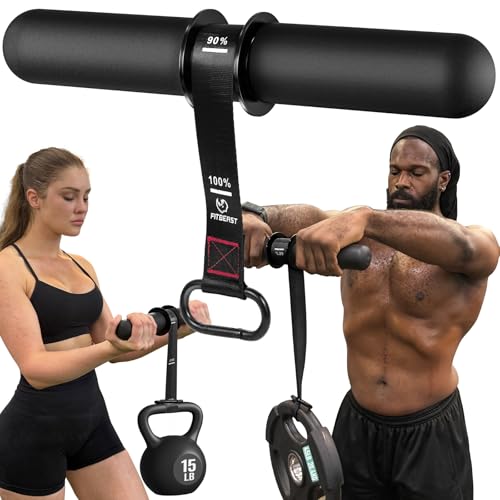
The FitBeast Forearm Strengthener and Wrist Roller stands out for its thicker handle design. The brand states the handles are thicker than a standard roller, which increases grip demand on every turn and recruits more of the hand and forearm. For climbers and lifters whose grip gives out before their larger muscles do, that extra thickness can be the main reason to choose this model.
The adjustable nylon strap is another practical detail. You can change the length for your height and style, and an extension strap is included. Markings on the webbing help you reset the same length each session. The anti-slip surface supports controlled building work and careful light-load training. If you want a roller that deliberately makes holding on harder, examine this one closely.
Specs
- Handle material: Thick, non-slip handles, thicker than standard design
- Cord type and length: Adjustable nylon webbing strap with extension strap included
- Loading pin type: Strap loading for weight plates, plate fit via strap and connector
- Weight capacity: 220 pounds
- ASIN: B0D7397J6M
3. DMoose Fitness Forearm Strengthener and Wrist Roller

The DMoose Fitness Forearm Strengthener and Wrist Roller is built around heavy loading and a dual-purpose design. Its one-piece alloy steel core has a rust-resistant finish, and the textured rubber handles are made to stay put during sweaty sessions. Beyond the main roller, the design incorporates a grooved finger roller element, giving you a second way to work finger dexterity and forearm control with the same tool.
The loading pin fits both plate sizes with a carabiner for quick changes, while the reinforced strap provides a smooth roll and full wrist rotation. With the highest stated capacity here, it suits trainees who want plenty of headroom. It is also a good pick if you prefer rubber over foam for repeated hard sets.
Specs
- Handle material: Alloy steel core with textured non-slip rubber handles
- Cord type and length: Reinforced nylon strap, 35 inches
- Loading pin type: Loading pin with carabiner, fits 1-inch standard and 2-inch Olympic plates
- Weight capacity: 240 pounds
- ASIN: B0FPGHD9TP
4. AJKPL Forearm Strengthener and Wrist Roller

The AJKPL Forearm Strengthener and Wrist Roller focuses on strap length and a quick-locking setup. You can choose the shorter webbing for compact, faster sets or the longer webbing for more rotations per lift. That choice is useful if several people in a household share one roller, or if you like to vary time under tension without changing the weight.
The roller uses alloy steel with anti-slip handles, and the quick-locking mechanism makes attaching the load fast and secure. At under a kilogram in package weight, it is easy to carry anywhere. For trainees who value a longer drop and simple handling, it offers a clean, functional approach. Keep the webbing flat as you begin, and the weight rises smoothly.
Specs
- Handle material: Alloy steel with durable anti-slip grip handles
- Cord type and length: Ultra-strong nylon webbing, 43.3 inches or 51.2 inches
- Loading pin type: Quick-locking mechanism for plate loading
- ASIN: B0CS8VLZP9
5. PELLOR Forearm Wrist Roller

The PELLOR Forearm Wrist Roller is a lightweight, classic option for home use. It combines steel, nylon, and foam in a simple layout: foam-covered handles for comfort, a nylon cord for winding, and a weight-bearing setup for standard plates. Weighing well under a kilogram for the unit itself, it is one of the easiest rollers here to pack for travel or store in a small apartment gym.
This fits beginners adding forearm work as a finisher two or three times per week. Begin with a very light plate, focus on slow lowering, and add weight only when you can complete the full cycle without shrugging. The foam grip keeps the learning phase comfortable.
Specs
- Handle material: Steel with foam anti-slip handle covering
- Cord type and length: Nylon weight-bearing rope
- Loading pin type: Weight-bearing pin for plates, plates not included
- Item weight: About 680 grams
- ASIN: B01CG2ZQD0
Verdict: Which Wrist Roller Should You Buy?
Choose the Yes4All Wrist and Forearm Blaster if you want a balanced, comfortable first roller that fits both standard and Olympic plates. Choose the FitBeast model if a thicker handle and an adjustable strap appeal to you, especially for grip-focused training. Choose the DMoose roller if you want textured rubber grips, a carabiner loading pin for both plate sizes, and the highest stated capacity in this guide, plus the added finger roller feature.
Choose the AJKPL roller if strap length choice and a quick-locking connection are your priorities, or choose the PELLOR roller if you want the lightest, simplest design for home finishers and travel.
Whichever model you pick, technique decides your results. Use a weight you can lower slowly without dropping, train both rolling directions, and progress in small steps. Two or three short sessions per week, placed at the end of an upper-body workout, are enough for most people to build stronger forearms, steadier wrists, and a grip that holds up when the rest of your training gets heavy.
More from Amazon
Programs that pair well with the guide above. Offers and eligibility are set by Amazon and may change.
Free shipping on eligible items, Prime Video and more. Eligible new members can start with a free trial.
Start a Prime free trialA Prime membership for ages 18-24 with a trial period. Eligibility is set by Amazon.
See Prime for Young AdultsAudiobooks and podcasts to listen to on the go. Eligible new members can start with a free trial.
Try Audible freeAd-free music streaming. Eligible new subscribers can start with a free trial.
Try Music Unlimited freeAs an Amazon Associate we earn from qualifying purchases.