Key takeaways
- Compare the best crampons for mountaineering and ice climbing, from a 12-point steel all-rounder to a technical mono-point and ultralight ski models.
A crampon is the piece of kit that turns steep snow and hard ice from a gamble into a walking surface. Unlike the microspikes and stretch-on traction cleats covered in our separate microspikes guide, which slip over hiking shoes for icy paths, the crampons here are rigid or semi-rigid metal frames with long points that fasten directly to mountaineering boots. They are built for glacier travel, alpine routes and ice climbing, where a slip has real consequences and short trail teeth cannot bite deep enough.
The five models below come from five different makers. Two are steel classics for general mountaineering, one is a technical mono-point tool for steep ice and mixed ground, and two are aluminium designs that trade durability for a lighter carry on ski tours and fast alpine days. Match the binding to your boots first, then think about points and weight.
Disclosure: As an Amazon Associate, I earn from qualifying purchases.
How to Choose the Right Crampons
Begin by being clear about the category. Microspikes and other slip-on traction aids use elastic harnesses, chains and short teeth; they help on flat ice and winter paths, but they can roll or peel off on a steep slope and their teeth are too short for firm glacier ice. A true crampon has a metal frame sized to the boot, points around an inch long, and a binding that locks the frame to the sole so the points stay where you place them. If your route involves steep snow, blue ice or front-pointing up a gully, you need the second kind.
Binding and boot fit decide everything else. Strap bindings wrap over almost any stiff boot and suit flexible B1 footwear. Semi-automatic, or hybrid, bindings add a heel lever that clips onto a rear welt, so they need a stiffer B2 boot. Fully automatic step-in bindings use a toe bail and a heel lever and demand a rigid B3 boot with welts at toe and heel, the pairing used for technical climbing. Crampons are graded C1, C2 and C3 to mirror those boot classes. A crampon that does not match your boot welts and sole stiffness can detach mid-route, so confirm the pairing before anything else.
Next, look at points and materials. A 12-point layout with two horizontal front points is the classic mountaineering pattern: it walks well, kicks into steep snow and handles moderate ice. Ten-point designs give up a little security for lower weight on glacier routes. Vertical front points, especially a single mono-point, belong on steep water ice and mixed climbing, where precision matters more than walking comfort. Steel holds an edge on ice and survives contact with rock, which is why most mountaineering crampons are steel. Aluminium models cut weight sharply and work well on snow, but their points dull quickly on hard ice and rock, so treat them as snow tools for ski mountaineering and summer glaciers.
Finally, check anti-balling plates and fit. Flexible plates under the frame pop snow loose before it builds into a slippery platform, and they matter most in wet spring snow. Length adjusts with a linking bar; confirm the range covers your boots, then test the fit at home in the boots you will climb in, checking for sideways play.
1. Petzl Vasak Flexlock — The Classic 12-Point All-Rounder
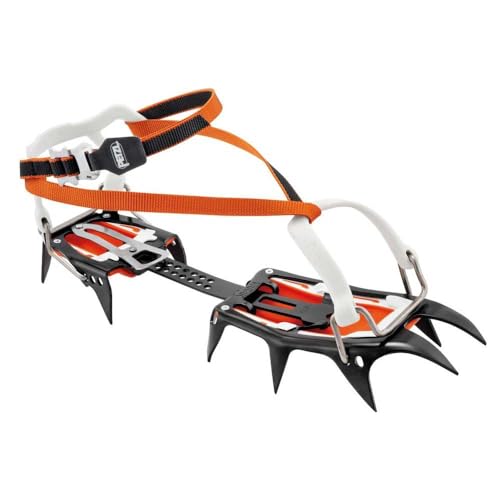
The Vasak is the crampon most mountaineers picture when they picture a crampon: a 12-point steel frame with two long, wide horizontal front points that kick securely into steep snow and give steady purchase on moderate ice. Made for classic mountaineering, it walks comfortably on glacier approaches yet still climbs snow couloirs and easy ice without feeling vague underfoot.
This Flexlock version uses a strap binding that fastens to boots without toe and heel welts, which makes it a sensible first serious crampon for people whose boots are still flexible. Its modular ALPEN ADAPT build lets you swap or replace front sections, linking bars and bindings as parts wear or your climbing changes. The ANTISNOW anti-balling system sheds wet snow before it packs under the frame, and tool-free length adjustment covers a wide span of boot sizes.
Specs
– Brand: Petzl
– Model: Vasak Flexlock
– ASIN: B0CQPP7P9T
– Points: 12
– Materials: Steel, stainless steel, aluminum, nylon
– Binding: Flexlock strap binding, for boots without toe and heel welts
– Boot sizes: EU 36–50
– Weight: 895 g per pair
– Anti-balling: ANTISNOW system
– Certification: CE EN 893, UKCA, UIAA
2. Black Diamond Contact Strap — Stainless Glacier Workhorse

The Contact Strap has been a glacier-travel staple for years because it keeps the formula simple: a 10-point stainless steel frame, horizontal front points and a strap binding that fastens to a wide range of boots, including many stiff hiking and alpine models that have no welts at all. Stainless steel shrugs off the wet, gritty conditions that glacier moraines dish out season after season.
Ten points rather than twelve trims weight and suits the Contact to its home ground of glacier walking, snow slopes and general mountaineering rather than steep ice. ABS anti-balling plates sit under the frame to limit snow build-up. If your climbing is mostly volcano walk-ups, guided glacier peaks and moderate alpine snow, this is the uncomplicated pick.
Specs
– Brand: Black Diamond
– Model: Contact Strap
– ASIN: B002YHI57M
– Points: 10
– Material: Stainless steel
– Binding: Strap (universal)
– Weight: 808 g per pair
– Boot sizes: EU 36–46
– Anti-balling: ABS plates
– Best for: Glacier travel, general mountaineering
3. Grivel G20 Plus Cramp-O-Matic EVO — Mono-Point Precision for Steep Ice

At the technical end of this guide sits the G20 Plus, a forged steel crampon built around a single front point. A mono-point slots into small pockets and thin features that defeat wider dual points, and it pivots cleanly on mixed ground, which is why this design suits steep water ice, mixed routes and dry tooling.
The front point is replaceable, so a worn point does not end the life of the crampon, and Grivel’s Mono-Rail layout adds centre points under the arch for security on featured ice. The Cramp-O-Matic EVO binding is a full step-in with a toe bail and heel lever, so it demands rigid boots with proper welts, and a rear Antibott plate handles snow build-up on approaches and descents. This is a specialist tool: precise and confidence-inspiring on vertical ground, and more than a glacier walker needs.
Specs
– Brand: Grivel
– Model: G20 Plus Cramp-O-Matic EVO
– ASIN: B09VLH55HB
– Front point: Single forged mono-point, replaceable
– Material: Forged steel
– Binding: Cramp-O-Matic EVO step-in (toe bail and heel lever)
– Boot sizes: EU 37–48
– Anti-balling: Rear Antibott plate
– Certification: CE EN 893, UIAA 153
– Best for: Steep ice, mixed climbing, dry tooling
4. Salewa Alpinist Aluminium Combi — Lightweight Crampon for Ski Days

The Alpinist Aluminium Combi is Salewa’s answer for ski mountaineers who carry crampons as insurance and resent every gram. Its 12-point aluminium frame keeps the pair light during the skin up, then goes on for the firm bootpack or glacier section near the summit.
The Combi binding is semi-automatic, pairing a heel lever for welted boots with a front basket, and anti-balling plates come fitted for spring snow. The trade is durability: aluminium points are for snow and soft ice, and they wear fast on rock and hard water ice. Kept on the ground it was designed for, the Alpinist Aluminium Combi is a dependable, easy-carrying option for ski tours and summer alpine peaks.
Specs
– Brand: Salewa
– Model: Alpinist Aluminium Combi
– ASIN: B00ET40I8M
– Points: 12
– Material: Aluminium
– Binding: Combi semi-automatic (heel lever, front basket)
– Anti-balling: Plates included
– Best for: Ski mountaineering, glacier travel on snow
5. CAMP XLC Nanotech Semi-Automatic — Ultralight Frame, Steel-Biting Front Points

The XLC line from CAMP is built for moving fast in the mountains, and the XLC Nanotech pairs a three-dimensional forged aluminium frame with Sandvik Nanoflex steel inserts at the front points. That hybrid build answers the usual aluminium complaint: the points that do the hardest work get the bite and edge life of steel, while the frame keeps the low weight ski mountaineers want.
The semi-automatic binding clips onto a heel welt and suits semi-rigid boots, and the package includes Antibott plates plus a protective cover for the points. Like any aluminium crampon it is happiest on snow, where it serves ski mountaineering, glacier crossings and light alpine routes; save it from long stretches of rock and hard ice, which belong to the steel models above.
Specs
– Brand: C.A.M.P.
– Model: XLC Nanotech Semi-Automatic
– ASIN: B07CG1SLND
– Frame: Aluminium 7075 with Sandvik Nanoflex steel front-point inserts
– Binding: Semi-automatic
– Included: Antibott plates, crampon cover
– Best for: Ski mountaineering, fast and light alpine travel
Which Crampon Should You Buy?
For most mountaineers, the Petzl Vasak Flexlock is the safest single purchase: a 12-point steel crampon that fits boots without welts and covers glaciers, couloirs and moderate ice. The Black Diamond Contact Strap trades two points for a simpler glacier tool with the most forgiving fit of the group. Choose the Grivel G20 Plus when your routes turn vertical and mixed, and pick between the Salewa Alpinist Aluminium Combi and the CAMP XLC Nanotech when low carry weight decides whether the crampons come along at all. Whichever pair you choose, fit them to your own boots at home and practice walking and front-pointing somewhere low-consequence first.
Frequently Asked Questions
Are crampons the same as microspikes?
No. Microspikes are stretch-on traction aids with chains and short teeth for icy paths and packed snow. Crampons are rigid frames with long points and boot bindings, made for steep snow, glacier ice and climbing. The two solve different problems, and our microspikes guide covers the lighter option.
Can aluminium crampons handle steep ice?
They are not the right tool for it. Aluminium points dull quickly on hard ice and rock, so aluminium models such as the Salewa and CAMP above suit snow travel and ski mountaineering. For steep ice, choose a steel crampon such as the Vasak or the G20 Plus.
Will these crampons fit my hiking boots?
Strap models such as the Vasak Flexlock and the Contact Strap fit stiff hiking and alpine boots without welts. Semi-automatic models need a heel welt, and the G20 Plus needs a rigid boot with toe and heel welts. Flexible trail shoes are not safe with any crampon, because the frame can shift or detach under load.
More from Amazon
Programs that pair well with the guide above. Offers and eligibility are set by Amazon and may change.
Free shipping on eligible items, Prime Video and more. Eligible new members can start with a free trial.
Start a Prime free trialA Prime membership for ages 18-24 with a trial period. Eligibility is set by Amazon.
See Prime for Young AdultsAudiobooks and podcasts to listen to on the go. Eligible new members can start with a free trial.
Try Audible freeAd-free music streaming. Eligible new subscribers can start with a free trial.
Try Music Unlimited freeAs an Amazon Associate we earn from qualifying purchases.