Key takeaways
- Compare the best VHF radios for boats, from floating DSC handhelds with GPS to a budget marine radio, with power, waterproofing and battery tips.
Disclosure: As an Amazon Associate, I earn from qualifying purchases.
A handheld marine VHF is the one piece of safety gear that works when a phone does not. It talks to the Coast Guard, the marina, the tow service and every other boat in range on channel 16, receives NOAA weather broadcasts, and keeps working when it is wet. Unlike a fixed-mount set, a handheld goes with you into the dinghy or onto the kayak, and the floating models below can be fished back out after a fumble at the rail.
The five radios in this guide cover the main ways boaters use a handheld: a DSC model with built-in GPS for offshore work, two floating 6-watt all-rounders, a long-running submersible design with simple controls, and a budget floating radio for a tender or grab bag. They differ in distress features, waterproof rating, battery design and audio, so the right pick depends on how far you go from shore.
1. Standard Horizon HX890
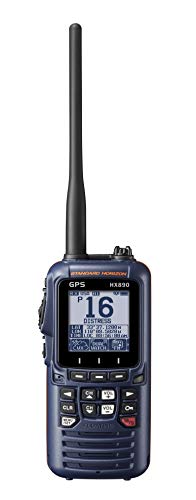
The HX890 is the most complete handheld in this group, because it is the only one here that can send a digital distress call with your position attached. Its Class H DSC radio has a built-in 66-channel WAAS GPS receiver, so pressing the distress key sends your coordinates to the Coast Guard and to nearby DSC-equipped vessels with no connection to the boat. For anyone who runs offshore or boats alone, that feature justifies the step up.
Day to day, it behaves like a premium floating handheld. Output is selectable at 6, 2 or 1 watts, the case is IPX8 submersible and floats, and a water-activated white strobe helps you find it at night. Audio is a loud 700 mW with noise cancelling on transmit and receive, which matters on an open helm in wind. There is also an FM broadcast receiver and waypoint navigation on the GPS.
The box is unusually complete: Li-ion pack, alkaline battery tray for emergencies, wall and 12-volt chargers, cradle and belt clip, and the pack runs about 11 hours. The trade-offs are size and menu depth: this is the biggest radio here, and the DSC features take an evening with the manual, starting with registering an MMSI number.
Specs
- Brand: Standard Horizon
- Model: HX890NB, STH-HX890NB, Navy Blue
- ASIN: B07K6T9F43
- Transmit power: Selectable 6 / 2 / 1 watts
- DSC: Class H DSC with built-in 66-channel WAAS GPS
- Waterproofing: IPX8 submersible, floats, water-activated strobe
- Battery: 1800 mAh Li-ion pack, about 11 hours, alkaline tray included
2. Cobra MR HH350 FLT

The MR HH350 FLT is the balanced all-rounder of the group. It transmits at a selectable 1, 3 or 6 watts, floats with a bright orange core that is easy to spot in chop, and is rated JIS7/IPX7 submersible, so a dunking at the dock is not a problem.
Cobra concentrates on being heard and hearing clearly. The microphone is noise cancelling, which cleans up speech against engine and wind noise, and the BURP feature vibrates water out of the speaker grille after a submersion so the first call after a dunk is not muffled. Tri-Watch keeps an ear on channels 16 and 9, and NOAA weather channels with alerts are built in.
There is no DSC and no GPS, so a distress call is a voice call on channel 16 and you must state your position yourself. That is the honest trade-off at this level, and why offshore skippers should look at the HX890 above. For inshore fishing, sailing and paddling, and as a backup to a fixed-mount set, the HH350 covers the job.
Specs
- Brand: Cobra
- Model: MR HH350 FLT, Grey
- ASIN: B00AJVMVQQ
- Transmit power: Selectable 1 / 3 / 6 watts
- Waterproofing: JIS7 / IPX7 submersible, floats with orange core
- Features: Noise cancelling microphone, BURP speaker clearing, Tri-Watch, NOAA weather
- Battery: Rechargeable lithium polymer pack, included
3. Icom IC-M37

The IC-M37 is the pick for buyers who value build quality and a battery they can swap themselves. Icom gives it 6 watts of output, big keys that work with cold or gloved hands, and Float’n Flash: if the radio goes over the side it floats and an LED flashes so you can find it, day or night. Its IP57 rating adds dust protection to the usual 1-metre, 30-minute submersion figure.
Audio is a strength. The IC-M37 puts out 700 mW, loud enough for an open cockpit, and AquaQuake vibrates water out of the speaker after immersion, so calls stay intelligible. The BP-296 Li-ion pack is user replaceable and runs for more than 12 hours, and a spare pack keeps it alive on multi-day trips in a way sealed designs cannot match.
Channel handling is well thought out: instant access to channel 16, dual-watch and tri-watch scanning, weather channels with alert, and a channel history storing the last five channels used. There is no DSC and no GPS, so distress calling is by voice; what you get instead is a rugged, loud, long-running radio.
Specs
- Brand: Icom
- Model: IC-M37 31 USA
- ASIN: B0B8TLFL7M
- Transmit power: 6 / 1 watts
- Waterproofing: IP57 dust and waterproof, floats with Float’n Flash LED
- Audio: 700 mW with AquaQuake speaker draining
- Battery: BP-296 Li-ion pack, user replaceable, more than 12 hours
- Features: Dual-watch and tri-watch, channel history, instant channel 16
4. Uniden MHS75
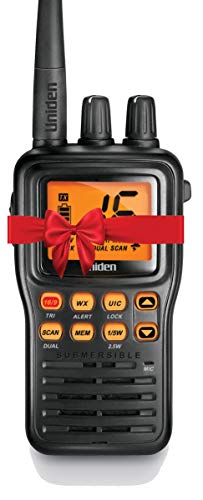
The MHS75 is the long-running, no-nonsense option in this line-up. It is a compact handheld rated JIS8/IPX8 submersible, covering all USA, International and Canadian marine channels plus NOAA weather alert. Transmit power is selectable at 1, 2.5 or 5 watts, with a boost key for instant full output.
Controls are deliberately simple. Triple Watch monitors channels 16 and 9 while you listen to a working channel, and glow-in-the-dark seals make the radio easy to find in a dark cabin or ditch bag. The kit is practical too: a Li-ion pack and a rapid clip-on DC charger, suiting boats where the radio lives on board.
Be clear about what it does not do. The MHS75 is submersible but it does not float, so a lanyard is a sensible habit, and there is no DSC or GPS. In return you get a tough, compact radio with the strongest submersion rating here alongside the HX890.
Specs
- Brand: Uniden
- Model: MHS75, Black
- ASIN: B001J5MQ20
- UPC: 050633501252
- Transmit power: Selectable 1 / 2.5 / 5 watts with power boost key
- Waterproofing: JIS8 / IPX8 submersible (does not float)
- Features: Triple Watch, instant channel 16/9, glow seals, NOAA weather alert
- Battery: Li-ion rechargeable pack with rapid clip-on DC charger
5. Retevis RT55

The RT55 is the budget pick, aimed at kayakers and dinghy sailors who want a genuine marine VHF in the grab bag without paying flagship money. It is a proper FCC Part 80 marine radio covering 88 channels across the USA, International and Canadian groups, and it floats, staying on the surface with its screen light flashing so you can pick it back up.
Waterproofing is IP67, good for 1 metre for 30 minutes, a step below the IPX8 models above but enough for spray, rain and a brief dunk. A vibration draining system clears water from the speaker grille, and the feature list is fuller than the price suggests: NOAA weather alert, dual-watch and tri-watch, priority scan, VOX hands-free operation and a backlit LCD.
Power comes from a 1200 mAh Li-ion battery with USB charging, handy on small boats where a power bank is already in the kit. Output is switchable high/low rather than the multi-step settings of the bigger brands, and there is no DSC or GPS. As a first or second marine radio, it delivers the essentials: it floats, it seals, and it talks on the marine band.
Specs
- Brand: Retevis
- Model: RT55, FA9153A
- ASIN: B07NSMK8QL
- Transmit power: Switchable high / low output
- Waterproofing: IP67 submersible, floats with flashing screen light
- Channels: 88 USA, International and Canadian marine channels
- Battery: 1200 mAh Li-ion, USB charging
- Features: Vibration speaker draining, NOAA weather alert, dual and tri-watch, VOX
How to Choose the Right VHF Radio
Start with distress calling. A DSC handheld with built-in GPS, like the HX890, sends your position digitally at the push of a button once you register an MMSI number, and suits offshore passages, night work and single-handed boating. A voice-only handheld still reaches the Coast Guard on channel 16, but you must know and state your position, which is harder in an emergency.
Next, decide how the radio will meet the water. A floating model is the safer default for small open boats, kayaks and dinghy work, where a dropped radio is gone if it sinks. Check the rating too: IPX8 models tolerate deeper submersion than IPX7 or IP67 sets, and an IP57 rating like the Icom’s adds dust protection.
Then match power and battery to your range. Full-size handhelds top out around 5 to 6 watts, and antenna height matters more than the last watt, so expect a few miles boat to boat and more to a tall shore station. Low power saves battery for marina chatter. A user-replaceable pack suits long trips, sealed packs are fine for day boats, and USB charging is a real convenience on small craft.
Finally, think about audio. A loud speaker, 700 mW on the Standard Horizon and Icom, and a way to clear water from the grille decide whether you can understand a call in wind.
Setup and Care Tips
Charge the battery fully before first use and register an MMSI for a DSC radio before you need it. Learn three controls with the boat tied up: the channel 16 shortcut, the power setting, and how to start a scan. Keep the radio tethered in rough weather, rinse salt off after trips, dry the contacts before charging, and check the battery at the start of the season rather than the start of an emergency.
Conclusion
For most boaters who stay inshore, the Cobra MR HH350 FLT is the easiest recommendation: it floats, it is simple, and its noise cancelling microphone and 6-watt output cover everyday calls and voice distress work well. Choose the Standard Horizon HX890 when DSC distress calling with GPS is worth having, and the Icom IC-M37 when loud audio and a swappable battery matter most. Keep the Uniden MHS75 in mind for a deeply submersible cabin radio, on a lanyard since it does not float, and the Retevis RT55 as the budget pick. Match the distress features and waterproofing to the water you cross, and any of these five will do the job.
More from Amazon
Programs that pair well with the guide above. Offers and eligibility are set by Amazon and may change.
Free shipping on eligible items, Prime Video and more. Eligible new members can start with a free trial.
Start a Prime free trialA Prime membership for ages 18-24 with a trial period. Eligibility is set by Amazon.
See Prime for Young AdultsAudiobooks and podcasts to listen to on the go. Eligible new members can start with a free trial.
Try Audible freeAd-free music streaming. Eligible new subscribers can start with a free trial.
Try Music Unlimited freeAs an Amazon Associate we earn from qualifying purchases.