Key takeaways
- Compare the best marine grease for boat trailer bearings, from saltwater cartridges to hand-pack tubs, by NLGI grade, washout resistance and pack format.
Picking marine grease is really a decision about what tries to remove it. A hub that gets dunked at a saltwater ramp after a hot highway run needs grease that stays in place, resists washout, and keeps protecting steel while it cools in the water. A freshwater trailer used twice a month faces a gentler version of the same problem, and the pack format matters too, because a cartridge for a grease gun and a tub for hand packing lead to very different jobs.
This guide is for boat trailer owners who repack their own bearings, top up bearing protectors between trips, or maintain winches, hinges, and other hardware around the boat. Every product below was chosen from its name and specifications on its Amazon product page, including stated grade, container size, thickener or formula type, and listed applications, rather than from brand reputation alone.
Quick Picks
As an Amazon Associate we earn from qualifying purchases
| Product | Best for | Key spec from title |
|---|---|---|
| Lucas Oil Marine Grease, 14 Ounce Cartridge | Trailers that run in both fresh and salt water | 14 ounce cartridge, universal marine grease |
| Star Brite Trailer Wheel Bearing Grease, 14 Ounce Cartridge | Saltwater ramps and corrosion-prone hubs | NLGI number 2, marine-grade wheel bearing grease |
| Sta-Lube Marine Grease for Boat Trailer Wheel Bearings, 14 Ounce | Hand-checking hubs that see severe water exposure | 14 ounce, aluminum complex marine grease |
| Quicksilver High Performance Marine Grease, 8 Ounce Tube | Smaller jobs and outboard-area fittings as well as bearings | 8 ounce tube, NLGI 2 extreme marine grease |
| Better Boat Marine Grease Tube, 14 Ounce | Grease-gun users who want a stated GC-LB rating | 14 ounce tube, NLGI 2, waterproof high temp |
How to Choose
Water Washout Resistance and NLGI Grade
Start with how the grease behaves when water gets past the seal, because that moment decides whether the bearing keeps a protective film or runs on a thin, milky residue. Listings that state an NLGI grade give a concrete consistency check: NLGI number 2 is the familiar medium grade used in most options here, firm enough to stay in a hub yet workable enough to pack by hand or gun. Pair the grade with the washout language on the listing. A grease described as water-insoluble or built with a polymer for adhesion claims staying power during repeated launches, which matters far more for a trailer dunked weekly than one launched on a calm lake twice a season.
Salt Water, Fresh Water, and Temperature Range
Decide next whether your exposure is salt or fresh, because corrosion protection is not a generic extra. Salt water and salt air attack bearing steel and hub hardware between trips, so a listing that names saltwater corrosion protection speaks directly to coastal owners, while a freshwater user can weigh other factors more heavily. Temperature range deserves the same literal reading. One option here states a working range starting at freezing and running to a few hundred degrees, which covers cold morning launches and hot hubs after towing. Compare the stated range on the listing with your climate and towing distance instead of assuming every marine grease handles the same heat from brakes and bearings on a long summer haul.
Cartridge, Tube, or Tub for Your Method
Match the container to how you actually apply grease, because the wrong format turns a simple repack into a messy workaround. A standard 14 ounce cartridge drops into a full-size grease gun and suits bearing protectors and zerk fittings, letting you add grease without opening the hub. A squeeze tube in a smaller size fits jobs where you dab grease onto linkage points, prop shaft splines, or a single hub cap by hand. A tub is the hand-packing format: you press grease through the rollers with your palm, which many owners prefer during a full teardown. Check the listing size carefully, since an 8 ounce tube runs out halfway through a tandem-axle repack while a cartridge keeps going.
Compatibility With Old Grease and Seals
Switching grease types without cleaning out the old fill can undo the benefit of a better product, because thickeners do not always blend well. Listings describe different bases in this group, including calcium sulfonate, aluminum complex, and lithium-based formulas, and a grease described as non-blending is telling you it will not mix happily with whatever is already in the hub. The safe approach is to strip old grease completely during a repack when you change formula families, and to confirm seal material compatibility with the trailer or hub maker if your seals are older or aftermarket. If you only top up through a bearing protector, staying with the same grease type already in the hub avoids the mixing question entirely.
The 5 Best Options
Lucas Oil Marine Grease, 14 Ounce Cartridge

This cartridge suits owners who split time between saltwater ramps and freshwater lakes and want one grease positioned for both. Its listing frames it as a universal marine grease for trailer wheel bearings, trailer chassis lubrication, and outboards, so it covers the hub job and the smaller fittings around the boat in a single purchase. The overbased calcium sulfonate formula is described with polymers, anti-wear agents, and tackifiers, which fits owners who care about grease staying in place under load. Choose it if your maintenance routine mixes bearing work with chassis points and you prefer a standard cartridge that loads straight into a full-size gun.
Specs
- Brand: Lucas Oil
- Model number listed: 10320
- Container: 14 ounce cartridge
- Formula: Overbased calcium sulfonate (OBCS)
- Typical weld point: 500 kg
- Timken load: 65 lbs
- Dropping point: 570 degrees Fahrenheit
- Listed uses: Trailer wheel bearings, trailer chassis, outboards
Best for: Owners who launch in both fresh and salt water and want one cartridge for bearings and chassis points.
Watch out for: The listing notes it is not recommended for centralized dispensing systems, so confirm your shop setup before buying in quantity.
ASIN: B005973H5Y
Star Brite Trailer Wheel Bearing Grease, 14 Ounce Cartridge
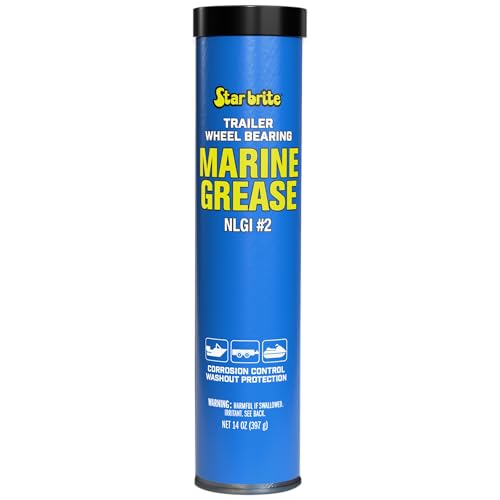
Star Brite is the pick aimed squarely at saltwater corrosion, with a listing that names protection against marine corrosion, salt water, and atmospheric chemicals. That focus suits owners whose trailers sit outdoors near the coast, where hubs corrode even between launches. The grease is rated NLGI number 2 and meets the ASTM D4950 GC-LB classification, giving specification-minded buyers two concrete benchmarks to compare against a trailer manual. Its stated application list runs beyond bearings to winches, hatch hinges, pumps, and anchor chain reels, so one cartridge can cover a full round of ramp-side hardware. Pick it when washout resistance in salt conditions is your first priority.
Specs
- Brand: Star Brite
- Container: 14 fluid ounce cartridge
- NLGI grade: Number 2
- Classification: Meets ASTM D4950 GC-LB
- Stated temperature range: 0 to 325 degrees Fahrenheit
- Formula claim: Water-insoluble, resists washout
- Listed uses: Trailer wheel bearings, winches, bearings, hatch hinges, pumps, anchor chain reels
Best for: Coastal owners launching in salt water who want stated corrosion and washout protection.
Watch out for: The stated range starts at 0 degrees Fahrenheit, so cold-climate users should check that floor against winter storage and towing conditions.
ASIN: B000XBHAV8
Sta-Lube Marine Grease for Boat Trailer Wheel Bearings, 14 Ounce
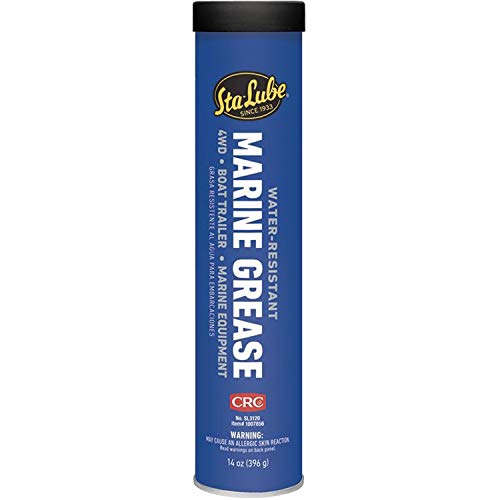
Sta-Lube takes a different route with a blue, tacky aluminum complex grease, a formula family many owners choose for water resistance. The listing describes a polymer added for adhesive, non-blend, and water washout characteristics, and states the grease will resist water under the most severe conditions. That wording fits trailers submerged deeply at steep ramps or launched in rough water where hubs sit under longer. The blue color also helps during inspection, since fresh grease is easy to distinguish from old, darkened fill when you pull a hub apart. Consider it if you repack on a schedule and want new grease visually obvious at the next teardown.
Specs
- Brand: Sta-Lube
- Container: 14 ounce cartridge
- Thickener: Aluminum complex
- Appearance: Blue, tacky grease
- NLGI grade: 2
- Polymer added for adhesive and water washout characteristics
- Listed uses: Boat trailer bearings, wheel bearings, winches, steering cables, deck equipment
Best for: Owners who repack by hand on a schedule and launch in severe water conditions.
Watch out for: The non-blend description means you should clean out old grease of a different type before switching to it.
ASIN: B000KKLLPS
Quicksilver High Performance Marine Grease, 8 Ounce Tube
Quicksilver brings the engine-maker option, an 8 ounce tube of 2-4-C marine grease positioned for high performance and multi-purpose use around the boat. The smaller tube suits owners who grease prop shaft splines, steering and shift linkages, and trailer bearings from the same supply, rather than dedicating a full cartridge to hubs alone. Its listing describes a grease formulated to withstand the marine environment and not break down in water, the core requirement for any fitting that gets splashed or submerged. Choose it if your bearing work is occasional, your hubs are small, or you keep grease aboard for linkage points as well as the trailer.
Specs
- Brand: Quicksilver
- Model number listed: 8M0071838
- Container: 8 ounce tube
- Product line: 2-4-C marine grease
- NLGI grade: 2
- Item weight: 8 ounces
- Listed uses include trailer wheel bearings and general marine lubrication
Best for: Owners who want one smaller tube for bearings plus steering, shift, and prop shaft points.
Watch out for: At 8 ounces it holds notably less than the 14 ounce options, so a full multi-axle repack may need more than one tube.
ASIN: B00BO8A6P6
Better Boat Marine Grease Tube, 14 Ounce

Better Boat offers a blue lithium-based grease in a standard tube, with a listing that states an NLGI number 2 rating, a GC-LB rating, and compliance with ASTM D4950 requirements. Those stated benchmarks make it easy to check against a trailer manual without guessing. The listing describes the grease as waterproof and high temperature in positioning, and names trailers, wheel bearings, hitch balls, and marine machinery among its applications, so it fits owners who maintain the tow setup as well as the hubs. It is sold as a grease-gun tube, which keeps application clean for bearing protectors. Pick it if you want a rated, gun-ready option from a boat-focused brand.
Specs
- Brand: Better Boat
- Container: 14 ounce tube
- Formula: Blue lithium-based grease
- NLGI rating: Number 2, GC-LB
- Standard stated: Meets ASTM D4950 requirements
- Format: Compatible with grease guns
- Listed uses: Trailers, wheel bearings, hitch balls, marine machinery
Best for: Grease-gun users who want stated NLGI and GC-LB ratings in a 14 ounce tube.
Watch out for: The listing positions it as waterproof and high temperature without a specific numeric range in the details reviewed, so check the tube label if you need an exact figure.
ASIN: B0CY3D6JLT
Which One Fits Your Situation
You Launch in Salt Water Most Weekends
Salt exposure punishes bearings twice, once at the ramp and again while the trailer sits in coastal air. Star Brite fits this routine because its listing centers on marine corrosion, salt water, and washout protection with an NLGI number 2 grade. Lucas Oil is the alternative if your trips mix salt and fresh water, since its listing claims corrosion protection in both environments from the same cartridge.
You Repack Bearings by Hand Once a Season
A seasonal teardown rewards grease you can see and work with your palms. Sta-Lube suits this job because its blue, tacky aluminum complex formula stands out against old fill during inspection, and its polymer is described as resisting washout under severe water conditions. Clean the hubs fully before packing, since its non-blend character makes leftover grease of another type a poor base.
You Top Up Through Bearing Protectors
If your hubs have protectors or zerk fittings, the gun format matters more than anything else. Better Boat and Lucas Oil both come in 14 ounce gun-ready formats, so either loads without decanting or mess. Better Boat states its NLGI and GC-LB ratings plainly for a manual check, while Lucas Oil adds chassis and outboard applications if you grease more than hubs during the same session.
You Maintain the Outboard and Trailer Together
Owners who service linkage points, splines, and hubs in one pass benefit from a smaller, versatile tube. Quicksilver fits that pattern, with an 8 ounce tube of 2-4-C grease listed for general marine lubrication including trailer wheel bearings. Keep a second tube on hand if the trailer has two axles, because the smaller size is the trade-off for that flexibility around the boat.
Common Mistakes
- Mixing grease types during a top-up, then finding the blend has thinned or separated inside the hub.
- Buying a cartridge when your routine is hand packing, or a tub when every fitting on your trailer takes a grease gun.
- Ignoring the stated temperature range and running a grease whose listed floor or ceiling does not match your climate.
- Overfilling through a bearing protector until the rear seal pushes out, which lets water in instead of keeping it out.
- Choosing by brand habit without checking whether the listing actually names trailer wheel bearings as an application.
Frequently Asked Questions
Can I use marine grease in regular trailer bearings?
Marine grease is still bearing grease, and the options here list trailer wheel bearings among their applications, so the fit is direct for boat trailers. For a utility or cargo trailer that never gets submerged, it also works, though you may be paying for washout and corrosion protection you rarely need. Always match the NLGI grade to the trailer manual.
How often should boat trailer bearings be regreased?
Interval depends on launch frequency and whether hubs get fully submerged. Owners who launch weekly in salt water typically inspect and top up far more often than freshwater users, and a full repack at least once a season is a common baseline. Milky, gray, or watery grease at inspection means water entered the hub and the schedule should shorten.
What happens if two different greases mix in a hub?
Some thickener families do not blend well, and the mixture can soften, harden, or separate, reducing the protection either grease would give alone. One listing here is explicitly described as non-blending, which is a warning to clean hubs thoroughly when switching formulas. When in doubt, strip the old grease completely during the repack rather than topping up blindly.
Is a cartridge or a tub better for repacking?
Neither is better in absolute terms; they serve different methods. A cartridge feeds a grease gun and suits bearing protectors, zerk fittings, and quick top-ups between trips. A tub suits a full teardown where you press grease through each roller by hand and inspect the bearing closely. Many owners keep both, using the gun during the season and hand packing at the annual service.
More from Amazon
Programs that pair well with the guide above. Offers and eligibility are set by Amazon and may change.
Free shipping on eligible items, Prime Video and more. Eligible new members can start with a free trial.
Start a Prime free trialA Prime membership for ages 18-24 with a trial period. Eligibility is set by Amazon.
See Prime for Young AdultsAudiobooks and podcasts to listen to on the go. Eligible new members can start with a free trial.
Try Audible freeAd-free music streaming. Eligible new subscribers can start with a free trial.
Try Music Unlimited freeAs an Amazon Associate we earn from qualifying purchases.