Key takeaways
- Fast Inflation & Time-Saving
- Easy In-Cab Control
- Easy and Effortless Inflation
The best onboard air compressors depend on your vehicle and intended use: a compact 12-volt unit suits occasional tire inflation, while a higher-duty compressor with a tank is the better choice for airing up several off-road tires, running air tools, or powering air suspension.
Our top picks
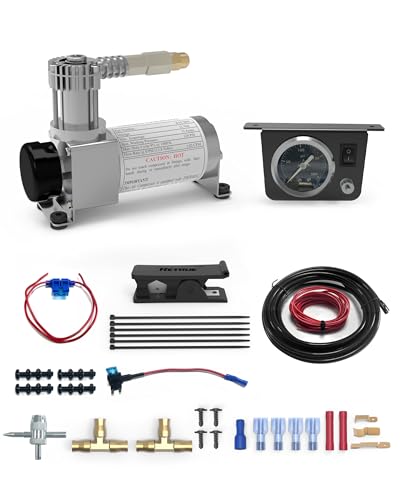 RETRUE Onboard Air Compressor System Universal Air
- Fast Inflation & Time-Saving
- Easy In-Cab Control
- Easy and Effortless Inflation
 Air Lift 25980EZ WirelessONE On-Board Air Compressor
- WIRELESS CONTROL, ANYWHERE: Inflate or deflate your air…
- Inflates and deflates both air springs equally to…
- Includes a powerful 12V compressor rated up to…
 Medium Duty Onboard Air System/Kit 150 PSI
- Compressor Spec: | Power: 12 Volt | Duty…
- Tank Spec: | 2.5 Gallon Air Tank (5X…
- Product Includes: | 1X Air Compressors with Tank…
| Product | Key specs | |
|---|---|---|
| RETRUE Onboard Air Compressor System Universal Air | Fast Inflation & Time-Saving Easy In-Cab Control Easy and Effortless Inflation | Check price |
| Air Lift 25980EZ WirelessONE On-Board Air Compressor | WIRELESS CONTROL, ANYWHERE: Inflate or deflate your air… Inflates and deflates both air springs equally to… Includes a powerful 12V compressor rated up to… | Check price |
| Medium Duty Onboard Air System/Kit 150 PSI | Compressor Spec: | Power: 12 Volt | Duty… Tank Spec: | 2.5 Gallon Air Tank (5X… Product Includes: | 1X Air Compressors with Tank… | Check price |
 VEVOR 12V Air Compressor with Tank 0.8 | Air Compressor 0.8-Gal Tank Kit: Our 12 volt… 90-120 psi Air Compressor: The train horn air… Strong Air Tightness: The air horn compressor is… | Check price |
As an Amazon Associate we earn from qualifying purchases at no extra cost to you.
Quick picks by vehicle and use
- Small car, crossover, or emergency kit: Choose a portable 12-volt compressor rated around 1.5–2.5 CFM, with a 10–15 ft hose and battery-clamp wiring.
- Pickup or SUV used on trails: Choose at least 3 CFM at 0 psi, a 30% or higher duty cycle, and a 20–25 ft hose so all four tires can be reached without moving the compressor.
- Frequent four-tire airing-up: A twin-cylinder compressor producing roughly 5–6 CFM is faster and puts less heat into the motor than a small single-cylinder model.
- Air suspension, horns, or pneumatic accessories: Use a permanent compressor-and-tank system with a pressure switch, relay, moisture protection, and correctly sized air lines.
- Air tools: Do not size the system by maximum pressure alone. Most compact 12-volt compressors cannot supply the continuous airflow required by impact wrenches, grinders, or die grinders.
Best onboard air compressors compared
The figures below are useful buying benchmarks. Manufacturer specifications can vary by revision, temperature, and test method, so treat airflow and inflation times as comparisons rather than guarantees.
| Compressor type or example | Approx. airflow | Duty cycle | Electrical demand | Typical size | Best suited to |
|---|---|---|---|---|---|
| Compact portable, such as VIAIR 88P | 1.5–2.0 CFM at 0 psi | About 25% at 100 psi | 12–15 amps; battery clamps commonly supplied | Approx. 9.5 x 5.5 x 6 in | Cars, crossovers, motorcycles, occasional emergencies |
| Medium portable, such as VIAIR 300P | About 2.5–3.0 CFM at 0 psi | About 33% at 100 psi | Around 30 amps; direct battery connection preferred | Approx. 10 x 4 x 7 in | Light trucks and SUVs with moderate-size tires |
| High-output portable, such as VIAIR 400P | About 2.5–3.0 CFM at 0 psi | About 33% at 100 psi | Around 30 amps; battery clamps or fused wiring | Approx. 10 x 4 x 7 in | Large tires and regular trail use |
| Twin permanent compressor, such as ARB CKMTP12 | About 6 CFM at 0 psi | About 50% at 100 psi | Roughly 50–60 amps at full load | Approx. 12 x 7 x 8 in | Four-tire inflation, lockers, tanks, frequent off-road use |
| Heavy-duty portable, such as Smittybilt 2781 | About 5.6 CFM at 0 psi | About 40% at 100 psi | Roughly 45 amps; direct battery connection | Approx. 16 x 7 x 10 in | Large trucks, RVs, high-volume portable inflation |
Airflow matters more than maximum pressure
Maximum pressure is a poor way to compare compressors because nearly every model can advertise a pressure figure that is irrelevant to tire inflation speed. Look instead for CFM at a stated pressure. Free-air CFM describes output with no restriction; CFM at 30 or 40 psi is more useful because that is close to the pressure range where a tire is being inflated.
A compressor rated at 6 CFM free air will not deliver 6 CFM while pushing against a tire. As pressure rises, airflow falls, the motor draws more current, and heat builds in the cylinder head and hose. For a 33-inch all-terrain tire, a practical target is at least 2.5–3 CFM for occasional use, or 5 CFM and above when four tires must be inflated repeatedly.
How fast will it inflate a tire?
Inflation time depends on tire volume, starting pressure, final pressure, temperature, hose restriction, and the compressor’s real airflow under load. A useful estimate is to compare the compressor’s effective output rather than its free-air rating.
For example, assume a 35-inch tire takes approximately 1.8 cubic feet of added air between 18 and 36 psi. If a compressor averages 2 CFM during that pressure range, the theoretical time is:
1.8 cubic feet ÷ 2 CFM = 0.9 minutes
In practice, allowing for pressure losses, heating, gauge checks, and declining airflow makes about 2–3 minutes per tire more realistic. Four tires could therefore require 8–12 minutes, plus cooling pauses. A twin compressor averaging 4.5 CFM under the same conditions might reduce that to roughly 5–7 minutes for the set.
These are planning estimates, not promises. A narrow hose, a damaged tire valve core, a hot compressor, or a low battery can add substantial time.
Duty cycle and cooling: the specification owners overlook
Duty cycle describes how long a compressor may operate within a stated time at a stated pressure. A 33% duty cycle at 100 psi generally means approximately 20 minutes of operation followed by 40 minutes of cooling in a one-hour period. It does not mean the unit can run continuously whenever the pressure is below 100 psi.
Duty-cycle ratings are especially important for large tires. A compact compressor may inflate one tire successfully but overheat when asked to inflate four tires in succession. Thermal switches protect many units, but repeated overheating can shorten motor, piston-ring, reed-valve, and seal life.
For regular trail use, choose a compressor with a metal cylinder head, replaceable air filter, thermal protection, and a duty cycle of at least 30%. A twin compressor with a 50% rating is more suitable for repeated vehicle servicing, though it still needs airflow around its motor.
Tank or no tank?
A tank is useful when the system must deliver short bursts of air or maintain pressure for an accessory. It is not automatically faster for tire inflation. A compressor must first fill the tank, and a small tank offers limited reserve.
- No tank: Simpler, lighter, cheaper, and usually the best arrangement for direct tire inflation.
- 1–3 gallon tank: Useful for air horns, air lockers, brief blow-off tasks, and reducing compressor cycling.
- 4–5 gallon tank: Better for repeated accessory use, but requires stronger mounting, a pressure switch, a check valve, a drain, and more plumbing.
For an air tool, compare the tool’s required CFM at its working pressure with the compressor’s delivered CFM at that pressure. A small tank may power an impact wrench for a few seconds, but it cannot compensate for a compressor that cannot replenish the air supply.
Wiring, fuses, and mounting requirements
Electrical demand rises quickly with output. A 15-amp compressor may operate from a suitable accessory circuit, but a 30-amp or larger unit should normally connect directly to the battery through an appropriately rated fuse or circuit breaker. A twin compressor drawing 50–60 amps needs short, heavy-gauge wiring, secure terminals, and a relay or manufacturer-approved switching arrangement.
Voltage drop reduces motor speed and increases heat. As a practical guide, keep high-current wiring as short as possible and follow the compressor maker’s wire-size recommendation. For a 30-amp circuit, 10-gauge copper may be adequate for a short run; longer runs or higher-current systems may require 8-gauge or larger cable. Do not select wire or fuse size by guesswork.
Mount the compressor on a rigid, protected surface away from exhaust heat, water spray, mud, and moving suspension components. Leave space around the motor and cylinder head. An under-hood location is convenient but can expose the compressor to temperatures that reduce duty-cycle performance.
Hose length and fittings affect real-world convenience
A 10–15 ft hose works for a compact vehicle if the compressor can be placed near the center of the car. A 20–25 ft hose is more practical for a pickup or SUV because it can reach all four tires without repeatedly moving the unit. Longer hoses add pressure loss, particularly when they have a small internal diameter or restrictive couplers.
For rapid inflation, use a hose with an internal diameter around 1/4 inch or larger, a reliable chuck, and full-flow fittings. A four-tire inflation manifold can save time and equalize pressures, but it adds hose length and connection points. Check every coupler for leaks before relying on the system.
Decision matrix for choosing the right system
| Your situation | Recommended specification | Why |
|---|---|---|
| Low budget; emergency use twice a year | 1.5–2.5 CFM, 10–15 amp draw, portable design | Lowest cost and easy storage; slower but adequate for passenger tires |
| Beginner with a midsize SUV | 2.5–3 CFM, 20 ft hose, battery clamps, thermal protection | Simple setup with enough reach and output for common SUV tires |
| Limited mounting space | Compact single-cylinder compressor; no tank | A tank and permanent plumbing consume more room than they save |
| Weekly off-road driving | 5–6 CFM twin or heavy-duty compressor, 40% or higher duty cycle | Reduces airing-up time and tolerates repeated use better |
| Air lockers or pneumatic accessories | Permanent compressor, pressure switch, filtered intake, optional 1–3 gallon tank | Provides controlled pressure and dependable cycling |
Ownership details that affect long-term reliability
The air filter is often the first neglected consumable. Dust entering the intake accelerates piston and cylinder wear, especially when the compressor is mounted under a vehicle. Inspect and clean or replace the filter according to the manufacturer’s schedule. Keep the compressor level where required, and do not block cooling vents.
Before each major trip, inspect the power leads, fuse, hose, chuck, pressure gauge, and battery terminals. Listen for air leaks at fittings. Do not run the compressor with a crushed hose or repeatedly reset a tripped thermal protector without finding the cause. Allow the unit to cool between tires when its duty-cycle limit approaches.
For the best balance of price, portability, and capability, a 2.5–3 CFM compressor is the sensible choice for most pickups and SUVs. Choose a compact 1.5–2 CFM model for occasional passenger-vehicle emergencies, and move to a 5–6 CFM twin or heavy-duty unit when large tires, frequent trail use, or accessory air demand makes inflation speed and heat management more important than size.