Key takeaways
- Compare the best guitar cables for stage and studio, from a silent Mogami studio run to a vintage-style D'Addario coil, with lengths, plugs and shielding.
A guitar cable is the simplest link in your rig, and one of the easiest to get wrong. Weak shielding hums when you move, high capacitance dulls your top end, and fragile plugs fail at the worst moment. The fixes are all in the construction: an oxygen-free copper conductor, dense shielding, a jacket that matches how you play, and plugs that fit standard jacks without forcing them.
This guide compares five instrument cables from five makers: a premium studio cable built for silent handling, braided and woven 10-foot cables for everyday use, a thick-jacketed stage cable that resists kinking, and a long coiled cable with a vintage look and a warmer tone. Every cable below uses standard 1/4-inch TS connections, so each works between a guitar or bass and an amp, pedalboard, or interface.
Disclosure: As an Amazon Associate, I earn from qualifying purchases.
1. Mogami Gold Instrument 10 — the silent studio standard

Mogami wiring has been a fixture in professional recording studios for decades, and the Gold Instrument 10 applies that same approach to a ready-made guitar lead. It is built around Mogami 2524 high-definition instrument cable, with an oxygen-free copper core, an ultra high density spiral shield, and a conductive polymer sub-shield. A carbon-impregnated PVC layer sits in the construction specifically to kill handling noise, so the cable stays quiet when it drags across a studio floor or shifts under your foot mid-take.
The result is a 10-foot, straight-to-straight cable aimed at transparency rather than character. Mogami describes the design as extremely low in coloration, which makes it a sensible first cable for recording, where you want the guitar and amp to decide the tone. The plugs are standard size, which matters more than it sounds: oversized plugs can stretch and damage older input jacks, and this cable is explicitly made to avoid that. It is backed by a lifetime warranty, which softens the commitment of choosing the premium option in this lineup.
Specs
- ASIN: B0010CHS8E
- Length: 10 feet
- Connectors: 1/4-inch TS, straight to straight
- Conductor: Oxygen-free copper core, Mogami 2524 cable
- Shielding: Ultra high density spiral shield with conductive polymer sub-shield
- Jacket: PVC with carbon-impregnated anti-static layer
- Warranty: Lifetime warranty
2. Ernie Ball Braided Instrument Cable, 10ft, Black — tangle-resistant everyday lead

Ernie Ball takes a different route to durability: instead of a smooth jacket, this 10-foot cable wears a braided exterior that resists tangling when you coil it, toss it in a gig bag, and pull it out again at the next rehearsal. Inside, dual conductors carry the signal, and multiple shielding materials work to preserve it with low handling noise. Ernie Ball describes the tone as reliably clear, with crisp highs, tight mids, and rich harmonics, which is exactly what you want from a general-purpose lead that has to suit clean and driven sounds alike.
The plug layout is straight at one end and angled at the other, a combination that suits most players. The straight plug goes into the amp or pedalboard, while the angled plug sits flatter against a guitar with a top-mounted jack and puts less leverage on the jack when you move. The connectors are heavy-duty metal with plated contacts. If you want one cable that lives in your bag and handles practice, rehearsal, and small stages without fuss, this is the straightforward pick of the five.
Specs
- ASIN: B07N6XP1ZJ
- Length: 10 feet
- Connectors: 1/4-inch, straight to right angle
- Construction: Dual conductors with multiple shielding materials
- Jacket: Braided, tangle-resistant exterior, black
- Plugs: Heavy-duty metal connectors with plated contacts
- Series model: P06081
3. Fender Professional Series Instrument Cable, 10ft, Black — the anti-kink stage workhorse
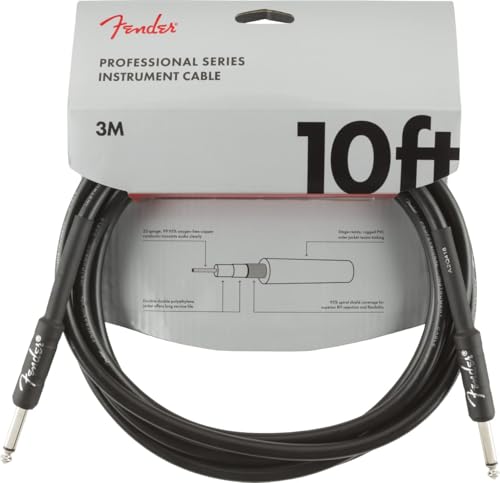
Fender built the Professional Series for players who treat cables as stage equipment rather than studio accessories. The headline numbers are a 22-gauge conductor and 95 percent oxygen-free copper spiral shielding, wrapped in an 8mm PVC jacket. That jacket is thicker than average, and it is the reason this cable resists twisting, kinking, and the physical memory that makes cheaper leads coil up on stage and trip you mid-song.
The connectors are nickel-plated and straight at both ends, which keeps the cable simple to route through a pedalboard or straight into the front of an amp. Fender positions the series as road-reliable and flexible, with components chosen to retain your tone transparently. At 10 feet, it is long enough for most small and mid-size stages while staying short enough to keep capacitance low and your high end intact. For a house cable, a rehearsal-room spare, or a main lead that gets stepped on nightly, the thick jacket and spiral shielding make a practical case.
Specs
- ASIN: B07MVZQXRZ
- Length: 10 feet
- Connectors: 1/4-inch, straight to straight, nickel-plated
- Conductor: 22-gauge
- Shielding: 95 percent oxygen-free copper spiral shielding
- Jacket: 8mm PVC, anti-kinking design, black
- Use: Stage and studio, guitar, bass, and other instruments
4. D’Addario Custom Series Coiled Cable, 30 Feet, Red — vintage reach with a warmer voice
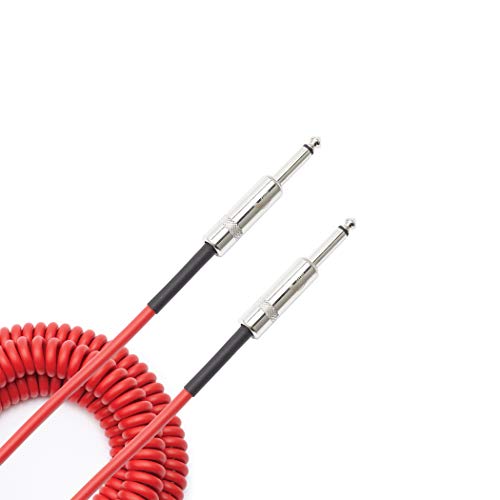
The D’Addario Custom Series coiled cable is the character option in this guide. Its spiral cord stretches to a full 30 feet of cable, then pulls itself back into a compact coil that stays close to your amp instead of spreading across the floor. That makes it a tidy choice for home studios, crowded practice rooms, and players who move around a desk or a small stage and are tired of untangling a long straight lead.
D’Addario is open about the trade-off. A coiled cable needs extra wire to create the coil, so its total capacitance is higher than a straight cable of the same reach. That produces a slightly warmer tone while retaining playing dynamics, which the company frames as part of the vintage tonal equation. If your rig is bright, this cable leans in your favor. If you want maximum sparkle from single-coil pickups, pick a 10-foot straight cable above instead. The red finish is easy to spot as yours at pack-up time.
Specs
- ASIN: B07NLQ72S5
- Length: 30 feet (9.14 meters), coiled
- Connectors: 1/4-inch instrument plugs
- Design: Coiled cord, vintage style
- Tone character: Higher total capacitance for a slightly warmer tone
- Color: Red
- Series model: PW-CDG-30RD
5. Kirlin Premium Plus Instrument Cable, 10 Feet, Carbon Gray — woven style on a sensible budget path

Kirlin’s Premium Plus cable pairs a woven cloth jacket with a properly specified core. The conductor is 20-gauge oxygen-free copper, a heavier gauge than several cables in this guide, and the woven jacket in carbon gray gives it the finished, tweed-style look that a plain PVC lead does not. The listing notes gold-plated contacts, which resist corrosion at the exact point where signal enters and leaves the cable.
At 10 feet, it covers the same ground as the Ernie Ball and Fender cables here: guitar to amp at home, a short stage run, or the first lead into a pedalboard. Cloth jackets also lay flatter and slide less than glossy PVC on a hard floor. Kirlin backs it with a limited lifetime warranty, reassuring at this end of the market. Choose it for the woven look and a heavier-gauge conductor without stepping up to studio-cable territory.
Specs
- ASIN: B00Y4S67OM
- Length: 10 feet
- Connectors: 1/4-inch plugs with gold-plated contacts
- Conductor: 20-gauge oxygen-free copper
- Jacket: Woven cloth jacket, carbon gray
- Warranty: Limited lifetime warranty
- Series model: IWB-202BFGL-10/CA
How to choose the right guitar cable
Start with length, because length quietly shapes tone. Instrument cable adds capacitance as it gets longer, and higher capacitance rolls off high frequencies. A 10-foot cable is the safe default for most players: long enough to move, short enough to keep a bright, clear top end. Go longer only when your stage or room genuinely demands it, and if you choose a long or coiled cable, do it knowing the tone will warm up slightly.
Next, look at shielding. Spiral and braided shields both work when coverage is dense, and the percentages and construction notes in the specs above tell you more than marketing language does. If you record or play near lights, screens, and power supplies, prioritize the quietest construction you can, which is where a sub-shield and an anti-handling-noise layer earn their keep.
Then match the plugs and jacket to your guitar. A right-angle plug suits top-jack guitars and tight pedalboard spaces, while straight plugs are simpler for recessed jacks and amp inputs. Braided and woven jackets resist tangles, thick PVC shrugs off stage abuse, and a coil keeps a long cable contained. Finally, check the warranty: a lifetime or limited lifetime warranty signals the maker expects the cable to survive years of use.
Frequently asked questions
Does cable length change my tone?
Yes, a little. Longer cables have higher capacitance, which softens high frequencies. That is why the 30-foot coiled cable in this guide sounds warmer by design, while the 10-foot cables keep a clearer top end.
Are these cables suitable for bass and keyboards too?
Yes. All five are unbalanced instrument cables with standard 1/4-inch TS connections, the same format used by electric basses, keyboards, and other instruments with high-impedance outputs.
What is the difference between spiral and braided shielding?
Both block interference when coverage is dense. Spiral shields are flexible and common on stage cables, while braided shields are tough and often paired with woven jackets. Handling noise and build quality usually matter more than the shield style alone.
How should I store a guitar cable?
Coil it loosely in the over-under pattern, avoid sharp kinks at the plugs, and keep it in a bag or case rather than under heavy gear. A cable that is stored gently keeps its plugs and solder joints healthy for years.
Conclusion
There is no single best guitar cable here, only the best match for how you play. Choose the Mogami Gold Instrument 10 for silent, transparent recording work. Take the Ernie Ball braided cable as your tangle-resistant daily lead, or the Fender Professional Series when a thick anti-kink jacket matters most. Pick the D’Addario coiled cable for vintage style, long reach, and a warmer voice, and consider the Kirlin Premium Plus for a woven finish with a heavier-gauge conductor. Match the length to your room, the plugs to your guitar, and the shielding to your noise environment, and any of these five will serve your rig well.
More from Amazon
Programs that pair well with the guide above. Offers and eligibility are set by Amazon and may change.
Free shipping on eligible items, Prime Video and more. Eligible new members can start with a free trial.
Start a Prime free trialA Prime membership for ages 18-24 with a trial period. Eligibility is set by Amazon.
See Prime for Young AdultsAudiobooks and podcasts to listen to on the go. Eligible new members can start with a free trial.
Try Audible freeAd-free music streaming. Eligible new subscribers can start with a free trial.
Try Music Unlimited freeAs an Amazon Associate we earn from qualifying purchases.