Key takeaways
- Compare the best guitar string winders, from 3-in-1 cutter and pin puller tools to a motorized USB-C winder, with fit, bearing and grip advice.
Disclosure: As an Amazon Associate, I earn from qualifying purchases.
Turning tuning pegs by hand is the slowest part of a string change. A good peg winder multiplies every turn of your wrist, so a fresh set goes on in minutes. The best guitar string winders go further than a basic crank. Some combine a winder, a string cutter and a bridge pin puller in one 3-in-1 tool, so you stop hunting through a case for three separate items. Others add a smooth bearing, a head that protects polished tuner buttons, or a motor that does the turning for you.
Acoustic players should also care about the pin puller, because levering a stubborn bridge pin with the wrong tool can mark the bridge.
This guide compares five proven designs from established makers: a classic all-in-one tool, a bearing-assisted manual winder, a simple deluxe crank, a basic branded winder for a spare kit, and a rechargeable motorized model for high-volume work.
How to Choose a Guitar String Winder
Start with format. A plain peg winder only turns pegs. A 3-in-1 tool adds a cutter for trimming strings and a notched puller for acoustic bridge pins. If you play acoustic, the 3-in-1 format saves the most time and clutter. If you play only electric, a plain winder with a better bearing and grip may feel cleaner in the hand.
Check the head next. The socket should slip over the tuner button without forcing, grip without slipping, and stay narrow enough to clear neighbouring pegs on a crowded headstock, especially on six-in-line electrics and twelve-string acoustics. Rubber-lined or non-abrasive heads reduce clatter and help protect glossy buttons. A loose, oversized head wobbles and slows you down.
Think about the turning action. Basic moulded winders are light and work fine for occasional use. Bearing designs turn more smoothly and quietly, with less wrist effort over a full set. Motorized winders remove the cranking entirely and help most when you restring many instruments or have limited hand strength, but they need power, and you should always finish the final tension by hand and by ear.
Finally, consider grip and storage. An ergonomic, non-slip handle matters when your hands are tired or a stage is dim. Compact tools travel well, while larger motorized units suit a bench.
The 5 Best Guitar String Winders
1. D’Addario Pro-Winder
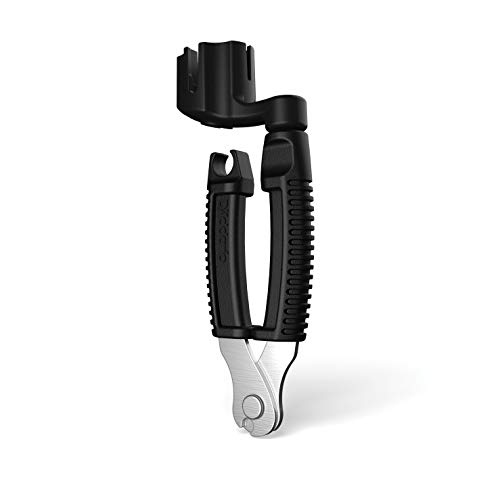
The D’Addario Pro-Winder is the benchmark 3-in-1 tool in this category, and the one most players should consider first. It combines a peg winder, hardened steel string clippers and a bridge pin puller in a single ergonomic body, so one tool handles removal, winding and trimming from start to finish. D’Addario designs it to fit virtually all guitars, along with banjos, ukuleles and mandolins, which makes it useful for a household or studio with mixed instruments.
The extra-length design gives useful leverage, and the cutter handles plain and wound strings cleanly. The integrated puller avoids prying pins with pliers or a coin. It fits a case pocket and needs no charging. This is the safest starting point in the guide.
Specs
- Brand and model: D’Addario Pro-Winder DP0002
- Type: 3-in-1 winder, cutter and bridge pin puller
- Cutter: Hardened steel clippers
- Fit: Virtually all guitars, banjo, ukulele and mandolin
- Colour: Black
- ASIN: B0002E1G5C
2. Ernie Ball Pegwinder Plus

The Ernie Ball Pegwinder Plus refines the manual winder with an ultra-smooth ball bearing action. That bearing is the reason to choose it over a basic moulded crank: the handle spins freely, so bringing a slack new string up toward tension feels faster and takes less wrist work across a full set. The universal peghead is designed for most electric and acoustic guitars and for bass, and Ernie Ball uses a non-abrasive, scratch-free peghead to reduce the chance of marking tuner buttons.
An integrated bridge pin puller sits at the base of the handle, covering the main acoustic task, although this model does not include a cutter, so keep separate clippers nearby. The grip is soft and comfortable, and the body is compact for a gig bag. Choose the Pegwinder Plus if smooth manual speed is your priority and you already own a good cutter.
Specs
- Brand and model: Ernie Ball Pegwinder Plus P09604
- Type: Manual peg winder with bridge pin puller
- Action: Ball bearing design for smooth turning
- Head: Universal, non-abrasive peghead
- Fit: Most electric, acoustic and bass guitars
- ASIN: B08T1MBS9S
3. Dunlop 114SI Deluxe Guitar Stringwinder

The Dunlop 114SI Deluxe is the classic simple crank, built for players who want durability without extra features competing for space in the hand. Its shaped head has a notch that doubles as a bridge pin puller, so it still covers acoustic string changes even without a cutter. The moulded body is tough, light and easy to clean, and the familiar shape has been a case staple for years because there is very little to break or adjust.
This suits a spare kit or a player who prefers separate cutters. It will not feel as refined as a bearing model, but it does the core job quickly and repeatedly.
Specs
- Brand and model: Dunlop 114SI Deluxe Guitar Stringwinder
- Type: Manual peg winder with notched head
- Function: Notched head removes bridge pins
- Construction: Durable moulded body
- Fit: Standard guitar tuning pegs
- ASIN: B003BGO2OK
4. Fender String Winder

The Fender String Winder is the simplest option here: a lightweight moulded winder that restrings in a fraction of the time needed by hand, with a notch shaped for pulling bridge pins on acoustic guitars. That simplicity is its appeal. There is no cutter, no bearing and no power source, just a compact crank that drops into a gig bag or practice room kit and is ready whenever a string change comes up.
It suits beginners, teachers who need several winders on hand, and players who want a branded spare. Seat the head fully, turn steadily, and finish tuning by hand for control.
Specs
- Brand and model: Fender String Winder 0991028000
- Type: Manual peg winder
- Function: Notched for pulling acoustic bridge pins
- Colour: Black
- Weight: Lightweight moulded design, about 20 grams listed
- ASIN: B0002KZK4O
5. Ernie Ball Power Peg Pro USB-C

The Ernie Ball Power Peg Pro USB-C is the motorized option for players who restring often and want the machine to do the turning. Ernie Ball describes it as winding up to eighty percent faster than manual peg winders, with a universal head that fits acoustic and electric guitars, basses, mandolins, ukuleles and more. Forward and reverse control lets you unwind old strings and wind new ones with the same tool, which is where the time saving adds up across several instruments.
This Pro version uses a rechargeable lithium-ion battery charged over USB-C, with the cable included, so you are not swapping disposable cells before a session. Use a light touch as a string nears pitch, stop the motor early, and tune the final stretch by hand. For guitar techs, teachers and multi-guitar owners, it is the clear speed pick in this line-up.
Specs
- Brand and model: Ernie Ball Power Peg Pro USB-C P09626
- Type: Motorized rechargeable string winder
- Power: Rechargeable lithium-ion battery, USB-C cable included
- Head: Universal head design
- Fit: Acoustic and electric guitar, bass, mandolin and ukulele
- ASIN: B0DBN91FD5
Comparison and Which Winder Suits You
For most players, the D’Addario Pro-Winder is the best single buy because it covers winding, cutting and pin pulling in one body. If you already own good cutters and want the smoothest hand action, the Ernie Ball Pegwinder Plus and its ball bearing design move ahead, and its non-abrasive head suits guitars with tidy, polished hardware.
The Dunlop 114SI Deluxe and the Fender String Winder serve the simple end of the market in different ways. The Dunlop feels like the hardier workshop staple, while the Fender is the lightest spare to scatter across cases. Neither includes a cutter, so pair either one with dedicated clippers rather than household scissors, which can fray a cut end.
The Power Peg Pro USB-C rewards its extra size and charging attention only if you restring often. Occasional players will be happier with a 3-in-1 manual tool.
FAQ
Do I need a cutter and pin puller in the same tool?
Only if you play acoustic or want the smallest possible kit. A 3-in-1 tool such as the Pro-Winder handles a complete string change alone. Electric-only players can choose a plain or bearing winder and use separate cutters they already trust.
Will a string winder fit bass and other instruments?
Some will, but check the head size. The Pro-Winder, Pegwinder Plus and Power Peg Pro are all described by their makers for a wider range that includes bass or other fretted instruments. Basic guitar winders may feel tight on larger bass buttons, so test the fit gently first.
Is a motorized winder safe for tuning pegs?
Yes, with control. A motorized winder is for taking up slack and removing old strings quickly, not for final tuning. Stop well before pitch, keep the head seated, and bring the string to pitch by hand so you do not overshoot.
Why does a bearing winder feel faster if it turns at hand speed?
Because less effort is wasted on friction and wobble. A bearing handle spins more freely and stays balanced, so each turn feels smoother and you can keep a steadier rhythm across all six pegs.
Can a pin puller notch damage an acoustic bridge?
It should not when used correctly. Slide the notch under the pin head, lever gently and evenly, and avoid twisting against the bridge. If a pin is stuck, work it slowly rather than forcing it.
Conclusion
The best guitar string winders all solve the same slow problem, but at different levels. Pick the D’Addario Pro-Winder for a complete 3-in-1 manual kit, the Ernie Ball Pegwinder Plus for smooth bearing-assisted winding, the Dunlop 114SI Deluxe for a tough classic crank, and the Fender String Winder for a light, simple spare. Choose the Ernie Ball Power Peg Pro USB-C when volume and hand fatigue make motorized help worth it. Match the head to your tuners, keep a proper cutter in the kit if your winder lacks one, and string changes become a quick routine instead of a reason to delay playing.
More from Amazon
Programs that pair well with the guide above. Offers and eligibility are set by Amazon and may change.
Free shipping on eligible items, Prime Video and more. Eligible new members can start with a free trial.
Start a Prime free trialA Prime membership for ages 18-24 with a trial period. Eligibility is set by Amazon.
See Prime for Young AdultsAudiobooks and podcasts to listen to on the go. Eligible new members can start with a free trial.
Try Audible freeAd-free music streaming. Eligible new subscribers can start with a free trial.
Try Music Unlimited freeAs an Amazon Associate we earn from qualifying purchases.