
Key takeaways
- Carry weight: If you take stairs or public transport, weigh the board against your commute. Some decks are heavy enough to be tiring after a few blocks.
- Deck length: Shorter decks are nimbler; longer decks feel more stable at speed. Taller riders often prefer longer, wider decks.
- Battery care: Follow the manual for charging and storage. Avoid leaving the board in a hot car or charging it unattended, and do not use a charger the maker does not specify.
- Water: Unless the maker states a water-resistance rating, avoid rain and puddles. Even rated boards should not be submerged.
- Maintenance: Belt-drive boards need occasional belt and bolt checks; hub-motor boards need less attention, but wheel wear still matters.
For most adult riders, a mid-range belt-drive board from Exway, Meepo or Backfire is the sensible starting point, while heavier riders and hill-heavy commutes point toward premium dual-motor boards such as the Evolve Hadean or the Exway Atlas family. Light-duty, short-trip riders on a tight budget can look at entry-level single-motor decks, accepting lower range and weaker hill climbing. The right pick depends on rider weight, terrain, carrying needs and how much maintenance you will tolerate.
Our top picks


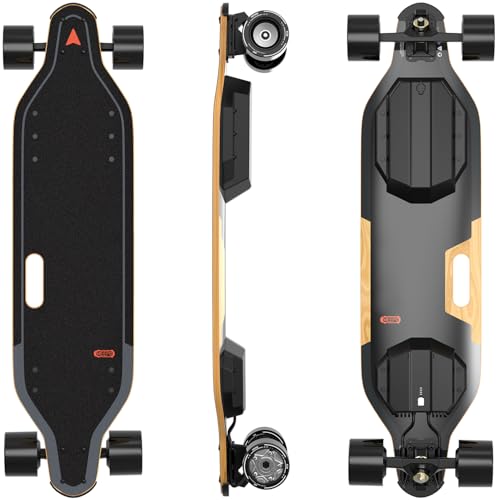
As an Amazon Associate we earn from qualifying purchases at no extra cost to you.
Electric Skateboards at a Glance
| Board family | Best for | Drive type (as the makers describe it) | Limits to know |
|---|---|---|---|
| Exway Flex / Wave lines | Lightweight commuters and first-time buyers | Belt or hub motor depending on model | Smaller batteries mean shorter range on hills |
| Exway Atlas / Ripple lines | Heavier riders, hills, rougher pavement | Dual motors, larger decks | Heavier to carry; higher tier |
| Meepo V5 / Hurricane lines | Budget-conscious beginners | Belt-drive, dual-motor options | Deck and component quality varies by tier |
| Backfire G-series | Value-focused riders who want a standard longboard feel | Belt-drive | Range figures are stated under ideal conditions |
| Evolve Stoke / Hadean / Bamboo | Riders wanting all-terrain wheels and a long-established brand | Belt or gear drive, larger wheels on some models | Premium tier; heavier decks |
| Hub-motor cruisers (various brands) | Low-maintenance, quiet riding | Motor inside the wheel | Less torque on steep climbs than belt-drive |
Model lineups change often, so treat the family names above as a guide to where each brand sits and confirm current model names on the maker’s own site before choosing. Reviewers who cover electric boards regularly note that the original Boosted brand ceased operations, so replacement parts for those older boards now come from third parties.
What Matters Most for Adult Riders
Rider weight and motor power
Makers publish a maximum rider weight, and it is worth staying well under it. A heavier rider on a single-motor board will feel slower acceleration and weaker braking on slopes. Dual-motor boards spread the load and generally hold speed better on inclines, which is why most hill-focused reviews favour them.
Range claims
Stated range is measured by makers under favourable conditions: a lighter rider, flat ground and moderate speed. Real-world range drops with hills, headwinds, cold weather and heavier riders. Expect meaningfully less than the headline figure and pick a battery with room to spare for your commute. Many riders find that a battery sized for double their daily trip removes range anxiety.
Wheel size and road surface
Small urethane wheels suit smooth bike paths and are lighter. Larger pneumatic or all-terrain wheels absorb cracks and rough pavement, but add weight and can feel less nimble. Check your actual route surface before choosing, because a smooth-wheel board becomes uncomfortable on broken asphalt.
Remote and braking
Electric braking is done through the handheld remote, so a reliable connection matters. Look for boards where the maker lists regenerative braking, and practise braking in an empty lot before riding in traffic. Keep the remote charged, since losing the remote usually means losing control of the board.
Budget Tiers
Entry level
Entry boards are usually single-motor, lighter and cheaper to repair. They work for flat campus paths and short trips. Expect modest hill climbing and smaller batteries. These are a reasonable way to find out whether you enjoy riding before spending more.
Mid-range
This tier is where most adults land. Dual-motor or stronger single-motor setups, better decks, longer-range batteries and sturdier remotes show up here. Meepo, Backfire and Exway all have competitive models in this tier, and reviewers often single them out as the best balance of performance and cost.
Premium
Premium boards add all-terrain wheels, higher-capacity batteries, better enclosures, and in some cases water-resistance claims by the maker. They suit daily commuters, heavier riders and anyone riding hills. The trade-off is weight, since some of these decks are awkward to carry up stairs.
Fit, Carry and Care Notes
- Carry weight: If you take stairs or public transport, weigh the board against your commute. Some decks are heavy enough to be tiring after a few blocks.
- Deck length: Shorter decks are nimbler; longer decks feel more stable at speed. Taller riders often prefer longer, wider decks.
- Battery care: Follow the manual for charging and storage. Avoid leaving the board in a hot car or charging it unattended, and do not use a charger the maker does not specify.
- Water: Unless the maker states a water-resistance rating, avoid rain and puddles. Even rated boards should not be submerged.
- Maintenance: Belt-drive boards need occasional belt and bolt checks; hub-motor boards need less attention, but wheel wear still matters.
Safety and Legal Notes
Wear a properly fitted helmet, and consider wrist guards and knee pads, since falls on a motorised board happen at higher speeds than on a manual one. Rules for electric skateboards vary by city and state; some places restrict them on sidewalks or roads, or limit speed. Check local regulations before commuting, and follow the maker’s manual for battery handling and charging.
Pick X If… Decision Table
| If you… | Consider | Why |
|---|---|---|
| Want an affordable first board for flat paths | Meepo or Backfire entry models | Low entry cost, simple belt-drive feel |
| Ride hills or are near the upper weight limit of lighter boards | Exway Atlas family or Evolve Hadean | Dual motors and larger batteries |
| Ride on rough pavement | Boards with larger all-terrain wheels, such as Evolve all-terrain models | Better cushioning on cracks |
| Carry the board often | Lighter Exway Flex or Wave models | Lower deck weight |
| Want minimal maintenance | Hub-motor boards | No belts to adjust |
Alternatives to Consider
- Electric scooters: Easier to learn, with a stable standing platform, and often better for commuting if you are not attached to the board feel.
- Electric bikes or folding e-bikes: A better fit for longer commutes or when you need to carry cargo.
- Manual longboards: If you only want a cruising feel, a conventional longboard costs less and has nothing to charge.
How to Choose Between Close Contenders
When two boards look similar on paper, the differences usually show up in the details the spec sheet glosses over. Start with the warranty: makers state coverage periods for batteries, motors and electronics, and reviewers note that support quality varies widely between brands. A board from a company with accessible replacement parts is easier to live with than a slightly cheaper one that cannot be repaired. Check that spare belts, wheels, bushings and remotes are sold separately and that the maker has a record of shipping them.
Next, look at the deck. Flex, concave and length change how a board feels underfoot. Stiffer decks feel more stable at speed, while flexible decks absorb vibration and feel more like a traditional longboard. Riders with larger feet or a wider stance often prefer wider decks, and riders who carve often like a little flex. If you can, step on a friend’s board or a shop demo before committing.
Battery size is usually quoted in watt-hours, and this number matters for air travel as well as range. A larger pack gives more range but adds weight and time to charge. Check the charge time listed by the maker, and consider whether you can charge at work or at home between trips. Some riders buy a second charger to keep one at each location.
Finally, think about how you will actually use the board over the next two years. A commuter who rides every day will value reliability, braking and weather tolerance more than top speed. A weekend cruiser might prefer a lighter, simpler board. Be honest about hills, rough roads and how often you will carry the board, because those three factors cause most of the regret reported in owner discussions. Top speed claims are the least useful number, since sensible riding happens well below them and speed raises injury risk.
Frequently Asked Questions
How long does it take to learn an electric skateboard?
Most people with some board or skating experience feel comfortable within a few sessions, while complete beginners often need longer. Start in an empty parking lot in the lowest speed mode, and practise braking before attempting hills. Many makers include a beginner mode that limits acceleration.
How far can an electric skateboard go on one charge?
Makers publish range figures under ideal conditions, and real results are usually lower. Rider weight, hills, speed and temperature all reduce range. Pick a battery that comfortably exceeds your longest regular trip.
Are electric skateboards legal to ride on the road?
It depends on your location. Some jurisdictions treat them like e-scooters or personal mobility devices, while others restrict or ban them in public spaces. Check your local transportation rules before riding on streets or sidewalks.
Belt drive or hub motor, which is better?
Belt-drive boards typically offer stronger acceleration and hill-climbing, but need occasional belt maintenance. Hub-motor boards are quieter and lower-maintenance, though many reviewers find them less punchy on steep slopes. The better option depends on your terrain and tolerance for upkeep.
Can I ride an electric skateboard in the rain?
Only if the maker states water resistance, and even then follow the manual’s guidance. Water can damage electronics and make wheels slip, so riding in wet conditions raises the chance of a fall. When in doubt, wait for dry weather.
Can I bring one on a plane?
Airlines restrict lithium batteries by capacity, and many electric skateboards exceed the common carry-on limit. Check the battery watt-hour rating in the manual and contact the airline well before travel. Never assume a board is permitted.



