Key takeaways
- Flexible spring tines: Comb through the turf and lift loose thatch with comparatively low surface damage. They are suited to annual maintenance and shallow layers.
- Rigid scarifier blades: Cut vertically into a dense mat. They are more effective for serious thatch but can expose soil and stress the lawn if set too low.
- Replaceable cartridges or reels: Reduce long-term cost because the working attachment can be replaced without buying a complete machine.
- Adjustable depth: More important than an aggressive maximum setting. Start shallow, inspect the result, and make a second pass only if necessary.
The best dethatchers for most homeowners are a 13-inch electric scarifier for small-to-medium lawns, a battery model when cord-free convenience matters, and a 40-inch tow-behind tine dethatcher for large lawns that already have a riding mower or lawn tractor.
Choose by the thickness of the thatch layer, not simply by motor power. A thin layer of dead stems can be lifted with flexible spring tines, while compacted, several-year-old thatch usually needs more aggressive fixed blades or a dedicated scarifier. The right working width also matters: a wide machine saves time, but a narrow unit is easier to control around beds, trees, and irregular edges.
Our top picks



As an Amazon Associate we earn from qualifying purchases at no extra cost to you. Ratings are shown as listed on Amazon.
Best dethatchers by lawn situation
| Situation | Best type | Useful working width | Why it fits |
|---|---|---|---|
| Small suburban lawn, lowest purchase cost | Electric scarifier/dethatcher | 12–14 inches | Strong continuous power and no battery replacement |
| Medium lawn with limited outdoor outlets | Battery dethatcher | 13–16 inches | Quiet, portable, and easier to maneuver around obstacles |
| Large open lawn with a riding mower | Tow-behind tine dethatcher | 36–48 inches | Covers several times more ground per pass |
| Thatch deeper than about 1/2 inch | Scarifier with rigid blades | 12–16 inches | Reaches into a dense layer more effectively than light spring tines |
| Occasional light cleanup | Spring-tine dethatcher | 12–40 inches | Removes loose material with less aggressive soil disturbance |
Electric dethatchers: the strongest value for many yards
Corded electric units are usually the best balance of price, consistent performance, and maintenance. They deliver full power for the entire job, unlike a battery tool that may slow as the pack empties. The trade-off is managing an outdoor-rated extension cord and keeping it behind the machine.
Sun Joe AJ801E
The Sun Joe AJ801E is a well-known 13-inch electric scarifier and dethatcher. Its replaceable scarifying cylinder uses rigid steel blades for cutting into compacted thatch, while a separate dethatching mechanism uses spring tines to lift lighter debris. Its adjustable depth control is valuable because a single aggressive setting can scrape soil, damage crowns, and fill the collection bag prematurely.
Its approximately 12-amp motor is appropriate for small and medium residential lawns. The included collection bag is convenient, but small bags fill quickly when the lawn is heavily thatched. Expect to rake or empty repeatedly rather than treating the bag as a substitute for a high-capacity mower catcher.
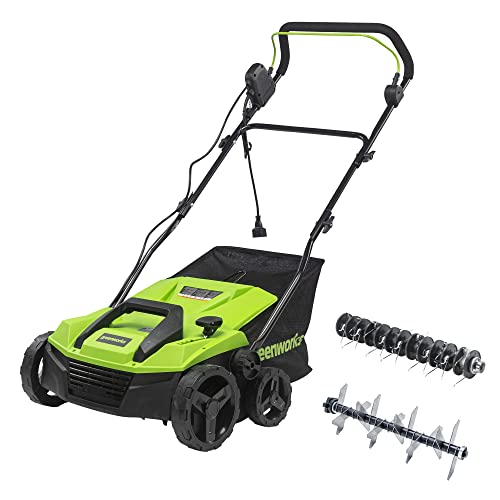
Greenworks corded dethatcher models
Greenworks sells corded dethatchers in the roughly 10-amp, 14-inch class, depending on the market and model year. These machines generally use spring tines on a rotating reel and offer height adjustment for light-to-moderate thatch. They are a sensible choice when the main goal is lifting dead grass without cutting deeply into the soil.
Choose a corded electric model when the lawn is under about 5,000 square feet, an outlet is accessible, and you dethatch once or twice per year. A 100-foot, 12- or 14-gauge outdoor extension cord is often more practical than a thin household cord, which can heat up and cause voltage drop.
Battery dethatchers: convenient, but size the battery first
Battery machines eliminate cord management and are easier to transport between front and back lawns. Their limitation is runtime. Manufacturer runtime figures vary with grass density, working depth, battery size, and whether the machine is actually scarifying rather than merely combing the surface.
Greenworks 40V dethatcher
The Greenworks 40V dethatcher platform includes a 14-inch cordless unit using spring tines and a removable tine cartridge. It is aimed at routine residential cleanup rather than severe renovation. A larger-capacity 40V battery is preferable for thick thatch, damp turf, or a lawn approaching the upper end of its practical coverage.
As a planning estimate, a cordless dethatcher may cover roughly 3,000–5,000 square feet per charge under moderate conditions, but difficult material can reduce that figure substantially. If the lawn is 4,000 square feet and your real-world coverage is 2,000 square feet per charge, one spare battery or a second charging cycle is necessary. That calculation is more useful than relying on a headline runtime.
Battery selection and ownership cost
Battery tools make the most sense when you already own compatible packs for a mower, trimmer, or blower. Buying a new battery platform solely for annual dethatching can erase the convenience advantage. A typical replacement battery may cost $100–$250, while a replacement tine reel commonly costs far less. Store batteries indoors during the off-season and avoid leaving them fully discharged.
Tow-behind dethatchers: the practical choice for large lawns
Tow-behind units use a row of steel spring tines mounted on a tray or frame. Agri-Fab offers tow-behind tine dethatchers in approximately 40-inch widths, including models with a weight tray that lets you add blocks or other approved ballast. The broad coverage is their main advantage: at a ground speed of 3 mph, a 40-inch tool has a theoretical coverage of about 1.45 acres per hour before turning and overlap.
Real coverage is lower. For a 20,000-square-foot lawn, allowing 20 percent for turns and overlap produces about 16,000 square feet of effective coverage per hour at that speed. That is still considerably faster than a 13-inch walk-behind unit, whose theoretical coverage is about 0.47 acres per hour under the same conditions.
Tow-behind spring tines are best for large, open areas and recurring seasonal maintenance. They are less suitable for tiny lawns, steep slopes, tight gates, and areas where you need precise depth control. They also do not collect the loosened material. Plan to mow afterward with a catcher, rake, or lawn sweeper.
Blade versus tine design
- Flexible spring tines: Comb through the turf and lift loose thatch with comparatively low surface damage. They are suited to annual maintenance and shallow layers.
- Rigid scarifier blades: Cut vertically into a dense mat. They are more effective for serious thatch but can expose soil and stress the lawn if set too low.
- Replaceable cartridges or reels: Reduce long-term cost because the working attachment can be replaced without buying a complete machine.
- Adjustable depth: More important than an aggressive maximum setting. Start shallow, inspect the result, and make a second pass only if necessary.
Do not confuse dethatching with core aeration. Dethatching removes organic material near the surface; aeration removes plugs of soil to relieve compaction. A lawn can need one, the other, or both at different times.
Collection: bag, rake, or sweeper?
Walk-behind electric machines may include a collection bag, but collection is often incomplete because loosened thatch is bulky and light. The bag can also make the machine harder to push as it fills. For a heavily affected lawn, the fastest workflow is usually to dethatch first, rake or blow the material into rows, and then mow with a catcher or use a lawn sweeper.
Tow-behind dethatchers normally leave all material on the surface. Their advantage is speed, not collection. If you do not already have a lawn sweeper or suitable mower catcher, include that extra cleanup time in the purchase decision.
How to use a dethatcher without damaging the lawn
- Measure the thatch layer. Cut a small plug at the lawn edge and measure the brown, spongy layer between green blades and soil. If it is less than about 1/2 inch and water moves through normally, aggressive scarifying may not be necessary.
- Mow slightly shorter than usual. This helps the tines reach the surface, but avoid scalping or mowing drought-stressed grass.
- Set the machine high for the first pass. The tines should touch the thatch rather than dig continuously into bare soil.
- Make one pass in a straight pattern. Inspect the debris and turf. Lower the setting only if a substantial layer remains.
- Change direction only when needed. A cross-pass can improve removal, but it also increases stress and soil disturbance.
- Remove debris promptly. Heavy thatch left on the surface can shade the grass and interfere with watering.
- Clean and inspect the machine. Disconnect the cord or battery before clearing wrapped grass, and check the reel, guards, wheels, and fasteners.
Durability and maintenance realities
The first parts to wear are usually spring tines, scarifier blades, reel bearings, drive belts, and plastic collection bags. Wet thatch is especially hard on belts and can clog ventilation openings. Let the lawn dry, keep passes steady, and never force the machine through a mat that requires repeated pushing.
After every use, brush off packed debris and wipe the housing dry. Do not spray water directly at the motor, battery compartment, or bearings. Replace bent or badly worn tines rather than continuing with an uneven reel, which can make the machine vibrate and produce inconsistent depth. Store tow-behind units under cover and release added weight before transport.
Bottom line
For most smaller lawns, the best dethatchers are 12–14-inch corded electric scarifiers because they provide dependable power at a moderate overall cost. Select a 40V battery model when cord-free operation and shared batteries are more important than maximum runtime. Choose a 36–48-inch tow-behind spring-tine unit for large, open lawns and existing riding-mower owners. Whichever format you choose, adjustable depth, replaceable working parts, and a realistic debris-removal plan matter more than the widest advertised number.