Key takeaways
- Choose a shallow MDF cabinet if wall space and budget are limited. Prioritize sealed edges and a dependable mounting plate over decorative trim.
- Choose a solid-wood cabinet if the dart area is a permanent feature of a finished game room and you expect frequent use.
- Choose a cabinet with dry-erase scoring for fast, low-mess family games.
- Choose chalkboard scoring if you play traditional games and want a simple system that does not need batteries or power.
- Choose a cabinet with built-in hooks if several people use different dart sets.
- Add a separate surround if beginners will play, the wall finish is valuable, or the cabinet leaves little margin around the board.
- Choose an electronic cabinet cautiously if automatic scoring is more important than low maintenance and minimal depth.
The best dart board cabinets for organized game rooms are solid-wood or reinforced MDF cabinets with a properly sized sisal board, useful interior storage, and a mounting system that keeps the board secure without consuming more wall space than your room can spare.
Our top picks
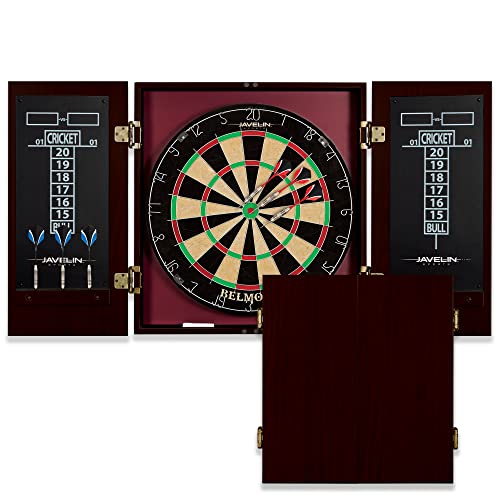
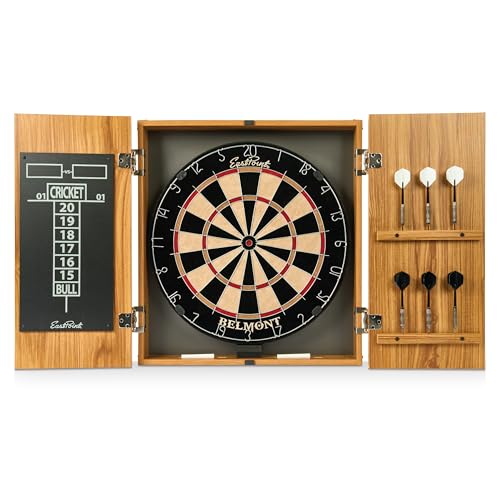
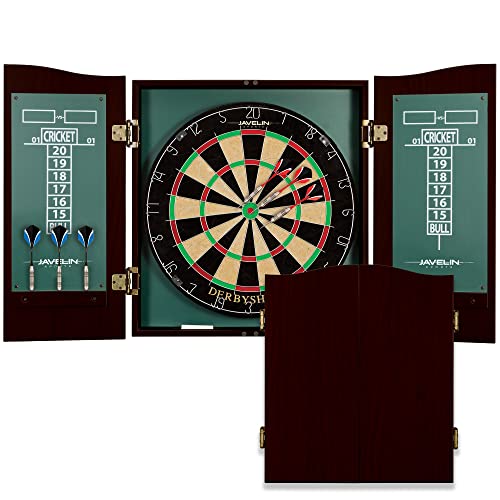

As an Amazon Associate we earn from qualifying purchases at no extra cost to you. Ratings are shown as listed on Amazon.
Quick picks by room and playing style
| Room or user profile | Best cabinet type | What to prioritize | Typical market range |
|---|---|---|---|
| Small apartment or office | Shallow MDF cabinet | Depth under 5 inches, magnetic doors, compact storage | $60–$130 |
| Regular home play | Steel-tip sisal set with wood-look cabinet | Self-healing sisal, chalkboard doors, strong wall bracket | $100–$220 |
| Frequent league-style practice | Premium sisal cabinet | Staple-free board, replaceable number ring, rigid construction | $180–$350 |
| Family or casual game room | Complete cabinet set with soft-tip or steel-tip options | Easy scoring, dart storage, rounded corners, simple installation | $80–$200 |
What makes a dart board cabinet worth buying?
A cabinet is more than decoration around a dartboard. It protects the board from dust and accidental contact, provides a defined scoring station, and can keep darts and accessories in one place. The strongest buying decision comes from matching the cabinet to the board rather than choosing the cabinet’s appearance first.
Cabinet materials: solid wood, MDF, and metal
Solid wood cabinets offer the best long-term feel and usually tolerate repeated door opening, screw removal, and wall-mounting better than inexpensive fiberboard. They are also heavier, often weighing 15–30 pounds before the board and darts are added. That extra weight matters if the cabinet is mounted to drywall.
MDF is the most common material in the mid-priced market. It creates a smooth, consistent finish and keeps prices moderate, but exposed edges can swell if the cabinet is stored in a damp basement or garage. Look for sealed or laminated edges, metal hinges, and a back panel that does not flex when the board is installed.
Metal cabinets are less common for traditional home setups, but they can be durable and slim. Their drawbacks are noise, possible vibration, and a less furniture-like appearance. A metal frame is most useful where resistance to bumps matters more than warm styling.
Dartboard protection
Cabinet doors protect the scoring face from dust, sunlight, and stray contact, but they do not eliminate wear. A standard bristle sisal board still needs to be rotated regularly. Choose a cabinet with enough internal clearance that the doors do not touch the number ring, wire spider, or dart points.
Check the door closure before buying. Magnetic catches are quiet and convenient; latches are more secure but can loosen or become noisy. Felt or foam padding around the inside door edge can reduce rattling, particularly in rooms with hard floors and bare walls.
For steel-tip darts, the cabinet should not be treated as a substitute for a surround. A dart that misses the board can damage the wall, door, or cabinet frame. Add a foam, rubber, or dense fabric surround if the cabinet has narrow margins around the board. Soft-tip boards generally reduce wall damage, but their electronic components require different clearance and power arrangements.
Scoring surfaces: chalkboard, dry-erase, or electronic?
Chalkboard doors
Chalkboard panels are inexpensive, readable, and appropriate for traditional steel-tip games. They work well for cricket and 501, but chalk dust can collect along the cabinet’s lower edge. Use a damp microfiber cloth rather than abrasive cleaner, and avoid soaking the board because moisture can soften low-quality fiberboard.
Dry-erase panels
Dry-erase scoring is cleaner and quicker for frequent play. Its main weakness is marker staining. Use low-odor, non-permanent markers and wipe the panel after each session. Leaving scores on the surface for weeks can make ghosting permanent, especially on budget laminate.
Electronic scoring
Electronic scoring is convenient for families and players who do not want to calculate totals manually. However, it may require a power outlet, creates more cabinet depth, and can add failure points such as buttons, display panels, and sensors. An electronic cabinet should have ventilation and a cable path that does not interfere with mounting.
Storage capacity that is actually useful
Many cabinets advertise storage but provide only two narrow shelves. For most homes, useful capacity means at least four dart sets, spare flights, shafts, points, a sharpener, score markers, and a small cleaning cloth. Interior hooks are better than deep open shelves for darts because they keep flights from being crushed.
| Storage feature | Practical capacity | Best for |
|---|---|---|
| Two shallow shelves | 2–4 dart sets plus accessories | Occasional players |
| Four or more shelves | 6–10 dart sets and spare parts | Families or shared game rooms |
| Hooks or molded dart holders | 4–12 assembled sets | Players who want flights protected |
| Full-width lower shelf | Scorebooks, cases, chalk, and tools | League-style practice areas |
Do not store heavy objects in a cabinet door. Repeated loading can pull hinges out of MDF and cause the door to sag. Keep metal dart points capped, particularly if children can access the cabinet.
Mounting requirements and room-size calculation
A regulation steel-tip board is 18 inches in diameter. The bull should be 5 feet 8 inches above the floor, measured from the floor to the center of the bull. The official throwing distance is 7 feet 9 1/4 inches from the face of the board, although a cabinet’s front lip may require you to measure from the board surface rather than the wall.
Cabinet dimensions vary, but a typical closed unit is about 24–26 inches wide, 30–36 inches high, and 4–8 inches deep. Allow additional clearance for the door swing and at least 12 inches of open space beside the cabinet if players need to stand comfortably.
A useful minimum playing footprint is approximately 8 feet wide by 11 feet deep. Here is the calculation: 7 feet 9 1/4 inches of throwing distance plus roughly 3 feet of standing and rear clearance equals about 10 feet 9 inches in depth. A tighter room can work, but furniture and walking paths will make play less comfortable.
Mount the cabinet into a wall stud whenever possible. If the studs do not align with the desired position, use heavy-duty hollow-wall anchors rated for the combined cabinet, board, and stored accessories. A cabinet weighing 20 pounds can exceed 30 pounds once a dense sisal board and darts are installed. Check the mounting hardware periodically for loosening caused by vibration.
Durability and ownership realities
The sisal surface usually wears before the cabinet does. Rotate a traditional board a small amount every few sessions, while keeping the number ring orientation consistent. This distributes impacts across the board and helps prevent one heavily used segment from becoming soft.
The next parts most likely to wear are the number ring, cabinet hinges, door magnets, and chalkboard or dry-erase surface. A staple-free board generally makes rotation easier and reduces exposed metal around the scoring area. Replacement number rings and mounting brackets are inexpensive compared with replacing an entire cabinet, so confirm that compatible parts are available before purchase.
Keep the setup away from direct heat, condensation, and unheated damp spaces. Excess humidity can affect MDF, soften sisal, and encourage metal components to corrode. Vacuum loose dust from the cabinet rather than spraying cleaner near the board. Never saturate sisal with water or household disinfectant.
Decision guide: which cabinet should you choose?
- Choose a shallow MDF cabinet if wall space and budget are limited. Prioritize sealed edges and a dependable mounting plate over decorative trim.
- Choose a solid-wood cabinet if the dart area is a permanent feature of a finished game room and you expect frequent use.
- Choose a cabinet with dry-erase scoring for fast, low-mess family games.
- Choose chalkboard scoring if you play traditional games and want a simple system that does not need batteries or power.
- Choose a cabinet with built-in hooks if several people use different dart sets.
- Add a separate surround if beginners will play, the wall finish is valuable, or the cabinet leaves little margin around the board.
- Choose an electronic cabinet cautiously if automatic scoring is more important than low maintenance and minimal depth.
Final recommendation
For most organized home game rooms, the best dart board cabinet is a medium-depth MDF or wood cabinet holding a regulation-size bristle board, with magnetic doors, dry-erase or chalkboard scoring, four or more dart-storage positions, and a wall bracket that can be secured to a stud. Spend extra on board quality, mounting hardware, and protection from misses before paying for ornate cabinet details. A cabinet that fits the room, protects the board, and keeps accessories accessible will remain useful long after decorative features stop mattering.