Key takeaways
- Find the best compasses for hiking and orienteering, from mirror sighting to lensatic models, with declination tips and clear buying advice.
A phone is useful on the trail until the battery fades, the screen washes out in sun, or the signal disappears in a deep valley. A good compass needs none of that. It works in rain, cold, and heat, weighs almost nothing, and paired with a paper map it can keep you oriented for days. That is why land navigation remains a core skill for hiking, backpacking, and orienteering.
Not every compass suits every job, though. A clear baseplate model made for map work feels very different from a metal lensatic model made for precise bearings across open ground. Mirror sighting, declination adjustment, needle balance, and low-light markings all change how a compass performs. This guide compares five proven models from five makers, covering mirror, baseplate, and lensatic designs, so you can match the tool to the way you travel.
Disclosure: As an Amazon Associate, I earn from qualifying purchases.
1. Suunto MC-2 NH Mirror Compass

The Suunto MC-2 NH is a benchmark for serious map and compass work, earning the top spot here for precision, durability, and thoughtful details. Made in Finland, it pairs a clear baseplate with a folding sighting mirror, so you can take a bearing on a distant peak while still reading the dial. That mirror also doubles for signaling in an emergency and protects the capsule when packed.
Declination is adjustable with the small key in the lanyard, so you can set it once for your region and work directly in true bearings. The needle sits on a jewel bearing in a liquid-filled capsule, settling quickly and staying steady while you walk. Luminous markings help at dawn and dusk, and the baseplate carries a magnifying lens, UTM scales, and rubber feet that keep it from sliding on a map. For off-trail hikers and orienteers who need repeatable accuracy, this is the most complete package here.
Specs
- Type: Mirror sighting baseplate compass
- Balance zone: Northern Hemisphere
- Declination: Adjustable with included key
- Needle: Stainless steel needle on jewel bearing, liquid-filled capsule
- Baseplate: Magnifying lens, UTM scales, inch and centimeter rulers
- Clinometer: Yes, for measuring slope angle
- Dimensions: About 2.6 x 4.0 x 0.7 inches
- Weight: About 2.6 ounces
- Extras: Luminous markings, detachable lanyard with snap lock
2. Brunton TruArc 10 Baseplate Compass

Brunton has built navigation instruments in Wyoming for over a century, and the TruArc 10 shows that heritage in a clean, map-focused design. The clear baseplate, long straight edge, and printed scales make plotting and measuring routes straightforward, while the rotating bezel is marked in fine one-degree steps for careful work.
The standout feature is the TruArc global needle, balanced for both hemispheres and far more tolerant of tilt than a conventional needle, saving international trekkers from owning separate compasses. Declination adjustment is tool-free, and a small magnifier makes the bearing easier to read. It lacks a sighting mirror, so it is less ideal for long-distance bearings, but for everyday hiking it is accurate, light, and easy to teach with.
Specs
- Type: Baseplate compass
- Model: F-TRUARC10
- Needle: TruArc global needle, balanced for worldwide use
- Declination: Tool-free adjustable
- Resolution: 1-degree azimuth markings
- Baseplate: Clear plate with map scales and magnifier
- Dimensions: About 5.2 x 2.8 x 0.5 inches
- Weight: About 1.7 ounces
- Origin: Made in the USA
3. Silva Ranger 2.0 Mirror Compass

Silva invented the modern baseplate compass, and the Ranger 2.0 is its advanced mirror model for experienced users. Tilt the mirror to about 45 degrees, sight your target through the notch, and read the bearing in the reflection without looking down. The result is noticeably more accurate bearings in open or mountainous terrain where your objective is far away.
What sets the Ranger 2.0 apart is the included kit. A slope card helps you judge gradient and avalanche terrain, and the distance lanyard carries four map scales for measuring a winding route. The capsule has a built-in declination adjuster, a clinometer, and luminous markings. The DryFlex grip makes the bezel easy to turn with gloves on, and rubber feet hold the plate steady. If you want the most complete accessories included, this is the one.
Specs
- Type: Mirror sighting baseplate compass
- Model: Ranger 2.0, part 37038-PE
- Declination: Built-in adjustable
- Clinometer: Yes, for measuring slope angle
- Map scales: 1:25k, 1:50k, 1:24k USGS, millimeter and inch
- Included: Slope card and distance lanyard with four scales
- Grip: DryFlex bezel grip for use with gloves
- Dimensions: About 11 x 5 inches packaged; compass sized for hand use
- Extras: Magnifying lens, luminous markings, rubber friction feet
4. Cammenga 3H Tritium Lensatic Compass

The Cammenga 3H is a completely different instrument. It is the official lensatic compass supplied to the United States military, built to a military specification in Michigan with a rugged aluminum body that shrugs off drops, water, and sand. Instead of a baseplate, it uses a sighting wire and lens: look through the rear lens, align the wire on your target, and read the bearing from the floating dial. With practice, it is exceptionally precise for marching bearings.
Its signature feature is tritium illumination. Tiny tritium vials light the dial and sighting elements for years without batteries or charging, which is why it is trusted at night. The induction-damped dial settles smoothly, the body is waterproof, and the thumb loop helps you hold it level. It offers no map scales, so plotting is clumsier than with the baseplate models, and it is heavier. But for durability, night use, and bearing accuracy, nothing else here comes close.
Specs
- Type: Lensatic sighting compass
- Model: 3H, built to MIL-PRF-10436N specification
- Illumination: Tritium vials, no batteries or charging needed
- Body: Aluminum, waterproof and sandproof construction
- Dial: Induction damped, graduated in degrees and mils
- Included: Carrying pouch, lanyard, and belt clip
- Weight: About 5.4 ounces
- Origin: Made in the USA
- Extras: Thumb loop for steady holding, sighting wire and lens
5. Eyeskey Tactical Lensatic Compass
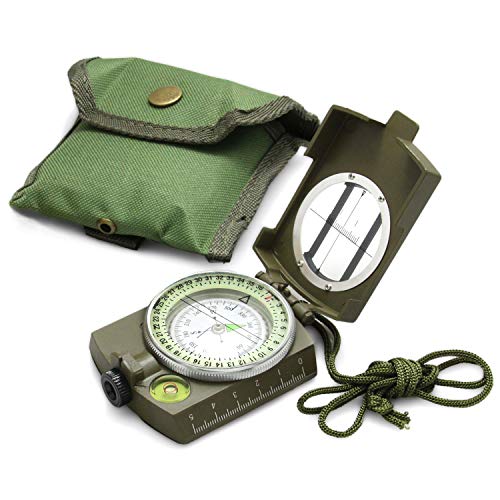
The Eyeskey tactical compass brings the classic lensatic layout to hikers who want that military-style sighting method in a lighter, simpler package. The metal body folds open to reveal a sighting lens, front sight wire, and floating dial, and it feels solid without the bulk of a full military instrument. A camouflage finish, lanyard, and belt pouch make it easy to carry on a pack strap or belt.
In use, the fluid-filled dial settles smoothly, and luminous points help you hold a bearing in low light. The clamshell body protects the dial when closed and includes a thumb hold that steadies the compass at eye level. It is waterproof and impact resistant for normal trail abuse, and the dial is marked in degrees and mils, suiting orienteering practice and scout training. You give up adjustable declination and map tools, so pair it with a protractor for plotting. As an affordable way to learn lensatic navigation, it does the job well.
Specs
- Type: Lensatic sighting compass
- Model: EK1001-M
- Body: Metal clamshell, camouflage finish
- Dial: Fluid-filled, graduated in degrees and mils
- Resistance: Waterproof and impact resistant
- Included: Lanyard and carrying pouch
- Dimensions: Compact folding design for belt or pack carry
- Weight: Lightweight handheld unit
- Extras: Thumb hold, luminous dial points, sighting lens and wire
How to Choose the Right Compass
Begin with how you navigate. If most of your work happens on a paper map, choose a baseplate or mirror baseplate model. The transparent plate, rulers, and map scales are tools you will use constantly. If you mainly follow bearings across open ground or forest with few landmarks, a lensatic model gives you a rugged, precise sighting system, but you will want a separate protractor for map work.
Next, consider declination. Magnetic north and true north differ by an amount that changes with location, and ignoring it can put you hundreds of yards off course over a long leg. An adjustable setting, found on the Suunto, Brunton, and Silva here, lets you set the offset once and forget it. If a compass has neither, you must add or subtract the offset for every bearing, which is workable but error prone when you are tired.
Needle balance matters if you travel far. Most needles are balanced for one hemisphere and will drag in the other. A global needle, like the Brunton design, works worldwide, while regional models such as the Northern Hemisphere Suunto are optimized for their zone. Buy for where you will hike most.
Finally, weigh the extras. A sighting mirror improves long-distance accuracy and doubles for signaling. A clinometer helps with slope assessment on mountain and snow routes. Luminous markings, or tritium in the Cammenga, matter for low-light travel. And practice matters most: learn to set declination, follow a bearing, and triangulate your position before you need those skills for real.
FAQ
Do I still need a compass if I carry a phone with GPS?
Yes. A compass needs no battery, signal, or subscription, and it keeps working after a drop or soaking. Use GPS for convenience and the compass and map as your dependable backup.
What is declination and why does it matter?
Declination is the angle between magnetic north, which your needle points to, and true north, which maps use. Setting it aligns your bearings with the map, so you follow the route you plotted.
Which type is best for a beginner?
A clear baseplate compass is easiest to learn on because you can see the map through it. Add a mirror model later when you want more accurate long-distance bearings.
How do I keep a compass accurate?
Hold it level and away from metal objects, knives, phones, and vehicles, which pull the needle. Store it away from strong magnets, and check it against a known bearing occasionally.
Conclusion
Each compass here does its intended job well. Choose the Suunto MC-2 NH for refined mirror sighting and map work, the Brunton TruArc 10 for light weight and worldwide balance, or the Silva Ranger 2.0 for its slope card and lanyard kit. Pick the Cammenga 3H when durability and night visibility come first, and the Eyeskey to learn the lensatic method in compact form. Whichever you carry, spend an afternoon practicing with a local map. That practice turns a compass into confidence.
More from Amazon
Programs that pair well with the guide above. Offers and eligibility are set by Amazon and may change.
Free shipping on eligible items, Prime Video and more. Eligible new members can start with a free trial.
Start a Prime free trialA Prime membership for ages 18-24 with a trial period. Eligibility is set by Amazon.
See Prime for Young AdultsAudiobooks and podcasts to listen to on the go. Eligible new members can start with a free trial.
Try Audible freeAd-free music streaming. Eligible new subscribers can start with a free trial.
Try Music Unlimited freeAs an Amazon Associate we earn from qualifying purchases.