Key takeaways
- Find the best water filter bottles for travel and hiking, from insulated steel to ultralight squeeze bottles, with filter life, capacity and care tips.
Tap water at an airport, a refill station on a trail, or a sink in a rental apartment does not always taste clean, and in the backcountry it may carry bacteria and parasites you cannot see. The best water filter bottles solve that problem in the container you already carry. You fill, drink or press, and the filter does the work — no separate pump, no waiting for tablets, and no pile of single-use plastic bottles.
This guide compares five bottles from five different makers, from an insulated stainless bottle for everyday trips, to a press-style purifier for international travel, to an ultralight collapsible bottle that disappears into a running vest. For each one we list capacity, filter life, filtration level, and materials from the product listing.
Disclosure: As an Amazon Associate, I earn from qualifying purchases.
1. LifeStraw Go Series Insulated Stainless Steel Bottle — 18 oz

LifeStraw built its name on backcountry filtration, and the Go Series brings that same two-stage system into a vacuum-insulated stainless bottle suited to airports, road trips, and daily commuting as well as day hikes. Fill it from a tap or stream-side source where filtration is appropriate, and drink through the mouthpiece. The membrane microfilter handles the safety side, while the activated carbon filter improves taste and reduces chlorine and odors.
The double-wall insulation keeps water cold through a long travel day, and the steel body shrugs off drops that would dent thin plastic. The trade-off is weight and capacity: at 18 ounces it holds less than the plastic options below, so pick it when temperature and durability matter more than ultralight packing.
Specs
– ASIN: B0CFWX5GD4
– Capacity: 18 oz
– Material: Insulated stainless steel, double-wall vacuum insulation
– Filtration: Membrane microfilter, 0.2 micron, plus activated carbon filter
– Membrane life: Up to 1,000 gallons (4,000 liters)
– Carbon filter life: Up to 26 gallons (100 liters)
– Removes: Bacteria, parasites, and microplastics; carbon reduces chlorine and improves taste
– Best for: Everyday travel, commuting, and day hikes where cold water matters
2. GRAYL GeoPress Water Purifier Bottle — 24 oz, Bali Blue
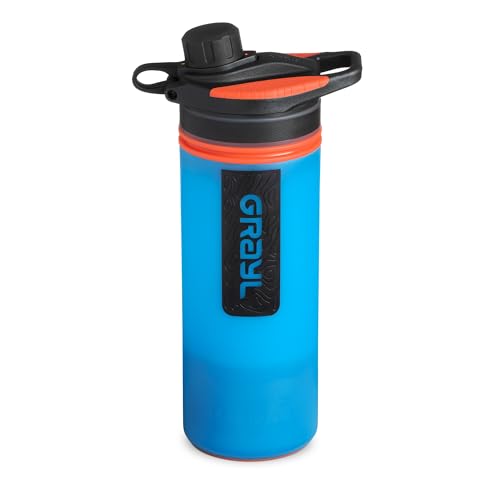
The GeoPress works differently from straw-style bottles. You fill the outer vessel, insert the inner press with its cartridge, and push it down like a French press. In one press the water is purified, not just filtered, which is why travelers heading to places where viruses are a concern often choose GRAYL over simpler bottles. The electroadsorption and activated carbon cartridge also improves taste, color, and odor, and it handles heavy metals and many chemicals listed by the maker.
At 24 ounces it offers generous capacity in a rigid bottle, and the process is fast once you learn the motion — fill, press, drink. It needs both hands and a flat surface, so it suits camp, hotel rooms, and rest stops better than drinking mid-stride on a trail. Cartridges are a consumable, so plan a spare for long trips.
Specs
– ASIN: B09255PYRM
– Capacity: 24 oz (710 ml)
– Material: BPA-free polypropylene and food-grade silicone components
– Filtration: Electroadsorption and activated carbon purifier cartridge
– Cartridge life: Up to 65 gallons (250 liters)
– Removes: Viruses, bacteria, and protozoa, plus particulates, many chemicals, and heavy metals listed by the maker
– Operation: Press-style purification, no straw, batteries, or pumping
– Best for: International travel, overlanding, and emergency kits
3. Brita Hard-Sided Premium Filtering Water Bottle — 26 oz, Blush

Brita is the familiar name in taste filtration, and this hard-sided bottle is aimed at a different job from the backcountry models. It is made for tap water: hotel sinks, office refill stations, gym fountains, and airport taps. The filter inside the straw reduces chlorine taste and odor as you sip, which makes plain municipal water noticeably more pleasant and helps you skip buying bottled water while traveling in cities.
At 26 ounces it is the largest rigid bottle in this guide, it fits most car cup holders, and the plastic body is lighter than insulated steel. The important limit is scope — this is a taste and odor filter for treated tap water, not a purifier for streams or questionable wells. Maintenance is easy: swap the small bottle filter every two months or 40 gallons.
Specs
– ASIN: B08FSBNYQC
– Capacity: 26 oz
– Material: BPA-free hard-sided plastic
– Filtration: Activated carbon filter built into the straw
– Filter life: Up to 40 gallons, about 2 months of regular use
– Purpose: Reduces chlorine taste and odor in treated tap water
– Included: Bottle with 1 filter
– Best for: City travel, work, school, and the gym
4. Katadyn BeFree Collapsible Water Filter Bottle — 1.0L

The BeFree is the ultralight favorite among hikers and trail runners, and the reason is simple: when it is empty, the soft flask rolls up to almost nothing, and when it is full you have a full liter of filtered water. The hollow fiber membrane sits in the cap, so you fill the flask from a stream or tap, screw the cap on, and drink or squeeze water into a cooking pot or a second container.
Flow is fast for a filter this small, and cleaning is low effort — shake the membrane in clean water or swish it to clear sediment, with no tools required. The soft body is not as armored as a hard bottle, so keep it away from sharp edges in your pack. For backpacking and travel where every ounce counts, the BeFree offers the best capacity-to-weight balance here.
Specs
– ASIN: B075X5R67T
– Capacity: 1.0 liter
– Material: BPA-free collapsible soft flask
– Filtration: Hollow fiber membrane, 0.1 micron, EZ-Clean design
– Filter life: Up to 1,000 liters, depending on water quality
– Removes: Bacteria, protozoa, and sediment
– Cleaning: Shake or swish the membrane in water; no tools required
– Best for: Backpacking, trail running, and ultralight travel
5. Survivor Filter Squeeze Kit with Collapsible Bottles

The Survivor Filter kit takes a modular approach: instead of building the filter into one bottle, it pairs a filter straw with two collapsible 33.8-ounce bottles. You can drink directly through the straw, squeeze filtered water into a pot or another bottle, or use the bottles on their own for carrying. That flexibility is useful for camp cooking and for sharing water in a small group, something a personal straw bottle handles poorly.
The filtration level is the finest listed here, and the maker notes the system is tested in the USA. Because the filter and bottles are separate pieces, you can pack only what a trip needs — one bottle and the straw for a day hike, both bottles for camp. Keep track of the small parts, rinse after silty sources, and let everything dry before storage.
Specs
– ASIN: B06WWQMRFY
– Capacity: Two collapsible bottles, 33.8 fl oz (1 liter) each
– Material: BPA-free collapsible bottles
– Filtration: 0.05 micron filtration through the included filter straw
– Configuration: Squeeze kit — drink through the straw or squeeze into another container
– Removes: Bacteria, parasites, and viral contaminants as listed by the maker
– Testing: USA-tested, per the product listing
– Best for: Camping, group trips, and emergency preparedness
How to Choose the Right Filter Bottle
Begin with your water source, because that decides the filtration level you need. For treated tap water in cities, a carbon taste filter like the Brita is enough. For streams and lakes in North American backcountry, a 0.1 to 0.2 micron membrane that removes bacteria and protozoa — LifeStraw, Katadyn, or Survivor Filter — is the usual choice. For international travel or sources that may carry viruses, choose a purifier design like the GRAYL GeoPress.
Next, think about how you drink. Straw bottles are the most natural on the move. A press bottle needs two hands and a pause, but purifies a full batch at once. A squeeze flask doubles as storage and can fill a pot, which matters for cooking. Then check capacity against weight: a liter is a good trail minimum, while 18 to 26 ounces suits daily carry where refills are easy.
Finally, look at filter life and upkeep honestly. Note the replacement interval for your pick, buy one spare filter before a long trip, and follow the cleaning steps — most flow problems in the field come from sediment that a quick shake or rinse would have cleared. Never let a membrane filter freeze, and store bottles dry between trips.
FAQ
Can a filter bottle make any water safe?
No. Each bottle has a defined scope. Taste filters improve treated tap water, membrane bottles remove bacteria and protozoa from freshwater, and only purifier designs address viruses. None of these bottles desalinate seawater or remove every possible chemical spill.
How do I know when to replace the filter?
Follow the listed life for your model — gallons, liters, or months — and watch for slower flow or returning bad taste. Carbon stages usually expire first. When in doubt before a big trip, replace it.
Can I filter juice or sports drinks?
No. These filters are designed for water only. Sugary or flavored drinks clog membranes and carbon quickly and can damage the filter.
What should I do before a first use and after a trip?
Rinse or flush the bottle as the maker directs before first use. After a trip, clean it, let all parts dry fully, and store it with the cap loose. Keep membrane filters from freezing in storage and in your pack on cold nights.
Conclusion
There is no single winner here, only the right match for your trip. Choose the LifeStraw Go Series for an insulated everyday bottle, the GRAYL GeoPress for the broadest protection abroad, the Brita for better-tasting tap water in cities, the Katadyn BeFree for ultralight miles, and the Survivor Filter kit for flexible camp and group use. Pick by source first, then by capacity and upkeep, and the best water filter bottles will quietly do their job on every refill.
More from Amazon
Programs that pair well with the guide above. Offers and eligibility are set by Amazon and may change.
Free shipping on eligible items, Prime Video and more. Eligible new members can start with a free trial.
Start a Prime free trialA Prime membership for ages 18-24 with a trial period. Eligibility is set by Amazon.
See Prime for Young AdultsAudiobooks and podcasts to listen to on the go. Eligible new members can start with a free trial.
Try Audible freeAd-free music streaming. Eligible new subscribers can start with a free trial.
Try Music Unlimited freeAs an Amazon Associate we earn from qualifying purchases.