Key takeaways
- Shop the best cello strings for students and advancing players, from a full Prelude set to Larsen Soloist, Magnacore and Spirocore single strings.
Fresh strings are the cheapest way to make a cello sound like a better instrument. Old strings go false, lose their ring and stop responding to the bow, while a well-matched new set can add warmth, volume and tuning stability in a single afternoon. The tricky part is that cello strings are sold in more configurations than almost any other string family: full sets, single strings, three core types, three gauges and sizes from 4/4 down to 1/8.
This guide rounds up five dependable picks that cover the most common buying situations. There is a complete student set that replaces everything at once, plus four professional single strings that players commonly use to build or upgrade a mixed set, pairing bright, projecting upper strings with powerful lower ones. Every pick below is a current, widely stocked product from an established string maker, and each one lists its full specifications so you can match it to your instrument before you buy.
Disclosure: As an Amazon Associate, I earn from qualifying purchases.
1. D’Addario Prelude Cello String Set, 4/4 Medium

Prelude is the set most teachers hand to a new student, and it earns that spot by being durable, stable and easy to live with. Each string has a solid steel core wound with nickel, a construction that shrugs off the humidity swings of school music rooms and settles into pitch quickly after installation. The tone is warm and clear rather than brilliant, which flatters smaller student instruments and keeps ensemble playing blended instead of edgy.
Because the core is solid steel, Prelude strings are also forgiving of heavy beginner bow arms and survive far longer than synthetic-core sets in the same role. The 4/4 medium set is scaled for a playing length of 700mm (27-1/2 inches), so it fits standard full-size cellos, and the sealed packaging keeps the strings fresh until the day you fit them. If you are replacing a tired factory set on a student or rental instrument, this is the straightforward one-box answer.
Specs
- Brand: D’Addario
- Contents: Full set (A, D, G, C)
- Size: 4/4 scale
- Tension: Medium
- Core: Solid steel
- Winding: Nickel
- Playing length: 700mm (27-1/2 in)
- ASIN: B000EENLZI
2. Larsen Soloist Cello A String, Medium
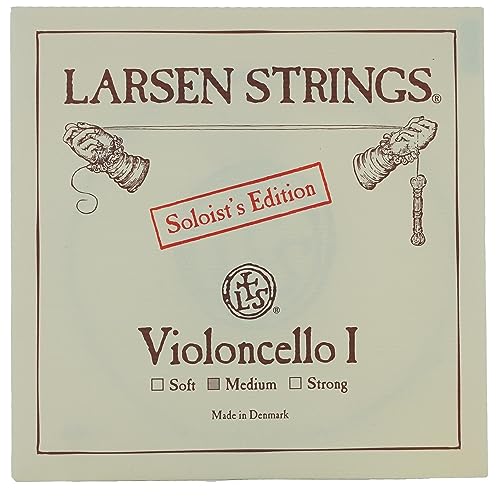
The A string does most of the melodic talking on a cello, and the Larsen Soloist A is built for players who need that voice to project. It uses a solid steel core wound with stainless steel, giving it a direct, focused sound with a fast bow response that carries in a hall. Larsen voices the Soloist edition for solo and orchestral playing at the front of the section, where clarity matters more than sheer warmth.
At 18.3 kg of tension in medium gauge, it sits on the firmer side, so it rewards a controlled bow arm with excellent definition in fast passages. Many players pair this A with its matching Soloist D and then choose warmer or more powerful G and C strings underneath, which is exactly the mixed-set approach this guide is built around. Choose the Soloist A if your current top string sounds veiled or disappears when you play softly.
Specs
- Brand: Larsen
- Contents: Single A string
- Size: 4/4
- Tension: Medium, 18.3 kg (40.3 lb)
- Core: Solid steel
- Winding: Stainless steel
- ASIN: B07GC9VWHX
3. Larsen Soloist Cello D String, Medium

The Soloist D is the natural partner to the A above, sharing the same solid steel core and stainless steel winding so the two upper strings speak with one voice. Its character is clear and singing, with enough body to keep the D from sounding thin when a melody drops down from the A string. That balance across the top two strings is what makes the Soloist pair a long-running favorite for advancing students and working orchestral players.
Medium-gauge tension is 13.9 kg, and the string responds quickly under the bow, which helps articulation in orchestral excerpts and chamber music. Like the A, it is a single string, so it also works as a like-for-like replacement when only the D has worn out or snapped. If you like the idea of the Soloist A, buying the matched D keeps the top half of your set consistent in feel and color.
Specs
- Brand: Larsen
- Contents: Single D string
- Size: 4/4
- Tension: Medium, 13.9 kg (30.6 lb)
- Core: Solid steel
- Winding: Stainless steel
- ASIN: B07G572RZ2
4. Larsen Magnacore Cello D String, Medium

Magnacore is Larsen’s power line, designed for players who want maximum volume and a broad, commanding sound from their instrument. The D string uses a solid steel core with a stainless steel winding, and the design goal is a string that stays open and resonant even when you lean into it with the full weight of the bow. Where the Soloist D leans focused and direct, the Magnacore D leans big and expansive.
That makes it a smart alternative for cellists in larger ensembles, or for anyone whose instrument tends to sound small and wants more presence from the middle register. It blends well with Magnacore’s own lower strings and with other powerful G and C options. Pick the Magnacore D over the Soloist D if projection is your top priority and your cello responds well to a string with real authority behind it.
Specs
- Brand: Larsen
- Contents: Single D string
- Size: 4/4
- Tension: Medium
- Core: Solid steel
- Winding: Stainless steel
- ASIN: B00KFU8K8Y
5. Thomastik-Infeld Spirocore Cello C String, Medium

Spirocore is one of the most famous names in cello strings, and the C string is where the line built its reputation. The core is a flexible spiral steel rope, a construction that gives the string a distinctive combination of power, quick response and durability. This medium-gauge 4/4 C is wound with chrome steel, producing a clear, brilliant low end that speaks immediately instead of rumbling vaguely the way tired C strings often do.
A strong C string anchors the whole instrument, and Spirocore’s directness is why so many players build mixed sets on top of it, pairing it with brighter upper strings from other makers. It is sold as a single string, which suits its role: the C is often the first lower string players upgrade when a set feels unbalanced. If your cello’s bottom register lacks definition, this is the classic fix.
Specs
- Brand: Thomastik-Infeld
- Contents: Single C string
- Size: 4/4
- Tension: Medium
- Core: Flexible spiral steel rope
- Winding: Chrome steel
- ASIN: B000NJUJU4
How to Choose the Right Cello Strings
Start with size and gauge. Strings must match your cello’s size, and most adults play 4/4. When in doubt, choose medium gauge: it is the tension string makers design around, and it suits the widest range of instruments and playing styles. Light (dolce) gauges feel easier under the fingers but give up some volume, while heavy (forte) gauges add tension that not every cello enjoys.
Understand core types. Solid and rope steel cores, used by every pick in this guide, are bright, stable and long-lasting, and they hold pitch well in changing weather. Synthetic cores aim for a warmer, gut-like color with more complexity, at the cost of a shorter life and more tuning drift. Real gut is the warmest and most complex of all, but it is fragile, weather-sensitive and mainly chosen for period playing.
Decide between a set and singles. A full set like the Prelude is the economical, balanced choice for students and for anyone replacing strings that all aged together. Advanced players often build mixed sets instead, choosing each string for its job: a projecting A and D, a powerful G and C. Buying singles costs more per string but lets you correct exactly the register that is holding your instrument back.
Replace strings one at a time, and replace them on schedule. Fitting one string at a time keeps tension on the top so the soundpost stays put. As a rule of thumb, upper strings tire fastest; many regular players refresh A and D roughly twice as often as G and C. If a string sounds dull, will not tune cleanly or shows fraying at the bridge or nut, it is done, whatever the calendar says.
FAQ
How often should cello strings be replaced?
It depends on how much you play. A student playing a few hours a week can often get a year or more from a durable steel-core set, while a busy orchestral player may refresh strings every few months. Replace any string that sounds dull, resists tuning or shows visible wear, even if the rest of the set still has life.
Can I mix string brands on one cello?
Yes, and many experienced players do exactly that. Mixing lets you pair a bright, projecting A and D with a warmer or more powerful G and C. Just keep gauges consistent, usually medium across the set, so tension stays balanced across the bridge.
What is the difference between medium, light and heavy gauge?
Gauge describes tension. Medium is the standard recommendation for most cellos. Light gauge is easier on the fingers and can open up a tight-sounding instrument, while heavy gauge adds volume and resistance but also loads the top more, which some cellos dislike.
Do fractional-size cellos need different strings?
Yes. A 3/4, 1/2 or smaller cello needs strings made for that scale length; fitting 4/4 strings to a small instrument gives the wrong tension and can harm both sound and setup. Always match the string size printed on the packet to the size of the instrument.
Conclusion
For a complete, no-fuss refresh on a student instrument, the D’Addario Prelude set covers all four strings in one box with durable steel-core construction. For players building a stronger set piece by piece, the Larsen Soloist A and D bring focus and projection to the top register, the Larsen Magnacore D offers a broader, more powerful alternative in the middle, and the Thomastik-Infeld Spirocore C anchors the bottom with the direct response it is famous for. Match the size and gauge to your cello, change strings one at a time, and your instrument will reward you every time you pick up the bow.
More from Amazon
Programs that pair well with the guide above. Offers and eligibility are set by Amazon and may change.
Free shipping on eligible items, Prime Video and more. Eligible new members can start with a free trial.
Start a Prime free trialA Prime membership for ages 18-24 with a trial period. Eligibility is set by Amazon.
See Prime for Young AdultsAudiobooks and podcasts to listen to on the go. Eligible new members can start with a free trial.
Try Audible freeAd-free music streaming. Eligible new subscribers can start with a free trial.
Try Music Unlimited freeAs an Amazon Associate we earn from qualifying purchases.