Key takeaways
- Compare the best synthesizers for studio and stage, from analog polyphonic models to semi-modular designs, with key specs to help you choose the right fit.
A synthesizer can be a first instrument for learning how sound is built, a centerpiece for a small studio, or a patchable system that grows with a modular setup. The best choice depends on matching the keyboard, voice count, and sound engine to the music you want to make. A polyphonic model with presets suits players who need chords and quick recall, while a semi-modular desktop unit suits producers who enjoy patch cables.
This guide compares five synthesizers from five makers, covering analog, hybrid, virtual analog, and semi-modular approaches. Each entry explains who it fits and the practical details that matter, such as sequencer length, connectivity, and whether it has a keyboard.
Disclosure: As an Amazon Associate, I earn from qualifying purchases.
Arturia MicroFreak

The Arturia MicroFreak is a compact hybrid synthesizer built around a digital oscillator and an analog filter. Instead of conventional piano-style keys, it uses a flat printed circuit board keyboard that responds to touch and pressure, which encourages gliding, expressive playing and makes the instrument very portable. Its oscillator offers many different modes, including wavetable, harmonic, Karplus-Strong, and engines developed with Mutable Instruments and Noise Engineering, so a single small instrument can move from bass and leads to textured, experimental tones.
A state variable analog filter shapes those digital voices, and a modulation matrix lets you route sources such as the envelope, low-frequency oscillator, and keyboard pressure to multiple destinations. The sequencer and arpeggiator support pattern creation, with randomization functions that can vary a sequence. MIDI, USB, and control voltage connections make it easy to pair with a workstation, drum machine, or modular gear.
Specs
- Keyboard: 25-key capacitive touch PCB keyboard with polyphonic aftertouch
- Sound engine: Digital oscillator with multiple modes, including wavetable and harmonic types
- Polyphony: Paraphonic, up to 4 voices
- Filter: Analog state variable filter, 12 dB per octave, low-pass, band-pass, and high-pass modes
- Presets: 384 preset slots and 320 factory presets
- Sequencer: 64-step sequencer with 2 patterns per preset and 4 automation tracks
- Modulation: 5 by 7 modulation matrix
- Connectivity: MIDI in and out, USB, CV, gate, and pressure outputs, headphone output
- ASIN: B07NC254QQ
Korg Minilogue XD
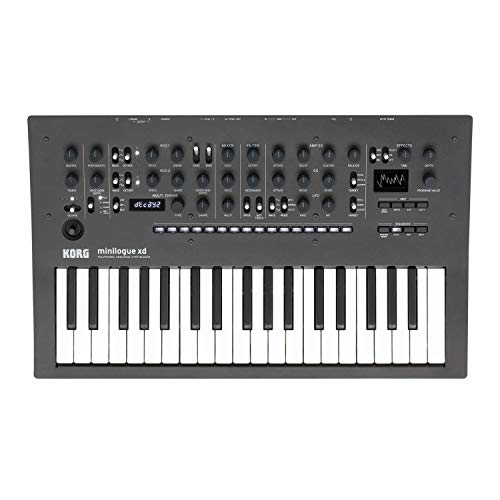
The Korg Minilogue XD is a four-voice polyphonic analog synthesizer with a 37-note slim-key keyboard. It builds on the original Minilogue format by adding a digital multi-engine as a third sound source alongside its two analog voltage-controlled oscillators. That multi-engine offers noise, a variable phase modulation engine, and user slots for loading custom oscillators, which broadens the range well beyond a standard analog polysynth while keeping the familiar panel layout and oscilloscope display.
Voice modes let you use the four voices polyphonically, stack them in unison, play chords from single notes, or use an arpeggiator. A 16-step sequencer records note and motion data, so knob movements become part of a pattern. Built-in effects, including modulation, delay, and reverb types, can be used together. The Minilogue XD suits players who want analog oscillators, chord capability, and preset recall in a compact keyboard.
Specs
- Keyboard: 37 slim keys, velocity sensitive
- Sound engine: Analog sound generator plus digital multi-engine with noise, VPM, and user modes
- Polyphony: 4 voices
- Oscillators: 2 VCOs plus multi-engine oscillator per voice
- Programs: 500 programs, with more than 200 factory programs and 300 user programs
- Sequencer: 16-step polyphonic sequencer with motion sequencing for up to 4 parameters
- Voice modes: Poly, unison, chord, and arp and latch
- Connectivity: MIDI in and out, USB MIDI, sync in and out, stereo output, headphone output
- ASIN: B07MWRPQPP
Novation MiniNova

The Novation MiniNova is a compact virtual analog synthesizer with 37 mini keys, a built-in vocoder, and a sound engine derived from the larger UltraNova. It offers up to 18 voices of polyphony, which is generous for pads, layered sounds, and long release times in this size class. Each voice uses three oscillators, and the instrument includes a wide choice of waveforms and wavetables, multiple filter types, and several effects that can be applied at the same time.
Animate buttons can trigger immediate changes to a patch during playing, and tweak knobs give quick access to key parameters. The included gooseneck microphone connects for the vocoder and VocalTune functions, making the MiniNova practical for players who want synthesized vocal effects in a live or studio rig. USB connectivity supports use as a MIDI controller and for patch management.
Specs
- Keyboard: 37 mini keys with velocity sensitivity
- Sound engine: Virtual analog, UltraNova-derived engine
- Polyphony: Up to 18 voices
- Oscillators: 3 oscillators per voice, plus noise generator
- Filter: 14 filter types
- Presets: 256 onboard sounds, with space for 128 user sounds
- Vocoder: 12-band vocoder with VocalTune, gooseneck microphone included
- Effects: Up to 5 effects per voice, including distortion, chorus, delay, and reverb types
- Connectivity: USB MIDI, MIDI in and out, audio input and outputs, headphone output
- ASIN: B009AK3NDW
Behringer Neutron

The Behringer Neutron is a paraphonic semi-modular analog synthesizer without a keyboard. It is designed to be played from an external MIDI keyboard or sequencer, used on a desktop, or mounted in a Eurorack case. Its sound comes from two analog oscillators based on the 3340 design, each offering multiple continuously variable waveforms. Because the internal routing is pre-wired, it makes sound immediately, yet its large patchbay lets you override and re-route signals for more complex patches.
A multimode analog filter, two envelopes, a low-frequency oscillator, sample and hold, and utilities such as attenuators support detailed sound design. An analog bucket-brigade delay and overdrive add character without external pedals. The Neutron fits producers learning modular concepts on one instrument and Eurorack owners who need a compact voice.
Specs
- Keyboard: None, desktop and Eurorack-mountable design, 80 HP
- Sound engine: Paraphonic analog, semi-modular with default routings
- Oscillators: 2 analog 3340 oscillators with 5 waveform shapes
- Filter: Multimode analog filter, 12 dB per octave
- Patchbay: 56 points, 32 inputs and 24 outputs
- Modulation: 2 ADSR envelopes, 1 LFO, sample and hold, 2 attenuators
- Effects: Analog bucket-brigade delay and overdrive circuit
- Connectivity: MIDI in and thru, USB MIDI, audio input and output, headphone output
- ASIN: B07J1VP47V
Moog Mother-32

The Moog Mother-32 is a semi-modular analog synthesizer with a single voltage-controlled oscillator, a classic Moog ladder filter, and an integrated step sequencer. It has a 13-note button keypad for entering notes and patterns, and it stores sequences across 64 locations with up to 32 steps each. Like the Neutron, it is pre-wired to play without patch cables, but its 32-point patchbay opens up routing to its oscillator, filter, mixer, envelope, and low-frequency oscillator, and to external modular equipment.
It can sit on a desktop or be mounted in a Eurorack system at 60 HP wide, serving as a first step into modular synthesis or as a complete analog voice in a larger case. MIDI input with MIDI-to-control-voltage conversion lets a keyboard or sequencer control it. The Mother-32 suits monophonic bass, lead, and sequenced lines.
Specs
- Keyboard: 13-note button keypad
- Sound engine: Analog, monophonic, semi-modular
- Oscillator: 1 VCO with sawtooth and pulse waveforms and pulse width modulation
- Filter: Moog ladder filter, switchable low-pass and high-pass, 20 Hz to 20 kHz
- Sequencer: 32-step sequencer with 64 sequence locations
- Patchbay: 32 patch points, 3.5 mm jacks
- Format: Desktop case, Eurorack mountable at 60 HP
- Connectivity: MIDI input, external audio input, headphone and line output
- ASIN: B0161LXW06
How to Choose the Right Synthesizer
Begin with polyphony. If you play chords, pads, or piano-style parts, choose a polyphonic or paraphonic model such as the Minilogue XD, MiniNova, or MicroFreak. If your focus is bass lines, leads, and sequences, a monophonic instrument such as the Mother-32 can be more focused and easier to learn, and a paraphonic desktop unit such as the Neutron can play intervals and simple two-note parts while still excelling at single-note sounds.
Next, consider the sound engine. Analog offers a direct, characterful signal path. Digital and virtual analog offer more oscillator types, more voices, and extensive preset storage. Hybrids combine both, pairing digital oscillators with an analog filter, for example.
Keyboard and format matter for workflow. A built-in keyboard makes an instrument self-contained. A desktop module saves space and lets you use a larger controller you already own, and Eurorack compatibility matters if you plan a modular system. A longer sequencer with automation supports more developed ideas without a computer.
Finally, check connectivity. Look for USB or standard MIDI for use with a workstation, sync for linking drum machines, audio inputs to process external sound through the filter, and control-voltage connections if modular gear is part of the plan.
Frequently Asked Questions
What is the difference between monophonic and polyphonic synthesizers?
A monophonic synthesizer plays one note at a time, which suits bass, lead, and sequenced lines. A polyphonic synthesizer can play several notes together, which is needed for chords and pads. Paraphonic instruments sit between the two, allowing multiple notes through a shared filter and amplifier path.
Do I need a keyboard, or is a desktop module enough?
A desktop module is enough if you already own a MIDI keyboard or plan to sequence everything from a computer or hardware sequencer. A built-in keyboard is more convenient for practice, songwriting, and live use, and it keeps the setup smaller and simpler to move.
What does semi-modular mean?
Semi-modular means the instrument is pre-wired to make sound without patch cables, but it also has patch points that let you change the internal routing or connect it to other modular equipment. It is a practical way to learn patching without needing to build a system from separate modules first.
Can these synthesizers work with recording software?
Yes. Models with USB MIDI or standard MIDI can exchange note and control data with recording software, and their audio outputs connect to an audio interface for recording.
Conclusion
For a compact hybrid with unusual oscillator modes and a touch keyboard, the Arturia MicroFreak is a strong first choice. For analog polyphony with a multi-engine and built-in effects, the Korg Minilogue XD is the most complete keyboard package in this group. The Novation MiniNova adds generous polyphony and a vocoder in a portable format. For patchable analog sound without a keyboard, the Behringer Neutron offers two oscillators and an extensive patchbay, while the Moog Mother-32 offers a focused monophonic voice, a ladder filter, and a sequencer in a Eurorack-ready case. Compare voice count, keyboard format, and connectivity against your own setup, and the right choice from these five should become clear.
More from Amazon
Programs that pair well with the guide above. Offers and eligibility are set by Amazon and may change.
Free shipping on eligible items, Prime Video and more. Eligible new members can start with a free trial.
Start a Prime free trialA Prime membership for ages 18-24 with a trial period. Eligibility is set by Amazon.
See Prime for Young AdultsAudiobooks and podcasts to listen to on the go. Eligible new members can start with a free trial.
Try Audible freeAd-free music streaming. Eligible new subscribers can start with a free trial.
Try Music Unlimited freeAs an Amazon Associate we earn from qualifying purchases.