Key takeaways
- Compare the best guitar tuners for acoustic, electric and bass, from clip-on and strobe models to a pedal tuner, with accuracy, range and display tips.
A guitar that is slightly out of tune can make good playing sound careless. Chords clash, bends feel uncertain, and recordings reveal small pitch problems that were easy to miss in the room. A dedicated tuner solves that faster and more reliably than tuning by ear alone, especially in a noisy room, on a dark stage, or when you change tunings often.
The five tuners here cover the main ways players actually tune. Four are clip-on models that read vibration from the headstock, so they work on acoustic guitars without a pickup and stay useful when others are making noise nearby. One is a pedal tuner that sits in a signal chain and mutes the output while you tune. Between them they span chromatic tuning, polyphonic checking of all six strings at once, and strobe tuning for setup work.
Disclosure: As an Amazon Associate, I earn from qualifying purchases.
When you compare them, check four practical things: how the tuner senses pitch, how clearly the display reads from your playing position, what reference pitch range it offers, and how it is powered.
1. Snark ST-2 Super Tight All Instrument Tuner

The Snark ST-2 is the straightforward choice for players who want a clip-on tuner that handles more than guitar. It is chromatic, it can read through vibration from the clip or through its built-in microphone, and it adds pitch calibration plus flat tuning and transpose helpers. That mix makes it useful for a household with a guitar, a bass, and maybe a ukulele or violin sharing the same music stand.
Its display rotates a full circle, so you can mount it in front of or behind the headstock and still turn the screen toward you. The clip grips firmly, which matters on smaller headstocks where a loose tuner can slip mid-song. The ST-2 suits beginners, teachers, and casual players who want one tuner to use without opening a menu or learning a strobe pattern.
Choose this model if simplicity and versatility matter more than the finest possible resolution. It will not give you strobe-level precision for bench work, but for everyday tuning before practice, lessons, or a jam, it is quick, legible, and forgiving to use.
Specs
- Brand: Snark
- Model: ST-2 Super Tight
- Type: Clip-on chromatic tuner
- Sensing: Vibration sensor and built-in microphone
- Display: Full color, rotating display
- Calibration: 415 to 466 Hz
- Power: Coin cell battery
- ASIN: B01H62TQ68
2. TC Electronic PolyTune Clip Black
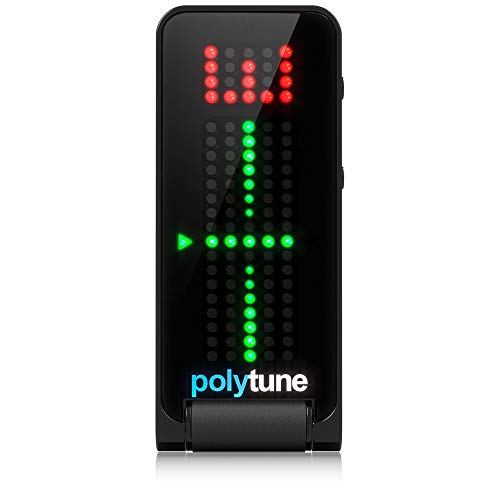
The PolyTune Clip Black brings a pedalboard idea to the headstock: strum all six strings and see the tuning of each one at the same time. That polyphonic mode is a genuine time saver between songs, because you can spot the one string that has drifted instead of checking every string in sequence. When you play a single string, it switches to a conventional chromatic reading, and a strobe mode is there when you need a finer check.
The display uses a bright matrix of lights that adapts to how the tuner is oriented, so it stays readable for left-handed and right-handed players. The black finish and low-profile body also make it one of the less conspicuous clip-on options on stage.
This is a strong pick for gigging acoustic and electric players who tune often and want speed without giving up a precise mode for setup days. Its main trade-off is that it is still a battery-powered clip-on, so players who prefer a mains-powered pedal with a footswitch and muted output should look at the pedal option later in this guide.
Specs
- Brand: TC Electronic
- Model: PolyTune Clip Black
- Type: Clip-on polyphonic tuner
- Modes: Polyphonic, chromatic, and strobe
- Display: 108-light matrix, auto-orienting
- Accuracy: Strobe mode to 0.02 cent
- Power: Coin cell battery, included
- ASIN: B01M1OPRJZ
3. Peterson StroboClip HD

The StroboClip HD is built for players who care about the smallest pitch differences, such as musicians checking intonation, setting up an instrument, or tuning in ensembles where several instruments must agree closely. Its true strobe display moves smoothly and slows as you approach the target, giving a level of feedback that a simple needle-style meter cannot match. The maker rates its accuracy to a tenth of a cent.
Beyond raw precision, it carries a large library of preset sweetened tunings: small, instrument-specific offsets designed to make particular instruments sound more in tune across their range. The clamp uses soft rubber-lined jaws to grip the headstock while protecting the finish, and the backlit screen stays clear in bright and dim light.
Expect a learning curve. A strobe display rewards a light touch and patience, and the menu offers more choices than a basic clip-on. For players who want that control, this is the most precise clip-on in this roundup and the one most suited to careful setup work.
Specs
- Brand: Peterson
- Model: StroboClip HD
- Type: Clip-on strobe tuner
- Accuracy: 0.1 cent
- Display: High-definition backlit strobe display
- Range: C0 to B6
- Presets: More than 50 sweetened tunings
- Power: Coin cell battery, included
- ASIN: B06ZZX99G8
4. Boss TU-3 Chromatic Tuner Pedal

The TU-3 is the pedal option for players who tune through an amplifier and want silent tuning built into their board. Step on the pedal and the output mutes while the meter works, so an audience does not hear you tune between songs. Its metal stompbox body is made for repeated stage use, and the meter uses a row of lights with a high-brightness setting for outdoor or strongly lit stages.
It offers chromatic mode for any pitch and a guitar and bass mode that tunes by string number, including support for seven-string guitar and six-string bass. Flat tuning support helps players who drop their pitch by several semitones. With the right optional adaptor and cable, the pedal can also feed power onward to other pedals.
The TU-3 needs a cable connection, so it does not help an acoustic guitar without electronics, and it takes up pedalboard space that a clip-on does not. For electric players who already run a board, those are easy trade-offs for muted tuning, a footswitch, and a body that tolerates years of boots and cable traffic.
Specs
- Brand: Boss
- Model: TU-3
- Type: Pedal chromatic tuner
- Accuracy: Within 1 cent
- Display: 21-segment light meter with brightness mode
- Range: C0 to C8
- Reference Pitch: 436 to 445 Hz
- Power: 9-volt battery or optional adaptor
- ASIN: B004D8KX7K
5. D’Addario Eclipse Headstock Tuner, Yellow

The Eclipse is a compact, no-fuss clip-on with a vertical full-color display that is easy to interpret at a glance: the meter sits upright, the reading is large, and the swivel lets you angle it from in front of or behind the headstock. That makes it a good fit for younger players, shared classroom instruments, and anyone who wants a tuner that a guest can use without instructions.
It is chromatic, so it handles standard and altered tunings on guitar, bass, and ukulele as long as you know the note name you are aiming for. Pitch calibration covers a wide range, and automatic power-off helps the coin cell last when you forget to switch it off.
This yellow version is also easy to find in a dark gig bag or a drawer full of accessories, a small practical advantage that matters more than it sounds. It does not offer polyphonic or strobe modes, so it is best viewed as a dependable everyday tuner rather than a precision setup tool.
Specs
- Brand: D’Addario
- Model: Eclipse, yellow finish
- Type: Clip-on chromatic tuner
- Display: Full-color vertical display, dual swivel
- Calibration: 430 to 450 Hz
- Features: Automatic power-off
- Power: Coin cell battery, included
- ASIN: B01KZHRCTO
How to Choose the Right Tuner
Start with where and how you play. Acoustic players, teachers, and anyone tuning in a noisy room should default to a clip-on, because vibration sensing ignores most background sound. Electric players with a pedalboard may prefer the TU-3 for silent tuning and a footswitch, while players who split time between both worlds often keep a clip-on in the case even if a pedal lives on the board.
Next, match precision to the job. For daily tuning, a good chromatic clip-on is plenty, and speed matters more than laboratory accuracy. For intonation checks, fret work, or recording sessions where small differences become obvious, a strobe tuner such as the StroboClip HD, or the strobe mode in the PolyTune Clip, gives finer feedback. Polyphonic checking sits in between: it is mainly about speed, letting you see all six strings after one strum.
Then check the display and fit. A screen you cannot read from your normal position will slow you down, so rotating mounts are worth having. Keep clip pressure gentle on delicate finishes, and avoid leaving a clip-on attached for long periods on sensitive lacquer. Finally, think about power: keep a spare coin cell in the case, and pedal users should confirm their board supply meets the pedal draw.
Frequently Asked Questions
Can a clip-on tuner work on an electric guitar that is not plugged in?
Yes. A clip-on reads vibration from the headstock, so it works with the amplifier off or with no cable connected at all. That is also why it works well on acoustic guitars.
What does chromatic mean on a tuner?
A chromatic tuner can identify every note, not only the six standard guitar strings. That makes it useful for alternate tunings, capos, bass, ukulele, and other instruments.
Is a strobe tuner better for beginners?
Not usually. Strobe displays are more precise but can feel busy at first. Beginners often learn faster on a clear chromatic meter, then move to a strobe when they start doing setup work.
How often should you tune?
Check tuning every time you pick up the instrument, after changing strings, and whenever temperature or humidity changes. New strings stretch and need frequent checks until they settle.
Conclusion
For most players, the best choice is the tuner that matches their main instrument and setting: the Snark ST-2 for simple all-instrument use, the PolyTune Clip Black for fast six-string checks, the StroboClip HD for precision, the Boss TU-3 for a pedalboard, and the D’Addario Eclipse for a bright, easy everyday clip-on. Pick the format you will actually use every session, keep it within reach, and tuning becomes a ten-second habit instead of a chore.
More from Amazon
Programs that pair well with the guide above. Offers and eligibility are set by Amazon and may change.
Free shipping on eligible items, Prime Video and more. Eligible new members can start with a free trial.
Start a Prime free trialA Prime membership for ages 18-24 with a trial period. Eligibility is set by Amazon.
See Prime for Young AdultsAudiobooks and podcasts to listen to on the go. Eligible new members can start with a free trial.
Try Audible freeAd-free music streaming. Eligible new subscribers can start with a free trial.
Try Music Unlimited freeAs an Amazon Associate we earn from qualifying purchases.