Key takeaways
- Compare the best guitar capos for acoustic and electric guitars, from trigger and squeeze designs to adjustable models that keep chords clear and in tune.
A capo does a simple job with demanding consequences. Clamp it behind a fret and every open chord shape you already know moves to a new key, which helps you match a singer, brighten an arrangement, or play along with a recording without retuning or learning a fresh set of fingerings. When a capo presses too hard, it pulls strings sharp. When it presses too lightly or unevenly, the low strings buzz and the high strings choke. The best guitar capos solve that balance in different ways, and the right choice depends on how often you move the capo, how varied your guitar collection is, and how much control you want over tension.
This guide compares five proven designs from five different makers: a fast spring clamp, a lever capo with adjustable pressure, a squeeze-on model that adapts to your fingerboard, a geared trigger design, and a dual-radius model for flat and curved boards. Each pick suits 6-string acoustic or electric guitars.
Disclosure: As an Amazon Associate, I earn from qualifying purchases.
1. Kyser Quick-Change Capo for 6-String Acoustic Guitars, Black

The Kyser Quick-Change is the capo many players picture first, and for good reason. Its spring-loaded trigger design has been a staple on acoustic headstocks for decades. You squeeze the handle, place the curved bar across the strings, and release. The strong spring does the rest, holding the strings down firmly with no dial, screw, or second hand required. That speed matters on stage, in a worship band, or anywhere a set list jumps between keys with little pause.
The body is aircraft-grade aluminum, so it feels solid without adding noticeable weight. A padded arm protects the neck, and the string pad is shaped for curved steel-string fingerboards. Because tension is fixed, placement matters: set it just behind the fret wire and centered, and chords ring cleanly. It parks neatly on the headstock when not in use.
This is the pick for players who value speed above fine adjustment. Players with very light strings or shallow necks may prefer an adjustable model below, but for everyday acoustic work this classic remains hard to beat.
Specs
- Brand: Kyser
- Model: Quick-Change for 6-string acoustic, Black
- Type: Spring-loaded trigger capo
- Material: Aircraft-grade aluminum with padded arm
- Fit: 6-string acoustic guitars with curved fingerboards
- Operation: One-handed squeeze and release
- ASIN: B0002CZVWI
2. Shubb Deluxe Capo for Steel String Guitars

The Shubb Deluxe takes the opposite approach to a fixed spring. Its over-center lever locks the capo in place, and a small adjustment screw lets you set exactly how hard it presses before you ever put it on the guitar. Set it once for your neck and string gauge, and the lever then snaps on and off with the same measured pressure every time. That repeatability is why so many fingerstyle and studio players keep a Shubb in the case.
The Deluxe is machined from stainless steel for a smooth, durable finish. Its roller helps the lever close evenly, and the soft pad mimics a fingertip, spreading pressure across all six strings. The result is clean notes with less tendency to drag tuning sharp, once you dial the screw in for your guitar.
Choose the Shubb if you play one main steel-string guitar and want set-and-forget precision. It is a fraction slower than a spring clamp, but the trade is worth it when tuning accuracy is your priority.
Specs
- Brand: Shubb
- Model: Deluxe for steel string guitars
- Type: Lever capo with adjustable tension screw
- Material: Stainless steel with roller mechanism
- Fit: Steel-string acoustic and electric guitars
- Operation: Over-center lever, set tension once per guitar
- ASIN: B004VDD4KK
3. G7th Performance 3 Capo with ART, Black
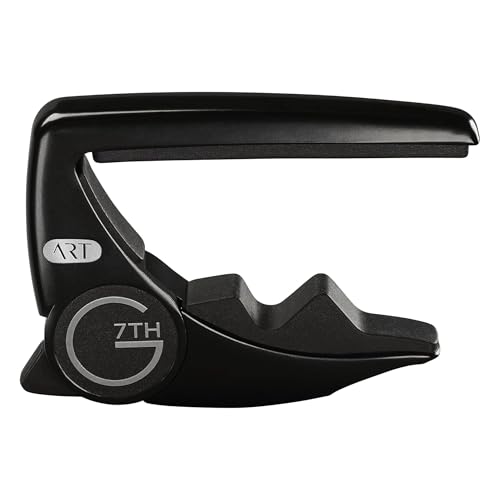
The G7th Performance 3 is built around two ideas: you control the tension by how hard you squeeze, and the string pad adapts to your fingerboard on its own. There is no spring fighting you and no screw to set. You place the capo where you want it, squeeze until the strings are clean, and the wrap-spring clutch holds that exact pressure. Squeeze again to release or slide it to a new fret.
The second idea is Adaptive Radius Technology in the string pad, which flexes to match the curve of the board, from a tight vintage curve to a flatter modern profile. That means more even contact across all strings, helping prevent outer strings buzzing while inner strings are pulled sharp. The low-profile frame stays out of the way of your fretting hand.
Pick the Performance 3 if you own several guitars with different neck shapes and want one capo that travels between them without readjustment. For players frustrated by one-size tension, this squeeze-and-go control is a genuine step forward.
Specs
- Brand: G7th
- Model: Performance 3 with ART, Black
- Type: Squeeze-on capo with wrap-spring clutch
- Material: Zinc alloy frame with adaptive string pad
- Fit: 6-string acoustic and electric guitars, varied radii
- Operation: Squeeze to set tension, squeeze to release
- ASIN: B07NDW6HH8
4. D’Addario NS Tri-Action Capo, Silver

The D’Addario NS Tri-Action blends trigger speed with adjustable tension, which is a combination many players have asked for. Its patented geometry reduces the hand force needed to open the capo, so squeezing it feels lighter than a traditional spring clamp, yet a micrometer adjustment lets you fine-tune how firmly it holds once it is on the neck. You get quick moves between frets without giving up control over pressure.
The frame is aircraft-grade aluminum, and the design applies tension evenly regardless of neck profile, limiting the sideways drag that pushes chords out of tune. An integrated pick holder is a useful touch: park a flatpick in the capo while you switch to fingerpicking.
This model fits players who like the trigger format but dislike fixed tension on lighter strings or slimmer necks. If hand comfort matters, the reduced opening force alone may make this your everyday capo.
Specs
- Brand: D’Addario
- Model: NS Tri-Action Capo, Silver
- Type: Trigger capo with micrometer tension adjustment
- Material: Aircraft-grade aluminum
- Fit: 6-string acoustic and electric guitars with radiused boards
- Extras: Integrated pick holder, headstock storage
- ASIN: B008BPI2HE
5. Ernie Ball Axis Dual Radius Capo, Rose Gold

Most capos commit to one fingerboard shape. The Ernie Ball Axis was designed to avoid that compromise. Its dual-radius pad works on both flat and curved fingerboards, so the same capo can move from a modern electric to a steel-string acoustic to a classical-style flat board with far less fuss. For players with mixed collections, that flexibility can replace two or three single-purpose capos in the gig bag.
The Axis uses a single-handed trigger with an ergonomic shape. Rubber pads protect the neck finish, and the lightweight aluminum body keeps the guitar balanced even when parked on the headstock. The rose gold satin finish is distinctive without being flashy.
Choose the Axis if versatility is your headline need, or if you are buying one capo for several different guitars. It handles 6-string and 7-string electrics and acoustics and changes position quickly.
Specs
- Brand: Ernie Ball
- Model: Axis Dual Radius Capo, Rose Gold
- Type: Trigger capo with dual-radius pad
- Material: Lightweight aluminum with rubber pads
- Fit: Flat and curved fingerboards, 6-string and 7-string guitars
- Operation: One-handed ergonomic trigger
- ASIN: B08T1WQQ9C
How to Choose the Right Capo
Start with tension control, because it affects tuning most. Fixed spring capos like the Kyser are fastest, but pressure is preset. Adjustable designs — the Shubb lever, the D’Addario micrometer trigger, and the squeeze-controlled G7th — let you use only as much force as your strings need, which usually means better intonation.
Next, match the capo to your fingerboard. Curved boards need a curved bar or adaptive pad, while flat boards need a flat one. Dual-radius and adaptive designs are safest when you own guitars with different profiles. Finally, think about how you play: band players who change keys every song should favor one-handed designs that park on the headstock, while studio players can accept a slower lever for precision. Place the capo just behind the fret and keep it parallel to the wire.
Frequently Asked Questions
Will a capo damage my guitar neck or finish?
A well-padded capo used correctly should not. Keep the pads clean, avoid leaving any capo clamped on for weeks at a time, and be extra careful with delicate vintage finishes, where prolonged pad contact can leave a mark.
Why do my chords sound sharp with a capo on?
Too much pressure, or a capo placed too far from the fret, bends the strings toward the board and raises pitch. Move the capo closer behind the fret wire, reduce tension if your model allows it, and press only until the buzzing stops.
Can I use one capo for acoustic, electric, and classical guitars?
Acoustic and electric 6-string guitars usually share capos happily. Classical guitars have wider, flat boards and nylon strings that need gentler, flat pressure, so a dual-radius or dedicated classical model is the safer choice there.
What fret should I place the capo on for a new key?
Each fret raises the key by one half step. Moving up two frets turns an open G shape into A, for example. Experiment with position as well as key, since the same chord shapes sound brighter higher up the neck.
Conclusion
There is no single capo that wins for every player, but there is a clear winner for each style of playing. Take the Kyser for pure speed, the Shubb for set-once precision, the G7th for adaptive squeeze control, the D’Addario for a lighter trigger with fine adjustment, and the Ernie Ball for dual-radius versatility. Match the tension style and fingerboard fit to your main guitar, place it carefully, and any of these five will keep your chords clear, your tuning honest, and your key changes effortless.
More from Amazon
Programs that pair well with the guide above. Offers and eligibility are set by Amazon and may change.
Free shipping on eligible items, Prime Video and more. Eligible new members can start with a free trial.
Start a Prime free trialA Prime membership for ages 18-24 with a trial period. Eligibility is set by Amazon.
See Prime for Young AdultsAudiobooks and podcasts to listen to on the go. Eligible new members can start with a free trial.
Try Audible freeAd-free music streaming. Eligible new subscribers can start with a free trial.
Try Music Unlimited freeAs an Amazon Associate we earn from qualifying purchases.