Key takeaways
- Compare the best sleeping bags by temperature rating, shape, weight and packed size: a classic bag, a mummy bag, a big and tall bag and a down bag.
Quick answer The best sleeping bag for most campers is the Coleman Brazos 20 Degree, because it is the simplest bag that does the core job well: a rectangular bag rated to 20 degrees Fahrenheit, sized for campers up to 5 feet 11 inches tall, with a no-snag zipper, a stuff sack and a machine-washable shell, at a budget tier. The TETON Sports Celsius XXL is the best cold-weather bag, rated to 0 degrees Fahrenheit with a roomy 90 by 39 inch cut and a compression sack, for the camper who sleeps cold or camps late into the fall. The Coleman Big Basin 15 Degree is the best big and tall bag, rated to 15 degrees Fahrenheit with a 92 by 39 inch cut for campers up to 6 feet 6 inches tall. The Kelty Cosmic 20 is the best lightweight backpacking bag, a 550 fill power down mummy bag that weighs 2 pounds 7 ounces and packs into a compression stuff sack. The Bessport Mummy is the best versatile mummy bag, with a comfort range of 32 to 50 degrees Fahrenheit and an extreme rating down to 15 degrees Fahrenheit, for the camper who wants one bag for three seasons. Note that every temperature rating in this guide is the maker’s stated limit figure unless the text says otherwise, so a bag rated to 20 degrees Fahrenheit is a bag for nights that stay above that figure with margin, not a bag that feels warm at exactly that temperature.
A sleeping bag is a simple object with a surprising amount of engineering inside it, because the bag has to do three jobs at once: trap body heat through the night, pack down small enough to carry and store, and survive being stuffed, unstuffed and washed season after season. The differences that matter are temperature rating, shape, weight and packed size, because those four variables decide whether the bag feels warm or cold, roomy or cramped, whether it can be carried far from the car, and whether it fits in a crowded trunk or a backpack. A low temperature rating means more insulation and a warmer bag, while a high rating means a lighter bag that suits summer nights. A rectangular bag suits a camper who moves in sleep and wants room to roll, while a mummy bag suits a camper who wants warmth above all and accepts a snug fit. A light bag can ride in a backpack, while a heavy bag belongs in a car trunk. Read the rating, the shape and the weight off the listing before ordering, and every pick below will arrive as the bag described.
One distinction has to be settled before any pick is described, because it is the distinction that decides whether the buyer orders the right product at all. A temperature rating is a limit, not a promise of comfort. Makers state the lowest temperature at which the bag keeps a sleeper alive and warm enough to sleep, and that figure assumes a sleeping pad underneath, dry clothing inside and a sleeper who runs warm. A camper who sleeps cold should treat the rating as a floor and buy a bag rated 10 to 15 degrees lower than the coldest night expected, because a bag that is barely warm enough on a mild night will be cold on a night that drops further than forecast. A second distinction matters just as much. A sleeping bag is sold as one bag for one sleeper, and the stuff sack or compression sack that comes with it is part of the product, not an accessory to buy later. A bag that arrives without a sack is a bag that will take up twice the space it should in the trunk, so check the listing for the sack before ordering, and confirm that the listing says sleeping bag rather than a sleeping bag liner, because a liner is a thin sheet that adds a few degrees of warmth inside a bag and serves a different purpose entirely.
The first divide is temperature rating, and it is the one that shapes every other choice. Most three-season camping bags are rated between 20 and 40 degrees Fahrenheit, and that range matters more than it looks, because the rating is the maker’s statement about the insulation and the shell together, and a bag used below its rating will leave the sleeper cold no matter how good the pad underneath is. A 20 degree bag suits most spring, summer and fall camping, because it covers cool nights with margin to spare. A 0 degree bag suits late fall and winter camping, because it carries enough insulation for nights near freezing and below. A 15 degree bag sits between the two, warm enough for cold shoulder-season nights without the bulk of a true winter bag. The second divide is shape. A rectangular bag gives the sleeper room to move, to bend the knees and to roll onto a side, while a mummy bag tapers from the shoulders to the feet and closes a hood around the head, leaving less air inside to heat. The third divide is weight, because a 2 pound bag can ride in a backpack and an 8 pound bag cannot, and the choice between them is really a choice between walking to the site and driving to it. The fourth divide is insulation, because down insulation packs smaller and weighs less for the same warmth, while synthetic insulation keeps warming when damp and costs less. The fifth divide is packed size, because a bag that compresses into a small sack fits in a pack, while a bag that stays bulky needs trunk space.
As an Amazon Associate, we earn from qualifying purchases.
Table of Contents
- How We Chose These Sleeping Bags
- Quick Comparison
- The 5 Best Sleeping Bags
- How to Choose the Right Sleeping Bag
- Frequently Asked Questions
- Conclusion
- Product and ASIN Reference
How We Chose These Sleeping Bags
The shortlist started from the sleeping bags that campers, backpackers and car campers actually buy again and again: the Coleman Brazos line, the TETON Sports Celsius line, the Coleman Big Basin line, the Kelty Cosmic line and the Bessport mummy line, because a bag that campers keep reordering has already passed the only durability trial that matters, which is repetition on real ground. From that pool, each candidate had to clear four checks. It had to be a current, orderable Amazon listing with a confirmed identifier read from the listing’s own product information or a corroborating Amazon listing record, not inferred from a similar model or a different configuration. It had to publish its temperature rating and its shape, or its weight and its packed size, because a bag listing that will not state how cold it is rated for or how it packs is a listing that cannot be bought with confidence. It had to fill a distinct role in the lineup, so the five picks divide into a best-overall classic rectangular bag, a best cold-weather bag, a best big and tall bag, a best lightweight backpacking bag and a best versatile mummy bag, rather than five versions of the same rectangular bag. And it had to be a real adult sleeping bag with a zipper and a sack, not a liner, a sleep sack for infants or a double bag for two sleepers: liners add warmth inside a bag, infant sleep sacks are garments for babies, and double bags sleep two people, and a guide about sleeping bags should start with bags made for one adult sleeping outdoors.
Two exclusions shaped the list as much as the inclusions. Double sleeping bags were left out of the main lineup entirely, because a double bag is a different product with a different job, and a solo camper who buys one will carry twice the weight and bulk for no reason. And bags sold only through a maker’s own shop or a specialist outdoor retailer, with no Amazon listing to confirm, were left out even when the bag itself earned praise, because a pick without a confirmed Amazon identifier cannot be ordered with the confidence this guide promises. One well-known name fell to a different rule during research: the Coleman North Rim 0 Degree mummy bag is a widely praised cold-weather bag, but the Amazon listing record for it showed no featured offers available in the most recent crawls, so it is not picked here, and a buyer who wants one should check the listing at the time of ordering rather than taking this guide’s word for it. What remains is five bags that between them cover how sleeping bags are actually bought: one classic rectangular bag for the camper who wants the standard choice, one cold-weather bag for the camper who sleeps cold, one big and tall bag for the camper who needs room, one down bag for the backpacker who counts every ounce, and one versatile mummy bag for the camper who wants a single bag for three seasons.
One honest note belongs up front, before any pick is described. A bag does not make a camping trip better on its own, and the warmest bag in this guide will not save a night spent on bare ground with no pad underneath, while the lightest bag here will serve a camper whose nights are mild and whose pad is thick. What a good bag does is remove friction: the right rating means the sleeper never wakes cold, the right shape means the sleeper never feels trapped, and the right weight means the bag is in the pack instead of left at home. The five picks below are judged on exactly that job, and on the published specifications that let a buyer check the bag before ordering.
Quick Comparison
| Pick | Temperature rating | Shape | Weight | Best for |
|---|---|---|---|---|
| Coleman Brazos 20 Degree | 20 F | Rectangular | 5.3 lb | Best overall classic bag |
| TETON Sports Celsius XXL 0 Degree | 0 F | Rectangular | 7 lb | Best cold-weather bag |
| Coleman Big Basin 15 Degree | 15 F | Rectangular with hood | 8.2 lb | Best big and tall bag |
| Kelty Cosmic 20 Down | 20 F | Mummy | 2 lb 7 oz | Best lightweight backpacking bag |
| Bessport Mummy 15 to 45 Degree | 15 F extreme, 32 to 50 F comfort | Mummy | 4.4 lb | Best versatile mummy bag |
The 5 Best Sleeping Bags
1. Coleman Brazos 20 Degree Sleeping Bag
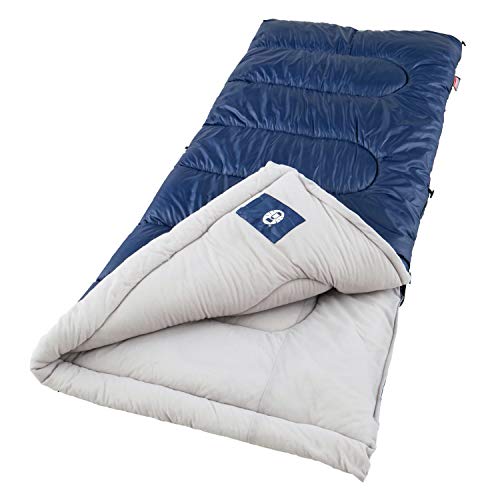
The Coleman Brazos 20 Degree Sleeping Bag is the best sleeping bag in this guide, and it earns that place because it is the bag that does the core job with the least fuss and the most forgiveness. Coleman builds it as a classic rectangular bag, and the listing states that it is rated to 20 degrees Fahrenheit, fits campers up to 5 feet 11 inches tall, and carries a no-snag zipper with a stuff sack included, which is the full set of facts a buyer needs to know whether it will feel warm, whether it will fit, and whether it will pack. The construction is the point of the bag: Coleman builds the Brazos as a rectangular bag with a polyester shell and a soft lining, so the sleeper has room to move, to bend the knees and to roll onto a side, and the bag is machine washable, so a season of campfire smoke and ground dirt washes out rather than building up. The feature that gives the bag its name in the listing sits along the side, a no-snag zipper that resists catching the fabric as it closes, so the bag zips up in the dark without a fight, and the stuff sack rounds out the package, giving the bag a home in the trunk between trips.
What separates the Brazos from the other bags below it is the balance of warmth, room and familiarity, and the trade that comes with it. A rectangular bag rated to 20 degrees Fahrenheit is the most versatile starting point a camper can buy, because it suits a camper who drives to a site and a family that wants one bag for every adult alike, and it keeps the sleeper warm on most spring, summer and fall nights while staying light enough to carry from the car to the tent. The trade is that it is neither the warmest bag here nor the lightest: a camper who camps into late fall will be warmer in the TETON Sports Celsius XXL below, and a camper who walks to the site will be happier with the Kelty Cosmic 20. A camper who needs a bigger bag will find the Coleman Big Basin more spacious. A camper who wants the warmth of a mummy cut will find the Bessport Mummy more efficient. None of that counts against the Brazos in its role. Most camping is done by car campers who want a warm, familiar bag that unrolls in seconds, zips without snagging and washes clean at the end of the season, and a bag that does all of that at a budget tier is the bag that belongs in most trunks. Buy it for the camper who wants the standard choice, for the family that needs a bag for every adult, and for the household that wants one bag that fits every sleeper in the family.
Specs
- Brand: Coleman
- Model line: Brazos 20 Degree
- Type: Rectangular adult sleeping bag, per the maker
- Temperature rating: 20 F, per the listing
- Fits up to: 5 ft 11 in, per the maker
- Zipper: No-snag zipper, per the maker
- Shell: Polyester, per the maker
- Weight: 5.3 lb, per Coleman customer care
- Stuff sack: Included, per the maker
- Care: Machine washable, per the maker
- Tier: Budget
2. TETON Sports Celsius XXL 0 Degree Sleeping Bag

The TETON Sports Celsius XXL 0 Degree Sleeping Bag is the best cold-weather sleeping bag in this guide, and it earns its place because it is the bag for the camper who sleeps cold and wants the warmest rectangular bag available. TETON Sports builds it as an oversized rectangular bag, and the listing states that it is rated to 0 degrees Fahrenheit, measures 90 by 39 inches and weighs 7 pounds, which is the full set of numbers a buyer needs to know whether it will feel warm, whether it will fit a tall sleeper, and whether it will ride in the trunk. The construction is the point of the bag: TETON Sports fills it with SuperLoft Elite synthetic insulation, a loose fill that holds its loft even in damp conditions, so the bag keeps warming when the night turns wet, and the shell is a polyester taffeta that resists tearing and sheds light moisture. The bag comes with a compression sack, so the big bag squeezes down for transport, and the mummy-style hood closes around the head on the coldest nights, giving the rectangular bag a little of the mummy bag’s heat-trapping shape when the temperature drops.
The honest trade-off in the Celsius XXL is the warmth itself, and a buyer needs to understand it before ordering. A bag rated to 0 degrees Fahrenheit carries a lot of insulation, so it is heavy and bulky compared with a summer bag, and a camper who uses it on a warm July night will wake up hot and sweaty, because the bag cannot shed heat it was built to hold. The bag is a car-camping bag by nature: at 7 pounds it is far too heavy for a backpacking trip, and a camper who walks to the site should buy the Kelty Cosmic 20 below instead. A camper who wants the lightest bag will find the Bessport Mummy easier to carry. A camper who wants the lowest tier will find the Coleman Brazos cheaper. A camper who needs the biggest cut will find the Coleman Big Basin taller still. Within its role none of that counts against it. A bag that holds warmth to 0 degrees Fahrenheit, fits a tall sleeper with room to move, and compresses into its own sack is a bag that turns a freezing night into a comfortable one, and the SuperLoft Elite fill is the feature that does that job. Buy it for the camper who sleeps cold, for the late-fall hunter and angler, and for the family that camps when the nights turn sharp.
Specs
- Brand: TETON Sports
- Model line: Celsius XXL 0 Degree
- Type: Rectangular adult sleeping bag with hood, per the maker
- Temperature rating: 0 F, per the listing
- Size: 90 x 39 in, per the listing
- Weight: 7 lb, per the listing
- Fill: SuperLoft Elite synthetic, per the maker
- Shell: Polyester taffeta, per the maker
- Compression sack: Included, per the maker
- Tier: Mid-range
3. Coleman Big Basin 15 Degree Sleeping Bag

The Coleman Big Basin 15 Degree Sleeping Bag is the best big and tall sleeping bag in this guide, and it earns its place because it is the bag for the camper who needs room and warmth in the same package. Coleman builds it as a big and tall rectangular bag with a hood, and the listing states that it is rated to 15 degrees Fahrenheit, measures 92 by 39 inches and fits campers up to 6 feet 6 inches tall, which is the full set of numbers a buyer needs to know whether it will feel warm, whether it will fit a tall sleeper, and whether the sleeper will have room to move. The construction is the point of the bag: Coleman fills it with Coletherm hollow polyester insulation, a fill the maker says holds heat while resisting cold spots, and the shell is a ripstop-reinforced polyester that resists tears at the campsite. The bag carries an adjustable hood and a fleece-lined footbox, so the head end seals in warmth while the foot end stays soft against the feet, and the snag-free zipper runs the length of the bag without catching the fabric, which is the detail that matters when the bag is zipped up in the dark.
The limits of the pick are the limits of a big, warm bag, and they should be stated plainly. A 92 by 39 inch bag rated to 15 degrees Fahrenheit is a heavy bag, at 8.2 pounds, so it is a car-camping bag and nothing else, and a camper who walks to the site should buy the Kelty Cosmic 20 instead. The bag is also warmer than a summer camper needs, so a camper who camps only in July and August will be happier with the Coleman Brazos above, which is lighter and less insulated. A camper who wants the warmest bag will find the TETON Sports Celsius XXL rated lower still. A camper who wants the efficiency of a mummy cut will find the Bessport Mummy more compact. Within its role none of that counts against it. The Big Basin is the bag for the tall camper, for the broad camper who feels trapped in a standard bag, and for the camper who wants a roomy bag with cold-weather warmth and margin to spare. Buy it for the camper over 6 feet tall, for the camper who sleeps on a side with bent knees, and for the household that wants one bag no adult in the family can outgrow.
Specs
- Brand: Coleman
- Model line: Big Basin 15 Degree
- Type: Big and tall rectangular sleeping bag with hood, per the maker
- Temperature rating: 15 F, per the listing
- Size: 92 x 39 in, per the maker
- Fits up to: 6 ft 6 in, per the maker
- Weight: 8.2 lb, per current buying guides
- Fill: Coletherm hollow polyester, per the maker
- Shell: Ripstop-reinforced polyester, per the maker
- Features: Adjustable hood and fleece-lined footbox, per the maker
- Zipper: Snag-free zipper, per the maker
- Tier: Mid-range
4. Kelty Cosmic 20 Down Sleeping Bag

The Kelty Cosmic 20 Down Sleeping Bag is the best lightweight backpacking sleeping bag in this guide, and it earns its place because it is the only pick that solves the whole problem for a camper who carries everything on foot. Kelty builds it as a mummy bag filled with 550 fill power down, and the listing states that it is rated to 20 degrees Fahrenheit and weighs 2 pounds 7 ounces, which is the full set of numbers a buyer needs to know whether it will keep the sleeper warm and whether it will ride in a pack. The construction is the point of the bag: down insulation packs smaller and weighs less than synthetic fill for the same warmth, so the Cosmic 20 compresses into a stuff sack that fits in a backpack side pocket, and the shell uses recycled fabrics with a PFAS-free water-repellent finish, so light rain and tent condensation bead up rather than soaking in. The mummy cut tapers from the shoulders to the feet and closes a hood around the head, leaving less air inside to heat, and the large footbox gives the feet room to move without breaking the taper, which is the detail that separates a good mummy bag from a bag that feels like a straitjacket.
The reason to choose the Cosmic 20 over a rectangular bag is the weight, not the room. A camper who hikes to a viewpoint, paddles to a beach or flies to a trailhead needs a bag that packs small, and the Cosmic 20 is the only pick here that does that job at a weight a backpacker will accept. The trade is the same as any down mummy bag: the fit is snug, so a restless sleeper who rolls all night will feel confined, and the bag has less room to spread out than the rectangular bags above. A camper who sleeps cold in damp conditions should also know that down loses warmth when it gets soaked, so the bag needs a dry sack and a dry tent, while the synthetic bags above keep warming when damp. A camper who wants the cheapest bag will find the Coleman Brazos far cheaper. A camper who wants the warmest bag will find the TETON Sports Celsius XXL rated lower. A camper who wants a roomy bag will find the Coleman Big Basin far more spacious. Within its role none of that counts against it. The Cosmic 20 is the pick for the backpacker, the paddler and the traveler, for the camper who counts every ounce in the pack, and for the household that wants a bag that can live in a closet without taking up the whole shelf. Buy it for a hike-in site, for a multi-day trail, and for the camper who wants a real bag rather than shivering in a liner.
Specs
- Brand: Kelty
- Model line: Cosmic 20 Down
- Type: Mummy backpacking sleeping bag, per the maker
- Temperature rating: 20 F, per the maker
- Fill: 550 fill power down, per the maker
- Weight: 2 lb 7 oz, per the maker
- Shell: Recycled fabrics with PFAS-free water-repellent finish, per the maker
- Fits up to: 6 ft, per the maker
- Footbox: Large footbox, per the maker
- Stuff sack: Compression stuff sack included, per the maker
- Tier: Premium
5. Bessport Mummy Sleeping Bag 15 to 45 Degree

The Bessport Mummy Sleeping Bag is the best versatile mummy sleeping bag in this guide, and it earns its place because it is the bag for the camper who wants one bag for three seasons without paying for down. Bessport builds it as a mummy bag with a stated comfort range of 32 to 50 degrees Fahrenheit and an extreme rating down to 15 degrees Fahrenheit, and the listing states that it measures 90.5 inches long, fits adults up to 6 feet 6 inches tall and weighs 4.4 pounds, which is the full set of numbers a buyer needs to know whether it will feel warm, whether it will fit, and whether it will carry. The construction is the point of the bag: Bessport builds the shell from ripstop polyester with a water-repellent finish, so the bag sheds light rain and tent condensation, and the synthetic fill keeps warming when damp, which is the advantage synthetic holds over down. The bag carries a drawstring hood and an insulated footbox, so the head end seals in warmth while the foot end stays warm through the night, and the anti-snag zipper runs the length of the bag with a protective wind flap, which is the detail that matters when the bag is zipped up in the dark.
The honest trade-off in the Bessport is the temperature rating itself, and a buyer needs to understand it before ordering. The listing gives several temperature figures, a comfort range of 32 to 50 degrees Fahrenheit and an extreme figure of 15 degrees Fahrenheit, and those two figures describe different things: the comfort range is where most sleepers will sleep well, while the extreme figure is the lowest temperature the bag is built to survive, not the temperature at which it feels warm. A camper who buys this bag for a 15 degree night should expect a cold night, and a camper who camps in the 30s and 40s will find it comfortable. The bag is also heavier than the Kelty Cosmic 20 above, at 4.4 pounds against 2 pounds 7 ounces, so a backpacker who counts ounces should buy the Kelty instead. A camper who wants the cheapest bag will find the Coleman Brazos cheaper. A camper who wants the warmest bag will find the TETON Sports Celsius XXL rated lower. A camper who wants a roomy rectangular bag will find the Coleman Big Basin more spacious. Within its role none of that counts against it. The Bessport is the bag for the camper who wants a mummy cut, a water-repellent shell and three-season versatility at a mid-range tier, for the tall camper who needs a 90.5 inch bag, and for the camper who wants one bag that covers spring, summer and fall. Buy it for a car-camping trip, for a hike-in site reached on foot, and for the camper who wants a mummy bag without the cost of down.
Specs
- Brand: Bessport
- Model line: Mummy Sleeping Bag 15 to 45 Degree
- Type: Mummy adult sleeping bag, per the maker
- Temperature rating: 15 F extreme, 32 to 50 F comfort, per the listing
- Length: 90.5 in, per the listing
- Fits up to: 6 ft 6 in, per the listing
- Weight: 4.4 lb, per the listing
- Shell: Ripstop polyester with water-repellent finish, per the maker
- Fill: Synthetic, per the maker
- Features: Drawstring hood and insulated footbox, per the maker
- Zipper: Anti-snag zipper with wind flap, per the maker
- Stuff sack: Included, per the maker
- Tier: Mid-range
How to Choose the Right Sleeping Bag
Start with the temperature rating, because the rating chooses the bag before anything else. A bag used below its rating will leave the sleeper cold no matter how good the pad underneath is, so the buyer should add a margin below the coldest night expected and choose a bag whose rating clears that total with room to spare. A camper who camps only in summer can buy a bag rated to 40 degrees Fahrenheit, because summer nights rarely drop below that figure. A camper who camps in spring and fall should buy a bag rated to 20 degrees Fahrenheit, which means the Coleman Brazos, the Kelty Cosmic 20 or a similar bag. A camper who camps into late fall or winter should buy a bag rated to 0 or 15 degrees Fahrenheit, which means the TETON Sports Celsius XXL or the Coleman Big Basin. Whatever the rating, remember that the figure is a limit, not a comfort promise, and a camper who sleeps cold should buy a bag rated 10 to 15 degrees lower than the coldest night expected.
Next, match the shape to the sleeper. A rectangular bag suits a camper who moves in sleep, because it gives room to bend the knees and roll onto a side, and the Coleman Brazos, the TETON Sports Celsius XXL and the Coleman Big Basin are the rectangular bags in this guide. A mummy bag suits a camper who wants warmth above all, because the taper leaves less air inside to heat, and the Kelty Cosmic 20 and the Bessport Mummy are the mummy bags here. A camper who does not know which shape suits them should lie in a bag of known shape before ordering, because the shape on the listing is the only way to compare bags without trying them, and a bag that is too snug will feel like a straitjacket while a bag that is too roomy will feel cold.
Then buy on the carry, because that is the detail that shows its value after the first trip. A bag that compresses into a stuff sack and rides in a backpack is a bag that gets carried to the site without a second thought, and the Kelty Cosmic 20 is the only pick here that truly does that at a weight a backpacker will accept. A bag that folds into a stuff sack and rides in a trunk is a bag for car camping, and the Coleman Brazos, the TETON Sports Celsius XXL, the Coleman Big Basin and the Bessport Mummy all include a sack for that reason. Check the packed size on the listing before ordering, and confirm that the listing says sleeping bag rather than a liner, because a liner is a thin sheet that adds a few degrees of warmth inside a bag and a buyer who orders a liner by mistake will receive no insulation at all.
A word on safety records, because buyers ask. No recall covers any of the five picks in this guide. The records that do exist cover different products in the wider sleep and camp family, and they are worth knowing because they show how the categories differ. The CPSC recalled Coleman Converta camping cots and suspension stretchers in 2025 after finding that the seatback mechanism could pinch fingers, a cot and a stretcher rather than a sleeping bag, and no pick here is a cot or a stretcher. Safety notices for infant sleep sacks and baby sleeping bags cover garments for babies, where a hood or a missing arm opening can pose a suffocation risk, and no pick here is an infant product: every bag in this guide is an adult camping bag. The CPSC recalled above-ground pools sold under the Coleman name in 2025, a pool rather than a sleeping bag, and no pick here is a pool. None of those records touches an adult camping sleeping bag in this guide. A sleeping bag is fabric and fill with a zipper: inspect the zipper for snags before a trip, wash the bag according to the care label so the fill keeps its loft, store it loose rather than compressed between trips, and never use an adult camping bag as a substitute for an infant sleep product.
Finally, read the listing the way this guide read them: confirm the temperature rating in the specification block, confirm the shape and the weight, confirm that the listing says sleeping bag with a stuff sack rather than a liner, and treat any listing that will not state its rating or its packed size as a bag to skip whatever its name claims. The name on the bag is a product line, not a specification; the specification block is the product.
Frequently Asked Questions
What temperature rating sleeping bag should I buy?
A camper should buy a bag rated 10 to 15 degrees lower than the coldest night expected, because the rating is a limit figure, not a comfort promise, and a bag used below its rating will leave the sleeper cold. A camper who camps only in summer can buy a bag rated to 40 degrees Fahrenheit, a camper who camps in spring and fall should buy a bag rated to 20 degrees Fahrenheit, and a camper who camps into late fall or winter should buy a bag rated to 0 or 15 degrees Fahrenheit. Check the rating in the specification block before ordering, and treat the comfort range as the real guide when the listing gives both a comfort range and an extreme figure, because the extreme figure describes survival, not a good night of sleep.
What is the difference between a rectangular sleeping bag and a mummy sleeping bag?
A rectangular sleeping bag is wide from shoulders to feet and gives the sleeper room to move, to bend the knees and to roll onto a side, while a mummy sleeping bag tapers from the shoulders to the feet and closes a hood around the head, leaving less air inside to heat. A rectangular bag is the comfortable choice, because it feels like a bed, and the Coleman Brazos, the TETON Sports Celsius XXL and the Coleman Big Basin are the rectangular bags in this guide. A mummy bag is the warm choice, because the taper traps heat, and the Kelty Cosmic 20 and the Bessport Mummy are the mummy bags in this guide. A restless sleeper should buy a rectangular bag, and a camper who wants maximum warmth for the weight should buy a mummy bag.
How much should a sleeping bag weigh?
A sleeping bag should weigh as little as the trip allows, because every pound in the bag is a pound carried from the car or in the pack. A bag for car camping can weigh 5 to 8 pounds without causing trouble, and the Coleman Brazos at 5.3 pounds, the TETON Sports Celsius XXL at 7 pounds and the Coleman Big Basin at 8.2 pounds are the car-camping bags in this guide. A bag for backpacking should weigh under 3 pounds, and the Kelty Cosmic 20 at 2 pounds 7 ounces is the backpacking bag in this guide. A camper who drives to the site should not pay for a lighter bag, and a camper who walks to the site should not buy a heavier one.
Can sleeping bags be machine washed?
Most synthetic sleeping bags can be machine washed, and the Coleman Brazos in this guide is machine washable, per its listing. A down bag needs more care, because down clumps when wet and takes a long time to dry, so a camper should follow the care label on the Kelty Cosmic 20 and use a front-loading washer with a gentle cycle rather than a top-loading washer with an agitator. A buyer should always check the care label before washing, because a bag washed the wrong way can lose its loft and never feel as warm again. Between trips, store the bag loose in a large cotton sack rather than compressed in its stuff sack, because long-term compression flattens the fill.
Conclusion
The best sleeping bags divide cleanly once the category’s four variables are separated: temperature rating, shape, weight and packed size. For the best overall classic bag, the Coleman Brazos 20 Degree is the rectangular bag rated to 20 degrees Fahrenheit, sized for campers up to 5 feet 11 inches tall, with a no-snag zipper and a stuff sack at a budget tier. For the best cold-weather bag, the TETON Sports Celsius XXL is the 0 degree bag with a 90 by 39 inch cut, SuperLoft Elite fill and a compression sack at a mid-range tier. For the best big and tall bag, the Coleman Big Basin 15 Degree is the 92 by 39 inch bag for campers up to 6 feet 6 inches tall, with an adjustable hood and a fleece-lined footbox at a mid-range tier. For the best lightweight backpacking bag, the Kelty Cosmic 20 is the 550 fill power down mummy bag at 2 pounds 7 ounces at a premium tier. For the best versatile mummy bag, the Bessport Mummy is the 90.5 inch bag with a comfort range of 32 to 50 degrees Fahrenheit and an extreme rating down to 15 degrees Fahrenheit at a mid-range tier. Buy the rating for the coldest night, match the shape to the sleeper, check the weight against the walk to the site, and the five picks above will cover a full season of camping between them.
More from Amazon
Programs that pair well with the guide above. Offers and eligibility are set by Amazon and may change.
Free shipping on eligible items, Prime Video and more. Eligible new members can start with a free trial.
Start a Prime free trialA Prime membership for ages 18-24 with a trial period. Eligibility is set by Amazon.
See Prime for Young AdultsAudiobooks and podcasts to listen to on the go. Eligible new members can start with a free trial.
Try Audible freeAd-free music streaming. Eligible new subscribers can start with a free trial.
Try Music Unlimited freeAs an Amazon Associate we earn from qualifying purchases.