Key takeaways
- Choose the Feedback Sports RAKK when you want the best balance of footprint, loading convenience, stability, and everyday flexibility. Select a basic front-wheel cradle when price and simplicity matter most. For multiple bikes, compare the complete loaded width rather than the rack’s advertised width, and…
The best floor bike storage racks for small spaces are the Feedback Sports RAKK for most single-bike users, a compact front-wheel cradle for tight budgets, and a freestanding vertical rack when floor width matters more than height clearance.
A floor rack is usually the least complicated way to store a bicycle: it needs no drilling, can move between rooms, and works in rented apartments or shared garages. The trade-off is that every rack consumes some floor area, and the wrong wheel support can be unstable, difficult to load, or incompatible with a road, mountain, gravel, or e-bike tire.
Our top picks
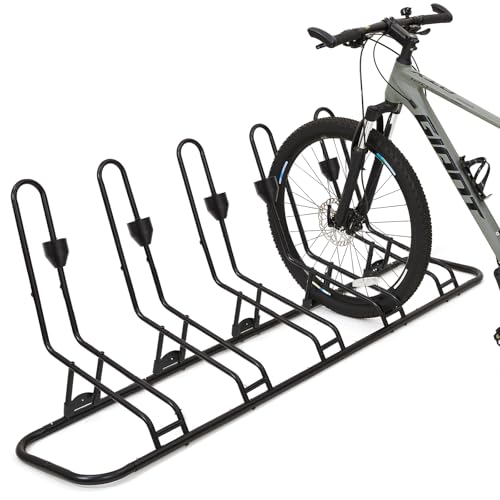


As an Amazon Associate we earn from qualifying purchases at no extra cost to you. Ratings are shown as listed on Amazon.
Quick comparison of the leading floor-rack types
| Rack type or example | Typical footprint per bike | Wheel compatibility | Typical capacity | Best use | Assembly effort |
|---|---|---|---|---|---|
| Feedback Sports RAKK | About 19 x 5 in. (48 x 13 cm) when folded; roughly 19 x 14 in. (48 x 36 cm) in use | Approximately 20–29 in. wheels; tires up to about 2.5 in. depending on version | 1 bike | General-purpose storage in a garage, entryway, or apartment | Low; open the support arm and fit the wheel cradle |
| Front-wheel cradle or hook-style floor stand | About 14–20 x 10–16 in. (36–51 x 25–41 cm) | Often best with 20–29 in. wheels and tires up to 2.3–2.5 in.; check the slot width | 1 bike | Lowest-cost storage for a conventional bike | Low to moderate; may require attaching the cradle |
| Two-sided gravity floor rack | About 24–36 x 18–24 in. (61–91 x 46–61 cm) for two bikes | Commonly 20–29 in. wheels; some accept tires up to 2.5–3 in. | 2 bikes | Couples, families, or shared storage rooms | Moderate; base and uprights usually need assembly |
| Freestanding vertical wheel rack | About 24–36 in. wide x 24–30 in. deep (61–91 x 61–76 cm) | Often accommodates 20–29 in. wheels; tire clearance varies widely | 2–6 bikes | Concentrating several bikes along one wall without drilling | Moderate to high; more parts and leveling are typical |
Dimensions above are useful planning ranges rather than universal specifications. Measure the actual product, including its feet, before committing to a narrow alcove. A rack that is 5 inches wide may still need 14 inches of clearance once the bicycle is loaded.
Best picks by storage situation
Best overall: Feedback Sports RAKK
The Feedback Sports RAKK is a strong default because its spring-loaded arm supports the front or rear wheel without requiring the frame to be lifted. It folds relatively flat when not in use, stands on a broad base, and is available in versions intended for different wheel and tire sizes. It is particularly practical for a road, hybrid, gravel, or moderate-width mountain bike used every day.
Its main limitation is side clearance. The rack keeps the bike upright, but handlebars and pedals still occupy the bicycle’s full width. Place it where the bike can be rolled straight in rather than angled through a narrow doorway. For bikes with very wide tires, fenders, unusual axle hardware, or small wheels, confirm the specified wheel range before buying.
Best low-cost choice: a single front-wheel cradle
A basic steel or reinforced-plastic front-wheel cradle is enough when the bike will stay in one location and you do not need a folding mechanism. These racks usually cost less than premium folding stands and are easy to replace. Choose a model with a rubberized contact surface and a base extending well behind the wheel; a narrow, lightweight cradle can tip when a bike has a heavy rear rack, child seat, or loaded panniers.
Front-wheel cradles are less forgiving than the RAKK. You need to push the wheel fully into the slot, and a suspension fork, disc rotor, fender, or tire wider than the slot may prevent a proper fit. They are best for lighter bikes and users who can inspect the fit during installation.
Best for two bikes: a two-sided gravity rack
A two-sided gravity rack lets the bikes lean into opposing wheel channels, saving space compared with two separate stands. It is a useful choice for a couple or for a shared room where bikes need to be removed independently. Look for padded contact points and enough separation between channels to prevent handlebars, pedals, and brake rotors from colliding.
Do not judge capacity by wheel slots alone. Two bikes with 720-millimeter handlebars can need more lateral clearance than two narrow road bikes. Before purchase, add the handlebar widths of both bikes and allow at least 2–4 inches of handling space between them.
Best for maximum bike count: a freestanding vertical rack
Vertical racks reduce the length of floor occupied by each bicycle, but they require more ceiling height and a controlled lifting motion. A bike with a 29-inch wheel commonly needs around 72–78 inches of vertical clearance when stored upright, depending on the frame and rack design. Measure from the floor to the highest point of the handlebar or saddle, not just the wheel diameter.
This style suits a garage or storage room with a straight wall and several bikes. It is less convenient for heavy e-bikes because lifting the front or rear end repeatedly can be awkward. A rack with a low wheel channel and a wide, weighted base is preferable to a tall, narrow stand that can sway when one bicycle is removed.
How to measure whether a rack will fit
- Measure the available floor rectangle. Record width, depth, and nearby door-swing space. Add 4–6 inches in front of the rack if you need room to roll the bike into position.
- Measure the tire. Read the printed tire size, then measure the inflated width with a ruler if the tire is close to the rack’s maximum. A “2.4-inch” mountain-bike tire can measure more or less depending on rim width and pressure.
- Check the wheel format. Common bicycle wheels include 20, 24, 26, 27.5, and 29 inches, plus 700c road and gravel wheels. A rack designed around a narrow 700c tire may not accept a 29-inch mountain-bike wheel even if both have similar outside diameters.
- Measure bike height for vertical storage. Use the taller of the saddle and handlebar, then add clearance for lifting and removing the bike.
- Check protrusions. Disc rotors, fenders, kickstands, racks, panniers, and front baskets can interfere with a wheel channel or stop the bike from sitting squarely.
Stability matters more than a small footprint
A compact rack is not automatically space-efficient if it is easy to knock over. Examine three areas: base width, contact with the floor, and the direction in which the bicycle’s weight is supported. Rubber feet help on smooth concrete, tile, and wood, while a broad steel base is valuable on uneven garage floors.
For a heavy e-bike, use a rack specifically rated or clearly designed for the bike’s weight. A wheel-only stand can hold the bicycle upright yet still be unstable when the battery, rear cargo rack, or child seat shifts the center of gravity. Keep the heaviest bike closest to the base and avoid hanging bags from handlebars unless the rack manufacturer permits it.
Assembly and ownership realities
Single-bike stands normally require only a few minutes of assembly, but tighten every fastener after the first loading. Recheck them after several weeks because vibration and repeated wheel insertion can loosen a joint. Multi-bike racks take longer because their stability depends on correctly aligned crossbars and feet.
The parts that usually wear first are rubber feet, foam or plastic frame guards, wheel-channel liners, and spring pivots. Replace damaged pads rather than allowing metal to contact a rim or frame. Wipe grit and road salt from the wheel slot, especially in winter. A small amount of manufacturer-approved lubricant on a metal pivot may help, but do not lubricate a surface intended to grip the tire.
Common mistakes include placing the stand on a sloped drain area, forcing a wide tire into a narrow slot, storing a muddy bike against an unprotected painted frame, and positioning the rack where the handlebar blocks a fire exit or door. If the bike has hydraulic brakes, store it in the orientation recommended by its manufacturer, particularly if it will be left unused for long periods.
Decision matrix
| Your situation | Most suitable choice | Why | Watch out for |
|---|---|---|---|
| One daily-use road, hybrid, or gravel bike | Feedback Sports RAKK | Fast loading, folding storage, broad compatibility | Confirm tire width and allow handlebar clearance |
| Lowest budget and fixed storage location | Basic front-wheel cradle | Few parts and low replacement cost | Tip resistance and slot width |
| Two bikes in a narrow shared room | Two-sided gravity rack | One base serves both bikes | Handlebar and pedal interference |
| Three or more bikes in a garage | Freestanding vertical rack | Uses wall length efficiently without drilling | Ceiling height and lifting weight |
| Heavy e-bike or cargo bike | Wide-base, low-loading floor stand | Better stability and less lifting | Verify weight rating and wheel-channel dimensions |
| Very wide mountain-bike tires | Wide-slot gravity or wheel cradle | More tolerant of 2.4–3-inch tires | Fenders, rotors, and suspension components |
Bottom line
Choose the Feedback Sports RAKK when you want the best balance of footprint, loading convenience, stability, and everyday flexibility. Select a basic front-wheel cradle when price and simplicity matter most. For multiple bikes, compare the complete loaded width rather than the rack’s advertised width, and choose a vertical rack only when ceiling height and lifting effort are acceptable. The right rack is the one that fits the inflated tire, supports the bike’s actual weight, leaves a safe passage around it, and remains easy enough to use that the bike is stored after every ride.