Key takeaways
- Compare the best recurve bows for beginners and intermediates, from takedown models to a classic one-piece, with draw weights, lengths and fit tips.
A recurve bow takes its name from limbs that curve away from the archer at the tips, storing more energy than a straight-limbed bow of the same length. That is why the best recurve bows remain the default for new archers: no cams to tune, no cables to service, and nothing between you and the fundamentals of draw, anchor, and release.
This guide covers recurve bows only — not compound bows or crossbows, which have their own guides on this site. The five picks below are takedown and one-piece bows for learning, practice, and club shooting, plus one traditional hunting bow for archers ready to commit to a fixed weight. Each comes from a different maker and suits a different buyer.
Disclosure: As an Amazon Associate, I earn from qualifying purchases.
1. Samick Sage Takedown Recurve Bow — Best Overall for New Archers

The Samick Sage is the bow instructors mention first. Its three-piece takedown design pairs a laminated wood riser with maple limbs faced in fiberglass, and the limbs bolt on and off in minutes. You can begin with light limbs while you learn form, then buy heavier limbs for the same riser instead of replacing the whole bow. The riser is drilled for a rest, sight, and stabilizer, so you can shoot it bare off the shelf or build it up gradually. At 62 inches, it draws smoothly for most adults yet breaks down small enough for a car trunk.
Specs
– Type: Takedown recurve, three-piece
– Length: 62 inches
– Draw weight: 25 lb on the listed version; other limb weights run from 25 to 60 lb in 5 lb steps
– Hand: Right and left hand versions
– Riser: Laminated olive dymondwood and hard maple
– Limbs: Hard maple core with fiberglass facing
– Included: Riser, two limbs, Dacron bowstring, arrow rest
– ASIN: B007O7Q2L8
Choose the Sage if you want one bow that can grow with you from first lessons to confident intermediate shooting.
2. Southwest Archery Spyder Takedown Recurve Bow — Best Takedown Upgrade Path

The Southwest Archery Spyder follows the same proven layout as the Sage — its design team worked on that earlier bow — but refines the details. Riser edges and limb pockets are rounded, limb bolts sit flush, and the tips are reinforced for modern low-stretch strings as well as the supplied Dacron string. Limbs swap easily, so moving up in weight is a limb purchase, not a new bow. The listed version is the 62-inch model at 40 lb in right hand, a genuine hunting weight in many states. A 64-inch XL version suits taller archers, and threaded bushings accept a rest, plunger, sight, quiver, or stabilizer.
Specs
– Type: Takedown recurve
– Length: 62 inches on the listed version; 64-inch XL version also made
– Draw weight: 40 lb on the listed version; range runs from 20 to 60 lb on the 62-inch model
– Hand: Right hand on the listed version; left hand versions also made
– Riser: Laminated woods, including dymondwood and hard maple
– Limbs: Hard maple core with fiberglass lamination, reinforced tips
– Included: Riser, two limbs, 14-strand Dacron string, adhesive arrow rest, stringer tool
– ASIN: B01CLXZY36
Choose the Spyder if you like the Sage formula but want a neater finish and tips built for upgraded strings.
3. Southland Archery Supply SAS Courage Takedown Recurve Bow — Best for Hunting-Weight Practice
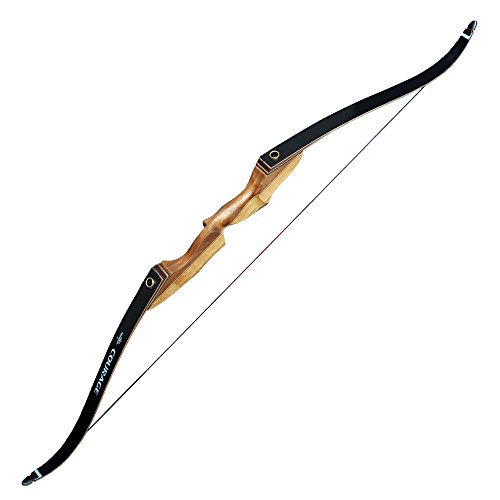
The SAS Courage, from Southland Archery Supply, is a 60-inch takedown built around hunting weights rather than light target weights. The listed version draws 45 lb in right hand, squarely in the range most states require for deer. Its riser is laminated from bintangor, makore, and chuglam hardwoods, and the limbs combine maple and makore laminations faced with high-strength fiberglass. Two inches shorter than the Sage and Spyder, it handles quicker in brush, though long draws feel more finger pinch. It is a plain working bow — and note that 45 lb is a lot to learn on, so treat it as a second bow.
Specs
– Type: Takedown recurve
– Length: 60 inches
– Draw weight: 45 lb on the listed version, right hand; other versions run from 35 to 60 lb
– Hand: Right hand on the listed version
– Riser: Bintangor, makore, and chuglam hardwood laminate
– Limbs: Maple and makore laminations with fiberglass facing
– Model reference: SAS-361R45
– Included: Riser, two limbs, bowstring, rug rest
– ASIN: B00LP2CU82
Choose the Courage if your plan is traditional bowhunting and you want a takedown that arrives at hunting weight.
4. Bear Archery Grizzly Recurve Bow — Best Traditional One-Piece
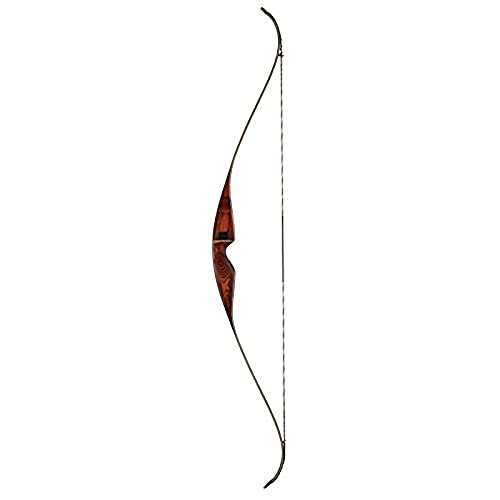
The Bear Grizzly is the outlier here, and deliberately so. In more or less continuous production since the late 1940s, it is a 58-inch one-piece bow: no bolts, no limb swaps, nothing to assemble. The listed version is the 55 lb right-hand model in brown maple, with clear maple limbs backed and faced with black fiberglass, a crowned shelf cut on center, a leather side plate, and a bear-hair rest, shot off the shelf in traditional style. A one-piece draws smoothly and a well-kept Grizzly can serve for decades, but the weight you buy is the weight you keep — so it suits an intermediate archer who already knows their comfortable weight. Draws well beyond 28 inches may stack near full draw.
Specs
– Type: One-piece traditional recurve
– Length: 58 inches AMO
– Draw weight: 55 lb on the listed version, right hand; range runs from 30 to 60 lb
– Hand: Right hand on the listed version; left hand versions also made
– Riser: Brown maple, one-piece construction
– Limbs: Clear maple with black fiberglass backing and facing
– Shelf: Crowned, cut on center, with leather side plate and bear-hair rest
– Included: Bow and Dacron string
– ASIN: B002QG5PJ2
Choose the Grizzly if you have settled on a draw weight and want a classic one-piece bow to keep for the long term.
5. PSE Snake Recurve Bow — Best First Bow for Youth and Casual Practice

The PSE Snake takes the opposite approach to the Grizzly: a one-piece molded composite bow built to be nearly indestructible. At 60 inches with a light draw of about 25 lb at 28 inches, it suits youth archers, smaller-framed beginners, camp programs, and adults who want a loaner bow that survives drops and garage storage. It is ambidextrous, with a shelf on both sides, so left- and right-handed shooters can share it. There are no accessory mounts and the weight is fixed, so nobody will hunt with it — its job is to make the first hundred arrows cheap, safe, and fun before you spend more on a wooden takedown.
Specs
– Type: One-piece recurve, molded composite
– Length: 60 inches
– Draw weight: About 25 lb at a 28-inch draw
– Hand: Ambidextrous, shelves on both sides
– Brace height: 8.75 inches
– Mass weight: 3.2 lb
– Included: Bow, bowstring, stick-on arrow rests
– ASIN: B003BRINYO
Choose the Snake if the bow is for a young archer, a group program, or a first taste of archery on a tight budget.
How to Choose the Right Recurve Bow
Match draw weight to your strength, not your ambition. Most adult beginners shoot best between 25 and 35 lb: heavy enough for flat flight at practice distances, light enough to hold without shaking. Youth and smaller archers often belong between 15 and 25 lb. Hunting usually requires 40 lb or more, but reaching it is a progression — begin light, learn clean form, then step up in 5 lb increments.
Match bow length to your draw length. A 62-inch bow suits draws up to about 28 or 29 inches; longer draws are better served by a 64-inch bow. Shorter bows like the 58-inch Grizzly are handier in brush but less forgiving of a long draw or rough release.
Decide between takedown and one-piece early. A takedown travels easily and lets you change weight by changing limbs. A one-piece offers a traditional feel but commits you to one weight. Most beginners should begin with a takedown.
Get the hand right. Handedness follows eye dominance, not writing hand. A right-hand bow is held in the left hand and drawn with the right. If you are cross-dominant, ask an instructor to check before you order.
Budget for the extras. Matched arrows, a stringer, an armguard, a finger tab or glove, and a target are part of shooting safely and well. A stringer protects you and the limbs every time you brace the bow.
Frequently Asked Questions
Can a beginner begin at 40 or 45 lb?
Most cannot do so with good form. A weight you can barely pull teaches you to collapse, snap-shoot, and strain your shoulder. Begin lighter, even if your goal is hunting weight, and build up through limb changes.
What arrows should I use?
Arrow spine must match your draw weight and draw length, so use the maker’s spine chart or a shop’s advice rather than guessing. Poorly matched arrows fly badly no matter how good the bow is, and damaged arrows should never be shot.
Do I need to unstring a recurve between sessions?
For wooden bows, unstringing with a stringer during long storage reduces stress on the limbs. For short gaps, many archers leave the bow braced; follow the guidance that came with your bow.
Can these bows be used for hunting?
Only the heavier versions, where local rules allow. The Courage at 45 lb and the Grizzly at 55 lb sit in genuine hunting territory for deer-sized game with suitable broadheads and close, ethical shots. The Snake is a practice bow only, and light Sage or Spyder limbs are for targets.
Conclusion
For most readers, the Samick Sage remains the safest first purchase: affordable, adaptable, and easy to grow with. The Spyder adds a more refined finish, the SAS Courage suits archers aiming at hunting weight, the Bear Grizzly rewards those who want a traditional one-piece for the long haul, and the PSE Snake covers youth and groups best. Pick by draw weight and length first, and the rest gets much simpler.
More from Amazon
Programs that pair well with the guide above. Offers and eligibility are set by Amazon and may change.
Free shipping on eligible items, Prime Video and more. Eligible new members can start with a free trial.
Start a Prime free trialA Prime membership for ages 18-24 with a trial period. Eligibility is set by Amazon.
See Prime for Young AdultsAudiobooks and podcasts to listen to on the go. Eligible new members can start with a free trial.
Try Audible freeAd-free music streaming. Eligible new subscribers can start with a free trial.
Try Music Unlimited freeAs an Amazon Associate we earn from qualifying purchases.