Key takeaways
- Find the right indoor putting mat for home or office practice, comparing roll-up, ball-return and long training designs for small and large spaces.
Choosing an indoor putting mat is really a decision about the floor you can spare and the putts you actually miss on the course each week. A mat that is too short only rehearses tap-ins, while one that is too long for the room will stay rolled up in a corner and never get used. Length, surface speed, and whether the ball comes back to you matter far more than extra accessories included in the box.
This guide is for apartment golfers with a hallway, office workers who want short breaks between calls, and committed players building a longer practice lane at home. The three mats below were chosen from the names, dimensions, and specifications shown on their Amazon product pages, covering a roll-up design, a ball-return design, and a long training design.
Quick Picks
As an Amazon Associate we earn from qualifying purchases
| Product | Best for | Key spec from title |
|---|---|---|
| PuttOut Pro Golf Putting Mat | Rolling up and storing in a small flat or office | 7.87-feet x 1.64-feet |
| SKLZ Accelerator Pro Indoor Putting Green with Ball Return | Repetitive practice without walking to fetch the ball | 9 Feet x 16.25 Inches with Ball Return |
| WELLPUTT Golf Putting Training Mat – 13ft | Longer putts and structured training in a dedicated space | 13ft Green training mat |
How to Choose
Measure the Lane, Not Just the Room
Start with the clear floor run, then subtract space for your stance behind the ball and for the ball to stop beyond the target. A hallway that measures ten feet wall to wall rarely gives you ten feet of putting, because you need room to stand, swing the putter, and avoid a skirting board at the far end. For example, a 7.87-foot roll-up mat can fit a spare-room wall where a 13-foot mat cannot, even though both are described as indoor mats. Leave a margin at both ends, check doors that open into the lane, and confirm the mat width still lets you stand beside it without one foot on the surface.
Match Surface Speed to the Greens You Play
A mat that rolls much slower than your usual greens teaches you to hit every short putt too firmly, while a very fast surface can make you tentative when you return to ordinary greens. Look for a stated speed in the listing rather than vague claims about a realistic roll. For example, the PuttOut mat in this guide lists a stimpmeter reading of 10, described as medium-to-fast, and the Wellputt mat lists different speeds in opposite directions. If your home club has slow winter greens, a medium speed is the safer everyday teacher. If you regularly play fast tournament greens, practising on a quicker surface at home makes more sense.
Decide Whether a Ball Return Helps or Hinders
A ball return keeps a short session moving, because made and missed putts travel back toward your feet and you can repeat the same stroke without walking the lane. That rhythm suits a nine-foot mat in a living room, where the SKLZ design pairs a return track with a collector behind the hole. The trade-off is hardware: rails and a raised hole area take assembly, storage space, and a firmer stroke up a small slope. A flat roll-up mat has no return, so you need several balls and a few steps to collect them, but it stores in a bag and lies completely flat for pace work.
Check Backing, Storage, and Floor Type
Indoor mats live on hardwood, tile, laminate, and carpet, and the backing decides whether the mat creeps forward after every few putts. A heavy rubber backing, as listed for the PuttOut mat, helps it lie smooth and flat and resist bunching on a hard floor. Thick carpet underneath any mat will slow the roll and can tilt the ball offline, so a firm, level floor is the better base wherever possible. Think about storage before you buy: a roll-up mat in a carry bag suits a flat or office cupboard, while a mat with return rails needs a corner, a box, or a permanent lane.
The 3 Best Options
PuttOut Pro Golf Putting Mat

This mat suits the golfer whose practice space has to disappear again after twenty minutes. Its 7.87-foot length covers the short and mid-range putts that decide most scorecards, while the printed alignment guides, target points, and distance markings give a session structure without needing a hole cut into the surface. Because there is no raised cup or return track, the roll stays flat from end to end, which helps when you are working on pace rather than holing out. It also suits travellers and office users, since it rolls into its compact carry bag and can be laid in a spare room, a hotel-style space, or beside a desk.
Specs
- Size from title: 7.87-feet x 1.64-feet, Green
- Item model number: PUT/MAT/GRN
- Included components: 1 x PuttOut Mat
- Surface: high quality cut-pile surface with stimpmeter reading of 10
- Backing: durable, heavy-rubber backing
- Features: printed alignment guides, target points and distance markings
Best for: Small homes and offices where the mat must roll away after practice
Watch out for: No putting cup or ball return is included, so you putt to marked targets and collect the balls yourself
ASIN: B0777137V2
SKLZ Accelerator Pro Indoor Putting Green with Ball Return
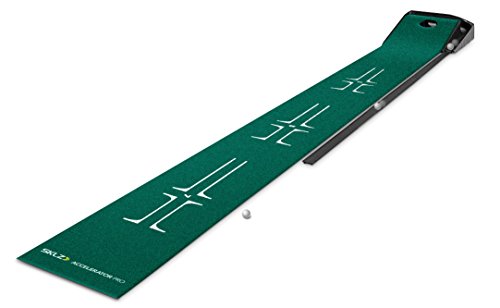
Choose this mat if repetition is the point of your practice and bending to retrieve balls breaks your concentration. The nine-foot lane carries putter alignment guides at 3, 5, and 7 feet, so you can move through a simple distance ladder and watch whether your start line stays consistent as the putt gets longer. The automatic return and the collector behind the hole keep one ball in play for a whole session, which is practical in a living room, garage, or office corner. Its narrower width also helps in tight spaces, although that same narrow shape leaves less room for a wide stance beside the ball on longer putts.
Specs
- Size from title: 9 Feet x 16.25 Inches
- Floor length: 108 inches
- Hole count: 1
- Backing: rubber-backed surface
- Features: auto-ball return and behind-the-hole ball collector
- Features: putter alignment guides at 3, 5, and 7 feet
- Included components: Accelerator Pro Mat, Gravity Ball Return, Removal Ball Tracks
Best for: Repetitive distance-ladder practice at home with a single ball
Watch out for: The hole sits on a small uphill slope for the return, so putts need a firmer stroke than on a flat green
ASIN: B003D6FFXK
WELLPUTT Golf Putting Training Mat – 13ft

This is the option for a player with a dedicated lane who wants more than a place to roll casual putts. At 13 feet long it extends practice beyond the short range covered by the other two mats, and putting in opposite directions gives two different listed speeds, changing the pace demanded by the same stroke. The mat is built around structured training rather than a cup and return, with guided exercises through the Wellputt app and visual aids for alignment printed into the design. It fits a garage, basement, or spare room that can keep a practice lane in place.
Specs
- Size: 13 x 1.64 ft
- Length: 157.48 inches
- Width: 19.68 inches
- Speed: stimp 11.5 ft in one direction and 10 ft in the other
- Training: app with 54 exercises
- Surface: UV resistant material listed for the 13ft Green model
Best for: Committed players with a long, dedicated indoor practice lane
Watch out for: Thirteen feet plus stance room rules out most hallways and small offices, so measure carefully before ordering
ASIN: B0789LW4WW
Which One Fits Your Situation
You Live in a Flat and Store Everything Away
Pick the PuttOut Pro Golf Putting Mat. It is the shortest mat here, it rolls into a compact carry bag, and its heavy rubber backing is made to lie flat after unrolling. You lose a cup and a ball return, but you gain a practice surface that can live in a cupboard and appear on a bedroom or living-room floor whenever you have a short window to practise.
You Want Quick Sessions Without Chasing Balls
Pick the SKLZ Accelerator Pro Indoor Putting Green with Ball Return. The return track and behind-the-hole collector keep a single ball coming back, and the guides at 3, 5, and 7 feet give each short session a clear routine. It is the most practical choice for a living room or office corner where walking the lane after every putt would quickly make practice feel like a chore.
You Have a Garage or Spare Room for a Permanent Lane
Pick the WELLPUTT Golf Putting Training Mat – 13ft. The extra length lets you practise putts the shorter mats cannot offer, and the two speeds in opposite directions add a pace challenge without changing equipment. The app-based exercises also give the lane a purpose beyond free rolling. Choose it only when the room can hold the full length plus your stance without moving furniture every time.
You Mostly Miss Short Putts Under Pressure
Start with the PuttOut Pro Golf Putting Mat and its marked targets, or the SKLZ mat if you want the feedback of a real hole. Both keep practice inside the distances where short misses happen. The PuttOut markings reward a ball that stops in the right zone, while the SKLZ hole and return reward repetition. Either is more useful for this problem than a long mat used only for occasional lag practice.
Common Mistakes
- Buying by total room length and forgetting stance room, so the mat fits the floor but leaves no space to stand and putt.
- Practising only on thick carpet, then blaming the mat when the roll is slower and less straight than on a firm floor.
- Choosing a ball-return mat for pace practice, even though the raised hole area changes the stroke needed at the end of the putt.
- Leaving a roll-up mat tightly rolled for months and expecting it to lie flat immediately, instead of unrolling it flat before a session.
- Working only on six-foot putts and never changing distance, target size, or direction, so practice stops testing pace control.
Frequently Asked Questions
How long should an indoor putting mat be for home use?
For most homes, a mat between about eight and ten feet covers the putts you can practise honestly once stance room is included. Shorter mats suit flats and offices, while a 13-foot mat needs a garage or spare room. Measure the clear lane first, subtract room to stand behind the ball, and only then compare lengths in the listings.
Does a ball return make practice better?
A return makes practice faster and more repetitive, which helps when you are grooving one distance at a time with a single ball. It does not make the roll itself better, and a raised hole can demand a firmer stroke. If your main goal is delicate pace control on a flat surface, a plain roll-up mat may teach a cleaner lesson.
Can I use an indoor putting mat on carpet?
You can, but the carpet underneath becomes part of the surface. Thick or uneven carpet slows the ball, softens the roll, and can push putts offline, so results will differ from a hard floor. A rubber-backed mat on a firm, level floor gives the most consistent practice. If carpet is your only option, choose the thinnest, firmest area available and keep the mat in the same place.
What should I practise first on a new putting mat?
Start with start line, not distance. Place a ball on an alignment guide, roll short putts at a marked target, and check whether the ball starts where you aimed before you worry about speed. Once the line is stable, move back in small steps, change targets, and finish with pace drills where the ball must stop inside a marked zone rather than simply reach a hole.
More from Amazon
Programs that pair well with the guide above. Offers and eligibility are set by Amazon and may change.
Free shipping on eligible items, Prime Video and more. Eligible new members can start with a free trial.
Start a Prime free trialA Prime membership for ages 18-24 with a trial period. Eligibility is set by Amazon.
See Prime for Young AdultsAudiobooks and podcasts to listen to on the go. Eligible new members can start with a free trial.
Try Audible freeAd-free music streaming. Eligible new subscribers can start with a free trial.
Try Music Unlimited freeAs an Amazon Associate we earn from qualifying purchases.