Key takeaways
- Heritage Steel titanium-strengthened cookware generally occupies the premium stainless category, with set prices commonly ranging from several hundred dollars for smaller bundles to substantially more for large collections. The value improves when the set includes pans you would otherwise buy individually, particularly a large skillet,…
Best Heritage Steel Titanium Cookware Sets
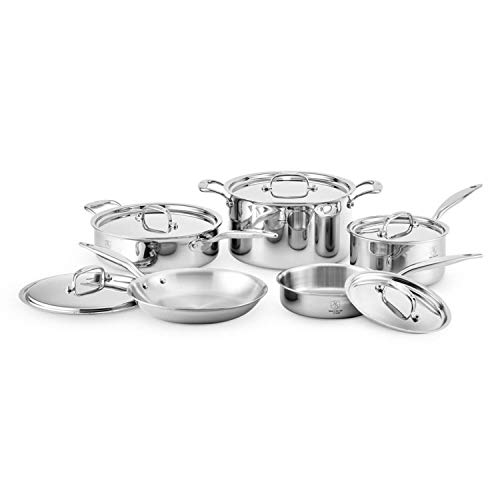
The best Heritage Steel titanium-strengthened cookware set for most households is a mid-size Titanium Series bundle with two skillets, two saucepans, a sauté pan or stockpot, and matching lids; it provides the broadest day-to-day coverage without paying for duplicate specialty pieces.
Heritage Steel’s Titanium Series is aimed at cooks who want stainless-steel durability, responsive multi-layer construction, and induction compatibility rather than a permanently nonstick cooking surface. Its notable feature is titanium-strengthened 316Ti stainless steel in the cooking surface. That does not mean the pans are made from solid titanium, nor does it make them nonstick. Instead, the alloy is intended to improve corrosion resistance and long-term durability while retaining stainless steel’s ability to brown food and deglaze with fond.
Our top picks


As an Amazon Associate we earn from qualifying purchases at no extra cost to you. Ratings are shown as listed on Amazon.
What you receive in the different set sizes
Heritage Steel sets vary by bundle and may be sold with different combinations of pans, lids, and accessories. The piece count can therefore be misleading: a lid often counts as one piece. Before buying, compare the actual pan inventory rather than choosing solely by the number in the set name.
| Cookware type | Useful working size | Best use | What to check in a set |
|---|---|---|---|
| Small skillet | 8 inches | One or two eggs, small portions, toasted spices | Helpful, but not essential for a large household |
| Large skillet | 10.5–12 inches | Steaks, vegetables, pancakes, family portions | Most important everyday pan; confirm the exact diameter |
| Small saucepan | 1.5–2 quarts | Sauces, grains, reheating, small servings | A lid should be included |
| Medium saucepan | 2.5–3 quarts | Oatmeal, vegetables, soup, pasta sauce | More useful than a second small skillet for many cooks |
| Sauté pan | 3–4 quarts | One-pan meals, braising, shallow frying | Look for a flat base and a lid |
| Stockpot | 6–8 quarts | Soup, pasta, stock, batch cooking | Worth prioritizing for families or freezer cooking |
Small sets: best for limited space
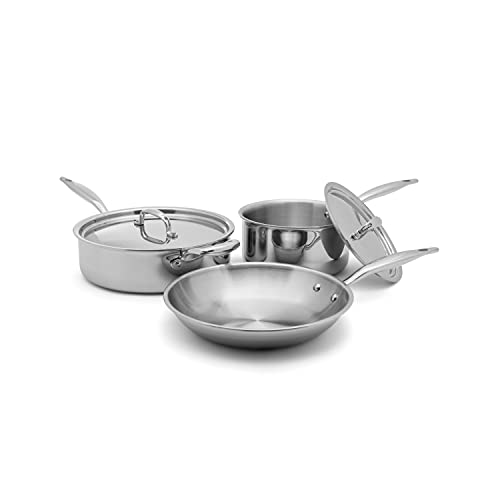
A compact set containing a large skillet, one saucepan, and a lid is suitable for a single cook, a couple, or someone building a cookware collection gradually. It leaves fewer duplicate pieces in a small kitchen, but it may require buying a stockpot or sauté pan separately.
Medium sets: the practical choice
A medium set is usually the strongest value for regular home cooking. The ideal mix is an 8- or 10.5-inch skillet, a larger skillet or sauté pan, two saucepans, and at least two lids. This combination covers searing, sauces, grains, vegetables, shallow braises, and leftovers without demanding excessive cabinet space.
Large sets: best for frequent batch cooking
Larger bundles make sense when several burners are used at once, meals are prepared for four or more people, or cooking is done in batches. They can include multiple saucepans, a sauté pan, a stockpot, and two skillet sizes. The drawback is not only price—generally a few hundred dollars more than a small set—but also weight, storage, and the likelihood that one or two pieces will rarely leave the cupboard.
Head-to-head: titanium-strengthened stainless versus conventional stainless
The Titanium Series should be viewed as premium stainless steel, not as an alternative to nonstick cookware. Stainless is better for high-heat browning, pan sauces, oven finishing, and long service life. A properly preheated pan can develop a strong sear, but eggs, delicate fish, and sticky starches require more technique than they would in a coated pan.
| Criterion | Titanium-strengthened stainless | Conventional stainless | Coated nonstick |
|---|---|---|---|
| High-heat searing | Strong | Strong | Limited compared with stainless |
| Induction compatibility | Yes, with a magnetic exterior | Often yes; verify the base | Depends on the base |
| Metal utensil tolerance | Very good | Very good | Usually restricted |
| Nonstick performance without technique | Low to moderate | Low to moderate | High when the coating is new |
| Typical wear concern | Discoloration, scratches, warped or damaged components from misuse | Discoloration and warping | Coating wear or loss of release |
The practical advantage of 316Ti is ownership confidence: the cooking surface is designed as a durable stainless surface rather than a layer that gradually loses release. It can still discolor from heat, show water spots, or develop cooked-on residue. Those are maintenance issues, not evidence that the pan has stopped functioning.
Induction, gas, and oven performance
Heritage Steel Titanium cookware is designed for induction as well as gas and electric stovetops. On induction, the magnetic outer layer transfers heat efficiently, so medium settings may be sufficient where a thinner pan would need a higher setting. Start lower and increase gradually, particularly on powerful induction burners.
The multi-ply construction spreads heat more evenly than a basic single-layer stainless pan. It does not eliminate hot spots entirely: a burner that is smaller than the pan base can still heat the center more aggressively than the edges. Match the burner to the pan and preheat for a few minutes rather than immediately using maximum power.
Stainless handles are durable and oven-friendly, but they are not guaranteed to remain cool on the stovetop. A long handle may stay comfortable during moderate cooking while becoming hot near an oven, a large burner, or when the pan is used for a long time. Use a dry mitt when moving a hot pan. Check the manufacturer’s current temperature guidance before using any lid or pan under a broiler.
Handles, lids, and everyday ergonomics
Long stainless handles provide leverage for lifting a skillet and avoid the deterioration associated with soft-touch coatings. The trade-off is storage: two long-handled skillets can consume more drawer or rack space than their pan diameters suggest. Helper handles on larger pans are especially valuable when carrying sauces, braises, or a full stockpot.
Before choosing a large set, measure the cabinet opening and stovetop clearance. A 12-inch skillet may fit the burner but not lie flat in a standard drawer once its handle is included. Glass lids, where supplied, make it easier to monitor simmering without lifting the lid, while stainless lids generally tolerate more abuse and match the cookware’s durable construction.
Care requirements and the mistakes that shorten service life
- Preheat gradually. Use low to medium heat for roughly two to three minutes, then add oil and food. Adding oil to a cold pan makes release less predictable; blasting an empty pan on high can cause unnecessary discoloration or warping.
- Dry food before searing. Surface moisture lowers the pan temperature and encourages sticking. Let meat or vegetables form a crust before trying to turn them.
- Deglaze after cooking. Add water, wine, or stock to the warm pan and scrape with a wooden, silicone, or stainless utensil. This converts browned residue into sauce and reduces abrasive cleaning.
- Let the pan cool before washing. A sudden plunge from a very hot pan into cold water can stress metal and may contribute to distortion over time.
- Use a nonabrasive cleaner for routine washing. Mild detergent and a soft sponge are usually enough. For rainbow heat tint, a stainless-steel cleaner or diluted vinegar solution can restore appearance without changing the pan’s cooking function.
- Do not confuse stains with damage. Brown residue, rainbow tint, and mineral spots are common stainless-steel issues. Severe warping, a loose handle, or a lid that no longer seats correctly is a more meaningful ownership concern.
Dishwasher use may be permitted for stainless pieces, but hand washing generally preserves the finish and avoids detergent residue. Dry the pans promptly, especially in areas with hard water.
Which Heritage Steel set fits your situation?
| Your situation | Best choice | Reason |
|---|---|---|
| Small kitchen or one- to two-person household | Compact set with one large skillet and one saucepan | Less duplication and easier storage |
| New to stainless cooking | Medium set with two skillets and two saucepans | Enough variety to practice without buying specialty pieces |
| Family meals several nights per week | Medium or large set with a sauté pan | The sauté pan handles shallow braises and one-pan meals efficiently |
| Frequent soup, stock, or pasta cooking | Large set including a 6–8-quart stockpot | Batch capacity matters more than an extra small pan |
| Strict cookware budget | Small set plus individually selected additions | Avoids paying for pieces used only occasionally |
Value and final verdict
Heritage Steel titanium-strengthened cookware generally occupies the premium stainless category, with set prices commonly ranging from several hundred dollars for smaller bundles to substantially more for large collections. The value improves when the set includes pans you would otherwise buy individually, particularly a large skillet, two useful saucepans, and a lidded sauté pan.
Choose the best Heritage Steel titanium-strengthened cookware set if you prioritize induction readiness, durable stainless performance, oven versatility, and the ability to keep using the pans after a conventional nonstick surface would wear out. Choose a smaller bundle if storage or budget is tight, and choose the larger collection only when its stockpot and specialty pieces match how often you cook. The main learning curve is stainless-steel technique: controlled preheating, sufficient cooking fat, dry ingredients, and patience before turning food. Once those habits are established, the titanium-strengthened construction offers a durable, flexible foundation for everyday cooking.