Key takeaways
- The best golf simulator screens under 500 dollars: three screen-only impact screens for garage and indoor setups, compared by size, thickness, mounting, and projector image quality.
A golf simulator screen is the one part of a home setup that takes every shot. The launch monitor reads the ball, the projector paints the course, and the screen has to catch real golf balls at full speed, show a clear image, and stay quiet enough that a garage session does not sound like a drum. Get it right and even a modest projector and a simple frame can deliver a convincing round of golf at home.
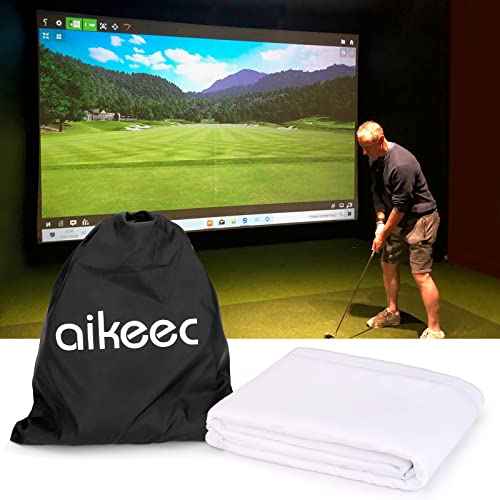

This guide looks only at the screen itself. Every pick below is a screen-only product, sold on Amazon US, and every pick sits under the five-hundred-dollar cap. That distinction matters, because the simulator market is full of complete enclosure kits, hitting nets, and bundled packages that include a frame, netting, and padding. A net catches balls; a screen catches balls and carries the projected image, so buying a net when you need a screen leaves you with nowhere to project the course.
The three screens here cover the main ways people build a budget simulator: a thick, heavy-duty screen for a do-it-yourself frame, a triple-layer screen built to soften impact noise, and a straightforward woven-polyester screen sized for a popular hitting-net setup.
Disclosure: As an Amazon Associate, we earn from qualifying purchases.
Quick Picks
Our Short List of 3

All 3 Picks at a Glance
| Product | Specs | Action |
|---|---|---|
| 1. aikeec Golf Simulator Impact Screen — Best for Heavy-Duty DIY Frame Builds | Check price on Amazon | |
| 2. Durbles Golf Simulator Impact Screen — Best for Quieter Impact and HD Projection | Check price on Amazon | |
| 3. GoSports Golf Simulator Impact Screen — Best for Compact Setups and Net Integration | Check price on Amazon |
In-Depth Reviews
1. aikeec Golf Simulator Impact Screen — Best for Heavy-Duty DIY Frame Builds
The aikeec is the workhorse of this roundup: a thick, single-purpose impact screen designed to be tied to a frame you build or buy yourself. The pinned variant is a 7 mm thickened screen, made from premium polyester, with reinforced edges and 32 grommet holes around the perimeter. That combination is aimed at golfers who hit real balls at full speed and want the screen to absorb the impact without tearing or sagging.
The variant to order is the 98 x 98 inch size. The listing sells several sizes on the same page, so pause on the size selector before checkout and confirm that the 98 x 98 inch option is selected. That square format suits a standard garage bay, and most simulator software can fill a square image area without letterboxing or cropping.
Thickness drives almost everything else about this screen. A 7 mm screen is substantially heavier and stiffer than the thin projection fabrics sold for movie nights, and that weight is doing real work: when a golf ball strikes, a thicker, denser weave spreads the force across more material. The listing describes the screen as an ultra-clear hitting screen, and the smooth, tight surface reflects the projector image cleanly, without the hot spots or texture that a loose or coarse fabric can introduce. The trade-off is that a thick screen arrives folded, and folded polyester holds creases that show on the projected image. The listing notes that creases can be eased by ironing the screen or flattening it under a heavy object before hanging.
The grommet layout is the second defining feature. Thirty-two grommets around a 98-inch square gives a tie-off point roughly every few inches, which matters more than it might sound. A screen held only at the corners will belly inward under impact and ripple between shots, and a rippling screen makes the projected image wobble. A screen tied at many points stays flat, and a flat screen stays readable. The intended mounting is a wall mount or a frame with bungee cords or ties threaded through the eyelets, and bungee cords are the usual choice, because they let the screen give slightly on impact and then pull it back flat. Bungee cords and frame materials are a separate purchase unless you already have them.
In use, the aikeec suits a permanent or semi-permanent bay. It needs a frame or wall area of similar size, with clearance behind it for the fabric to flex on impact; most builders leave a gap of a foot or more between the screen and the wall or netting behind it. The screen is listed for indoor, outdoor, and garage training, and the polyester construction is washable.
There are honest limitations. The aikeec is a screen, not a system: it ships without a frame, without side netting, and without the blackout material that keeps stray shots contained and ambient light off the image. If you hit a wild shot, the screen alone will not catch it, so side protection is something to plan separately. The screen is also square, which suits a 1:1 projector setting but does not match a widescreen 16:9 image without unused screen at the top and bottom. For the golfer who wants the thickest, most heavily grommeted screen in this roundup and is happy to build the frame around it, the aikeec is the natural first pick.
2. Durbles Golf Simulator Impact Screen — Best for Quieter Impact and HD Projection
The Durbles takes a different approach to the same problem. Where the aikeec leans on raw thickness, the Durbles leans on layers. It is a premium triple-layer impact screen, built from polyester, with an HD outer layer for the projected image, a sound-damping middle layer, and an impact-resistant inner layer. Each layer does a separate job: the outer layer carries the picture, the middle layer takes the noise out of the hit, and the inner layer takes the force. For a simulator in a living space or a basement under bedrooms, that middle layer matters most, because impact noise limits how often and how late you can practice.
The variant to order is the 8.2 x 8.2 foot triple-layer screen. As with the aikeec, the listing sells several sizes on the same page, so the size selector deserves a careful look before checkout. The 8.2 x 8.2 foot size is the square variant this review is based on: large enough to fill the projector image and catch the occasional mishit, small enough to fit a standard garage or spare room. The included components are listed as ball bungee cords and a carrying bag.
The triple-layer construction is worth explaining in plain terms, because it is easy to overstate what layers can do. A screen cannot make a golf ball silent, and no fabric will turn a driver strike into a whisper. What the layers do is change the character of the sound: a single thin layer tends to snap and crack on impact, while a layered screen tends to produce a duller thud, with less of the high-frequency crack that carries through walls and floors. The HD outer layer is the projection surface, and the listing describes it as delivering high-definition visuals, which in practice means a smooth, bright white face that holds the projector image without the texture or sheen that can wash out a picture.
Mounting follows the same pattern as the aikeec: grommets around the edge, bungee cords through the grommets, and a frame or enclosure to tie them to. The Durbles is listed as a screen for an enclosure and net, and it is also sold as a replacement screen for a Durbles enclosure kit, so it fits a standard enclosure frame as well as a DIY build.
The square format suits a 1:1 image setting, but it will not match a 16:9 image edge to edge. Most simulator software lets you set the aspect ratio to match the screen, so this is a configuration choice rather than a problem, but it is worth settling before the first session so the image is not stretched or cropped.
There are a couple of points to keep in mind. First, the Durbles is a screen-only product in this listing, even though the same brand sells a full enclosure kit under a different listing. Do not confuse the two: the screen listing includes the screen, bungee cords, and carrying bag, and it does not include a frame, netting, or padding. Second, the triple-layer build is heavier than a single-layer screen of the same size, so the frame or wall mounts need to be sturdy enough to hold it taut. A sagging screen is a blurry screen. For the golfer who practices in a shared house and wants the quietest impact and the cleanest projected image in this roundup, the Durbles is the pick that best fits.
3. GoSports Golf Simulator Impact Screen — Best for Compact Setups and Net Integration
The GoSports is the simplest and most compact of the three, and that simplicity is its strength. It is a high-density woven polyester impact screen, made to be hit with real golf balls and sized to fit the GoSports 7 x 7 foot ELITE Golf Net, with universal mounting options for a wall or a frame of your own. The variant to order is the 7 ft x 7 ft size, part number GOLF-SIMSCREEN-ELITE-7X7. The same listing also offers a 10 x 7 foot size, which is a different size of the same screen, not a separate product, so the 7 ft x 7 ft option is the one this review covers.
Seven feet square is the smallest screen in this roundup, and that is both its advantage and its limit. In a small garage, a basement corner, or a spare room where eight feet of width is hard to find, seven feet can be the difference between a simulator that fits and one that does not. The screen’s impact area is listed at approximately 79 x 80.5 inches, with overall dimensions of about 84 x 91.5 inches including the black borders, so the white projection area is slightly smaller than the nominal seven-foot size. That is normal for a screen with a border, and it means the projector image should be sized to the white area rather than the full fabric. The seven-foot nominal size and the roughly 79 x 80.5 inch impact area are the figures to plan around.
The construction is high-density woven polyester, a durable, tightly woven fabric that holds up to repeated ball strikes without the fraying or pilling that a looser weave can show. The screen is white, with black borders that frame the projected image and reinforce the edge. Mounting is by four grommets, one at each corner, which is fewer than the aikeec or the Durbles. Four corner grommets make for a quick hang, and the screen ships with four shock cords for exactly that purpose, but the screen is held at fewer points, so it needs to be hung taut and the frame needs to hold it square, with a small gap behind it for the fabric to flex.
The GoSports screen’s natural home is with the GoSports ELITE hitting net. The screen is designed to integrate with the 7 x 7 foot ELITE Golf Net, which is sold separately, and together the net and screen make a compact simulator bay: the net catches stray shots and contains the ball, while the screen carries the projected image. A golfer who already owns the ELITE net gets a screen made to fit it. The same white woven surface also works as a general projection screen for movies or presentations. The screen’s item weight of about 7.8 pounds makes it easy to take down and store.
The limitations are straightforward. Seven feet is compact, and a compact screen demands more accuracy: a badly mishit shot can miss the screen entirely, so side netting or a larger net behind it matters more here than with an eight-foot screen. The four-grommet mounting is quick but less forgiving of a loose hang, and the projector needs to be set to the white impact area, not the full fabric. Finally, the screen is a screen only: the projector, launch monitor, net, and frame are all separate purchases. For the golfer with a tight space, a GoSports ELITE net, or a first simulator build where simplicity and a small footprint matter more than maximum size, the GoSports is the right pick.
How to Choose
Choosing between three screen-only products comes down to four questions: how much space you have, how much noise you can tolerate, how you plan to mount the screen, and what shape your projector image will be.
Start with space. Measure the wall or frame area where the screen will hang, including the depth behind it: a screen needs clearance so the fabric can flex on impact without hitting a hard wall, and a foot of depth is a reasonable minimum. The GoSports at seven feet square fits the smallest rooms, the Durbles at 8.2 feet square fits a standard garage bay, and the aikeec at 98 inches square is the largest of the three and needs the most wall.
Next, think about noise. A simulator in a basement under a bedroom or a living room shared with family needs a quieter screen. The Durbles triple-layer build is the pick for noise-sensitive spaces, because its sound-damping middle layer takes the edge off the impact crack. The aikeec and GoSports are single-layer woven screens, and they will be louder on impact, though a bungee-mounted screen is quieter than a rigidly mounted one in every case, because the bungees let the fabric give.
Mounting is the third question, and it is the one most first-time builders underestimate. A screen is only as good as its hang: a loose screen ripples, a sagging screen blurs, and a screen held at too few points bellies on impact. The aikeec, with 32 grommets, is the most forgiving of a DIY frame. The Durbles, with grommets and included bungee cords, is a good middle ground. The GoSports, with four corner grommets, is the quickest to hang but demands the most precise frame. Whichever screen you choose, use bungee cords rather than rigid ties and keep the screen taut but not drum-tight.
Check the size selector before ordering: aikeec at 98 x 98 inches, Durbles at 8.2 x 8.2 feet, and GoSports at 7 ft x 7 ft under part number GOLF-SIMSCREEN-ELITE-7X7. Ordering a different size by mistake is the most common error in this category.
FAQs
What is the difference between a golf simulator screen and a hitting net?
A hitting net is designed to catch golf balls and stop them, and it does not need to carry a projected image. A simulator screen is designed to do both: it catches the ball and it provides a smooth, bright surface for the projector to paint the course onto. Some setups use both, with a net behind the screen to catch stray shots, but a net alone cannot replace a screen.
Can I hit real golf balls into these screens?
Yes, all three screens in this roundup are made to be hit with real golf balls. The aikeec is a 7 mm thickened polyester screen, the Durbles is a triple-layer screen with an impact-resistant inner layer, and the GoSports is a high-density woven polyester screen built for real ball impacts. The screens themselves are built for real balls at full speed.
Do I need a frame, or can I hang the screen on a wall?
You can hang a screen on a wall, but a frame is usually the better choice. A frame, whether bought or built from pipe or timber, holds the screen away from the wall and lets it give on impact, which is quieter, kinder to the fabric, and better for the projected image. The aikeec and Durbles suit a DIY frame, while the GoSports is designed to integrate with the GoSports ELITE net, which acts as its frame. Whichever route you choose, use bungee cords, keep the screen taut, and leave a gap behind it.
Will a square screen work with my projector?
Yes, in most cases. A square screen suits a 1:1 aspect ratio setting, which most simulator software supports, and a short-throw projector placed a few feet from the screen can fill a square image area cleanly. Check the aspect ratio setting in your simulator software before the first session, and size the projected image to the white impact area rather than the full fabric including borders.
Verdict
The best golf simulator screen under five hundred dollars depends on the room and the way you play. The aikeec is the pick for the builder who wants the thickest, most heavily grommeted screen and is happy to construct a frame around it. The Durbles is the pick for the golfer who practices in a shared house and wants the quietest impact and the cleanest projected image. The GoSports is the pick for the compact setup, the small room, and the golfer who already owns or plans to buy the GoSports ELITE net.
If only one screen had to be chosen for the widest range of home setups, the Durbles would be the recommendation: its triple-layer build addresses noise and image quality, the two things that matter most in a home simulator, and its 8.2-foot square size fits a standard garage bay. But the honest answer is that the right screen is the one that fits the room, the frame, and the projector you actually have. Measure the space, confirm the pinned variant before ordering, and spend what you save on the projector and launch monitor.
More from Amazon
Programs that pair well with the guide above. Offers and eligibility are set by Amazon and may change.
Free shipping on eligible items, Prime Video and more. Eligible new members can start with a free trial.
Start a Prime free trialA Prime membership for ages 18-24 with a trial period. Eligibility is set by Amazon.
See Prime for Young AdultsAudiobooks and podcasts to listen to on the go. Eligible new members can start with a free trial.
Try Audible freeAd-free music streaming. Eligible new subscribers can start with a free trial.
Try Music Unlimited freeAs an Amazon Associate we earn from qualifying purchases.