Key takeaways
- Compare the best battery tennis ball machines for solo practice, from lightweight app-controlled trainers to full-size hoppers. Runtime, speed, spin and weight compared.
A battery tennis ball machine turns an empty court into a practice partner. Instead of hunting for a hitting partner or waiting for a free court with a power outlet, you roll the machine into place, switch it on, and start grooving forehands, backhands, volleys, and overheads on your own schedule. Most public courts have no outlet nearby, which is exactly why battery power matters.

Battery machines vary enormously. Some run for two hours and weigh close to 40 pounds, while others fold into a backpack-sized unit. Speed, spin, ball capacity, and oscillation shape what kind of practice you get. A machine that only feeds flat balls at one speed stops helping you once your timing improves, while one with topspin, backspin, and random oscillation keeps challenging you for seasons.
This guide compares four battery tennis ball machines sold on Amazon: a classic full-size hopper, a metal-framed family machine, an all-in-one rolling bag launcher, and an ultralight app-controlled trainer. Each suits a different kind of player, so read the buying guide before you decide.
As an Amazon Associate, we earn from qualifying purchases.
Quick Picks
Our Short List of 3
- Battery: rechargeable 8.5 amp battery, 2 to 4 hours of runtime, charger included
- Ball capacity: 150 balls
- Ball speed: 10 to 70 mph
- Elevation: manual, 0 to 50 degrees
- Battery: battery powered, charger included, battery shipped separately and ordered as an optional module
- Playing time: 2 to 3 hours typical for the in-cage battery
- Ball capacity: 120 balls
- Ball speed: 10 to 120 km/h

- Battery: removable 6.6 Ah lithium-ion battery, up to 3.5 hours of runtime, charger included
- Ball capacity: up to 144 balls
- Ball speed: 10 to 45 mph
- Spin: topspin, increasing with speed
All 3 Picks at a Glance
| Product | Specs | Action |
|---|---|---|
| 1. Lobster Sports Elite Liberty Battery Operated Tennis Ball Machine |
| Check price on Amazon |
| 2. Spinshot Pro Tennis Ball Machine |
| Check price on Amazon |
| 3. Slinger Tennis Tournament Pack Ball Launcher |
| Check price on Amazon |
1. Lobster Sports Elite Liberty Battery Operated Tennis Ball Machine
- Battery: rechargeable 8.5 amp battery, 2 to 4 hours of runtime, charger included
- Ball capacity: 150 balls
- Ball speed: 10 to 70 mph
- Elevation: manual, 0 to 50 degrees
The Lobster Elite Liberty is the long-running classic of this category, and it remains the most proven battery machine in this roundup. It is built for beginners and intermediate players who want a full-size machine with real spin control, without an app or a complicated programming menu. You turn the knobs, set the speed, spin, elevation, and feed rate, and the machine does the rest.
Battery life is the headline feature for this angle. The rechargeable 8.5 amp battery delivers two to four hours of court time between charges, and the charger is included in the box. That runtime covers a normal solo session with room to spare, and the machine holds 150 balls, so you spend more time hitting and less time collecting. Ball speed runs from 10 to 70 mph, elevation adjusts manually from 0 to 50 degrees, and the feed rate can be set from 2 to 12 seconds between balls.
Key specs:
Pros:
Cons:
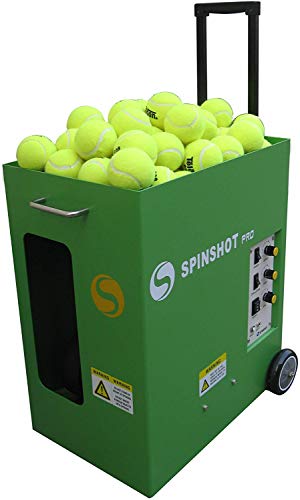
2. Spinshot Pro Tennis Ball Machine
- Battery: battery powered, charger included, battery shipped separately and ordered as an optional module
- Playing time: 2 to 3 hours typical for the in-cage battery
- Ball capacity: 120 balls
- Ball speed: 10 to 120 km/h
The Spinshot Pro is the family-friendly pick in this roundup, and it takes a different approach from the Lobster. Instead of a plastic body, it uses a metal chassis, and instead of an app, it uses simple knob controls that even children can operate. The manufacturer describes it as the best model for family use, and that positioning fits: every feature is controlled by a knob, with no phone pairing or programming menu standing between you and a rally.
The battery setup needs attention before you buy. The machine is battery powered and the charger is included, but the actual battery is shipped separately and is not included in the ball machine box. That means you need to order the battery module as an optional part, and you should confirm exactly which power module your listing includes before checkout. Once fitted, the in-cage battery typically gives two to three hours of playing time, with a charging time of about six hours. An optional AC module is also available if you sometimes practice near an outlet.
Key specs:
Pros:
Cons:
3. Slinger Tennis Tournament Pack Ball Launcher
- Battery: removable 6.6 Ah lithium-ion battery, up to 3.5 hours of runtime, charger included
- Ball capacity: up to 144 balls
- Ball speed: 10 to 45 mph
- Spin: topspin, increasing with speed
The Slinger is the most portable concept in this roundup, because it is not just a ball machine. It is a rolling gear bag with a ball launcher built in, so the same unit that feeds you balls also carries your rackets, balls, towel, and accessories to the court. If your main frustration is hauling gear from the parking lot, the Slinger solves the transport problem and the practice problem in one trip.
The Tournament Pack includes the Slinger Launcher, an oscillator, a remote control, and a charger. The lithium-ion battery lasts up to 3.5 hours, dropping to about 1.5 hours at maximum settings, and it charges in about five hours. The launcher holds up to 144 balls and feeds them at 10 to 45 mph with topspin that increases with speed. Feed intervals adjust from 2 to 7 seconds, and manual elevation runs from 10 to 40 degrees. Horizontal oscillation moves feeds across the court.
Key specs:
Pros:
Cons:
4. Nisplay L1 Smart Portable Tennis Ball Machine
The Nisplay L1 is the lightest machine in this roundup by a wide margin, and it is built for players who walk, cycle, or take public transport to the court. At only 13 pounds, it folds into a backpack-style unit with a shoulder strap. If weight is the reason you have avoided buying a ball machine, this is the pick that removes that obstacle.
Despite its size, the L1 is a proper battery machine with smart controls. A portable battery and charger are included in the box, and the battery delivers two to three hours of play. The Nisplay app controls ball speed up to 60 km/h, feed frequency from 1 to 9 seconds per ball, elevation from 15 to 55 degrees, and horizontal oscillation, with multiple pre-set training modes. A compact pocket-size remote is also included, so you can change speed, frequency, and oscillation without your phone.
Key specs:
- Battery: portable battery included, 2 to 3 hours of battery life, charger included
- Ball capacity: up to 50 balls
- Ball speed: up to 60 km/h
- Feed frequency: 1 to 9 seconds per ball
- Elevation: manual, 15 to 55 degrees
- Oscillation: horizontal
- Control: Nisplay app and pocket-size remote
- Weight: 13 lb
- Included: ball machine, ball basket, shoulder strap, portable battery, battery charger, user manual
- Awards: Red Dot Award 2024, iF Design Award 2025, IDEA Gold Award 2024
Pros:
- Lightest machine in this guide at 13 pounds, with a backpack-style carry design
- App and remote control with pre-set training modes
- Portable battery and charger included in the box
- Compact folded size suits small cars, bikes, and public transport
- Award-winning industrial design
Cons:
- Small 50-ball capacity means more frequent ball collection
- Lowest top speed in this roundup, best suited to beginners and intermediates
- Newer brand with a smaller long-term owner history than Lobster or Spinshot
- Battery runtime of two to three hours is shorter than the longest-running machines here
Battery Tennis Ball Machine Buying Guide
How much runtime do you really need?
Battery runtime is the first number to check, and it is also the number most likely to shrink in real use. Manufacturers quote runtime at moderate settings, and running at top speed with fast feeds drains the battery faster. The Slinger, for example, is rated up to 3.5 hours but closer to 1.5 hours at maximum settings. As a rule, look for at least two hours of rated runtime for a solo session, and three or more if you run long drills or share the machine with a partner. A removable battery is a bonus, because a spare pack effectively doubles your session without waiting for a recharge.
Weight and transport matter more than they look on paper
A 35-pound machine sounds manageable until you lift it into a tall trunk, carry it up stairs, or walk it across a large parking lot. Large wheels and a folding handle help a lot, which is why the Lobster and the Slinger both emphasize rolling transport. The Nisplay L1 is the only machine here you can genuinely carry on your shoulder. Before buying, measure your trunk and think about the walk from your car to your usual court. If that walk is long, weight should rank above top speed in your decision.
Speed, spin, and oscillation decide how long the machine stays useful
Top speed gets the attention, but spin range and oscillation decide whether the machine keeps challenging you. A machine with topspin and backspin, like the Lobster and the Spinshot Pro, lets you practice slice defense, high balls, and approach shots. Random oscillation moves you around the court instead of feeding the same ball to the same spot, which builds footwork as well as strokes. Buying a machine with spin and oscillation gives you room to grow without replacing the unit in a year.
Ball capacity sets your rhythm
Capacity decides how often you stop to collect balls. A 150-ball hopper like the Lobster supports long rally blocks, while a 50-ball hopper like the Nisplay means shorter, focused sets with more breaks. If you practice alone and dislike collecting balls, prioritize capacity. If you practice in short bursts, a smaller hopper is a fair trade for lighter weight.
Check what is actually in the box
The Lobster, Slinger, and Nisplay all include the battery and charger. The Spinshot Pro includes the charger but ships the battery separately, so you must order the battery module as well. Always confirm the battery, charger, remote, and oscillator situation on the listing before checkout, because those extras decide whether the machine works on battery power on day one.
Use pressureless balls and charge after every session
Pressureless tennis balls last far longer in ball machines than pressurized balls, which go soft quickly under repeated feeding. Keep the hopper clean, store the machine somewhere dry, and recharge the battery after every session rather than leaving it flat for weeks. A machine that sits unused for months is the one most likely to greet you with a dead battery.
Frequently Asked Questions
How long does a battery tennis ball machine last on one charge?
Most battery tennis ball machines run for two to four hours on a full charge at moderate settings. The Lobster Elite Liberty is rated at two to four hours, the Slinger at up to 3.5 hours, the Spinshot Pro at two to three hours, and the Nisplay L1 at two to three hours. Running at top speed with fast feeds shortens runtime, so treat the rated figure as a best case rather than a guarantee.
Can I use a battery tennis ball machine on any court?
Yes, in most cases. Battery machines are designed for hard courts, clay, and other standard surfaces, and their wheels handle the trip from the car to the baseline. Check that your court allows ball machines, since some clubs restrict them during busy hours, and avoid wet courts, which can damage the electronics and make balls slippery.
Do I need a remote control?
A remote is useful but not essential. It lets you stop and start the feed from the baseline without walking back to the machine, which keeps your rhythm during drills. The Slinger Tournament Pack and the Nisplay L1 include a remote, the Spinshot Pro offers a watch remote as an optional extra, and the Lobster Elite Liberty remote depends on the listing, so confirm before ordering.
What kind of tennis balls should I use in a ball machine?
Pressureless tennis balls are the standard recommendation for ball machines. They keep their bounce far longer than pressurized balls under repeated feeding, and they are cheaper to replace in bulk. Avoid wet or damaged balls, which can jam the feed mechanism.
Is a battery machine better than a plug-in machine?
A battery machine is better when you practice at public courts without nearby outlets, which covers most casual players. A plug-in machine can run indefinitely, but it ties you to a power source and a cable across the court. If you always practice at a club with outlets beside the court, a plug-in model is worth considering, but for most solo players the freedom of battery power wins.
Conclusion
The best battery tennis ball machine is the one that matches how you actually practice. The Lobster Elite Liberty is the safest all-round choice, with a 150-ball hopper, two to four hours of battery life, and real topspin and backspin control in a proven design. The Spinshot Pro suits families and players who want simple knob controls and a metal frame, as long as you remember that the battery is ordered separately. The Slinger Tournament Pack is the pick for portability and convenience, rolling your gear and your practice partner to the court in one unit, with a lower top speed as the trade-off. The Nisplay L1 is the lightest option by far and the easiest to carry, ideal for beginners and players who walk to the court, with a smaller hopper and lower top speed to match.
Start with runtime and weight, then check speed, spin, and what is included in the box. Get those four decisions right, and any of the machines above can give you seasons of solo practice without ever needing a hitting partner or a power outlet.
More from Amazon
Programs that pair well with the guide above. Offers and eligibility are set by Amazon and may change.
Free shipping on eligible items, Prime Video and more. Eligible new members can start with a free trial.
Start a Prime free trialA Prime membership for ages 18-24 with a trial period. Eligibility is set by Amazon.
See Prime for Young AdultsAudiobooks and podcasts to listen to on the go. Eligible new members can start with a free trial.
Try Audible freeAd-free music streaming. Eligible new subscribers can start with a free trial.
Try Music Unlimited freeAs an Amazon Associate we earn from qualifying purchases.