Our Short List of 3

- Best for: Owners who want a simple analog load tester for 6V and 12V cells.
- 100A load tester and voltmeter
- 6V and 12V batteries up to 1000 cranking amps
- 50-amp load test for 6V, 100-amp load test for 12V
- Charging-system diagnosis and starter-motor test

- Best for: Owners of 12V carts who want digital readouts and a clear Good or Bad verdict.
- 12V lead-acid batteries only
- 100–2000 CCA
- SOH, SOC, voltage, current, rating
- Battery, cranking and charging tests
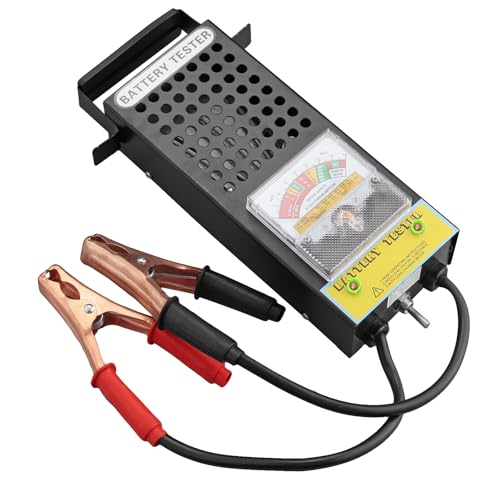
- Best for: 48V carts with six 8V cells — the only pick here that load-tests an 8V cell.
- 100AMP load tester for 6V/8V/12V/16V lead-acid batteries
- Voltage accuracy ±0.2V
- Analog pointer display
- Insulated carry handle
All 5 Picks at a Glance
| Product | Specs | Action |
|---|---|---|
| Schumacher BT-100 100A Battery Load Tester and Voltmeter |
| Check price on Amazon |
| TOPDON BT100 Car Battery Tester 12V Load Tester |
| Check price on Amazon |
| AUTTGINN Battery Load Tester, 100AMP 6V/8V/12V/16V |
| Check price on Amazon |
 Mighty Max Battery Golf Cart / Deep Cycle Battery Hydrometer Tester |
| Check price on Amazon |
 Frienda Golf Cart Battery Meter with Alarm, DC 12V–84V |
| Check price on Amazon |
Key takeaways
- Compare the 5 best battery testers for golf carts — load testers, a hydrometer, and a panel meter — matched to 6V, 8V, and 12V cells for 36V and 48V packs.
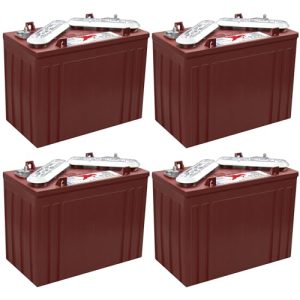
A golf cart that slows on hills or dies halfway around the course usually has one weak cell, not a dead pack. A 36 volt pack is six 6 volt cells, a 48 volt pack is six 8 volt cells or four 12 volt batteries, and a single tired cell drags the whole pack down. The right tester finds that cell before it strands the cart, and it tells the owner whether the fix is one battery or a full set.
The testers in this guide work in three different ways, and the difference matters. A load tester applies a load to one cell and watches how its voltage holds. A hydrometer reads the density of the electrolyte inside each cell. A panel meter sits on the dash and reads the whole pack at rest. No pick here load-tests a whole 36 or 48 volt pack — load testers test individual cells, and the panel meter reads the pack as a whole.
Quick Picks
As an Amazon Associate we earn from qualifying purchases
| Product | Best for | Key spec from title |
|---|---|---|
| Schumacher BT-100 | Classic analog load testing | 100A load tester and voltmeter |
| TOPDON BT100 | Digital 12V testing with health readouts | 12V load tester, 100-2000 CCA |
| AUTTGINN 100AMP | The only pick that tests 8V cells | 100AMP tester for 6V/8V/12V/16V |
| Mighty Max Hydrometer | Testing each cell by electrolyte density | Hydrometer, specific gravity 1.100-1.300 |
| Frienda Battery Meter | Always-on dash monitor for the whole pack | DC 12V-84V meter with low-battery alarm |
How to Choose
Know Your Pack Before You Pick a Tester
The first step is counting the cells in the cart, because the tester must match the cell voltage. A 36 volt pack is six 6 volt cells, a 48 volt pack is six 8 volt cells, and some 48 volt carts run four 12 volt batteries instead. The Schumacher tests 6 and 12 volt cells, the TOPDON tests 12 volt batteries only, and the AUTTGINN is the only pick here that covers 8 volt cells. Buy the tester that matches the cells in the cart, not the pack voltage, and check the battery labels before ordering.
Load Testers, Hydrometers, and Panel Meters
These three tools answer different questions, and mixing them up leads to the wrong purchase. A load tester applies a known load to one cell and watches whether its voltage holds under that load, which shows a weak cell directly. A hydrometer draws electrolyte from one cell and reads its specific gravity, which shows the state of charge in that cell. A panel meter mounts on the dash and reads the whole pack’s voltage and capacity percentage at rest. A load tester and a hydrometer diagnose cells; a panel meter monitors the pack.
Analog or Digital Readouts
Two of the load testers here read on an analog pointer gauge, and one reads on a digital screen. The Schumacher BT-100 uses an analog gauge, and the AUTTGINN uses an analog pointer display per its listing. The TOPDON BT100 uses a 2-inch backlit screen plus Good, Charge, and Bad LEDs, and it reports state of health, state of charge, voltage, current, and rating. An analog gauge is simple and needs no batteries of its own, while a digital screen gives exact numbers and a clear verdict. Pick the readout that is easiest to read in the garage.
What a Tester Cannot Tell You
Every tester has a limit, and knowing it saves a wasted purchase. A panel meter cannot diagnose a single cell: it reads the whole pack at rest, so a weak cell can hide behind five healthy ones. A 12 volt only tester cannot test a 6 volt or 8 volt cell at all, which rules out the TOPDON for most 36 and 48 volt carts built from small cells. A hydrometer cannot test a sealed battery, because it needs open caps and accessible electrolyte. Match the tool to the question being asked, and use a second method when the first one leaves doubt.
The 5 Best Options
Schumacher BT-100 100A Battery Load Tester and Voltmeter
- Best for: Owners who want a simple analog load tester for 6V and 12V cells.
- 100A load tester and voltmeter
- 6V and 12V batteries up to 1000 cranking amps
- 50-amp load test for 6V, 100-amp load test for 12V
- Charging-system diagnosis and starter-motor test
Owners who want a simple analog load tester for 6V and 12V cells.
This tester covers 6V and 12V only — it cannot load-test an 8V cell.
The Schumacher BT-100 is the classic analog load tester in this guide, and it has been around long enough to be a familiar sight in garages. It is a 100 amp load tester and voltmeter for 6 volt and 12 volt batteries up to 1000 cranking amps, with a 50 amp load test for 6 volt and a 100 amp load test for 12 volt. It also handles charging-system diagnosis and a starter-motor test, and its analog gauge and copper plated steel clamps are built for repeated use. The listing states it is not discontinued by the manufacturer, and it has been available since September 2003.
Watch out for: This tester covers 6V and 12V only — it cannot load-test an 8V cell.
TOPDON BT100 Car Battery Tester 12V Load Tester
- Best for: Owners of 12V carts who want digital readouts and a clear Good or Bad verdict.
- 12V lead-acid batteries only
- 100–2000 CCA
- SOH, SOC, voltage, current, rating
- Battery, cranking and charging tests
Owners of 12V carts who want digital readouts and a clear Good or Bad verdict.
12V only — it cannot test an individual 6V or 8V golf-cart cell, and it does not load-test a whole 36V or 48V pack.
The TOPDON BT100 is the digital tester in this guide, and it gives the most information per test. It covers 12 volt lead-acid batteries from 100 to 2000 CCA, and it reports state of health, state of charge, voltage, current, and rating, plus battery, cranking, and charging tests. It works with regular flooded, AGM flat plate and spiral, EFB, and GEL batteries, and it shows results on a 2-inch backlit screen with Good, Charge, and Bad LEDs. At 9 ounces and 5.3 by 3 by 1 inches, it is the lightest tool here, and its listing names golf carts among its compatible devices.
Watch out for: 12V only — it cannot test an individual 6V or 8V golf-cart cell, and it does not load-test a whole 36V or 48V pack.
AUTTGINN Battery Load Tester, 100AMP 6V/8V/12V/16V
- Best for: 48V carts with six 8V cells — the only pick here that load-tests an 8V cell.
- 100AMP load tester for 6V/8V/12V/16V lead-acid batteries
- Voltage accuracy ±0.2V
- Analog pointer display
- Insulated carry handle
48V carts with six 8V cells — the only pick here that load-tests an 8V cell.
Do not run an 8V test longer than 10 seconds; smoke may appear during initial use per the listing.
The AUTTGINN is the only tester in this guide that covers 8 volt cells, the key pick for most 48 volt carts, which commonly run six 8 volt cells. It is a 100 amp load tester for 6, 8, 12, and 16 volt lead-acid batteries, with voltage accuracy of plus or minus 0.2 volts and an analog pointer display per the listing. It has an insulated carry handle and copper-plated steel clamps with a rubber grip, and its cable is 24 cm, about 9.45 inches. The listing warns that an 8 volt test must not run longer than 10 seconds, and that smoke may appear during initial use.
Watch out for: Do not run an 8V test longer than 10 seconds; smoke may appear during initial use per the listing.
Mighty Max Battery Golf Cart / Deep Cycle Battery Hydrometer Tester
- Best for: Owners of flooded batteries who want to check every cell by hand.
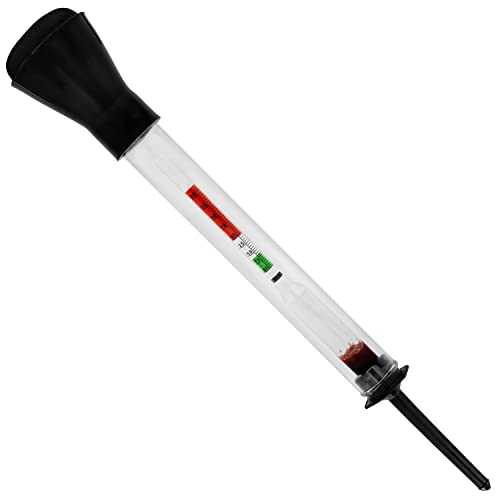
- Battery hydrometer / acid tester, electrolyte density checker
- Specific-gravity range 1.100–1.300
- Color-coded float scale
- Clear plastic tube
Owners of flooded batteries who want to check every cell by hand.
Flooded lead-acid batteries with removable caps only — it cannot test sealed AGM, gel, or lithium batteries.
The Mighty Max hydrometer tests a cell the old-fashioned way: by reading the density of the electrolyte inside it. It draws fluid from one cell at a time and reads specific gravity from 1.100 to 1.300 on a color-coded float scale, through a clear plastic tube with a suction bulb. At 29.21 by 5.08 by 5.08 cm and 68.04 grams, it is a simple hand tool with no electronics to fail. A hydrometer finds a weak cell that a whole-pack voltage reading can hide, because it checks each cell on its own.
Watch out for: Flooded lead-acid batteries with removable caps only — it cannot test sealed AGM, gel, or lithium batteries.
Frienda Golf Cart Battery Meter with Alarm, DC 12V–84V
- Best for: Owners who want an always-on dash gauge for whole-pack voltage and capacity.
- DC battery meter for 12V, 24V, 36V, 48V, 60V, 72V, 84V
- Tests battery capacity percentage AND voltage value
- LCD display, green backlight
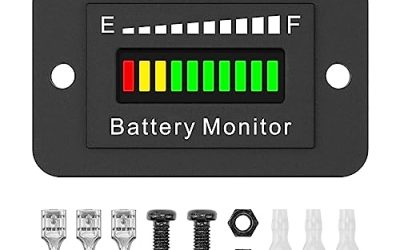
- Front setting and switch keys
Owners who want an always-on dash gauge for whole-pack voltage and capacity.
This is a panel-mount monitor, not a load tester — it reads the pack at rest and cannot diagnose a single cell.
The Frienda is the panel meter in this guide, and it plays a different role from the other four picks. It mounts on the dash and reads the whole pack at rest, showing battery capacity percentage and voltage value on an LCD display with a green backlight. It covers DC 12, 24, 36, 48, 60, 72, and 84 volts, and it has a low-battery alarm that flashes when capacity falls below 20 percent, plus a 10-second sleep mode. It offers lead-acid and lithium-ion settings, and it must be set to the correct battery type or the percentage reading will be wrong.
Watch out for: This is a panel-mount monitor, not a load tester — it reads the pack at rest and cannot diagnose a single cell.
Which One Fits Your Situation
Your Cart Has Six 8V Cells
Most 48 volt carts run six 8 volt cells, and only one tester here covers them. The AUTTGINN load-tests 6, 8, 12, and 16 volt cells, so it can check each 8 volt cell under load and find the weak one. Keep each 8 volt test under 10 seconds, as the listing warns, and expect possible smoke on first use. The Schumacher cannot test 8 volt cells, the TOPDON is 12 volt only, and the hydrometer needs open caps.
Your Cart Runs Four 12V Batteries
A 48 volt cart built from four 12 volt batteries is the TOPDON’s home ground. Its digital screen reports state of health, state of charge, voltage, current, and rating for each 12 volt battery, with a Good, Charge, or Bad verdict on the LEDs. The Schumacher also tests 12 volt cells with its analog gauge, and the AUTTGINN covers 12 volt cells too. Test each battery on its own, and replace the weak one rather than the whole set.
You Want to Check Every Cell by Hand
A hydrometer is the tool for a manual check of each cell. The Mighty Max draws electrolyte from one cell at a time and reads its specific gravity on a color-coded float, which shows the state of charge in that cell directly. It only works on flooded lead-acid batteries with removable caps, so sealed AGM, gel, and lithium packs are out. For a flooded pack, no other tool here shows each cell as plainly.
You Want a Gauge on the Dash
The Frienda meter is the pick for an owner who wants to see the pack’s state every time the cart runs. It mounts on the dash and shows capacity and voltage, with a low-battery alarm that flashes below 20 percent. It covers 12 through 84 volts, so it suits 36 and 48 volt packs. It reads the whole pack at rest, so it cannot point at a weak cell — use a load tester or hydrometer for that job.
Common Mistakes
- Testing the whole pack voltage and assuming every cell is healthy — one weak cell hides behind five good ones.
- Buying a 12V-only tester for a cart built from 6V or 8V cells.
- Calling the Frienda panel meter a load tester — it monitors the pack at rest and cannot diagnose a cell.
- Using a hydrometer on a sealed AGM, gel, or lithium battery, which has no accessible electrolyte.
- Running an 8V load test longer than 10 seconds on the AUTTGINN, against the listing warning.
Frequently Asked Questions
How do I find a bad cell in a 48V golf cart pack?
Test each cell on its own, not the pack. A load tester like the AUTTGINN applies a load to one cell at a time and shows whether its voltage holds, which points straight at the weak cell. A hydrometer like the Mighty Max reads the specific gravity of each cell’s electrolyte. A panel meter reads the whole pack at rest, so it cannot find a single bad cell.
Can a 12V tester check a 6V golf cart battery?
No. A tester built for 12 volt batteries, like the TOPDON BT100, cannot test a 6 volt or 8 volt cell. A 36 volt cart is six 6 volt cells, so a 12 volt tester has nothing to work with. Use a tester that covers the cell voltage in the cart: the Schumacher handles 6 and 12 volt cells, and the AUTTGINN handles 6, 8, 12, and 16 volt cells.
Do I need a hydrometer for lithium golf cart batteries?
No. A hydrometer reads the density of liquid electrolyte, and lithium batteries have no accessible electrolyte to draw. The Mighty Max hydrometer in this guide is for flooded lead-acid batteries with removable caps only. For a lithium pack, use a digital tester or a panel meter with a lithium setting, like the Frienda, and set the battery type correctly before trusting the reading.
What does a low-battery alarm on a panel meter mean?
On the Frienda meter, the low-battery alarm flashes the display when the pack’s capacity falls below 20 percent. It warns to charge the cart; it does not diagnose a cell. The meter reads the whole pack at rest, so a low reading can come from a weak cell or from a pack that simply needs charging. Check the cells with a load tester or hydrometer before replacing anything.
More from Amazon
Programs that pair well with the guide above. Offers and eligibility are set by Amazon and may change.
Free shipping on eligible items, Prime Video and more. Eligible new members can start with a free trial.
Start a Prime free trialA Prime membership for ages 18-24 with a trial period. Eligibility is set by Amazon.
See Prime for Young AdultsAudiobooks and podcasts to listen to on the go. Eligible new members can start with a free trial.
Try Audible freeAd-free music streaming. Eligible new subscribers can start with a free trial.
Try Music Unlimited freeAs an Amazon Associate we earn from qualifying purchases.