Our Short List of 3

- https://www.amazon.com/dp/B07Q2FQB33

- https://www.amazon.com/dp/B07NPV45VM

- https://www.amazon.com/dp/B08KNZ7HNW
All 4 Picks at a Glance
| Product | Specs | Action |
|---|---|---|
| FORM 36 Volt Golf Cart Battery Charger for EZGO TXT |
| Check price on Amazon |
| MODZ Max48 15 AMP EZGO RXV & TXT 48 Battery Charger |
| Check price on Amazon |
| Lester Summit Series II 650W Golf Cart Battery Charger (Performance Plus Carts) |
| Check price on Amazon |
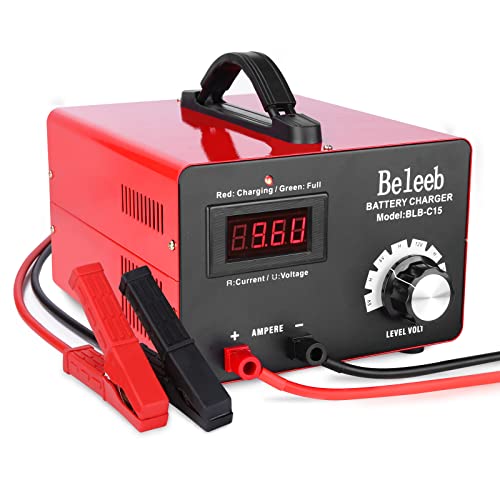 Beleeb C15 Multiple Voltage Battery Charger |
| Check price on Amazon |
Key takeaways
- Chargers for 6 volt golf cart batteries compared: 36V and 48V pack chargers for carts built on 6V batteries, plus 6V smart chargers for single batteries.
Shopping for a charger for 6 volt golf cart batteries starts with a clarification that decides everything else: almost nobody charges a 6 volt golf cart battery on its own while it is in the cart. A golf cart battery is one building block in a series-wired pack. Six 6 volt batteries wired in series make a 36 volt pack, and eight 6 volt batteries make a 48 volt pack. The charger that plugs into the cart has to match the pack voltage, not the voltage printed on any single battery. A charger sold as a “36 volt charger” is, in a cart built on 6 volt batteries, exactly a charger for 6 volt golf cart batteries — it simply charges all six of them at once, through the cart’s charge port, as one unit.
That leaves two genuinely different charging jobs, and this guide covers both. The first is whole-pack charging: a 36V or 48V golf cart charger with the correct plug for your cart’s charge receptacle. The second is single-battery charging: a charger with a true 6 volt mode, connected directly to one battery’s terminals with clamps. Single-battery charging matters when one battery in the pack has fallen behind the others, when a spare battery needs maintenance on the shelf, or when a pack is being brought back gradually after long storage. Confusing the two jobs is the most common buying mistake in this category — a 6V bench charger cannot charge a 36V pack through the cart port, and a 48V pack charger should never be clamped onto a single 6 volt battery.
As an Amazon Associate we earn from qualifying purchases.
Confirm Your Pack Voltage Before Anything Else
Count the batteries under the seat and do the simple multiplication. Six batteries at 6 volts each means a 36 volt system; eight means 48 volts. If the count does not line up, check the voltage stamped on each battery case, because some 48 volt carts run six 8 volt batteries or four 12 volt batteries instead, and those packs need the same 48V charger but behave differently at the individual-battery level. The individual-battery advice in this guide applies only when your batteries really are 6 volt units.
Next, identify the charge plug. Golf cart chargers are not interchangeable across brands because the DC plug has to match the cart’s receptacle: EZGO TXT models commonly use a two-pin D-style Powerwise plug, EZGO RXV and TXT 48 models use a three-pin plug, Club Car DS and Precedent models use a three-pin round plug, and Yamaha models use their own two- or three-pin styles. A charger with the right voltage and the wrong plug is a return waiting to happen, so match the plug shape in the listing photos to your receptacle before ordering.
Finally, note the battery chemistry. Most 6 volt golf cart batteries are flooded lead-acid deep-cycle batteries that need periodic watering. Some chargers below are built only for flooded lead-acid packs, while others carry selectable profiles for AGM, gel, and lithium conversions. A lithium-converted cart should never be charged on a flooded-only profile, so chemistry support is a hard filter, not a nice extra.
How to Judge a Pack Charger
Output current. Pack chargers for these carts typically deliver somewhere in the mid-teens of amps. Higher output shortens the bulk-charging phase on a deeply discharged pack; lower output is gentler but slower. For a cart used daily and charged overnight, anything in the normal range for this category finishes well before morning. Output matters more for carts that must turn around between morning and afternoon rounds.
Charge profile and float behaviour. A modern smart charger runs a staged profile — bulk, absorption, then a float or maintenance stage — and either shuts off cleanly or holds the pack at a safe float voltage. Float behaviour is what makes “plug it in and leave it” safe during the off-season. Older transformer-style chargers that rely on a timer or simple shutoff demand more attention from the owner.
Voltage flexibility. Some chargers auto-detect or can be configured for both 36V and 48V packs. That flexibility is valuable for households or small fleets running carts of both voltages, and it protects the purchase if you change carts later.
Build and placement. Chargers live in garages, barns, and cart sheds. A sealed or weather-resistant housing, a metal case that sheds heat, and cables long enough to reach from a wall outlet to the cart all matter in daily use. Weight matters too if the charger travels with the cart rather than living on a shelf.
The Pack Chargers
FORM 36 Volt Golf Cart Battery Charger for EZGO TXT
- https://www.amazon.com/dp/B07Q2FQB33
The FORM charger is the straightforward pick for the classic 36 volt setup: six 6 volt batteries in an EZGO TXT, charged as a pack through the cart’s D-style receptacle. The listing describes an 18 amp output at 36 volts, lead-acid charging, and a waterproof housing design, with the D-style plug that TXT and Medalist-era carts use. For an owner whose cart matches that plug and whose pack is flooded lead-acid, this is the direct replacement format: plug into the cart, plug into the wall, and let the charger run the pack back up after a day’s use. As with any plug-specific charger, the D-style connector is the whole compatibility story — it suits EZGO TXT carts and does not adapt to Club Car or Yamaha receptacles.
MODZ Max48 15 AMP EZGO RXV & TXT 48 Battery Charger
- https://www.amazon.com/dp/B07NPV45VM
The Max48 covers the other classic 6 volt configuration: eight 6 volt batteries forming a 48 volt pack in an EZGO RXV or TXT 48. Golf Cart King’s listing describes a 15 amp charger with an internal microprocessor that adjusts charging to real-time pack voltage and ambient temperature, plus a smart float mode intended to let owners leave the cart plugged in without overcharging or draining the pack. The aluminium case keeps the unit to roughly seven pounds, far lighter than the transformer chargers these carts originally shipped with, and the maker backs it with an 18-month limited warranty. One firm limit from the listing: the Max48 is for flooded lead-acid batteries from reputable golf cart battery brands, and the maker states it is not compatible with lithium, sealed lead-acid, gel, or AGM batteries. Owners who have converted a 48V cart to lithium should look at the Lester below instead.
Lester Summit Series II 650W Golf Cart Battery Charger (Performance Plus Carts)
- https://www.amazon.com/dp/B08KNZ7HNW
The Summit Series II is the flexible, fleet-grade option. Lester’s own data sheet for the 650W Summit II family describes automatic detection and adjustment across 36V and 48V packs, with maximum output of 18 amps at 36 volts and 13.5 amps at 48 volts, and charge profiles for flooded, AGM, and gel lead-acid as well as lithium-ion packs. The Amazon listing sold by Performance Plus Carts ships the charger with a Club Car three-pin moulded plug and an 8.5-foot DC cord, and adds Bluetooth monitoring through the ChargerConnect app, so charge status can be checked from a phone instead of by walking to the cart. Lester also lists the design as compliant with California Energy Commission and Department of Energy efficiency requirements. For a household running both a 36V cart on six 6 volt batteries and a 48V cart on eight, one Summit II can serve both, provided the plug and any needed cord sets match each cart. Buyers with EZGO or Yamaha carts should confirm the plug variant on the listing before ordering, since the charger is sold in several connector configurations.
Charging a Single 6 Volt Battery
Whole-pack charging keeps a healthy pack balanced, but packs do not always age evenly. If a voltmeter shows one 6 volt battery reading noticeably lower than its neighbours after a full pack charge — a rested, fully charged 6 volt flooded battery should read roughly 6.3 to 6.4 volts — that battery may benefit from individual attention, and it is certainly a candidate for a load test or replacement. Single-battery charging is also the right tool for a spare battery stored off the cart, and for the first, gentle charge of a new battery before it joins a pack.
Two cautions apply. First, never connect a pack charger to one battery: a 36V or 48V output into a single 6 volt battery is a serious overcharge. Second, an individual charge can mask a failing battery for a while, but it cannot restore lost capacity. If one battery repeatedly falls behind after individual charging, replacement of that battery — or, on an old pack, the full set — is the honest fix.
NOCO GENIUS10 10A Smart Battery Charger
The GENIUS10 is the polished single-battery option. NOCO’s listing describes a 10 amp smart charger with dedicated 6 volt and 12 volt modes for lead-acid batteries — flooded, AGM, gel, and deep-cycle included — and support for batteries up to 230 amp-hours, which comfortably covers the capacity class of a typical 6 volt golf cart battery. It adds an integrated thermal sensor for temperature-compensated charging, a desulfator function, spark-proof and reverse-polarity protection, and a force mode for batteries that have fallen too low for a standard charger to detect. The box includes clamps and integrated eyelet terminals, so it can be clipped on for a session or semi-permanently mounted for a stored spare. Ten amps into a large deep-cycle battery is a slow, gentle charge rather than a quick one, which suits recovery and maintenance work. Note that the lithium mode and the repair mode on this unit are 12 volt functions per the listing; for a 6 volt flooded golf cart battery, the plain 6 volt mode is the correct setting.
- https://www.amazon.com/dp/B07W3QT226
Beleeb C15 Multiple Voltage Battery Charger
- https://www.amazon.com/dp/B0B8NT3N8K
The Beleeb C15 is built almost exactly around the individual golf cart battery use case. Its listing describes selectable output for 6V, 8V, 12V, and 24V batteries at up to 15 amps, covering lead-acid and LiFePO4 types, with a desulfator function and a mode the maker aims at golf cart batteries. The 8 volt setting is a genuine differentiator: owners whose 48V pack turns out to be six 8 volt batteries rather than eight 6 volt ones can still charge a single battery from that pack with the same unit, which no 6V-only charger can do. Fifteen amps is also a brisker rate for a large single battery than the GENIUS10’s ten. The trade-off is that this is a clamp-on bench charger with manual voltage selection, so the owner must set the correct voltage before connecting — selecting 12V or 24V for a single 6 volt battery would badly overcharge it. Careful owners who value the multi-voltage flexibility get a lot of utility here; anyone who prefers a set-and-forget unit should lean toward the NOCO.
Habits That Make Any Charger Work Better
Charge after each day’s use rather than letting the pack sit discharged; lead-acid batteries sulfate when left low, and sulfation is the slow death of most golf cart packs. Check electrolyte levels in flooded batteries regularly and top up with distilled water, filling to the maker’s mark after charging rather than before, so the electrolyte does not overflow as it expands. Keep terminals clean and tight, since a corroded connection can make a good charger look faulty and can leave one battery chronically undercharged. Charge in a ventilated space, because flooded batteries vent hydrogen gas while charging, and keep sparks and flames away from the battery compartment. During winter storage, either leave a smart charger with a proper float stage connected or recharge the pack periodically through the season; a pack stored flat rarely recovers fully. Finally, measure individual battery voltages a few times a season. The spread between the strongest and weakest battery is the earliest warning that a pack is drifting out of balance, and catching it early is what single-battery chargers are for.
Frequently Asked Questions
Can I charge a 36 volt pack with a 48 volt charger, or the reverse?
No. The charger must match the pack voltage. A 48V charger on a 36V pack will overcharge it, and a 36V charger will never bring a 48V pack to full charge. Dual-voltage units such as the Summit Series II are the exception because they detect or are configured for the pack they are connected to.
How long does a full charge take?
It depends on pack capacity, depth of discharge, and charger output, but an overnight window is the normal expectation for the pack chargers in this guide. A single 6 volt battery on a 10 to 15 amp bench charger likewise takes hours, not minutes.
My cart has six batteries. Is it 36 volts?
Only if each battery is a 6 volt unit. Six 8 volt batteries make a 48 volt pack. Read the voltage on the battery case before choosing a charger or using the single-battery settings described above.
Should I leave the cart plugged in between uses?
With a smart charger that has a genuine float or maintenance stage, yes — that is what the float stage is designed for. With an older charger that simply runs until a timer or basic shutoff stops it, unplug once charging completes.
One battery reads lower than the rest. Should I just charge it separately?
An individual charge is a reasonable first step and a useful diagnostic. If the same battery falls behind again after being brought up on its own, it is failing, and replacing it — or the full set, if the pack is old — is the durable answer.
Bottom Line
For a 36 volt EZGO TXT running six 6 volt batteries, the FORM 36V charger is the direct, plug-matched pack charger. For a 48 volt EZGO running eight 6 volt batteries on flooded lead-acid, the MODZ Max48 adds microprocessor control and a leave-it-plugged-in float mode. For mixed fleets, lithium conversions, or app-monitored charging, the Lester Summit Series II covers 36V and 48V packs with selectable chemistry profiles. And for the second job — the individual 6 volt battery on the bench — the NOCO GENIUS10 offers the most automated 6 volt charging, while the Beleeb C15 offers higher output and an 8 volt mode for packs built differently. Match the charger to the job, the pack voltage, the plug, and the chemistry, and a set of 6 volt batteries will give the long service it was built for.
More from Amazon
Programs that pair well with the guide above. Offers and eligibility are set by Amazon and may change.
Free shipping on eligible items, Prime Video and more. Eligible new members can start with a free trial.
Start a Prime free trialA Prime membership for ages 18-24 with a trial period. Eligibility is set by Amazon.
See Prime for Young AdultsAudiobooks and podcasts to listen to on the go. Eligible new members can start with a free trial.
Try Audible freeAd-free music streaming. Eligible new subscribers can start with a free trial.
Try Music Unlimited freeAs an Amazon Associate we earn from qualifying purchases.