Key takeaways
- Compare Trojan T-1275 12V batteries in 4-pack and 6-pack sets for golf carts, with voltage, capacity, and maintenance notes to pick the right bank today.
A golf cart that crawls up hills or fades before the round ends usually has a battery problem, not a motor problem. Voltage decides what the cart can do: a 48-volt bank built from four 12-volt batteries is the standard setup on many popular carts, and the wrong voltage or a weak set turns a capable cart into a slow one. Picking the right 12-volt batteries means matching voltage, capacity, and physical size to the cart, then keeping the bank watered and charged so it lasts.


This guide covers two listings of the same battery, the Trojan T-1275, sold as a pack of four and a pack of six. Both are 12-volt flooded lead-acid units rated at 150 amp-hours, so the choice comes down to how many batteries your cart needs and whether you want spares on hand. Read the voltage math first, confirm your cart takes 12-volt units, and the decision gets simple. Match the voltage first, then the capacity.
Quick Picks
As an Amazon Associate we earn from qualifying purchases
| Product | Best for | Key spec from title |
|---|---|---|
| Trojan T-1275 12V 150Ah, Pack of 4 | Building a standard 48V golf cart bank | 12V, 150Ah flooded lead-acid |
| Trojan T-1275 12V 150Ah, Pack of 6 | A 72V bank or a 48V set plus spares | 12V, 150Ah flooded lead-acid |
How to Choose
Get the Voltage Math Right
Golf cart voltage is set by wiring batteries in series, so the pack count matters as much as the battery itself. Four 12-volt batteries wired in series make a 48-volt bank, which is the standard setup on carts such as the EZGO RXV, the Club Car Precedent from 2004 through mid-2008, and the Yamaha Drive G29. Six 12-volt batteries make a 72-volt bank, or they can serve as a 48-volt set with two spares on the shelf. Count your cart’s battery bays and check the existing bank voltage before ordering, because a pack that does not match your cart’s system will not work. A look at the battery bays and wiring tells you the count in a minute.
Capacity and Range on a Charge
Capacity, measured in amp-hours, decides how far the cart runs before the bank needs charging. The Trojan T-1275 is rated at 150 amp-hours at the 20-hour rate, which is a solid figure for a flooded lead-acid golf cart battery. A higher amp-hour rating means more runtime per charge, all else equal, but it also means a heavier battery. Match the capacity to how you use the cart: short trips around a flat course need less than long days on hilly terrain with a loaded cart. A tired bank with lost capacity shows up as a cart that slows on hills and dies early. Hills and heavy loads drain the bank faster, so size capacity to your hardest day.
Flooded Lead-Acid Maintenance
Flooded lead-acid batteries need regular care, and buyers should go in with eyes open. The electrolyte level drops as the batteries charge and discharge, so the cells need distilled water topped up on schedule, and the bank needs ventilation because charging produces gas. Terminals need cleaning and tightening, and the batteries should never sit discharged for long stretches. Owners who keep up with watering and charging get years from a flooded bank, while owners who ignore maintenance will replace batteries far sooner than they should. A simple monthly watering schedule and a monthly terminal check keep a flooded bank healthy for years. Use distilled water only, and never let the plates sit exposed to air.
Size, Weight, and Delivery
A golf cart battery is a heavy object, and the Trojan T-1275 weighs around 85 pounds per battery, so a four-pack ships at roughly 340 pounds before packaging. Check that the battery group size, BCI group GC12, fits your cart’s battery bays and hold-downs before ordering. Freight delivery is the norm for battery packs this heavy, and the buyer usually needs to be present to receive the shipment. Plan the delivery day, have a hand truck ready, and lift with care, because a dropped battery is a damaged battery. Measure the battery bays before ordering, since a group GC12 battery must fit the hold-downs exactly. A hand truck and a helper make delivery day far easier.
The 2 Best Options
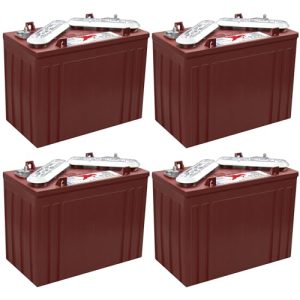
Trojan T-1275 12V 150Ah, Pack of 4
The four-pack of Trojan T-1275 batteries is the standard way to build a 48-volt golf cart bank. Four 12-volt units wired in series give the 48 volts that carts like the EZGO RXV, Club Car Precedent, and Yamaha Drive G29 run on, and each battery carries 150 amp-hours at the 20-hour rate. Trojan is a long-standing name in golf cart batteries, and the T-1275 in group GC12 is a proven flooded lead-acid unit. If your cart takes four 12-volt batteries and you want a fresh bank, this is the straightforward pick. A fresh set also resets the maintenance clock, so watering and charging schedules start clean for years.
Specs
- 12V flooded lead-acid deep-cycle battery
- 150Ah capacity at the 20-hour rate
- BCI group GC12
- Around 85 lb per battery
- Four batteries wired in series make a 48V bank
Best for: Replacing a tired 48-volt bank on a cart that takes four 12-volt batteries, with a fresh matched set that ages together and restores full range per charge for years of service.
Watch out for: Flooded lead-acid needs regular watering and ventilation, and freight delivery means you must be present to receive the shipment. Water the cells on schedule and charge in a ventilated space.
Trojan T-1275 12V 150Ah, Pack of 6
The six-pack is the same Trojan T-1275 battery, sold in a larger count for owners who need six units. Six 12-volt batteries wired in series make a 72-volt bank, and the same six can also serve as a 48-volt set with two spares kept on the shelf for the next replacement round. Every battery in the pack is the same 150 amp-hour flooded lead-acid unit in group GC12, so the performance matches the four-pack exactly, just with two more batteries. Buyers with a 72-volt cart or a spare-battery plan should pick this listing. The performance matches the four-pack exactly, with two more batteries in the box, exactly as listed.
Specs
- 12V flooded lead-acid deep-cycle battery
- 150Ah capacity at the 20-hour rate
- BCI group GC12
- Around 85 lb per battery
- Six batteries wired in series make a 72V bank
Best for: A 72-volt cart, or a 48-volt owner who wants two spares on hand for the next replacement round and a matched set that ages together for years of service.
Watch out for: Six batteries weigh over 500 pounds together, so plan freight delivery and safe handling before the shipment arrives. Lift with help and a hand truck, since each battery weighs around 85 pounds.
Which One Fits Your Situation
Rebuilding a Standard 48V Cart
Pick the four-pack when your cart runs a 48-volt system and takes four 12-volt batteries. The four T-1275 units wire in series to make the 48 volts your cart expects, and the 150 amp-hour rating gives solid range per charge. Confirm the group GC12 size fits your battery bays, then install the set together so every battery ages at the same pace. A balanced bank holds voltage better on hills and lasts longer overall.
Running a 72V Cart
Pick the six-pack when your cart runs a 72-volt system. Six 12-volt batteries in series give the 72 volts the controller and motor expect, and the 150 amp-hour rating keeps range reasonable. Do not try to run a 72-volt cart on four batteries, and do not mix old and new batteries in the same bank. Check the controller and motor ratings before ordering, since a 72-volt system needs all six batteries in series. Do not mix voltages.
Replacing a Worn Bank on a Budget
Pick the four-pack for a 48-volt cart when the old bank is tired and you want a fresh start. Replacing all four batteries at once keeps the bank balanced, which matters because a single weak battery drags the whole set down. A full fresh set also resets your maintenance clock, so watering and charging schedules start clean. Test the bank on a hill after install to confirm the range is back.
Stocking Spares for the Future
Pick the six-pack when you run a 48-volt cart and want two spares ready for the next failure. A spare T-1275 on the shelf means a dead battery does not sideline the cart for days while a replacement ships. Store spares charged and topped up, and rotate them into service before they sit too long. A stored battery still needs care, so check its water and charge every few weeks.
Common Mistakes
- Ordering 6-volt or 8-volt batteries for a cart that takes 12-volt units, then finding the bank voltage and bay count do not match at all. Check the voltage and bay count against the listing before you order, and confirm group GC12 fits the hold-downs. Measure the bays first.
- Mixing old batteries with new ones in the same bank, which lets the weakest battery drag down the whole set and shortens its life. A matched set ages together and keeps the bank balanced for years.
- Skipping the watering schedule on flooded lead-acid batteries, then wondering why the bank loses capacity and dies early. Top up with distilled water on schedule and never let the plates sit exposed. Check levels monthly.
- Charging the bank in a sealed space without ventilation, ignoring the gas that flooded batteries give off while charging. Charge in a ventilated area and keep the bank away from sparks and flames.
- Buying a single replacement battery instead of a matched set, which leaves the bank unbalanced and the cart underperforming on hills. A single new battery in an old bank will age fast and underperform. Buy a matched set.
Frequently Asked Questions
How many 12V batteries does a 48V golf cart need?
A 48-volt golf cart needs four 12-volt batteries wired in series, since four times 12 volts equals 48 volts. The four-pack of Trojan T-1275 batteries is built for exactly this setup on carts such as the EZGO RXV and Club Car Precedent. Always confirm your cart’s voltage and battery count before ordering, because some carts use six 8-volt or eight 6-volt batteries instead. Four times 12 equals 48.
Are these batteries lithium or AGM?
No, both listings are flooded lead-acid batteries, not lithium or AGM. Flooded lead-acid needs regular watering with distilled water, ventilation during charging, and terminal cleaning to stay healthy. The trade-off is a proven, widely available chemistry at a lower cost per battery than lithium, with maintenance the owner must keep up. Flooded batteries need watering, ventilation, and terminal cleaning to stay healthy over the years.
Can I use the 6-pack on a 48V cart?
Yes, you can buy the six-pack for a 48-volt cart and keep two batteries as spares, since the batteries are the same T-1275 units as the four-pack. Install four in the cart and store the other two charged and topped up. Do not wire all six into a 48-volt cart, because six 12-volt batteries in series make 72 volts and will damage a 48-volt system. Store spares charged.
How heavy is each battery?
Each Trojan T-1275 weighs around 85 pounds, so a four-pack totals roughly 340 pounds and a six-pack over 500 pounds. Plan freight delivery accordingly and have a hand truck ready on delivery day, since the buyer usually needs to be present to receive the shipment. Lift with your legs, use a hand truck, and get help rather than moving a battery alone. Plan the route to the cart.
More from Amazon
Programs that pair well with the guide above. Offers and eligibility are set by Amazon and may change.
Free shipping on eligible items, Prime Video and more. Eligible new members can start with a free trial.
Start a Prime free trialA Prime membership for ages 18-24 with a trial period. Eligibility is set by Amazon.
See Prime for Young AdultsAudiobooks and podcasts to listen to on the go. Eligible new members can start with a free trial.
Try Audible freeAd-free music streaming. Eligible new subscribers can start with a free trial.
Try Music Unlimited freeAs an Amazon Associate we earn from qualifying purchases.