Our Top Picks

The best golf simulator mats under 300 dollars are full-stance hitting mats that give a golfer room for both feet, a consistent hitting surface for irons and driver, and a base thick enough to protect wrists and elbows on fat shots. A simulator mat is not a small practice pad placed beside the feet. It is the surface a golfer stands on and hits from in a garage, basement, spare room or backyard enclosure, and a mat that is too small, too thin or too slick will change the swing itself.
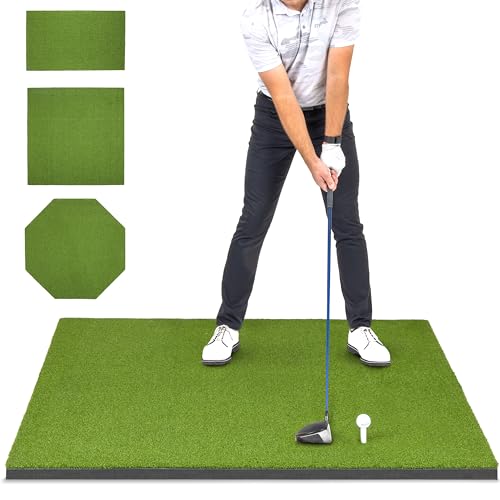

Quick answer: start with a mat at least five feet by four feet, with a turf layer and a cushioning base underneath it. A five by four foot mat fits most home simulator bays. A five by five foot mat gives extra room for stance changes and for left-handed and right-handed golfers sharing one bay. Thicker mats, around thirty-one millimetres in total thickness, tend to feel softer and absorb more shock than thin fifteen millimetre turf alone.
The four mats in this guide are all golf simulator hitting mats with a full stance area and a hitting surface designed for use with a launch monitor and simulator setup. Each one is a single-piece turf mat rather than a modular system with a separate replaceable hitting strip, and that point is flagged clearly below. None of the mats here is a putting mat, and none is a launch monitor.
Quick Picks
Our Short List of 3
All 3 Picks at a Glance
| Product | Specs | Action |
|---|---|---|
| GoSports Elite Golf Hitting Mat (B08BXBDRDY) | Check price on Amazon | |
| Bearwill Golf Mat (B0DSF7R1GX) | Check price on Amazon | |
 Joloofu Dual-Turf Golf Mat (B0FM8DGFVF) | Check price on Amazon |
How to Choose
Size and stance room
A simulator mat needs to hold both feet through the whole swing, not just at address. A golfer with one foot on the mat and one foot on concrete will feel the height difference on every shot. A five by four foot mat is a sensible minimum for most golfers. A five by five foot mat is better for taller golfers, for a wide stance, and for bays shared by left-handed and right-handed players. Measure the bay before ordering, including the enclosure frame, net, screen and launch monitor, and leave room to walk around the mat.
Turf type and hitting feel
Shorter, denser turf feels closer to a fairway lie and gives cleaner feedback on thin shots. Longer turf can feel softer and suit wedge practice, but very long turf can grab the clubhead through impact. Dual-turf mats combine a shorter fairway section with a longer rough section, so a golfer can practise two lies without swapping mats. Look for turf described as commercial grade or high density, and check whether it is bonded to the base.
Thickness and shock absorption
A mat listed at thirty-one millimetres in total thickness may combine a sixteen millimetre turf layer with a fifteen millimetre foam base, while a fifteen millimetre mat may be turf alone with a thin backing. The base is what absorbs shock. An EVA foam base compresses under impact and helps protect wrists, elbows and shoulders on heavy shots, especially for golfers who practise daily. A rubber base is heavier and stays in place better, but it can feel firmer. Golfers with joint concerns should give extra weight to base thickness.
The hitting strip question
Many dedicated simulator mats use a separate hitting strip, a rectangular insert in the centre of the mat that takes the club impact while the surrounding turf provides the stance area. The strip can be replaced when it wears out, without replacing the whole mat. The mats in this guide do not work that way. Each one is a single-piece turf mat, and the hitting zone is the turf itself. That is a partial fit to flag honestly: these mats are designed for simulator use, but they have no replaceable strip insert. Golfers who hit a very high volume of balls should consider a modular strip system instead.
Tee holes and tee compatibility
A simulator mat needs to work with tees, because driver practice without a tee is not realistic. Six tee holes spread across the hitting area allow a golfer to move the ball position for driver, irons and wedges, and to switch between left-handed and right-handed setups without turning the mat around. Rubber tees in different heights are useful for the same reason: a tall tee suits driver, a medium tee suits fairway woods and hybrids, and a short tee suits irons. Check whether the mat accepts standard rubber tees and real wooden tees, or rubber tees only, and check whether tees are included in the box.
Base grip and stability on hard floors
A simulator bay is often built on concrete, tile, hardwood or thin carpet, and a mat that slides on those surfaces is a safety concern as well as an annoyance. A non-slip backing, a textured underside, or a heavy base all help the mat stay planted during a full swing. A heavier mat is less likely to shift, although it is harder to move and store. A lighter mat is easier to roll up and carry, but it may need a non-slip underlay on a smooth floor.
Durability and care
A simulator mat takes repeated impact in the same small area, and durability depends on turf density, edge construction and how the mat is used. Reinforced edges resist fraying, and dense turf resists flattening in the hitting zone. Rotating the mat occasionally, or moving the ball position between tee holes, spreads wear across a wider area. Cleaning is simple: brush off loose debris, wipe the surface with a damp cloth, and allow the mat to dry fully before rolling it up. Avoid storing a mat folded for long periods if it can be rolled instead, because a fold can leave a crease.
The Best Golf Simulator Mats Under 300 Dollars Reviewed
GoSports Elite Golf Hitting Mat (B08BXBDRDY)
The GoSports Elite is the most established name in this group, and a sensible starting point for a first simulator bay. The five by four foot size gives room for a full stance with driver and irons, and the commercial-grade synthetic turf is designed to feel close to a fairway lie. The fifteen millimetre turf sits on an EVA foam base that absorbs shock on heavy shots, and the non-slip backing helps the mat stay in place on concrete and other hard floors. Six tee holes support left-handed and right-handed layouts, and three rubber tees in different heights are included. The listing describes the mat as working with golf simulators.
This mat suits golfers who want a proven, all-round hitting mat without a dual-turf layout or a larger five by five foot footprint, and households where more than one golfer shares the same mat. The single turf texture keeps the surface consistent across the whole mat. The mat folds for storage, although a fold can leave a crease that needs time to flatten.
Who should skip it: golfers who want the softest feel underfoot, or a larger stance area for a shared bay, should look at one of the thicker five by five foot mats below. Golfers who want a replaceable hitting strip should also look elsewhere, because this is a single-piece turf mat and the hitting zone is the turf itself.
Bearwill Golf Mat (B0DSF7R1GX)
The Bearwill Golf Mat pairs a five by four foot stance area with thirty-one millimetres of total thickness, combining sixteen millimetres of high-density synthetic turf with a fifteen millimetre EVA base and a tear-resistant fibre layer between them. That layered build is the main reason to choose it over a thinner mat: the turf provides the hitting surface, the fibre layer adds stability, and the EVA base absorbs impact. The listing describes the mat as suitable for garage and simulator use, and for driving, chipping and swing training. Ten practice balls are included.
The mat is roll-up in form, which helps with storage and flattening after delivery, and the anti-slip bottom helps it stay in place on hard floors. The five by four foot size matches the GoSports Elite, so the choice between the two comes down to thickness and feel: the Bearwill mat is thicker and softer underfoot.
This mat suits golfers who want extra cushioning in a standard five by four foot size, golfers who practise daily, and golfers who feel the impact of fat shots in their wrists or elbows. Who should skip it: golfers who need a five by five foot stance area, or a dual-turf layout with a separate rough section, should choose the Zonop or Joloofu mats below. There is no replaceable hitting strip here, so wear will concentrate in the centre over time.
Zonop Dual-Turf Golf Mat (B0FP2GSJ65)
The Zonop Dual-Turf Golf Mat is a five by five foot mat with thirty-one millimetres of total thickness, and its dual-turf design sets it apart. One section uses shorter turf for fairway lies, and the other uses longer turf for rough lies, so a golfer can practise two types of shot without changing mats. That variety is useful in a simulator bay, where the launch monitor measures the shot but the mat provides the lie. The larger footprint also gives more room for stance changes and for left-handed and right-handed golfers sharing one bay.
Six tee holes are spaced across the mat, and the included set contains ten practice balls, seven tees and two rubber tee holders. The cushioning EVA foam backing adds shock absorption under the turf, and the foldable form helps with storage. The listing describes the mat for garage, simulator, chipping and driving use.
This mat suits golfers who want a larger stance area and two turf textures in one mat, golfers who share a bay with a partner or family member, and golfers with a wide stance. Who should skip it: golfers with a small bay should measure carefully, because five by five feet takes up noticeably more floor than five by four feet. Golfers who want a replaceable hitting strip will need a modular system instead, because this mat is a single-piece dual-turf mat with no separate strip insert.
Joloofu Dual-Turf Golf Mat (B0FM8DGFVF)
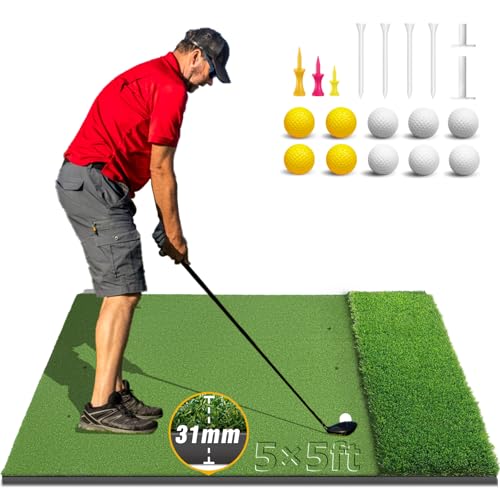
The Joloofu Dual-Turf Golf Mat is another five by five foot, thirty-one millimetre mat, and the most detailed dual-turf option in this guide. The fairway section uses sixteen millimetre turf, while the rough section uses thirty-five millimetre turf, giving a clear difference in feel between the two lies. A fifteen millimetre EVA base sits underneath for shock absorption, and the listing describes the base as non-slip and tear-resistant, with reinforced edges for durability. Six tee positions are spread across the mat, and the included set contains ten practice balls, nine tees and two rubber tee holders.
The mat is designed for garage, simulator, chipping, driving and swing practice, and the five by five foot area provides twenty-five square feet of hitting and stance surface. That size allows the hitting area to move across the mat as the turf wears, which helps spread impact over a wider area. The listing includes a one year warranty description.
This mat suits golfers who want the clearest fairway and rough contrast in a single mat, golfers who practise with a launch monitor and want the lie to vary between sessions, and golfers who need a large stance area for a shared bay. Who should skip it: golfers with limited floor space should choose a five by four foot mat instead. Golfers who want a replaceable hitting strip should look for a modular strip system, because this mat uses a single-piece dual-turf surface with no separate strip to swap out.
What to Check Before You Buy
Measure the bay first, and measure it twice. A mat that is too large will crowd the enclosure, and a mat that is too small will leave one foot off the surface. Check the floor type, the ceiling height, and the position of the launch monitor, because the monitor needs a clear view of the ball and the club, and the mat needs to sit flat without rocking. Confirm the mat size in the listing, and check whether the mat is sold in more than one size, because some listings cover several sizes under one title.
Check the thickness breakdown, not just the headline figure. Look for the base material, the turf height, and any fibre or backing layer described in the listing. Check the number of tee holes and whether tees are included, and confirm whether the mat accepts rubber tees, real tees, or both. Check the return and warranty terms before ordering, because a mat is a large item to return, and check the hitting strip question one more time: if a replaceable strip matters, choose a modular system rather than a single-piece turf mat.
FAQ
What size golf simulator mat should I choose for a home bay?
A five by four foot mat is a sensible minimum for most home bays, because it holds both feet through a full swing with driver and irons. A five by five foot mat gives extra room for stance changes and for left-handed and right-handed golfers sharing one bay. Measure the bay before ordering.
Is a thicker mat always better for a simulator setup?
Not always, although thickness helps with shock absorption. A thicker mat with a proper EVA or rubber base absorbs more impact on fat shots and feels softer underfoot. A thinner mat with dense turf can still feel realistic for clean strikes, but it transmits more vibration on heavy shots. Look at the thickness breakdown, including turf height and base thickness, rather than the headline figure alone.
Do I need a hitting strip, or is a single-piece turf mat enough?
A single-piece turf mat is enough for most home golfers, and all four mats in this guide use that design. A separate hitting strip is useful for golfers who hit a very high volume of balls, who want to replace only the worn centre section, or who want a different feel in the hitting zone from the stance area. If a replaceable strip is a priority, choose a modular strip system and check the strip dimensions first.
Can I use these mats with a launch monitor?
Yes, these mats are designed for use with a launch monitor and simulator setup, and the listings describe them for garage and simulator use. Place the mat so the launch monitor has a clear view of the ball and the club. A mat that is too small can force a stance that does not match a normal setup, so size matters for accurate readings as well as comfort.
How do I keep a simulator mat in good condition?
Rotate the mat occasionally or move the ball position between tee holes to spread wear. Brush off loose debris after each session, wipe the surface with a damp cloth when needed, and allow the mat to dry fully before rolling it up. Avoid storing a mat folded for long periods, and keep it out of prolonged direct sunlight when not in use.
Bottom Line
The best golf simulator mats under 300 dollars are full-stance hitting mats with room for both feet, a turf surface that feels close to a fairway lie, and a base thick enough to absorb shock on heavy shots. The GoSports Elite is the most straightforward starting point, with a five by four foot size and commercial-grade turf. The Bearwill mat adds thicker cushioning in the same footprint. The Zonop and Joloofu mats add a five by five foot stance area and a dual-turf layout, with the Joloofu mat giving the clearest contrast between the two turf heights.
Choose by size first, then by thickness and turf type. A golfer with a small bay should start with a five by four foot mat. A golfer with a larger bay, a shared setup, or a wide stance should choose a five by five foot mat. A golfer who feels fat shots in the wrists or elbows should give extra weight to base thickness. Any golfer who wants a replaceable hitting strip should look beyond this group to a modular strip system.
Disclosure: As an Amazon Associate, we may earn from qualifying purchases.
More from Amazon
Programs that pair well with the guide above. Offers and eligibility are set by Amazon and may change.
Free shipping on eligible items, Prime Video and more. Eligible new members can start with a free trial.
Start a Prime free trialA Prime membership for ages 18-24 with a trial period. Eligibility is set by Amazon.
See Prime for Young AdultsAudiobooks and podcasts to listen to on the go. Eligible new members can start with a free trial.
Try Audible freeAd-free music streaming. Eligible new subscribers can start with a free trial.
Try Music Unlimited freeAs an Amazon Associate we earn from qualifying purchases.